Skip to content

Baltimore

John Hopkins, Federal Policies & Slumification

The world watched last week as protesters stormed the streets of Baltimore to oppose police brutality and demand justice for Freddie Gray, the 25-year-old man, who died of spinal injuries suffered in police custody on April 19. But racist policing policies aren’t the only factor leading police officers to allegedly treat Gray, and others like him, inhumanely and disregard his cries for help inside that police van. Contempt for black life in Baltimore and indeed across the United States is also manifested through a legacy of discriminatory housing policies, which include federally mandated discriminatory housing and lending practices, as well as predatory redevelopment projects which benefit one group of people while displacing and disregarding others.

Families Impacted By Police Violence Organize To Stop The Killings

Families United 4 Justice possesses a unique perspective on the police brutality that they are protesting: Each of its members has a family member who was killed by the police. The group seeks to bring together families from around New York State to add a personal sense of urgency that can both pressure elected officials into action and support and strengthen local coalitions opposing police brutality and profiling practices. “We’ve been thrust into this by circumstance,” explained Cynthia Howell, who began the process of bringing the families together last summer with the help of Vanissa Chan, an activist whose Forced Trajectory Project documents many of the families’ experiences.

Press Freedom Is Declining In The US

Today the world recognizes World Press Freedom Day. Instituted by the United Nations Educational, Scientific and Cultural Organization (UNESCO), its purpose, according to the U.N., is to “celebrate the fundamental principles of press freedom, to evaluate press freedom around the world, to defend the media from attacks on their independence and to pay tribute to journalists who have lost their lives in the exercise of their profession.” The issues of quality reporting, media independence and the safety of journalists are as relevant today as ever, especially in the United States. While American journalists have long been hailed as flag bearers of the profession — able to report, write and broadcast in mostly ideal circumstances — in the past two decades or more, we have seen a number of cases of fabrication by journalists who have shamed the profession at large and undermined public trust.

Finally, B’more Mayor Joins Call Of Citizens For DOJ Investigation Of Police

Mayor Stephanie Rawlings-Blake asked the Justice Department on Wednesday to conduct a full-scale civil rights investigation into the pattern and practices of the Baltimore Police Department — a probe that would examine excessive force, discriminatory harassment, false arrests, and unlawful stops, searches or arrests. "We all know that Baltimore continues to have a fractured relationship between the police and the community," Rawlings-Blake said. "I'm willing to do what it takes to reform my department." The Justice Department already is conducting a "collaborative review" with Baltimore police, but its recommendations will not carry the weight of law. Such reviews differ from full-scale civil rights investigations because they are launched by agreement with local officials and are not enforced by court order.

Government Surveillance Planes Spotted Over Baltimore Protests

In the aftermath of the Baltimore protests and riots in response to the death of Freddie Gray in police custody, FBI surveillance planes were flown over the city on the evenings of April 30, May 1, and May 2, according to the Washington Post. An unnamed government official who spoke to the paper stated that these planes—a Cessna 182T Skylane propeller plane and a Cessna 560 Citation V jet—used infrared technology to monitor people’s movements, and that Baltimore police officials requested aerial support from the FBI. “It would be disturbing if police were overreacting to reactions to their own misconduct by calling in indiscriminate aerial surveillance,” Nathan Freed Wessler, a staff attorney with ACLU’s Speech, Privacy, and Technology Project, told me.

3,000% Increase In Mentor Volunteers After Baltimore Riots

Baltimore, there was a 3,000 percent increase in volunteers to mentor disadvantaged children in the city. A very small percentage of the protesters were causing damage, and among them were mostly children who were too young to know any better, and people who were in extremely desperate situations. The vast majority of the protesters in the city were peaceful and did not cause any damage to private property. Teenagers in the city were also responsible for “the purge” scare, in which students threatened to start a crime spree of vandalism begining in a Baltimore mall. Luckily, the teenagers were stopped and talked-down by local gang members, who had recently called a truce to keep peace in the community. The fact that so many children were involved in the destruction seen this week, has inspired many residents in Baltimore to reach out and give needy children some much needed support.

Don’t Call It A Curfew: Martial Law In The United States

The only things that could make worse the martial law effectively imposed in Baltimore recently were the discrimination and bias apparent in its enforcement. Being Black in Baltimore in recent days meant being imprisoned in your home. And beyond Baltimore, the city's "curfew" neatly encapsulated much of what is wrong in the United States. Driving to City Hall on May 2, I passed a staging area for the National Guard and armored vehicles from police departments across the state of Maryland. The scene resembled an invasion by an armored tank column. The grim presence of military vehicles on a civilian street contrasted sharply with the ebullient mood of the rally and march in which we participated. Drawing over 5,000 people, the May 2 event included large numbers of children and a diverse representation of local communities.

The Wars Come Home

Last week, as Baltimore braced for renewed protests over the death of Freddie Gray, the Baltimore Police Department (BPD) prepared for battle. With state-of-the-art surveillance of local teenagers’ Twitter feeds, law enforcement had learned that a group of high school students was planning to march on the Mondawmin Mall. In response, the BPD did what any self-respecting police department in post-9/11 America would do: it declared war on the protesters. Over the course of 24 hours, which would see economically devastated parts of Baltimore erupt in open rebellion, city and state police would deploy everything from a drone and a “military counter attack vehicle” known as a Bearcat to SWAT teams armed with assault rifles, shotguns loaded with lead pellets, barricade projectiles filled with tear gas, and military-style smoke grenades.

Rising Up, In Baltimore & Beyond

If we want climate justice — not just adaptation to or even mitigation of climate change — then it’s important to understand the structural drivers of the crisis. I’m thinking about those drivers today, and I’m thinking about Baltimore. The story of Baltimore doesn’t start with the wrongful death of Freddie Gray. It didn’t start with the wrongful deaths of Mike Brown or Eric Garner. The deep anger that the citizens of Baltimore are expressing in the streets is rooted in a long history of oppression. And it’s that same history of oppression that has landed us in this historical moment — with an overheating climate, a politics of cynicism, and unrest bubbling up across the globe.

In Baltimore We Need Protest In All Its Forms, Even Joyful Ones

Spots of joy are necessary and needed in the seemingly endless fight for justice. In Baltimore on Tuesday night, as the city reeled from how the death of Freddie Gray exposed the violence of a decades-long police occupation of the black population, I didn’t experience many moments of sweetness. But one came in the form of a parade of young girls and sashaying boys shortly before nightfall, who made it their business to fill the intersection outside the now infamous burned CVS in West Baltimore with dancing. The dancers fearlessly responded to the acute violence of the previous night’s events by prancing and voguing. These flamboyant young men and women used energetic dance and music to turn the void of black death into a space filled with black life - their spines were straight in defiance of a broken spine the police had severed.

Two Versions Of Same Event Show Media Does Not Give Whole Truth

Just minutes after the police state curfew went into effect in Baltimore Saturday night, the brutality began. However, the actual coverage of that brutality varies depending on who is telling this story. The first video of the arrest is put out by CNN. It begins with a semi-conscious man laying on the ground with a reporter speculating on the possibility of the man faking his unconsciousness. The second video of this arrest comes from Russia Today. Despite lacking any commentary, it depicts the actual story magnitudes more accurately. RT has a camera rolling as an apparently angry, but non-violent and unarmed protester begins yelling at police. He is then met with a pepper spray blast at near point blank range, directly in his face. The lack of reaction by this man seems to anger the officers as one of them runs behind him grabbing his dreadlocks and slamming him to the ground.

My 49 hours In A Baltimore Cell – For Being A Reporter

As a working member of the press, I was arrested on 27 April, just as Baltimore began to erupt, and detained for 49 hours before being released without charge. A flurry of legal maneuvering, coupled with the fog of a state of emergency, meant that I and several others were deprived of our constitutional protections under the first, fourth, sixth, and eighth amendments. A line of riot police then charged against a throng of rioters – I followed them, camera in hand, trying to capture the tumultuous scene. I was hit directly in the forehead with a plastic “less lethal” projectile that explodes with an irritant powder on impact. I stumbled over to the sidewalk. Everything went black for a moment, and the next thing I saw were faces staring down at me as I lay on the grass.

The Fruits Of Govenment Sponsored Segregation

Baltimore, not at all uniquely, has experienced a century of public policy designed, consciously so, to segregate and impoverish its black population. A legacy of these policies is the rioting we have seen in Baltimore. Whether after the 1967 wave of riots that led to the Kerner Commission report, after the 1992 Los Angeles riot that followed the acquittal of police officers who beat Rodney King, or after the recent wave of confrontations and vandalism following police killings of black men, community leaders typically say, properly, that violence isn’t the answer and that after peace is restored, we can deal with the underlying problems. We never do so. Certainly, African American citizens of Baltimore were provoked by aggressive, hostile, even murderous policing, but Spiro Agnew had it right. Without suburban integration, something barely on today’s public policy agenda, ghetto conditions will persist, giving rise to aggressive policing and the riots that inevitably ensue.

New York City Protesters Rally On May Day For Freddie Gray

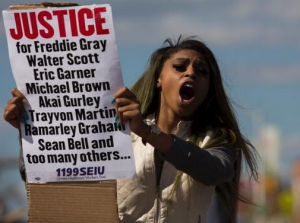
Hundreds of people, including union members, students, socialists, immigrants and others, gathered in New York City's Union Square on May 1, International Workers Day, calling for a higher minimum wage of $15 an hour, justice for unarmed people killed by police and an end to deportation and detention of undocumented immigrants. This year, May Day protesters in New York brought calls for an end to systemic racism and support for police accountability for the killing of unarmed civilians, especially people of color, to the forefront of the annual labor march and rally, with "Black Lives Matter" and the names of people killed by police written on signs, and chants calling for justice for the victims of police brutality or promises to "shut it down," a mantra of the Black Lives Matter movement.

Are Baltimore’s Protests The Prelude To A Revolution?

Nothing happens in a vacuum. The Baltimore Uprising, as it’s been dubbed on Twitter, is not just the community’s response to Freddie Gray’s murder at the hands of Baltimore police. While it may have started out that way, the anger that has exploded across Maryland’s largest city is a response to three systemic issues – staggering levels of unacknowledged poverty and persistent unemployment, the occupying military force known as the Baltimore Police Department, and the complacent and corrupt Baltimore city government. While it’s well-known that the big banks were terrorizing poor communities everywhere with subprime loans in the run-up to the financial crisis, their behavior is no more apparent than in Baltimore. Between 2005 and 2008, Wells Fargo preyed on Baltimore’s black community by targeting black churches, hoping that the ministers would convince congregations to take out subprime loans with Wells Fargo. More than half of the Baltimore properties in foreclosure with a Wells Fargo loan from 2005 to 2008 are currently vacant.
assetto corsa mods

Urgent End Of Year Fundraising Campaign

Online donations are back! Keep independent media alive. 

Due to the attacks on our fiscal sponsor, we were unable to raise funds online for nearly two years.  As the bills pile up, your help is needed now to cover the monthly costs of operating Popular Resistance.

Urgent End Of Year Fundraising Campaign

Online donations are back! 

Keep independent media alive. 

Due to the attacks on our fiscal sponsor, we were unable to raise funds online for nearly two years.  As the bills pile up, your help is needed now to cover the monthly costs of operating Popular Resistance.

Sign Up To Our Daily Digest

Independent media outlets are being suppressed and dropped by corporations like Google, Facebook and Twitter. Sign up for our daily email digest before it’s too late so you don’t miss the latest movement news.