Skip to content

Cooperatives

Berkeley Sets The Bar For Municipal Support Of Worker Cooperatives

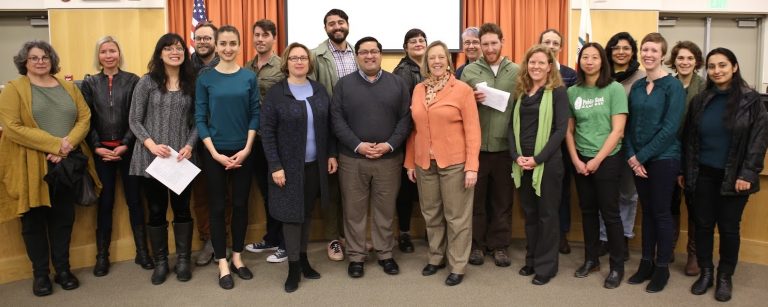
Berkeley, CA -  Last month, Berkeley City Council unanimously adopted a set of recommendations provided by the Sustainable Economies Law Center (Law Center) and a coalition of worker coop members and advocates. In doing so, Berkeley became a national leader in supporting worker cooperative businesses. “Berkeley is among the first US cities to earmark funding specifically to help local businesses convert to democratic worker ownership,” says Sara Stephens, Staff Attorney at the Law Center.

It’s Time To Think More Deeply About How We Can Better Uplift Our Shared Principles

It has taken profound effort and sacrifice to work against entrenched prejudices in our history and cultivate the inclusive diversity that is key to our country’s special dynamism. Cooperatives have been a crucial strategy for realizing the ideals behind those efforts, building on our longstanding and distinct advantages as a democratic business model, a participatory strategy for achieving inclusive socioeconomic goals, and a movement based in values and principles that speak directly to these challenges. Historically, cooperatives have been used to create access for people with few alternative options, to facilitate economic solidarity, and to provide the social stability that enables greater participation in society.

Scaling Social Justice: A Latinx Immigrant Worker Co-op Franchise Model

Araceli Dominguez, an immigrant housecleaner living in Staten Island, New York, has a lot to be proud of. She is a founding member of a local branch of Brightly®, a worker-owned cleaning cooperative with ambitions to be part of a newly created franchise model looking to scale nationally. She has worked hard with her fellow worker-owners to launch their business. “Being in this co-op fills me with a hunger to learn,” she notes. “I am so full of pride. I am an inspiration to my daughters that they too can achieve their goals. Without this, I wouldn’t be the person I am today; I would be a different Araceli.”

A Black-Led Food Co-Op Grows In Detroit

DETROIT, Mich.—Malik Yakini came to cooperative economics as a student at Eastern Michigan University in the mid-1970s when he started a food-buying club. “I wasn’t thinking of myself as a food activist,” he says, “I was thinking of myself as an activist in the black liberation movement.” He viewed controlling food retail and production as important aspects of black self-determination, echoing the sentiments of organizations like the Nation of Islam and Detroit’s Shrine of the Black MadonnaChurch that emphasized owning farmland and running food businesses.

Co-operative Study Tour To North America: Visiting US Co-operatives

Seikatsu Club Tokyo and Osaka celebrated the 50th anniversary of their founding in 2018, marking 50 years since the birth of Seikatsu Club as a co-operative. A co-operative study tour was planned as one element in the 50th anniversary events to be held over the two years 2018 and 2019. The plan to visit to the United States was implemented from September 19 to 29, 2018. A dozen co-operative members and producers participated in the group, learning about the outline of the US co-operative movement and paying visits to the workplaces of, for example, consumers’ co-operatives and workers co-operatives.

May The Cooperative Model Save The Local Media Industry?

How long has it been since you first heard that the media and publishing sector was in crisis? We believe long enough for you to be able to list several reasons for this continuous financial and social distress. Technological advancements challenge the traditional way of running a paper, for example, or a publishing house. Even without taking into account illegal downloads of multimedia files, we tend to opt for free-of-charge content online and an increasing number of  young people state  that Facebook is their first information source.

Can Cooperatives Save Us From The Next Economic Crisis?

In the summer of 2009, economists reported that one-third of the capital equipment in the United States stood idle while some 17 percent of the workforce were either unemployed, forced into part-time jobs, or “discouraged” from even seeking work. The Great Recession revealed just how much surplus capital and surplus labor was simply lying about, even in a time of urgent need. In this context, it’s no surprise that people started looking for ways to put labor and capital back together. Interest spiked — especially in worker-owned enterprises — and cities from New York to Madison, Oakland and Jackson, started investing in worker-owned businesses and business incubators.

Degeneration And Regeneration In Worker Cooperatives

Like all businesses, cooperatives can fail. Cooperatives can go bankrupt, but they can fail in another way too. Over time, cooperatives can degenerate. Cooperatives are said to degenerate when, under economic pressure, they abandon their cooperative principles and start adopting capitalist business practices and structures. In the worst case, given enough time and economic pressure, cooperatives can fully degenerate into privately-owned, capitalist businesses. Such businesses might still be economically viable ― they will have avoided bankruptcy ― but they can no longer be considered successful cooperatives.

Ecosocialism Enters The US Political Dialogue

We need to invent a form of socialism that not only can replace the dominant feudal-like corporate structures we detest but just as importantly, be culturally acceptable to the general public. In the USA, of course, this is a challenge, but one we are capable of handling. We need to re-activate the original intent definition of socialism to mean “control by the working class” including those currently not employed—all those who have nothing to sell but their labor.

Status Of Women In Cooperatives

Women and cooperation play a significant role in the Indian economy especially as no other country in the world has a co-operative movement as large and as diverse as India. Even prior to the current day cooperatives, the concept of cooperation & its activities prevailed in several parts of India known differently i.e., Devarai or Vanarai, Chit funds, Kuries, Bhishis, Phads (some of these were utilized by women solely). The co-operative movement can be defined as a “Voluntary movement of the people carried out democratically by pooling together their resources on the given activity, with the purpose of achieving certain benefits or advantage, which are given to people that cannot get it individually and with the purpose of promoting certain virtue and values such as self help, mutual help...

Financing The Future Of Cooperative Low-Income Housing

In the late 1970s and early 1980s, New York City went through a devastating financial crisis. Buildings in neighborhoods across the city were essentially abandoned by their landlords. In some cases, tenants banded together to take over managing their buildings. Clusters of such buildings emerged in some neighborhoods, including Manhattan’s Lower East Side, East Village, and Harlem. The city created the Housing Development Fund Corporation program, offering reduced property taxes to cooperatively-owned buildings reserved for low- and moderate-income residents, known as limited-equity cooperatives.

Do You Know You Are A Wage Slave?

The majority of people in the United States are in a position of wage slavery, in which they depend on their boss for the ability to survive, but it has been so normalized that many do not question this arrangement. We bring back an interview with John Curl, author of "For All the People: Uncovering the Hidden History of Cooperation, Cooperative Movements and Communalism in America." He writes about the long history, that isn't often taught, of people who created cooperative structures to counter the power of industry and finance. Cooperative movements often parallel social movements. We discuss why this matters today.

Losing Amazon

Last week, the cities still in the running for Amazon’s HQ2 officially found out the bad news: despite months of effort and billions of dollars in subsidies assembled, they will not be the new home for Amazon’s much ballyhooed second corporate headquarters, now split between two expansions in New York and Arlington, Virginia. This is, of course, how the game was going to go. The corporate attraction strategy behind these failed bids is premised on scarcity: in the end, it’s a zero-sum competition between cities. As the indefatigable researchers at Good Jobs First have amply demonstrated, this competition often turns into a race to the bottom, leading to questionable value for ordinary city residents as subsidies are lavished to bring the next big thing to town.

‘Everything For Everyone’ Brings Cooperative Revolution To Life

The most striking secret of emergent radical economic structures like worker ownership is that they aren’t radical at all. They’re not even new. As Jessica Gordon Nembhard has chronicled in the case of African-American cooperative economic structures over the past 300 years, and as John Curl encyclopedically laid out for U.S. history as a whole, material cooperation, either in opposition to capitalism or quietly alongside it, is an integral part of the American narrative. It’s a history that free market think tanks and corporate propagandists don’t want us to know.

This Co-Op Solar Project Will Be Owned By The Community Members It Benefits

In Sunset Park, a waterfront neighborhood in central Brooklyn, nearly 30% of residents live below the poverty line. The neighborhood has dealt with a history of environmental burdens, particularly due to an expressway that runs above one of its main streets. For residents, high energy costs compound the air quality concerns produced by passing traffic and the presence of three nearby fossil fuel plants. A new initiative, though, is working to bring renewable energy to the neighborhood–and following a cooperative ownership model that’s helped stabilize energy prices in rural America. Across rural America, it’s not uncommon for people to own their energy sources.
assetto corsa mods

Urgent End Of Year Fundraising Campaign

Online donations are back! Keep independent media alive. 

Due to the attacks on our fiscal sponsor, we were unable to raise funds online for nearly two years.  As the bills pile up, your help is needed now to cover the monthly costs of operating Popular Resistance.

Urgent End Of Year Fundraising Campaign

Online donations are back! 

Keep independent media alive. 

Due to the attacks on our fiscal sponsor, we were unable to raise funds online for nearly two years.  As the bills pile up, your help is needed now to cover the monthly costs of operating Popular Resistance.

Sign Up To Our Daily Digest

Independent media outlets are being suppressed and dropped by corporations like Google, Facebook and Twitter. Sign up for our daily email digest before it’s too late so you don’t miss the latest movement news.