Skip to content

Housing

Court Affirms Right Of Homeless Persons To Not Be Punished For Sleeping In Public

Boise, Idaho – The 9th Circuit Court of Appeals affirmed that homeless persons cannot be punished for sleeping outside in the absence of adequate alternatives in Martin v. Boise (formerly Bell v. Boise), a lawsuit challenging Boise, Idaho’s ban on sleeping in public. In so holding, the court of appeals permitted various homeless individuals who have received criminal citations under Boise’s policy to proceed with their constitutional claims against the City. The National Law Center on Homelessness & Poverty, which filed the case in 2009...

Community Control Of Land And Housing

A historical legacy of displacement and exclusion, firmly rooted in racism and discriminatory public policy, has fundamentally restricted access to land and housing and shaped ownership dynamics, particularly for people of color and low-income communities. Today, many communities across the country are facing new threats of instability, unaffordability, disempowerment, and displacement due to various economic, demographic, and cultural changes that are putting increased pressure on land and housing resources. As communities and policymakers alike consider ways to confront these threats—especially within the context of the urgent need for community and economic development—there is an emerging opportunity to develop strategies related to land and housing that can help create inclusive, participatory, and sustainable economies built on locally-rooted, broad-based ownership of place-based assets.

The Homelessness Problem We Don’t Talk About

The punishment for a crime doesn’t necessarily end when the person has been released from prison. Formerly incarcerated people face multiple barriers to securing housing (including public housing) and employment, which can lead to homelessness. And just by virtue of being homeless—by having to sleep on a bench or take shelter under a bridge—these people may then be targeted by the police. Thus starts an unrelenting cycle, through which people are tossed back and forth between jail and the street. A new report by the Prison Policy Initiative (PPI) presents some troubling numbers on this phenomenon. Using a Bureau of Justice Statistics survey, for which the last available year of data comes from 2008, it found that among formerly incarcerated people, the rate of homelessness that year was 10 times that of the general public.

Tenants Together: Stories, Struggles, And Strategies

Concord: Local allies conducted a survey and report (that Tenants Together helped edit) that 75 percent of tenants in Concord fear eviction, while over half experience unsafe living conditions, but fear retaliation from their landlords for reporting them. Los Angeles: According to a new report, the Los Angeles area loses 5.5 rent control units every day due to Ellis Act evictions. San Francisco: Our friends and member orgs in the San Francisco Anti-Displacement Coalition has released a new report, "The Cost of Costa-Hawkins". The report puts a spotlight on common landlord lies and exploitation of loopholes, as a resource for statewide action to support Yes on Prop 10, a full repeal of Costa-Hawkins. To join the fight for Proposition 10, the Affordable Housing Act, sign up here! To learn more about what Costa-Hawkins is, check out this primer on our website and educate your friends and neighbors to vote #YesOn10 this November.

Community Control Of Land And Housing

A historical legacy of displacement and exclusion, firmly rooted in racism and discriminatory public policy, has fundamentally restricted access to land and housing and shaped ownership dynamics, particularly for people of color and low-income communities. Today, many communities across the country are facing new threats of instability, unaffordability, disempowerment, and displacement due to various economic, demographic, and cultural changes that are putting increased pressure on land and housing resources. As communities and policymakers alike consider ways to confront these threats—especially within the context of the urgent need for community and economic development—there is an emerging opportunity to develop strategies related to land and housing that can help create inclusive, participatory, and sustainable economies built on locally-rooted, broad-based ownership of place-based assets.

Displacement Battles On Two Continents Show How We Can Reshape The Politics Of Housing

Communities can do more than just put a Band-Aid on the problem of gentrification and displacement, and a panel of researchers who held a forum at the Democracy Collaborative’s offices in Washington discussed the best thinking and work happening on both sides of the Atlantic to keep housing affordable for everyone. In a panel entitled “The Politics of Land and Housing,” The Democracy Collaborative’s Jarrid Green and Peter Gowan were joined by Laurie Macfarlane, who is based in Edinburgh, Scotland and is co-author of The Economics of Land and Housing and editor of openDemocracy. (Watch the full panel discussion below.) Together, they discussed the financial-sector-driven processes that keep housing costs spiraling upward and how we can move toward a world in which housing is a social good for all rather than a profit center for a few.

Housing Prices Rise At Twice The Speed Of Inflation And Pay

After losing over a third of their value a decade ago, which led to the financial crisis and a deep recession, U.S. house prices have regained those losses - led by a robust labor market that has fueled a pickup in economic activity and housing demand. But supply has not been able to keep up with rising demand, making homeownership less affordable. Annual average earnings growth has remained below 3 percent even as house price rises have averaged more than 5 percent over the last few years. The latest poll of nearly 45 analysts taken May 16-June 5 showed the S&P/Case Shiller composite index of home prices in 20 cities is expected to gain a further 5.7 percent this year. That compared to predictions for average earnings growth of 2.8 percent and inflation of 2.5 percent 2018, according to a separate Reuters poll of economists.

After Centuries Of Housing Racism, A Southern City Gets Innovative

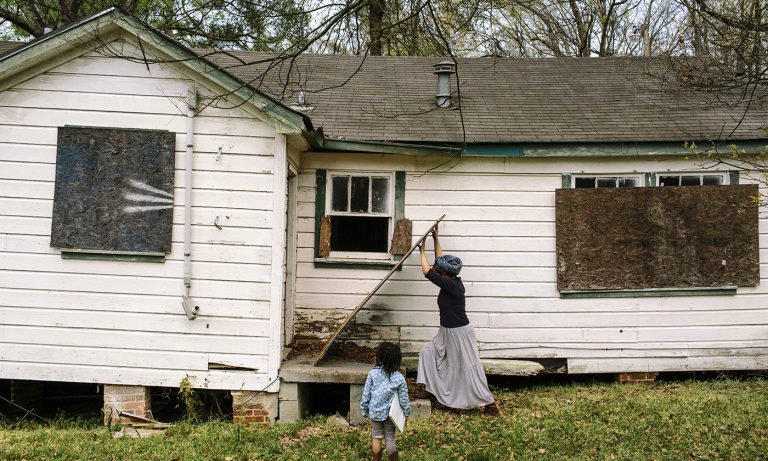
Denise Fitzgerald’s property abuts the string of quiet, empty lots that line Ewing Street in Jackson, Mississippi. Recently she was leaf-blowing detritus shed by the enormous sycamore tree dominating the yard of her tidy Habitat for Humanity home. She says she’d cut the tree down herself but knows it’s big enough to take out both her house and the house beside her if she dare try it. Fitzgerald is familiar with the empty lots of Ewing Street, just a few blocks from Jackson State University. She’s lived here since 2008, and she remembers when Ewing was a series of derelict buildings smeared across the neighborhood. Only two empty houses remain. The rest is a collection of oak and hackberry trees, with some untamed vines.

Tax Luxury Housing to Fund Social Housing

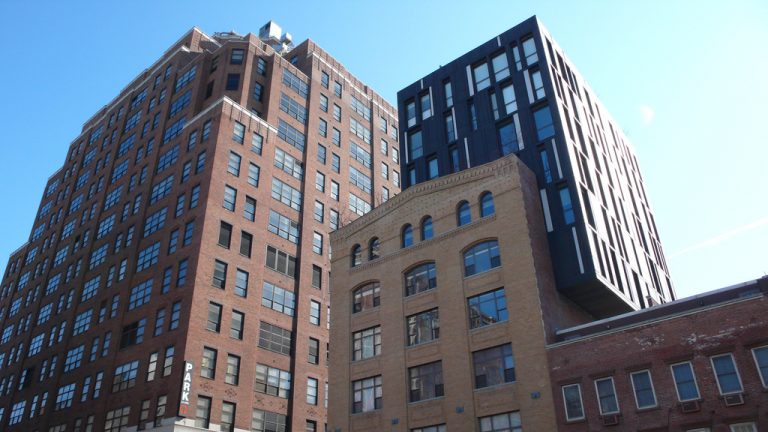
I’ve traveled in a lot of major US cities in the last year outside of my hometown of Boston, Mass. Most of them are experiencing gentrification as wealthy newcomers drive up the cost of housing and displace long-time residents. But there’s an additional disruptive force — a sort of globally supercharged gentrification resulting from billions of dollars in global wealth flowing into residential real estate. Across these cities, new residential luxury towers are rising up like weeds. Last month, I wrote an op-ed in the Sunday Boston Globe that has triggered some great conversations. The piece, called “Time to Tax the Swanktuaries,” describes One Dalton Place — a building under construction that I see on my daily walk.  The article led to an interview on WBUR’s Radio Boston and a recent conversation on Boston Neighborhood Network with Chris Lovett.

2,461 Evictions …Every Day

A new national database of court filed evictions filed since 2000 released this week by The Eviction Lab documented an estimated 2.3 million people who were evicted last year. The database - which doesn’t account for hundreds of thousands of evictions through intimidation and diception that happen without ever going to court - found that 2461 people were evicted EVERY DAY last year in the United States. In many communities like Richmond, Virginia, as many as 1 in 9 renters faced eviction. For women, particularly black women, that rate of eviction is even higher. We launched Homes For All in 2013 because we believe that every single person has a right to a safe, affordable and dignified home. We believe that if we guarantee that every child, person and family can live in a quality home without fear of eviction, rent increases or intimidation our entire society will be better off.

A Plan To Solve The Housing Crisis Through Social Housing

Many American cities face a severe shortage of affordable housing — and not just for the poor, but well up into the upper-middle class. A recent report from Harvard’s Joint Center for Housing Studies concluded: “The rental market thus appears to be settling into a new normal where nearly half of renter households are cost burdened,” or paying more than 30 percent of their income in rent. What these cities need is a dramatic increase in the number of mid-range and affordable dwellings to ease the price pressure on their rental markets. They should address the problem directly: by constructing a large number of government-owned municipal housing developments. Unlike traditional American public housing, all city residents will be eligible to live there. There are two major benefits to this approach. First, it adds new rental capacity in the housing market directly where it is needed.

South Africa’s Shack Dwellers See Politics Very Differently Than Average Westerner

Walking into the settlement at Kennedy Road in Durban, what one is confronted with is the familiarity of the place. I’ve been here before. Not to this settlement, but to others like it. To bastis in India and favelas in Brazil, to Mexico’s Neza-Chalco-Izta to Bangkok’s Klong Toey. The United Nation’s agency that monitors housing - UN Habitat - has said that there are a billion people in informal settlements (slums). A demographer at the UN tells me that within a few decades, he assumes that the number might easily double. In fact, he says, given how bad the data is, two billion people might already live in these kinds of vulnerable settlements. ‘We just don’t have the numbers,’ he said. The residents of Kennedy Road do not use the word ‘slum.’ They find the term dismissive and pejorative. Words aside, the residents would agree that they live in informal settlements. Kennedy Road is only one of Durban’s such habitats. A million of Durban’s citizens live in such places.

Orgs Call On FEMA To Address Critical Housing Needs Of Disaster-Impacted Families

Washington DC – More than 250 national, state, and local organizations called on FEMA to implement proven disaster-recovery housing solutions like the Disaster Housing Assistance Program (DHAP) for families with the lowest incomes. They note that the need for DHAP is underscored by FEMA’s recent decision to abruptly end its Transitional Shelter Assistance (TSA) for displaced Puerto Rican families in Connecticut. In a recent letter to FEMA Administrator Brock Long, the Disaster Housing Recovery Coalition (DHRC) – comprised of more than 250 organizations led by the National Low Income Housing Coalition (NLIHC) – called on FEMA to address the longer term needs of low income people displaced by the recent hurricanes and wildfires.

Adults With Roommates At Highest Level In Decades

SEATTLE — Having a roommate as an adult may be fairly common in the first years out of college, but more older, single Americans are opting against living alone. In fact, one-third of adults now live with roommates, a byproduct of rising rents, a new study finds. Researchers at Zillow, an online real estate database, analyzed figures from a 2016 U.S. Census Bureau survey and recently interviewed more than 13,000 Americans, asking them about their experiences with renting and homeownership. With rents jumping in many major cities, the number of single adults in America living “doubled-up” with roommates is at its highest since at least 1990. One component of their inquiry looked at doubled-up households, which are those in which two or more working-aged adults — none of whom are romantically involved — live together.

Affordable Housing Movement Rises From Foreclosure Crisis

By Michael Arria from In These Times. Over the last few years, housing activism has boomed—a trend that transcends the issue of rent control through its focus on halting gentrification and protecting low-income people of color from displacement. This work is even more important in the era of Trump, as the GOP is actively pushing a tax plan to benefit the richest members of U.S. society. House Republicans just passed a tax plan that will cut corporate rates down to 20 percent while increasing taxes for households that make between $10,000 and $30,000 a year. The movement has taken hold throughout the country, and it’s recently chalked up a number of important victories. After activists staged a hunger strike in San Jose, lawmakers approved some of the strongest renter protections in the nation. Seattle’s city council was pushed to end housing discrimination against formerly incarcerated individuals. Earlier this year, New York became the first city to guarantee attorneys for low-income renters facing eviction.
assetto corsa mods

Urgent End Of Year Fundraising Campaign

Online donations are back! Keep independent media alive. 

Due to the attacks on our fiscal sponsor, we were unable to raise funds online for nearly two years.  As the bills pile up, your help is needed now to cover the monthly costs of operating Popular Resistance.

Urgent End Of Year Fundraising Campaign

Online donations are back! 

Keep independent media alive. 

Due to the attacks on our fiscal sponsor, we were unable to raise funds online for nearly two years.  As the bills pile up, your help is needed now to cover the monthly costs of operating Popular Resistance.

Sign Up To Our Daily Digest

Independent media outlets are being suppressed and dropped by corporations like Google, Facebook and Twitter. Sign up for our daily email digest before it’s too late so you don’t miss the latest movement news.