Skip to content

Tax cuts for the rich

America’s 25-Year Tax Cutting And Fiscal Train Wreck

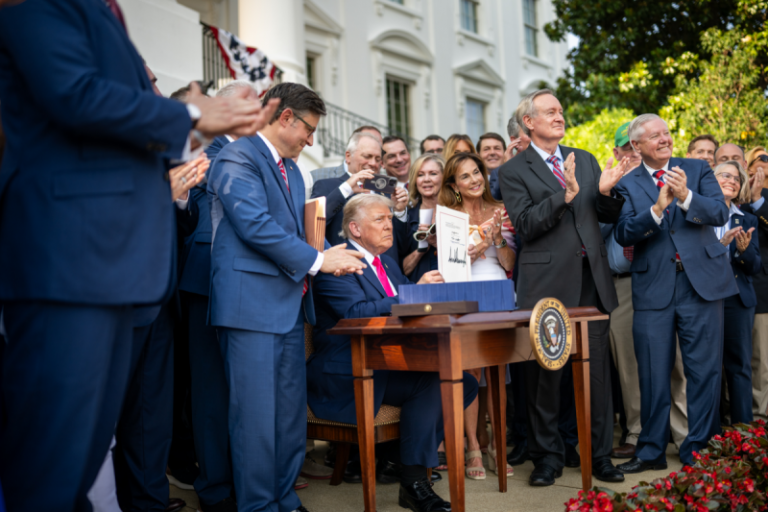
On July 4, the US Congress passed Donald Trump’s One Big Beautiful Bill Act—or BBB for short. The mainstream media and economists have mostly been reporting the details of the tax cuts contained in the bill—that is, which taxes got cut, how much accrued to businesses and the wealthy as opposed to the rest of us, what the impact is on GDP, and maybe even on government deficits and debt. All interesting facts. But not the most important. They purposely ignore the cuts in historical perspective and the bigger picture they represent.
‘Liberation Day’ Tariffs Will Concentrate Wealth Even More

Trump’s trade policies have been wildly unpredictable in the first two months of his second presidency. Tariff deadlines have come and been delayed with no rhyme or reason, leaving cross-border trade in the lurch. Such volatility was a nightmare for investors in the top one percent, but they are now given some clarity thanks to the inauguration of Trump’s so-called “Liberation Day” — a comprehensive set of retaliatory tariffs imposed on all imported products from trading partners who allegedly disadvantage US exports through their own regulatory regime.

Republicans Passed A Budget That Could Result In Cuts To Medicaid

On Tuesday, February 25, Republicans in the House of Representatives narrowly passed a budget resolution that would extend Trump’s 2017 tax cuts for the ultra-wealthy and implement new tax cuts, costing the government USD 4.1 trillion. These cuts will allow the highest income brackets to pay less in taxes, often contributing far less of their income than those at the lowest income brackets. Tax cuts to the wealthy serve to deprive the government of tax revenue it would have otherwise received from the highest income brackets—which could otherwise go to funding government programs that millions rely on.

States With Temporary Budget Surpluses Should Invest In People

Policymakers in at least 14 states are using temporary budget surpluses to call for costly and permanent tax cuts targeted more to wealthy people and profitable corporations than to those who need help. That’s a bad choice. States should be careful to protect their long-term ability to provide funding for high-quality schools, access to affordable health care, and other public services, which these tax cuts would badly erode. Instead of permanent tax cuts, states should use the surpluses for needed one-time supports for people and businesses or to seed longer-term investments, especially those targeted to the communities most harmed by the COVID-19 pandemic. The surpluses largely reflect substantial — but temporary — federal funding provided in relief bills enacted in 2020 and 2021; those relief bills also boosted state economies and thus state revenues as well, further improving state fiscal conditions.

The Basic Case For A Wealth Tax

Changes in tax policy since 1980 have been driving U.S. inequality to levels not seen since the original Gilded Age. Reversing that trajectory — and restoring a more egalitarian society — will require a complete overhaul of the changes in tax policy we’ve seen over the past four decades. Taxes as a share of national income have now been remarkably stable for 40 years. Total federal tax revenue last year stood at 17 percent, about the average for the last half-century. Income taxes, meanwhile, have stayed steady at 8 percent of the economy. According to Saez and Zucman, a 10 percent tax rate on wealth in excess of $1 billion would have, if begun in 1982, kept the Forbes 400 share of the nation’s wealth at its 1982 level of 1 percent. We can’t turn the clock back to 1982. But we can take serious steps to undo the inequality damage we’ve experienced since then. Our suggestion: Let’s add a third tier to Senator Warren’s proposal. On wealth in excess of $5 billion, let’s now impose a 10 percent tax.

As Tax Scam Turns One, Critics Say Law Is ‘One Of The Biggest Transfers Of Wealth To Richest 1% In US History’

"A year later, we can safely say that Republicans' tax overhaul was a huge payoff to donors, and a scam for average Americans." Massive corporations are "flush with leftover cash" and Wall Street banks are raking in enormous profits. CEOs and the wealthiest Americans are getting even richer. Average workers are seeing crumbs. That is the state of the American economy on the one-year anniversary of the passage of the GOP's $1.5 trillion dollar tax scam, which Americans for Tax Fairness said on Tuesday will go down as "one of the biggest transfers of wealth to the richest one percent in U.S. history."

Wall Street Thrives And Working People Struggle As GOP Tax Cut Turns One

The Tax Cuts and Jobs Act of 2017 — the only major piece of legislation passed by the Trump administration — turns one year old this week. The law’s advocates promised it would create an economic bonanza for working people. Instead, its biggest corporate backers have laid off employees and offshored jobs while the promised investment boom is nowhere to be found. And for all of the talk about rising GDP and a tight labor market, millions are still barely making ends meet. But that’s not all. As critics warned when the bill was being drafted, the legislation gave disproportionate benefits to one massive, reviled industry: Wall Street.

Trump’s Tax Cuts, Budget And Deficits: Recession 2019?

Trump tax cuts and Trump’s budget will exacerbate U.S. budget deficits and debt and cause the central bank to raise interest rates even faster and higher. Lies and misrepresentation of facts have become the hallmark of U.S. politics in recent years more than ever before. Not just lies of commission by U.S. President Donald Trump and his crew, but lies of omission by the mainstream media as well. In Trump’s recent package of tax cuts for corporations, investors and millionaires, the lie is that the total cuts amount to US$1.5 trillion — when the actual amount is more than US$5 trillion and likely even higher. And in his most recent announcement of budget deficits the amounts admitted are barely half of the actual deficits — and consequent rise in U.S. national debt — that will occur. Even his US$1.5 trillion so-called infrastructure spending plan, that Trump promised during his 2016 election campaign, and then throughout 2017, amounts to only US$200 billion.

The Democrats’ Half-Assed Answer To The Trump Tax Cuts

The Democratic Party brain trust is floating new ideas on taxes. Their economics are questionable and their politics are worse. From the heart of Barack Obama’s exiled brain trust comes Jason Furman, former head of Obama’s Council of Economic Advisers, with a proposal in the Wall Street Journal to “repeal and replace” the recent Trump/Republican tax cuts. How do his ideas compare to alternatives that might appeal to readers of this journal — not to mention the vast legions of Berniecrats and The Resistance. Furman’s analysis provides a useful window into the concerns of financial elites. To be fair, he takes aim at certain sources of tax relief for the rich, including those related to capital gains and “pass-through” entities (a form of business organization often used by medium-to-large-sized companies).

How Workers Would Spend Corporate Tax Cut

Over 200 CEOs have said they will raise wages or give bonuses as a result of the large corporate income tax cut passed late last year by Congress. Some view their plans as simply a public relations move, others as a response to tighter labor markets or worker pressures. Pretty much everyone hopes that it might signal a new era in which corporate leaders share earnings with workers in ways they have not done in the past. I’m among those who hold such a hope. Only if such profit sharing becomes the norm will the long-term trends in widening income inequality and wage stagnation be reversed. But why should this decision be left to CEOs? Don’t workers have a legitimate claim and stake in what is done with the profits they help produce? New research I’ve been leading at MIT finally gives workers a voice on these issues and many others.

After Scoring Huge Tax Cuts, Charles Koch Floods Ryan With Cash

“Republicans never hid the fact that this tax bill was about pleasing their big donors,” Adam Smith, communications director at campaign finance reform nonprofit Every Voice, told International Business Times. “And it looks like House Speaker [Paul] Ryan is quickly being rewarded for passing this legislation that overwhelmingly benefits the Kochs and billionaires like them.” Thirteen days after the U.S. House passed its version of the tax legislation, Charles Koch and his wife, Elizabeth, combined to donate nearly $500,000 to House Speaker Paul Ryan’s joint fundraising committee, according to a new campaign finance report released Thursday. These two donations were by far the largest sums added to Ryan’s coffers in the fourth quarter of 2017, but they were by no means the only major contributions: Marlene Ricketts, the wife of billionaire TD Ameritrade founder Joe Ricketts, donated $100,000, as did five other individuals.

Activists Disrupt Tax Vote In Final Show Of Defiance

WASHINGTON ― At least 63 activists were arrested Tuesday during protests of the Republican tax bill and how it could limit access to health care. Progressive activists disrupted the final House of Representatives vote on the tax bill, yelling “Shame!” and other disparaging chants during the speeches and parliamentary procedures that preceded the vote. To prolong the disruptions, most of the chants were done individually rather than as a group. Once a protester rose from the gallery to speak up, staffers quickly removed them from the chamber. They were subsequently subject to arrest by the U.S. Capitol Police, which reported 18 arrests.

Tax Bill: Stealing Money From College Education For Tax Cuts For Wealthy

New tax bills Congress just passed with zero input or support from Democrats hit higher education hard, but new legislation House Republicans are crafting will likely worsen the damage. As The Wall Street Journal reports [paywall], the House education committee recently gave a preview to its new legislation, a long overdue reauthorization of the Higher Education Act (HEA). Like recent tax bills passed by the GOP-controlled House and Senate, this proposed rewrite of HEA will have the effect of further constricting learning opportunities for students, adding to the costs students and families take on for education, and steering more public money for learning to private businesses.

Open Letter From William Barber To Mitch McConnell

We are writing to inform you that your faith is not in line with the Scriptures, nor with what your party’s first President called “the better angels of our nature.” This country’s most vulnerable will not remain silent as this immoral legislation moves through Congress. Tens of thousands of poor and disenfranchised people, clergy and moral leaders today announced that we are coming together to launch the Poor People’s Campaign: A National Call for Moral Revival. We will combine direct action with grassroots organizing, voter registration, and power building in the largest wave of nonviolent civil disobedience in U.S. history. Fifty years to the day after Dr. Martin Luther King and others called for the original Poor People’s Campaign, this legislation you are championing makes clear that we need this work now more than ever.

Newsletter – Countdown To Our Next Phase Of Resistance

By Margaret Flowers and Kevin Zeese. We are excited to announce our ten day countdown to the launch of the next phase of Popular Resistance. During the countdown, we are bringing you voices of some of the people behind Popular Resistance and who partner with us in our work. Read about Daniel Cooper Bermudez, who is currently coordinating the Trade for People and Planet campaign, Klee Benally, who coordinates the Clean Up The Mines campaign and Eleanor Goldfield, who is currently organizing the Protect Our Internet campaign. On Sunday, December 10, Human Rights Day, we will launch this next phase and share with you the exciting tools and programs that we will have to supplement our efforts to educate about issues and support actions to resist harmful policies and practices and replace them with positive alternatives that change the system. Given the many attacks on our communities, we need to escalate our efforts to educate ourselves, organize and take action for change.
assetto corsa mods

Urgent End Of Year Fundraising Campaign

Online donations are back! Keep independent media alive. 

Due to the attacks on our fiscal sponsor, we were unable to raise funds online for nearly two years.  As the bills pile up, your help is needed now to cover the monthly costs of operating Popular Resistance.

Urgent End Of Year Fundraising Campaign

Online donations are back! 

Keep independent media alive. 

Due to the attacks on our fiscal sponsor, we were unable to raise funds online for nearly two years.  As the bills pile up, your help is needed now to cover the monthly costs of operating Popular Resistance.

Sign Up To Our Daily Digest

Independent media outlets are being suppressed and dropped by corporations like Google, Facebook and Twitter. Sign up for our daily email digest before it’s too late so you don’t miss the latest movement news.