Skip to content

wealth inequality

Protests Target Gates Foundation Meeting On Africa Seed Systems

The Bill and Melinda Gates Foundation (BMGF) and the United States Agency for International Development (USAID) are sponsoring a secret meeting Monday in London to promote a recent report detailing in clear terms how to privatize the seed and agricultural markets of Africa– without African stakeholders having a seat at the table. The meeting is being criticized for including corporations, development bodies, trade bodies and aid donors, yet excluding any African farmers or representatives of affected organizations. Today protesters on both sides of the Atlantic are picketing to protest the corporate capture of seed, and to urge the foundation to support African food sovereignty. Both in London and Seattle protesters will distribute open-pollinated seeds as a symbol of the alternative to the corporate model promoted by USAID and BMGF.

IMF: Weaker Unions = Higher CEO Pay

As labor unions have declined in most countries around the world, CEO paychecks have ballooned. And that’s not just a coincidence, according to new research from the International Monetary Fund. In the latest issue of the IMF’s Finance & Development journal, researchers Florence Jaumotte and Carolina Osorio Buitron give a preview of their forthcoming study on the links between unionization rates and inequality. Jaumotte and Osorio Buitron also dare to point out that “top earners’ compensation may be larger than what is justified by their contribution to the economy’s output.”Their article — entitled, I kid you not, “Power from the People” — notes that “weaker unions can reduce workers’ influence on corporate decisions that benefit top earners, such as the size and structure of top executive compensation.”

The List Of 80 People Who Own Half The World

In a nutshell, while many oligarchs are extremely wealthy (or have access to extreme wealth), not all people with extreme wealth are oligarchs. The term oligarch is reserved for those with extreme wealth who also want to control the political process, policy levers and most other aspects of the lives of the citizenry in a top-down tyrannical and undemocratic manner. They think they know best about pretty much everything, and believe unelected technocrats who share their worldview should be empowered so that they can unilaterally make all of society’s important decisions. The unwashed masses (plebs) in their minds are unnecessary distractions who must to be told what to do.

Activists Disrupt Hearing Over Fast Track For TPP

U.S. Trade Representative Michael Froman was greeted with protest at Tuesday's Senate and House Hearings on Capitol Hill, as people raised concerns about the President's trade agenda and "Fast Track" Trade Promotion Authority. Activists with signs and banners chanting "No TPP!" and "No Fast Track!" were escorted from the Senate Finance Committee hearing room shortly after the U.S. Trade Representative took the microphone. The legislation, which Obama requested from both parties during last week's State of the Union address, would limit congressional oversight of the Administration's free trade agreements and is widely opposed by hundreds of environmental, labor, public health, food safety, and faith groups nationwide.

80 People Control Half Of World’s Wealth & All Elected Officials

The World Economic Forum Annual Meeting began this week in Davos, Switzerland. The meeting convenes “global leaders from across business, government, international organizations, academia and civil society for strategic dialogues which map the key transformations reshaping the world.” The hope is that the dialogue will lead to action on the part of the participating nations to improve conditions in their own communities, with an understanding that we are all globally connected. The idea is that the actions in one community can affect another anywhere in the world. The current state of global economic inequality shows just how tenuous that connection is. In what has now become tradition, Oxfam International, a confederation of organizations dedicated to fighting poverty, issued a report on the current state of economic inequality.

The Davos Oligarchs Should Fear The World They’ve Made

The architects of the crisis-ridden international economic order are starting to see the dangers. It’s not just the maverick hedge-funder George Soros, who likes to describe himself as a class traitor. Paul Polman, Unilever chief executive, frets about the “capitalist threat to capitalism”. Christine Lagarde, the IMF managing director, fears capitalism might indeed carry Marx’s “seeds of its own destruction” and warns that something needs to be done. The scale of the crisis has been laid out for them by the charity Oxfam. Just 80 individuals now have the same net wealth as 3.5 billion people – half the entire global population. Last year, the best-off 1% owned 48% of the world’s wealth, up from 44% five years ago. On current trends, the richest 1% will have pocketed more than the other 99% put together next year. The 0.1% have been doing even better, quadrupling their share of US income since the 1980s. This is a wealth grab on a grotesque scale.

Report: Every US State Tax System Is Fundamentally Unfair

The 2015 Who Pays: A Distributional Analysis of the Tax Systems in All Fifty States (the fifth edition of the report) assesses the fairness of state and local tax systems by measuring the state and local taxes that will be paid in 2015 by different income groups as a share of their incomes.1 The report examines every state and the District of Columbia. It discusses important features of each state’s tax system and includes de­tailed state-by-state profiles that provide essential baseline data to help lawmakers understand the effect tax reform proposals will have on constituents at all income levels. The report includes these main findings: • Virtually every state tax system is fundamentally unfair, taking a much greater share of income from low- and middle-income families than from wealthy families. . .

Black Wealth Matters

The racial wealth gap has persisted for decades. It widened following the Great Recession. According to the Pew Research Center, the median wealth of white households in 2013 was a stunning 13 times greater than the median wealth of black households — up from eight times greater in 2010. White households had 10 times more wealth than Latino households. While people of all races saw their net worth implode during the recession, recovery has come much more quickly to whites. The wealth divide is growing at an alarming rate today, with median wealth tumbling downward for people of color while ticking slightly upward for whites.

America’s Authoritarian Police Violently Enforces 1%’s Rule

While the public rituals that accompany the loss of a police officer are by definition designed to hide and obfuscate complex realities through the use of powerful symbols and rhetoric, the basic truth remains that police as a social institution and group are not victims. Rather, in the United States the police are a protected class of people. They are the day-to-day face of the State—and its power to visit violence upon the American people. Police are enforcers of the law; in many ways they are positioned above and outside it. The examples of this Orwellian abuse of power are many. The Supreme Court recently ruled in Hein v. North Carolina that even when a police officer stops a person without proper cause such an act is not a violation of the Constitution’s protections against unreasonable search and seizure.

How One Of The Wealthiest Cities Treats Its Homeless

When San Jose dismantled the “Jungle,” the nation’s largest homeless encampment, many of its residents with nowhere to go scattered. They found hiding places in the scores of small, less visible encampments within the city, where more than 5,000 people sleep unsheltered on a given night. But one group of about three dozen evictees gathered what they could salvage in backpacks and trash bags, and crossed a bridge to a spot about a mile away. They found a clean patch of grass near Coyote Creek, the same creek that the Jungle abutted. There, they pitched tents donated by some concerned citizens, assigned themselves chores and hoped for the best.

The Mexican Crisis Deepens

The Mexican government confronts a major political crisis on two fronts. The first is as a result of the massacre and kidnapping that took place on September 26 when police and other assailants in Ayotzinapa, Guerrero killed six, wounded twenty-five, and kidnapped 43 students. Since the massacre and kidnapping took place, there have been demonstrations in Guerrero, Mexico City, and several other states, some of them massive and some violent. Mexicans are appalled at the abduction of these young people and indignant at both the involvement of local officials and police and the national government’s failure to deal with the issue. hen, in early November, the media discovered that, in a flagrant conflict of interest, President Enrique Peña Nieto and his wife Angélica Rivera had a $7 million home in the exclusive Lomas neighborhood—the president’s wife call it “their real home”—a modern house that belonged to a subsidiary of Grupo Higa, a company that had done hundreds of millions of dollars of business with the State of Mexico when Peña Nieto was governor and which had just signed a contract on November 3 with a Chinese-led consortium to build a $3.7 billion high-speed railroad between Mexico City and Queretaro.

Moyers’ Last Episode: The Long, Dark Shadows Of Plutocracy

Some people say inequality doesn’t matter. They are wrong. All we have to do to see its effects is to realize that all across America millions of people of ordinary means can’t afford decent housing. As wealthy investors and buyers drive up real estate values, the middle class is being squeezed further and the working poor are being shoved deeper into squalor — in places as disparate as Silicon Valley and New York City. At the end of the show Bill says: “Tell us if you’ve seen some of these forces eroding the common ground where you live. Perhaps, like some of the people in our story, you’re making your own voice heard. Share these experiences at our website, BillMoyers.com.” Please use the comments section below to do so.

In Praise Of Russell Brand’s Sharing Revolution

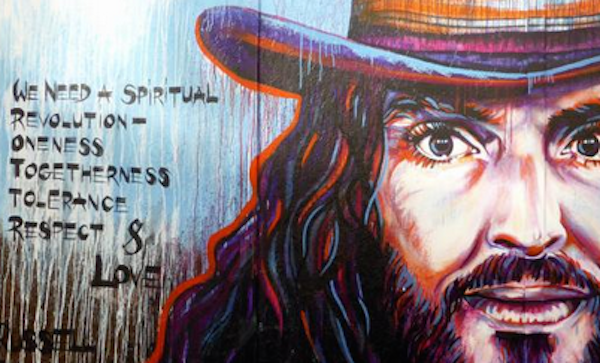
Here’s another of Brand’s sure-fire political insights: that a sharing society is dependent on mass civic engagement and truly representative democracy. Drawing on a fleeting interview in his house with David Graeber, he writes: “Democracy means if enough people want a fairer society, with more sharing, well-supported institutions and less exploitation by organisations that do not contribute, then their elected representatives will ensure that it is enacted.” But this will never happen, Brand suggests, so long as we have leaders who have been “conditioned and groomed to compliantly abide by the system that exploits them”, whose only true agenda is “meeting the needs of big business”. Hence there can be no true form of democracy without “a radical decentralisation of power, whether private or state.”

Two Detroits, Separate And Unequal

And now, after seven decades of these slow-moving storms, including acts that are almost impossible to see as anything but retribution against the city’s predominantly African American population, Detroit is often viewed from afar as a cautionary tale, a post-industrial dystopia of vacant buildings and dormant factories. The truth, however, is more complicated. On the brink of a new, post-bankruptcy beginning, Detroit is really two cities. One is comprised of wealthy enclaves like Palmer Woods linked to a compact, rapidly redeveloping downtown. The other is made up of the rest of the 139-square-mile urban expanse, populated by longtime residents who have fought for decades to survive in an environment that has become increasingly uninhabitable. In the first Detroit, private security is common and the living is relatively safe. In the second, running water has systematically been cut off from at least 27,000 households this year alone.

Why Current Global Inequality Is Unsustainable

Although many social scientists, most notably Thomas Piketty, have provided evidence of rising inequality across Europe and the rest of the world, there is little consensus on how the problem can be addressed. Is a solution to social and economic inequality feasible? The best analogy I can give to the current debate over inequality is that it’s a bit like talking about population growth in 1968. Around about 1968 was the point in human history when population growth had never been faster. The human population was growing by about 2-2.2 per cent a year. If that had continued then within 300 years the planet would have been unable to sustain our species and life as we know it would have ended.
assetto corsa mods

Urgent End Of Year Fundraising Campaign

Online donations are back! Keep independent media alive. 

Due to the attacks on our fiscal sponsor, we were unable to raise funds online for nearly two years.  As the bills pile up, your help is needed now to cover the monthly costs of operating Popular Resistance.

Urgent End Of Year Fundraising Campaign

Online donations are back! 

Keep independent media alive. 

Due to the attacks on our fiscal sponsor, we were unable to raise funds online for nearly two years.  As the bills pile up, your help is needed now to cover the monthly costs of operating Popular Resistance.

Sign Up To Our Daily Digest

Independent media outlets are being suppressed and dropped by corporations like Google, Facebook and Twitter. Sign up for our daily email digest before it’s too late so you don’t miss the latest movement news.