Skip to content

Art

Palestinians Will Not Let The Genocide Kill Their Hopes

In the United Nations’ Humanitarian Situation Update #340 on the Gaza Strip (12 November 2025), there is a section on the distress experienced by more than 1 million Palestinian children in Gaza. The most common symptoms among children reported in the assessment are ‘aggressive behaviour (93 per cent), violence toward younger children (90 per cent), sadness and withdrawal (86 per cent), sleep disturbances (79 per cent), and education avoidance (69 per cent)’. Children account for about half the population in Gaza, where the median age is 19.6 years.
Liberatory Unionism In The US Art Museum Labor Movement

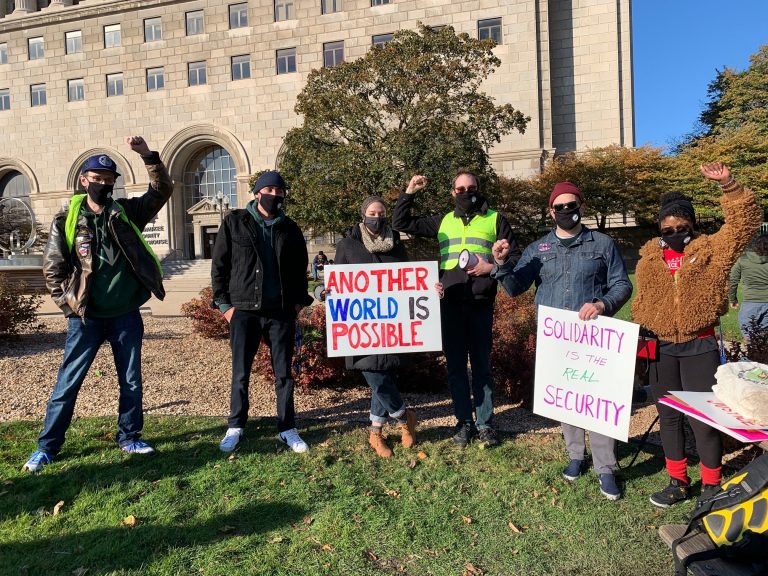
Art museum workers in the U.S. are in the midst of the most exciting period of labor organizing in decades. Since the launch of the New Museum Union in January 2019, there has been a 223% increase in new organizing at private, not-for-profit art museums alone. Though precarious working conditions long predate the COVID-19 pandemic, there was a boom in organizing in its wake after institutional responses exposed and exacerbated worker exploitation, unsafe working conditions, and layoffs and furloughs, predominantly affecting front-of-house workers.  Museum workers are also enacting liberatory unionism, a term I borrow from labor journalist Eve Livingston. In liberatory unionism, workers are not simply organizing for higher pay and better working conditions, but are also connecting labor struggles with resistance to racism and gender oppression.

Artist’s Prop Raps White House Greed, Grift, Gild, And Gaud

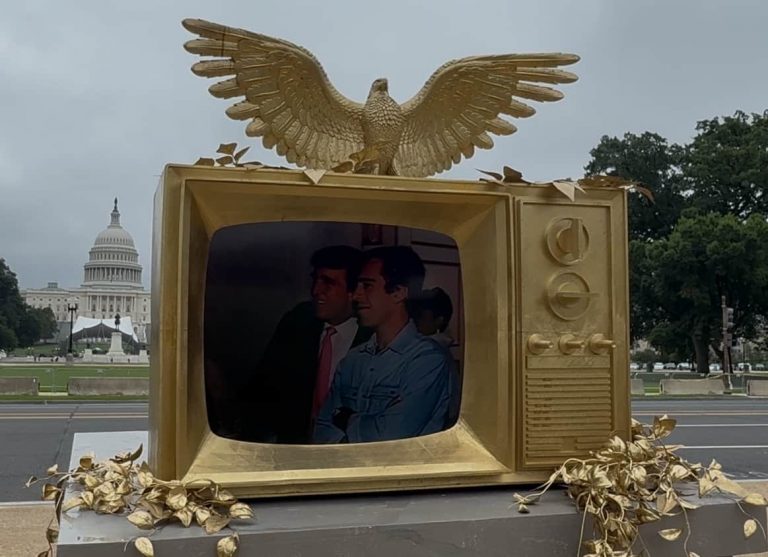
Washington DC—An anonymous artist has set up untitled installation art near the U.S. Capitol revealing their interpretation of the state of the U.S. presidency. The prop consists of a golden gilded television, a golden gilded eagle atop it with its wings spread, and golden laurel, resting on a grey column. A plaque is attached to the column with a raised quotation from the White House itself: “In the United States of America you have the right to display your so-called “Art” no matter how ugly it is.” The TV screen projects a muted short television show consisting of a series of poorly edited clips depicting an oddly cumbersome Trump dancing at various events.

Commoning Within Arts Collectives: Three International Stories

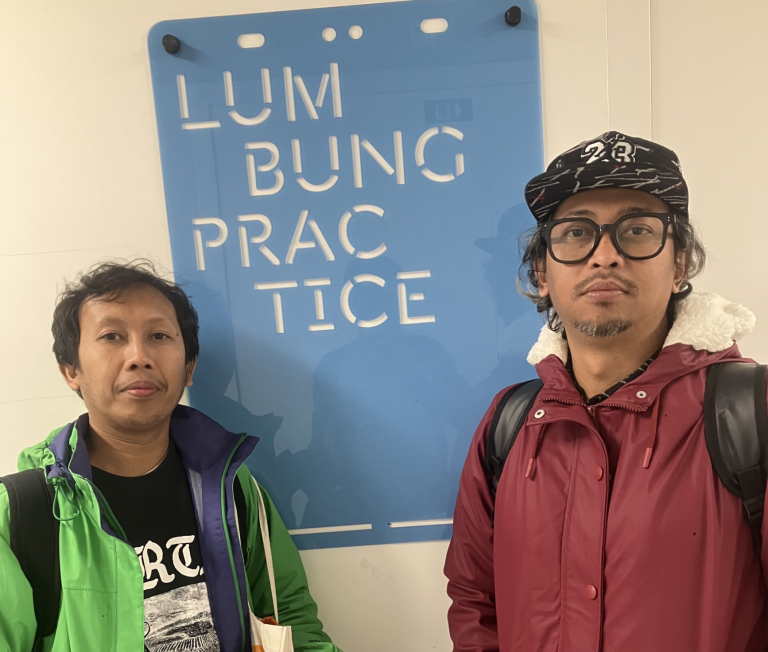
What are some of the distinctive ways that precarious arts collectives share resources, support each other, and make art? I recently learned a lot about this topic from a workshop of international artists convened in Amsterdam. Most of the artists are associated with the so-called Lumbung Practice collective, an interdisciplinary group experimenting with how to cultivate a commons-based art economy. The artists come from Indonesia, Iran, Morocco, transqueer-migrant disaporas, and other geographies and circumstances, so they have some very different experiences and talents.

Gig Organizing 101

The great Seattle-based songwriter, Jim Page, was coming to the east coast back in the mid-1990's. I was living in Boston then, and offered to organize a gig. I was already well into my twenties, but I had never done such a thing before. Jim was and is fairly well-known in Ireland, with one of Ireland's most revered musicians, Christy Moore, having recorded a number of his songs, one brilliant example of which became a real anthem for anti-nuclear sentiment in Ireland, "Hiroshima-Nagasaki-Russian Roulette." Boston had (and has) a large population of people who were born and raised in Ireland, and a much larger population of people of Irish descent.

We Need A Culture-In-All-Policies Approach To Democracy

Culture, unlike democracy, is self-propelled and self-propagating: it is persistent, in ways that democracy strives to be; it is effusive in ways that democracy should be; it is practical, as democracy must always be; and it is critical, in ways democracy is too often not. In these ways, culture’s strength and importance to civic life is that it runs through everything; it is the warp to democracy’s weft. The growing recognition of Indigenous wisdom about place and its management are important to acknowledge in any discussion of place-based work. The “new” ideas of regenerative and permaculture agriculture can draw a lineage to Indigenous wisdom, for example.

Weaving A Feminist Movement

Artist Indu Antony was enjoying conversation over chai at a women’s center in Bengaluru, India, when an angry man walked in. He tore a piece of art off the wall, took a lighter from his pocket, and set it on fire. Antony’s companions recognized the man as a local official in a right-wing political party; they scampered away. “This is a center that is attacking men,” the official fumed. It was three in the afternoon, and Antony smelled a day’s worth of drink on his breath. ​“You cannot burn our stories,” Antony shot back. The man’s eyes flared; he was not used to being challenged.  The two went back and forth, debating the community center she had founded: Is something created for women inherently against men?

Cooking Sections’ Singular Stew Of Art, Activism, And Local Food

What a delight to encounter the work of the British artistic duo Cooking Sections, two British artists whose virtuoso artworks effortlessly blend art with activism, local commoning, and eco-stewardship in the service of climate-friendly foodways. Alon Schwabe and Daniel Fernández Pascual -- Senior Research Fellows at the Royal College of Art in London – create distinctive works of art about modern food that are also enmeshed in the fabric of everyday life:  land, intertidal waters, restaurants, buildings, social festivals. The canvas for their art is large and unconventional: the bioregional theaters of the world where food is grown and harvested, from Scotland and Istanbul to southern Italy and South Korea, and beyond.

Charlie Chaplin’s Philosophy Of Cinema

Welcome to part two of our discussion about Charlie Chaplin with film director, screen writer, and producer, Martin Brest. Few individuals did more to shake modern cinema than the actor, director and producer, Charlie Chaplin. One of the greatest of all comic mimes, he also pioneered cinematic techniques and story telling. His films were this iconic roles as the belligerent Little Tramp with baggy trousers, mustache, cane, and bowler hat were not only comic masterpieces, but unflinching looks at poverty, unemployment, capitalist exploitation, the callousness of authority, the search for meaning and dignity in a hostile world, and the yearning for love and acceptance.

Baltimore Buried These Streams; An Artist Is Bringing One Back

Listen carefully nearby certain storm drains in Baltimore’s Remington neighborhood, and you might be able to hear the echo of Sumwalt Run, flowing 30 to 40 feet below. The creek disappeared from Baltimore’s landscape in the early 20th century when the city built a new sewer system. Sumwalt Run became a concrete culvert, moving springwater and storm runoff through Baltimore’s sewers into its harbor. It’s one of dozens of “ghost rivers,” as local artist Bruce Willen calls them, in the city: buried streams that still “haunt” the urban landscape and its residents by contributing to downstream water pollution and flooding.

To Stop Demolition, One London Home Transformed Into An Art Exhibit

London’s residents face the highest rents and have the lowest rate of homeownership in the U.K. today. One solution would be for local councils to expand public housing, known as “council housing.” However, the waitlist for these homes has jumped by 50,000 since 2020. This has happened partially because London councils have reduced their housing stock by 10 percent since the beginning of the pandemic, often due to privatization. Building complexes made up of only council housing, called council estates, are becoming increasingly rare sights in the capitol.

Storm King Art Center Recognizes Workers’ Union

After seven months, the workers of Storm King Art Center, in New York’s Hudson Valley, have successfully organized. The institution voluntarily recognized the new union, following a lengthy negotiation process and two elections, one in-person at the museum on April 27, and an online vote for the visitor services department on May 23. A total of 68 workers at the popular New Windsor sculpture park, home to monumental works by the likes of Alexander Calder, Mark di Suvero, and Maya Lin, are now part of the Civil Service Employees Association (CSEA) Local 1000, an affiliate of the American Federation of State, County and Municipal Employees (AFSCME).

Dancing Revolution: ’90s Protests Used Rave Culture To Reclaim The Streets

Thousands gathered on May 16, 1998 in Birmingham’s famous Bullring district, located in the city center. They were instructed to meet by the New Street Station subway stop and make their way towards the Bullring’s roundabout. The mood soon became nothing short of intoxicating as a roaring sound system hidden inside an ordinary car blasted techno to the masses. Fire eaters, drag queens, and clowns were normal amongst a crowd of lamppost climbers and stilt-tripod walkers filling up the streets, creating a gridlock of traffic that purged vehicles from the area and prevented drivers from coming in.

In Revolutionary Times, Are Art And Music Falling Short?

James Kennedy is a highly-regarded and accomplished Welsh singer, songwriter, multi-instrumentalist, and producer who is best known for his political activism through his music. With a career spanning more than two decades, he has made a name for himself as a powerful voice in the music industry, using his platform to raise awareness about important issues and to advocate for social justice. James joins “Behind The Headlines” host Lee Camp for a full, hour-long interview today. James takes us on a journey through his musical career, discussing the ways in which politics has influenced his music, the challenges of being a political musician in today’s world, and the reasons behind his decision to use music as a tool for change. His music career began with a strong focus on political issues, with songs that explored topics such as inequality, social justice, and human rights.

Binna Choi Of The Casco Art Institute: Curating Art Through Commoning

Many years ago I was intrigued to learn of an art institute in the Netherlands, that formally declares its mission to be "working for the commons." That's how the Casco Art Institute in Utrecht presents itself to the world. Their tagline immediately raises questions about how exactly arts and commoning are related, and how an art institute might enter into the world of commoning. I decided to learn more by inviting Binna Choi, Director at the Casco Art Institute, to join me in a podcast conversation for Frontiers of Commoning (Episode #35). Binna, a native of South Korea who has led Casco since 2008, curates artistic work for major exhibitions and was a faculty member of the Dutch Art Institute. She has been a curator or artistic director for the Singapore Biennale 2022, the Gwangju Biennale 2016, and the upcoming Hawai'i Triennial 2025. Choi has brought the ethic and practices of commoning to the creation of art and its exhibition.
assetto corsa mods

Urgent End Of Year Fundraising Campaign

Online donations are back! Keep independent media alive. 

Due to the attacks on our fiscal sponsor, we were unable to raise funds online for nearly two years.  As the bills pile up, your help is needed now to cover the monthly costs of operating Popular Resistance.

Urgent End Of Year Fundraising Campaign

Online donations are back! 

Keep independent media alive. 

Due to the attacks on our fiscal sponsor, we were unable to raise funds online for nearly two years.  As the bills pile up, your help is needed now to cover the monthly costs of operating Popular Resistance.

Sign Up To Our Daily Digest

Independent media outlets are being suppressed and dropped by corporations like Google, Facebook and Twitter. Sign up for our daily email digest before it’s too late so you don’t miss the latest movement news.