Skip to content

Cooperatives

Newsletter – The Consent Of The Governed

By Margaret Flowers and Kevin Zeese. Governments function because of the consent of the governed. When a government does not serve the needs or interests of the people, it loses its legitimacy and no longer deserves the consent of the people.Plutocracy defined We have argued for a long time that current governments at all levels - local, state and federal -function primarily to benefit the wealthy. Academics have proven that the United States is a plutocracy - rule of, by and for the wealthy. It is time for us to withdraw our consent. Let's consider how to do that and what protections will be needed. When a government loses the consent of the people, all it has left to wield to keep its power is repression and force. Cooperation Jackson and the Malcolm X Grassroots Organizing Movement, is calling for "a program of noncompliance and noncooperation on both the federal and state levels." We have entered a new era, a presidency of protest and an increasing illegitimate government. We have the power to withdraw our consent from hate and exploitation and build love and prosperity.

Building the Commune, Radical Democracy in Venezuela

By Stan Smith for MLToday. The grassroots struggle to build a new society, focusing on the cooperatives, the community councils, the communes, established to strengthen popular participatory democracy, is keeping the Chavista revolution alive. This communal movement began with the fight against neoliberalism’s anti-working class measures even before the Caracazo, the 1989 outburst against IMF imposed cuts resulting in the then government killing up to 2000 protesters. In Venezuela these struggles gave rise to popular local assemblies and neighborhood councils to meet community needs neglected by the government. In the Chavez era these became institutionalized as communal councils, participatory organizations for self-governance.

In Venezuela’s Difficult Times The Grassroots Are Stronger

By Tamara Pearson for the New Internationalist. It’s been three years now of food shortages, inflation, and queues in Venezuela, and the millions of people involved in community and movement organizing have been the most affected. But they’ve also defied right-wing and general expectations, and even perhaps the expectations of the Maduro government, and have become stronger and better organized as a result of the hardships. A worker in charge of sustainable development for the mountain town of Los Nevados for Merida’s Teleferico (cable car) and a member of an urban agriculture organization, La Minga, Loaiza was one of four people I interviewed to get a sense of how the grassroots have been affected by these difficult times – times that have been utterly sensationalised and lied about by the mainstream media. He described the current crisis as a result of politics, and ‘consumerism that isn’t working’ in an oil based, urban-centric economy where people don’t produce what they consume.

Conceptualizing Cooperatives As A Challenge To Capitalist Thinking

By Pete Dolack for Counter Punch - As capitalism lurches from crisis to crisis, and a world beyond capitalism becomes a possibility contemplated by increasing numbers of people, finding a path forward becomes an ever more urgent task. That path is likely to contain a multitude of possibilities and experiments, not all of which will prove viable. Psychological barriers will surely be a major inhibition to overcome; possibly the biggest roadblock given the still ubiquitous idea of “there is no alternative” that has survived despite growing despair at the mounting inequality and precarious futures offered by capitalism.

This Worker-Owned Cooperative Is ‘Bigger Than A Business’

By Sam Tabachnik for DCist - On the morning of his 34th birthday, Juan Reid woke up in a van parked outside a homeless shelter. He couldn’t stop sobbing. Reid had just finished 14 years in prison, and acclimating to life on the outside was taking its toll. He could feel himself being pulled back into his old habits, tempted by the routine that got him put away. Not wanting to burden his parents any longer, and filled with shame, he elected to sleep in a van on the street instead of ask them for help. Then his phone rang. It was his mom, calling to wish him a happy birthday and say she was proud of him.

Ethical, Cooperative Banking That Sustains Community

By Staff of The Next System Project - Adam Simpson: Goran, thank you for joining us today. You are the cooperative manager of the Cooperative for Ethical Financing in Croatia. Can you tell us about the process of where this idea came from and how the Cooperative was started? Goran Jeras: If you look at the origins of the idea, it has been about six years since this initiative started emerging. As all other ideas, it started as a talk over a beer. At that time, I was working in the Netherlands as a consultant, consulting with big international financial institutions, so big international banks, insurance companies, etc.

How America’s Largest Worker Owned Co-Op Lifts People Out Of Poverty

By Laura Flanders for Yes Magazine - Before Zaida Ramos joined Cooperative Home Care Associates, she was raising her daughter on public assistance, shuttling between dead-end office jobs, and not making ends meet. “I earned in a week what my family spent in a day,” she recalled. After 17 years as a home health aide at Cooperative Home Care Associates (CHCA), the largest worker-owned co-op in the United States, Ramos recently celebrated her daughter’s college graduation. She’s paying half of her son’s tuition at a Catholic school, and she’s a worker-owner in a business where she enjoys flexible hours, steady earnings, health and dental insurance, plus an annual share in the profits.

Income Sharing Could Save Our Lives

By Matt Stannard for Occupy.com. “Being poor is hoping the toothache goes away,” Hugo Award-winning author John Scalzi wrote in a personal blog post over a decade ago. “Being poor is a heater in only one room of the house... Being poor is needing that 35-cent raise... Being poor is six dollars short on the utility bill and no way to close the gap... Being poor is knowing you work as hard as anyone, anywhere.” Economic insecurity is the American nightmare. It kills us earlier, messes up our mental health, saps the life out of us. Since Scalzi’s 2005 post, we’ve learned that more than 60 percent of us can’t afford a $500 emergency – which roughly translates to hoping the toothache goes away. That’s a pretty raw deal in exchange for an economic system that’s also killing the planet. And only rarely can we count on others to help us out. They’re either broke themselves, or profiting from our financial instability.

8 Cities Have New Co-op-Style Black Worker Centers

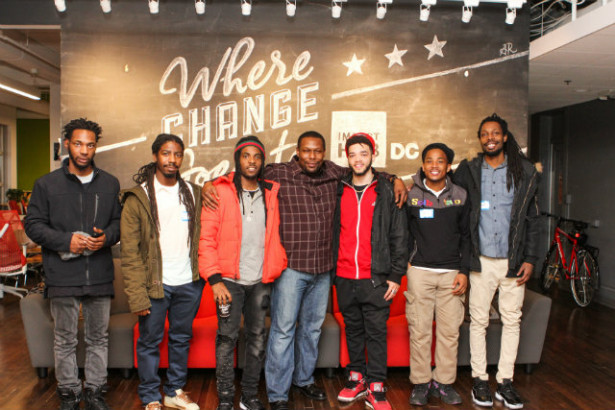
By Melissa Hellmann for Yes Magazine - Delonte Wilkins was looking for a fresh start when he was released from Pennsylvania’s Schuylkill Federal Correctional Institution in February. He polished his resume and applied to several jobs in his hometown of Washington, D.C. But when he was turned down for three job offers once those employers learned of his criminal background, Wilkins soon realized he couldn’t easily leave his felony behind.

How Urban Governments Are Promoting Worker Co-ops

By Michelle Camou for GEO - City governments are shaping up as key actors accelerating worker co-op development. It started in 2009 when the City of Cleveland accessed a federal guaranteed loan to help finance the Evergreen Cooperatives. Since then, nine more city governments have moved to promote worker cooperatives through municipal projects, initiatives, or policies because they want to reach people and communities often left out of mainstream economic development. Other city governments including Philadelphia are considering it now.

Under-Used Tool For Addressing Roots Of Inequality: Inclusive Ownership

By Marjorie Kelly for SSIR - It’s a sign of the times that the second-largest US foundation, the Ford Foundation, announced earlier this year that it was reorienting its entire portfolio of grants around a single goal: to disrupt the drivers of inequality. The topic of inequality is on everyone’s mind, including the Pope’s and Standard & Poor’s, which warned that, “income inequality in the US is dampening GDP growth.

Can ‘New Economy’ And Labor Movements Come Together

By Erin Dirnbach for Waging Nonviolence. California - Activists in Oakland have been campaigning for new city policies that would assist worker cooperative development. After successfully winning passage of a city resolution in support of cooperatives last fall, they are now pushing for a new law, the Oakland Worker Cooperative Incentives for Growth Ordinance. Supporters will speak in support at the upcoming hearing at City Hall on September 27, and the ordinance is likely to pass in October. It would grant a variety of benefits for registered worker cooperatives including procurement preferences, development funding, tax incentives, streamlined permitting and promotion of business conversion to cooperatives. The Sustainable Economies Law Center, one of the key promoters of the ordinance, says that it will be the first of its kind to offer this level of assistance for cooperatives.

Laura Flanders Show: African American Cooperatives & Civil Rights

By Staff of TRNN - This week, Laura Flanders interviews Jessica Gordon Nembhard on the role that economic cooperation played in the civil rights movement

The Role Of Cooperatives In Constructing 21st Century Socialism

By Cliff DuRand for Grassroots Economic Organizing - This paper conceptualizes socialist construction as a process of incremental reclaiming from capital of those resources that can best be held in common so that members of a community can achieve their fuller human development*. Under democratic rules the community regulates the commons so as to ensure its accessibility and sustainability. The formation of cooperatives is an instance of the socialization of the workplace.

 Where Government Is Embracing Coops, Citizen Activism, & Solar Energy

By Sebastiaan Faber and Becquer Seguin for The Nation. Barcelona, Spain—“When we moved into city hall, there were only paintings by men,” Barcelona Mayor Ada Colau tweeted in March, attaching a picture of her current office wall, which now featured portraits of eight prominent Catalan women—including the legendary anarchist leader Federica Montseny. “Redecorating the walls, that was the easy change,” Colau’s second in command, Gerardo Pisarello, joked when we spoke with him in late June. “The other ones take quite a bit longer—they are more difficult and don’t just depend on us.” Pisarello’s office, too, features black-and-white photographs: one of a woman celebrating the proclamation of Spain’s Second Republic in 1931, and another taken at the country’s first LGBT protest after dictator Francisco Franco’s death in 1975, a demonstration that, as Pisarello proudly points out, happened in Barcelona.
assetto corsa mods

Urgent End Of Year Fundraising Campaign

Online donations are back! Keep independent media alive. 

Due to the attacks on our fiscal sponsor, we were unable to raise funds online for nearly two years.  As the bills pile up, your help is needed now to cover the monthly costs of operating Popular Resistance.

Urgent End Of Year Fundraising Campaign

Online donations are back! 

Keep independent media alive. 

Due to the attacks on our fiscal sponsor, we were unable to raise funds online for nearly two years.  As the bills pile up, your help is needed now to cover the monthly costs of operating Popular Resistance.

Sign Up To Our Daily Digest

Independent media outlets are being suppressed and dropped by corporations like Google, Facebook and Twitter. Sign up for our daily email digest before it’s too late so you don’t miss the latest movement news.