Skip to content

Cooperatives

When Workers Become Owners: Taking Co-Op Movement To Next Level

By Brian Van Slyke for Truthout - There's a revolution taking place in the US workforce - but you may not have heard about it. Around the country, workers are starting businesses that they democratically control and that financially benefit them. These businesses, called worker cooperatives, are owned and governed by the employees. Every worker is a member of the co-op, which gives them one share and one vote in the company's operations. Worker cooperatives come in all shapes and sizes. Equal Exchange, a distributor of fair trade chocolate and coffee, has over 100 worker-owners, with a board of directors and co-executive directors, all ultimately accountable to the employees.

Co-Ops Build Stronger Communities, New Economy

By TESA Collective for TESA - Cooperatives are businesses and organizations democratically owned and managed by the people they serve. They come in many shapes and sizes: from a handful of people to thousands upon thousands of members. Some are owned and run by workers, others are owned and governed by consumers, still others are for producers (like farmers and artists). But no matter what, cooperatives always have the same foundation: one member, one share, one vote. Recently, we at The Toolbox for Education and Social Action (TESA) (a worker co-op) launched a new poster series to highlight and celebrate the power of the cooperative movement.

Solidarity Economy – From Quebec To Chicago To Mexico

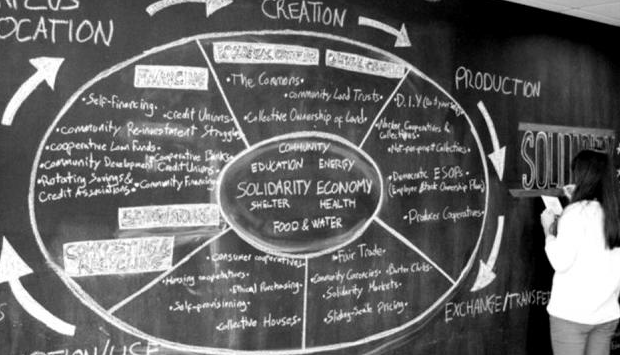
By Derek Royden for Occupy - Defining the term “solidarity economy” can be difficult: it has become a kind of catch-all to describe everything from worker-owned cooperatives to open source software to complementary currencies. Surprisingly, the ideas promoted in the solidarity economy aren't very well known in the English-speaking world, though they’ve been gaining a foothold in academia and civil society groups since the turn of the century. Quebec, Canada’s French language-majority province, is where the concept began to get traction in the late 1980s, mostly influenced by European experience (the word "solidarity" is, after all, French).

The Legacy And Current Growth Of Black Cooperatives

By Beverly Bell and Natalie Miller for Other Worlds - For National Co-op Month, we present a three-part series from an interview with Jessica Gordon Nembhard. Read the first piece, Black Cooperative Economics During Enslavement, here and the second piece, on how the cooperatives were critical partners to struggles throughout African-American history, here. When I first became interested in cooperative economics, everybody, Black and white, told me that Black people just don’t engage in cooperative economics. But that didn’t seem right to me. So I started studying it, talking to people about it, and participating in the US co-op movement.

Newsletter: Economy Of The Future-Economic Democracy

By Kevin Zeese and Margaret Flowers for Popular Resistance - This Labor Day weekend rather than looking at the history and current struggles of workers, we look to the future and imagine what will work be like in 2025 or 2050. What will the overall economy look like? What is our vision for an economy that works for the people? There are some major trends that indicate we are in the midst of a radical transformation of what work means and how people will have income. There will never be enough jobs in the future so we need a new way to ensure people have money on which to live and to keep the economy going. It is time to figure out how to provide people with a basic income where everyone receives a single basic income to provide for a comfortable living whether they work or not. To create wealth among workers, worker ownership through worker cooperatives or worker self-directed enterprises need to be encouraged. It takes roots to weather a storm, and the storm is here.

Cincinnati’s Experiment With An Economy That Works For Everyone

By Geoff Gilbert for Waging Nonviolence - With the 2016 presidential campaigns underway, economic populism has taken center stage. Bernie Sanders, calling for a $1 trillion investment in a sustainable infrastructure jobs program along with publically funded health care and college education, has forced Hillary Clinton to offer vague support for similar measures, while even some Republican candidates, like Marco Rubio, have asserted the need to stop the “fall of the [American] worker.” Not content to wait for national politicians to follow through on non-binding proposals, 1worker1vote — a joint venture launched in 2009 by the United Steelworkers, or USW, and Mondragon USA — has been pursing a grassroots agenda to move populist discontent beyond protest and toward the building of new institutions.

Energy, Democracy, Community

By John Duda in Medium - But there’s another lesson to be learned from Curtis Bay: organized communities can successfully demand something other than business as usual. It started with just a few high school students, who started talking about building neighborhood resistance to the incinerator. With the help of local economic human rights organization called the United Workers, that small initial group snowballed into a massive campaign, bringing students and neighbors together with supportive activists and artists from across the city, all showing up at meetings of the institutions who had signed up to purchase power from the planned incinerator, and demanding they do otherwise. Against all expectations, as of August 2015, it looks like they are winning. The consortium of school boards, local governments, and nonprofits has canceled their contracts with Energy Answers, and the incinerator is far from even beginning construction. Meanwhile, Curtis Bay residents have become leading voices working to create an alternative development plan.

Here’s What a Commons-Based Economy Looks Like

By David Bollier - So what might a commons-based economy actually look like in its broadest dimensions, and how might we achieve it? My colleague Michel Bauwens of the P2P Foundation offers a remarkably thoughtful and detailed explanation in a just-released YouTube talk, produced by FutureSharp. It’s not really a video – just Michel’s voiceover and a simple schematic chart – but the 20-minute talk does a great job of sketching the big-picture strategies that must be pursued if we are going to invent a new type of post-capitalist economy. Michel focuses on the importance of three specific realms that are crucial to this new vision – ecological sustainability, open knowledge and social solidarity. Each is critical as a field of action for overturning the existing logic of market capitalism.

Farmer Cooperatives, Not Monsanto, Supply El Salvador With Seeds

In the face of overwhelming competition skewed by the rules of free trade, farmers in El Salvador have managed to beat the agricultural giants like Monsanto and Dupont to supply local corn seed to thousands of family farmers. Local seed has consistently outperformed the transnational product, and farmers helped develop El Salvador’s own domestic seed supply–all while outsmarting the heavy hand of free trade. This week, the Ministry of Agriculture released a new round of contracts to provide seed to subsistence farmers nationwide through its Family Agriculture Program. Last year, over 560,000 family farmers across El Salvador planted corn and bean seed as part of the government’s efforts to revitalize small scale agriculture, and ensure food security in the rural marketplace.

New Organization For Solidarity Economy, Postal Banking

An expanded organization dedicated to postal and public banking, worker-owned cooperatives, debt forgiveness, and basic income will host a variety of speakers in its Spring 2015 phone conference series, according to the group’s web site. Commonomics USA, formed by veterans of the public banking, debt forgiveness, and foreclosure prevention movements, aims to “advance economic justice, reclaim the commons, and promote democratic economies through nonpartisan partnerships with America’s public officials, grass roots activists, and the general public,” according to its web site. Working with postal unions and other policy groups, the new organization will focus on postal banking, the delivery of basic financial services through the post office, during much of 2015, according to the group’s policy director, Matt Stannard.

Platform Cooperativism Vs. The Sharing Economy

The backlash against unethical labor practices in the “collaborative sharing economy” has been overplayed. Recently, The Washington Post, New York Times and others started to rail against online labor brokerages like Taskrabbit, Handy, and Uber because of an utter lack of concern for their workers. At the recent Digital Labor conference, my colleague McKenzie Wark proposed that the modes of production that we appear to be entering are not quite capitalism as classically described. “This is not capitalism,” he said, “this is something worse.” Take, for example, Uber’s app, with all its geolocation and ride ordering capabilities. Why do its owners and shareholders have to be the main benefactors of such platform-based labor brokerage? Developers, in collaboration with local, worker-owner cooperatives could design such a self-contained program for mobile phones.

Co-ops Get A Boost In Seattle

Low-income workers in Seattle are getting another economic boost. Five months after the local government became the first in the country to gradually raise the minimum wage to $15—making it the highest in the country—the Federal government's Small Business Administration has funded a local business support group to help train disadvantaged Seattle workers to develop worker cooperatives and home-based or cottage businesses. The SBA's PRIME program awarded $115,236 to the Center for Inclusive Entrepreneurship (CIE) at Pinchot University to help educate and train small business owners and to build community wealth. The PRIME program will be accepting grant applications from September 29, 2014 to September 30, 2015.

Students Getting Behind Development Of Cooperatives

On June 28 the New York City Council passed its budget for Fiscal Year 2015. Included in it, was the historic $1.2M Worker Cooperative Development Initiative. In terms of scale, the initiative is the first of its kind in the United States. The initiative's purpose is to lend support to 20 existing NYC worker cooperatives, as well as foster the creation of 28 more. Student Organization for Democratic Alternatives (SODA) is a student group advocating for and actively striving to build participatory democratic institutions (note of disclosure: the author is a founding member of SODA). Such institutions include: worker cooperatives, participatory budgeting and a range of other institutions commonly grouped under what is called "solidarity economy.”

10 Ideas For Change, Co-operative Local Economies

As the cracks in corporate capitalism deepen, the co-operative economy is gaining strength. Rooted in community and in the democratisation of ownership, co-operative structures allow citizens to reclaim power over their workplaces, their open spaces, their housing, shops and public realm. Here are ten ideas for building grassroots democratic economies: 1. Take over local shops: Community-run shops – and pubs and petrol stations and libraries – have grown in the UK in recent years, particularly in rural areas. In Ceredigion a co-operative called 4cg began by fighting back against a supermarket planning to move into the town.

Deer Isle’s Model Worker Cooperative

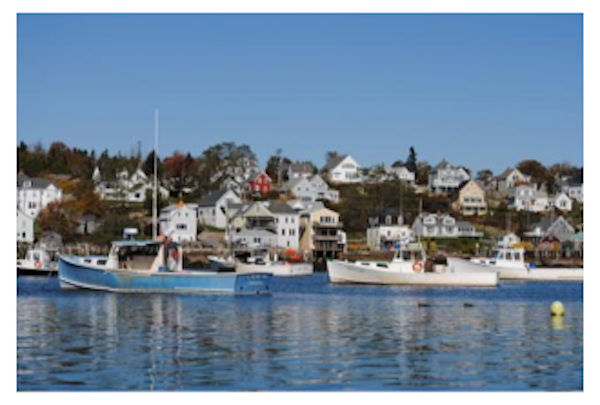
Beloved for its charming landscapes and fresh lobster, the rural community of Deer Isle, Maine is now gaining attention in the cooperative world. When Verne and Sandra Seile, proprietors of Burnt Cove Market, V&S Variety and Pharmacy, and The Galley, decided to retire last year, they sold their businesses to their employees. With 62 new worker-owners, Island Employee Cooperative, Inc. is now the twelfth largest worker cooperative in the nation. In a small community of just more than 2,500, with a workforce of 1,300, the loss of 62 jobs would have been felt intimately. Where family-owned businesses are significant, communities face additional challenges. Only 30 percent of family-owned businesses, like the Seile’s, survive to the next generation. When these businesses are closed or sold to outside investors, communities lose wealth. For example, an Institute for Local Self Reliance study analyzing the local multiplier effect in Maine, found that for every $100 spent at a big box retailer, $14 in local spending is generated compared to $45 when the money is spent at a locally-owned business. Additionally, communities sacrifice social benefits fostered by ownership of local business, such as good health and a politically engaged community. Hoping to keep wealth rooted in their home of over 40 years, the Seiles began working with the Maine- based Cooperative Development Institute and the Independent Retailers Shared Services Cooperative to convert their businesses to a worker-owned cooperative.
assetto corsa mods

Urgent End Of Year Fundraising Campaign

Online donations are back! Keep independent media alive. 

Due to the attacks on our fiscal sponsor, we were unable to raise funds online for nearly two years.  As the bills pile up, your help is needed now to cover the monthly costs of operating Popular Resistance.

Urgent End Of Year Fundraising Campaign

Online donations are back! 

Keep independent media alive. 

Due to the attacks on our fiscal sponsor, we were unable to raise funds online for nearly two years.  As the bills pile up, your help is needed now to cover the monthly costs of operating Popular Resistance.

Sign Up To Our Daily Digest

Independent media outlets are being suppressed and dropped by corporations like Google, Facebook and Twitter. Sign up for our daily email digest before it’s too late so you don’t miss the latest movement news.