Skip to content

Extreme weather

Minneapolis Teamsters Fight For Safety In Summer Heat

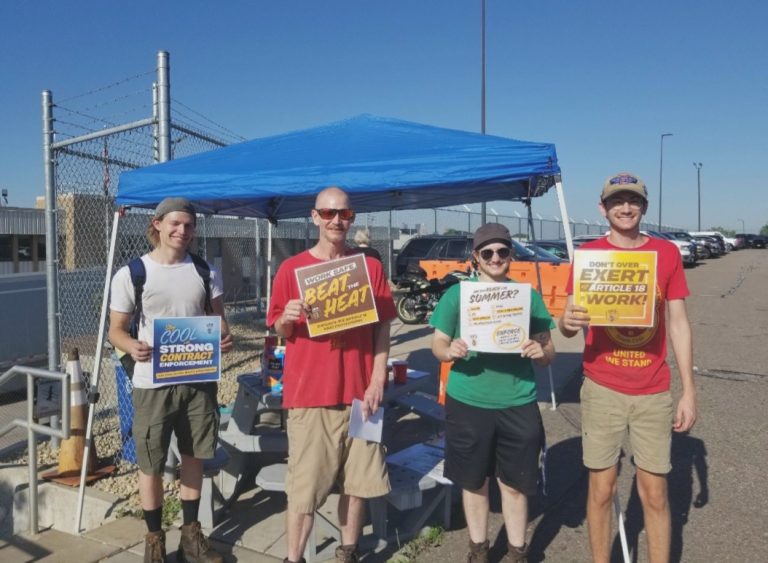
Minneapolis – Local 638 Teamsters tabled at the northeast Minneapolis UPS hub on Thursday, July 3. They distributed flyers on heat safety and union contract enforcement. Drivers coming in, and warehouse workers leaving for the day, stopped to learn about their rights, grab some lemonade, and share experiences as temperatures reached the 90-plus range in Minneapolis. Inside the warehouse and inside package cars, temperatures are regularly five to ten degrees higher for workers. As the result of a months-long contract campaign and credible strike threat in 2023, UPS workers won strong contract language. This requires UPS to install 2500 new water fountains, 18,000 new warehouse fans, and 28,000 new or replacement delivery vehicles equipped with air conditioning over the life of the five-year contract.

America Builds To Resist Disasters; The Global South Builds To Recover

In the last few weeks, as the United States suffered through a record-breaking heatwave, people were instructed to take refuge in buildings with indoor air conditioning. This reliance on a system that runs on fossil fuels and contributes to nearly 20% of our greenhouse gas emissions also inevitably set us up for another, more severe heatwave. Even as the U.S. faces increasingly frequent – and deadly – climate change-related disasters, we continue to be caught off guard, treating them as short-term inconveniences and not the new normal. Science has proved that we are actively contributing to future climate devastation, and yet we continue to design buildings with an assumption that climate resilience means waiting out disasters, wasting significant energy fighting the symptoms while contributing to the illness.

St. Louis Using Tornado Destruction To Displace Black Community

On May 16, 2025, an EF3 tornado tore through the city of St. Louis causing massive destruction. Instead of responding with aid to those who were impacted, the city deployed police to black communities and condemned 5,000 homes and buildings without fully reviewing if these designations were warranted. Some homes were condemned even though repairs were made. Clearing the FOG speaks with President Westbrook of the St. Louis branch of the International People's Democratic Uhuru Movement and Jesse Nevel, chair of the Uhuru Solidarity Movement, about what the city is currently doing to force Black residents from their homes, how this is part of a longer-term effort and why it is necessary to support residents there.

City Cuts Power To Black St. Louis After Tornado Disaster

On June 2, the St. Louis city government cut off electricity to thousands of tornado victims in the Northside Black community. Shortly after a tornado tore through the Black community of North St. Louis on May 16, red tags reading “Danger. Entry prohibited. Violators subject to prosecution”, were placed by volunteer inspectors who did not enter the homes, but made cursory assessments from the sidewalk. Mayor Cara Spencer had announced shortly after the May 16 tornado that the city would be directing Ameren to shut off the power to every red-tagged building, a minimum of 1500 homes.

Prescient Warnings About Helene Didn’t Reach People In Harm’s Way

When Hurricane Helene plowed over the Southeast last September, it caused more inland deaths than any hurricane in recorded history. The highest per capita death toll occurred in Yancey County, a rural expanse in the rugged Black Mountains of North Carolina devastated by flash flooding and landslides. On Monday, we published a story recounting what happened in Yancey. Our intent was to show, through those horrific events, how highly accurate weather warnings did not reach many of those most in harm’s way — and that inland communities are not nearly as prepared for catastrophic storms as coastal ones. No one in Yancey received evacuation orders.

Uhuru Movement Organizes Tornado Response In St. Louis

The Uhuru Movement’s Black Power Blueprint project is mobilizing black community recovery efforts in areas of North St. Louis that were devastated by at least one severe tornado on Friday, May 16, 2025. The National Weather Service (NWS) said they believe the tornado was an EF-3 with winds between 100-165 mph and was up to a mile wide at times. More than 80,000 buildings remain without power. Immediately after the storm, activists with the Uhuru Movement began to mobilize support and resources for neighbors in need. From the Uhuru House black community center at 4101 W. Florissant Avenue, they organized a drive for tools and supplies. On Sunday, they set-up a charging station, as well as a grill and gave away hot food.

Natural Disasters Are Driving A School Crisis

Adrinda Kelly watched from New York as Hurricane Katrina swallowed her hometown of New Orleans in 2005. Floodwaters rose, neighborhoods disappeared underwater, and she felt a familiar ache deepen. Her family was safe, but devastation quickly compounded a painful realization: Black children were portrayed as disposable, and New Orleans’ education system was almost completely privatized. Black students’ test scores faltered. Almost two decades later and nearly 2,000 miles away, similar echoes reverberated in Altadena, California, as wildfires swept through Los Angeles County in January.

World Experienced 152 Unprecedented Climate Events In 2024

According to the latest State of the Global Climate 2024 report from the UN World Meteorological Organization (WMO), the world experienced 152 unprecedented and 297 unusual extreme events related to climate change last year.  Topping the list of extreme events were heat waves, with 137 events, followed by extreme rain and wet spells (115 events), flooding (104 events), tropical cyclones (47) and drought (44).  In total, these events were linked to 1.1 million people injured, 1,700 deaths and 824,500 people displaced. As The Guardian reported, the number of people displaced by extreme climate events in 2024 was the highest annual number since 2008, when the records began.

Don’t Let Insurance Companies Fleece Homeowners

As climate-fueled disasters escalate, insurers are getting richer while leaving Americans in the lurch. Citing climate-related losses, many insurance companies are exorbitantly inflating rates, refusing to renew policies, and delaying, denying, or underpaying claims. The latest of many examples is Los Angeles, where wildfires devoured over 40,000 acres and left thousands unhoused and unemployed. Many families were dropped by their insurers or struggled to find affordable options before the fires. Some turned to the state’s coverage plan, which costs more and covers less.

Dispatch: Through The Fire

Unprecedented January wildfires devastate Los Angeles, as communities face both natural disaster and militarized state response. The Eaton Fire displaces numerous families in the Pasadena-Altadena area, including multigenerational Black households who have built lives in these neighborhoods for decades. Among them, the Edwards family stands displaced from their home of 32 years. For those seeking to support impacted community members, the Edwards family’s GoFundMe, provides direct aid to one of many displaced households fighting to survive. A broader directory of displaced Black families seeking support can be found here.

The Coming Climate Uncertainty Conundrum

This piece is about what we talk about when we talk about ‘climate change.’ Mostly, whether in the campaigning world or the policy world, the tech world or the business world, the everyday world or the world of international summitry, we mainly talk about cutting carbon emissions. And if we talk about impacts, we talk about the impacts of global heating, plus the impacts of the growing chaos. But we don’t talk enough about climate impacts, our vulnerability to them, let alone how to prepare adequately for them, or to tackle them ‘upstream’ before they land or get worse.

New York Climate Activists Show A Powerful Path Forward

On the evening of Dec. 10, 12 self-identified elder climate activists sat around the Christmas tree in the New York State Capitol, in Albany, singing carols as they waited to be arrested. The protesters, who were there to support New York’s Climate Change Superfund Act, had been told by police they would face criminal misdemeanor trespass charges if they stayed put. “Normally, for a protest like this, we’d expect to be written a citation rather than charged with a misdemeanor,” said Michael Richardson of Third Act Upstate New York, which helped plan the civil disobedience.

A Public Model For Home Insurance

With every extreme weather event, housing is damaged and belongings are lost. Insurance is supposed to be the safety net that helps people to recover and restart their lives. But as major disasters like hurricanes, wildfires, and hailstorms increase in frequency and severity thanks to climate change, more insurance companies are cutting back on policies, jacking up premium rates, or refusing to cover whole areas of the country. This change is leaving people who live in affected homes—including everything from single-family houses to multifamily rental buildings—facing financial hardship and even homelessness, among other ruinous consequences.

How Federal Disaster Funding Can Slow Rent Increases

Coloradans often welcome rain storms with the refrain, “We need the moisture.” After the deadly floods in September 2013, many Coloradans sang a different tune. Over five days, a slow-moving storm covered some areas of the Front Range with up to 20 inches of rain. Overall, the floods killed 10 people, displaced 18,000, and caused more than $4 billion in damage to more than 17,000 structures, of which 1,882 were completely destroyed, according to the Colorado Division of Homeland Security & Emergency Management’s after-action report.

Mutual Aid Networks Are Mobilizing Amid Los Angeles Fires

I’ve always said that Los Angeles is a mirror: Whatever you’re seeking, you’ll find it reflected back to you. Sure, the city has its ugly parts — celebrity worship and diet fads and smog that blots out the sky — but Los Angeles’ true core is multitudinous. Home to about 13 million people, the sprawling metropolis brims with countless communities and enclaves, neighborhoods and histories. If the ugly is all you see, then you’re not looking hard enough. Since the Palisades and Eaton fires roared to life last week, Los Angeles residents have shown how much strength and solidarity lies in their communities.
assetto corsa mods

Urgent End Of Year Fundraising Campaign

Online donations are back! Keep independent media alive. 

Due to the attacks on our fiscal sponsor, we were unable to raise funds online for nearly two years.  As the bills pile up, your help is needed now to cover the monthly costs of operating Popular Resistance.

Urgent End Of Year Fundraising Campaign

Online donations are back! 

Keep independent media alive. 

Due to the attacks on our fiscal sponsor, we were unable to raise funds online for nearly two years.  As the bills pile up, your help is needed now to cover the monthly costs of operating Popular Resistance.

Sign Up To Our Daily Digest

Independent media outlets are being suppressed and dropped by corporations like Google, Facebook and Twitter. Sign up for our daily email digest before it’s too late so you don’t miss the latest movement news.