Skip to content

Food and Agriculture

Mutual Aid In Public Housing Continues After Housing Authority Pushback

In early April, Baltimore City’s Housing Authority threatened Reverend Annie Chambers with arrest and eviction for distributing food to her neighbors at Douglass Homes, citing a policy barring non-government organizations from giving food donations to public housing residents. Rather than stopping Chambers’ mutual aid initiative, the incident led to widespread support for her work. Chambers says that the Housing Authority has not interfered with a giveaway since and that the public attention has resulted in an increase in donations. ”We have not had any trouble from them since. People called The Housing Authority from Washington, New York, Philadelphia and Virginia,” Chambers told The Real News Network. “Senator [Mary] Washington and the Teachers Union called the Housing Authority. Many single individuals have called the mayor and The Housing Authority on our behalf.”
‘No Evil’ Foods Purges Pro-Union Employees

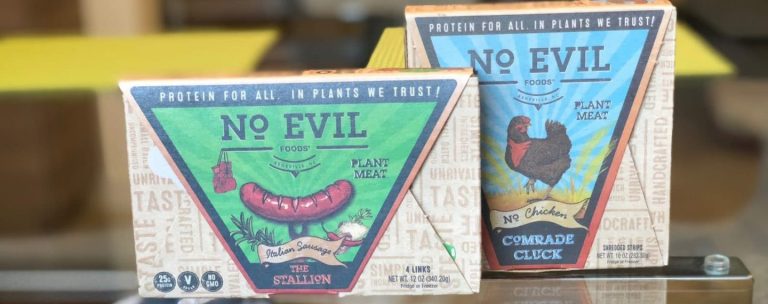
No Evil Foods created products like El Zapatista and Comrade Cluck, but workers say its conduct doesn’t live up to its leftist branding. No Evil Foods describes its mission as to “put more good into the world.” The North Carolina company started in 2014 when its owners and founders Mike Woliansky and Sadrah Schadel sold plant-based meat products out of a cooler at Asheville farmer's markets. Since then, the company sells products with left-wing names like Comrade Cluck (a mock chicken product), the Pardon (a Thanksgiving-season turkey substitute), and El Zapatista, vegan chorizo whose name is a nod to the revolutionary indigenous movement in southern Mexico.

The Generosity Of Agriculture

The generosity of agriculture and the potential for farmers, ranchers and all people to act in more selfless fashions can be found amongst the chaos of the times if one looks for it closely enough, said Zach Ducheneaux, Executive Director of the Intertribal Ag Council (IAC).  Ducheneaux, who works with his family on their fourth-generation ranch on the Cheyenne River Sioux Reservation in north central South Dakota, has experienced the challenges and successes of the current food system in this nation firsthand.  He took the time to tell an important story to help inspire more goodwill and problem solving in the wake of tumultuous times.  “Even in these times of uncertainty, collapsing markets and few signs of hope on the horizon – farmers, ranchers, some government officials, nonprofits and Tribal Nations are thinking of ways to serve others first,” Ducheneaux began.

Hundreds Of Apple Workers On Strike In Washington

Last week the COVID-related strike in Washington state’s Yakima Valley quadrupled in size, as workers walked out at three more apple packinghouses. More than a hundred stopped work on May 7 at Allan Brothers Fruit, a large apple growing, packing and shipping company in Naches, in Central Washington. On May 12 they were joined by 200 more workers, who walked off the job at the Jack Frost Fruit Co. in Yakima, and at the Matson Fruit Co. in Selah. The next day another 100 workers walked out at the Monson Fruit packing shed, also in Selah. At the center of the stoppages are two main demands for those who decide to continue working during the pandemic: safer working conditions and an extra $2 an hour in hazard pay.

Agroforestry Land Restoration Technique Improves Food Security In Honduras

Since 2012, the Inga Foundation’s revolutionary agroforestry system of Inga alley cropping in Honduras has dramatically transformed the lives of 300 subsistence farming families, planted over 3 million trees, and become a model for true environmental sustainability and ecological resilience. Damas and his family were following in the footsteps of 40 families that in 2012 planted half their land – less than a hectare in size – in Inga alleys and half using traditional cultivation methods.  Severe drought followed by torrential rains affected Central America that year, and the families feared their crops would die. The Inga Foundation model can be replicated, at scale, across the whole of the wet forest zone of Honduras and the rest of Central America and into South America.We have facilitated Inga alley replication in 15 countries with farmer/NGO/government groups by providing training.

Pandemic Used To Cover For Loosening Crop Poison Regulation

The Trump EPA wants to reapprove use of a dangerous herbicide. Trump appointees are hiding behind the COVID-19 pandemic to excuse a herbicide manufacturer from monitoring levels of the poison in Midwest lakes and streams. The EPA plans to raise the concentration of atrazine allowed in streams and lakes to 15 parts per billion. That is more than four times higher than what the EPA had recommended under the Obama administration. In April, Elissa Reaves, acting director of the herbicide re-evaluation division, suspended monitoring for the rest of the year. “The public will now have no idea whether dangerous levels of atrazine are reaching rivers and streams throughout the Midwest,” said Nathan Donley, a senior scientist with the Center for Biological Diversity. “That’s absurd and reckless.”

The Great Potato Giveaway

Auburn, Washington - When Tina Yates pulled her truck up to a mall in western Washington state on Thursday, workers waved her past hundreds of cars waiting to pick up free russet potatoes. “You get a VIP pass!” Yates, a bus driver in her 50s, said the workers hollered, as she loaded 1,800 pounds (816 kg) of potatoes into her gray Chevy Silverado, bound for the Salvation Army, local food banks and homes throughout western Washington. Giving away food is just one example of how people around the world are adjusting to the strain the coronavirus pandemic has put on supply chains, as restaurants, schools and hotels close. With unemployment soaring, demand from food banks is rising fast at the same time farmers have fewer outlets to sell their crops.

Farmworkers Are Walking Out To Protest Conditions During COVID-19 Pandemic

Yakima, Washington - Workers at Columbia Reach Pack and Hansen Fruit and Cold Storage Co. in Yakima walked out Thursday morning to protest their working conditions. They held signs asking employers for better COVID-19 safety measures, 6 feet of social distancing in the workplace, and protection from retaliation for protesting. They also want Columbia Reach to provide a hazard pay increase of $2 an hour. Thursday’s strikes are the sixth and seventh in Yakima County since Monday, with workers calling for paid sick leave, hazard pay, safer working conditions and protection from retaliation amid the COVID-19 pandemic. Since May 7, workers also have walked out of Frosty Packing and Roche Fruit in Yakima, Matson Fruit Co. and Monson Fruit Co. in Selah, and Allan Bros. in Naches

How Permaculture Can Build Resilience And Meet Basic Needs

Despite their urgency, coronavirus outbreaks, health crises and failing institutions are just some of the problems our global society is facing today. Billions of people worldwide still lack access to healthy food, clean water and sanitation services — being unable to properly wash hands and stay safe in the midst of a pandemic. And we are still trapped in an economic system that fuels environmental damage, from biodiversity loss to climate change, which is threatening the quality and sustainability of life on Earth. Now, more than ever, it is crucial that we rethink and redesign our modes of living and doing things in society. Permaculture, or “permanent culture” systems thinking, a set of ethical principles and DIY techniques, conceptualized by Australian scientist Bill Mollison, provides a way forward to address those issues.

The Uplifting Magic Of Mother’s Day In These Perilous Days

As Mother’s Day approaches, the celebration of our Mothers is overshadowed by the mounting Covid-19 casualties. Donald Trump is incapable and unwilling to provide the leadership needed to deal with the deadly pandemic attacking our communities. While we cannot afford to slow efforts to challenge the President and our Members of Congress, it is important to take a bit of time and reflect on what our parents, and in particular our mothers, have done and continue to do for their families. I describe this sentiment in the Ralph Nader and Family Cookbook about nutritious food and its relation to our upbringings. My mother and father and their four children – two girls and two boys – all ate the same food. There was peace and time for family discussions at the dinner table.

The Black Death Killed Feudalism. What Does COVID-19 Mean For Capitalism?

You pay little attention to the systems of your body — circulatory, digestive, pulmonary — unless something goes wrong. These automatic systems ordinarily go about their business, like unseen clockwork, while you think about a vexing problem at work, drink your morning cup of coffee, walk up and downstairs, and head out to your car to begin your morning commute. If you had to focus your attention on breathing, pushing blood through your veins, and metabolizing food, you’d have no time or energy to do anything else. The body abhors the micromanaging of the mind. The same applies to the world’s markets. They whir away in the background of your life, providing loans to your business, coffee beans to your nearby supermarket, labor to build your house, gas to fill your car.

The Struggle Against Neoliberalism Intensifies: Saving Our Postal Service And Workers

The wave of worker, student, and renter strikes is growing into a campaign for a general strike that begins on May 1 and continues at the first of each month from there. The government's response to the COVID-19 pandemic and economic collapse, a purely neoliberal money grab, has revealed that the only way we are going to survive and maintain social programs is by fighting for them. We speak with Mark Dimondstein, the president of the American Postal Workers Union, about Congress' failure to provide necessary funding for the US Postal Service as revenue has fallen by 50%. The USPS faces the real possibility of going bankrupt and the administration is openly saying it will let it fail in order to privatize it. We also speak with Joe Henry, political director of the League of United Latin American Citizens in Iowa, about the Meatless May campaign for meatpackers and against factory farming.

In Absence Of State Action, Organizers Help Homeless People During Pandemic

Prior to the COVID-19 pandemic, collectives sharing free food with the hungry were facing a sharp uptick in state repression. In Arizona, Tucson Police Park Safety warned the public that sharing food in public parks is illegal in a statement posted to Twitter on February 7. In response, the People’s Defense Initiative in Tucson started a petition and organized a rally at the City Hall on February 19 to “remind Tucson leadership that feeding the hungry is never a crime!” Free Hot Soup, a group that serves food to over a hundred people in a Portland, Oregon, park five nights a week, sued the city in November 2019 after it introduced a new “social service” law. The law creates new bureaucratic hurdles for solidarity services including food handling permits, insurance coverage, dumpsters, security, and restricts the services to once per week per park.

Groups Urge Mnuchin To Ban Large Agribusinesses From CARES Act Aid

Washington, DC — A coalition of 68 farmer, environmental, and antitrust groups across the country sent a letter to Treasury Secretary Steven T. Mnuchin today, urging the U.S. Department of the Treasury to ensure that pandemic relief funds do not lead to further consolidation of the food and agriculture industry. The letter urges Secretary Mnuchin to instead invest stimulus funds into farming systems that lift up farmers and rural communities while providing opportunities for diverse, sustainable agriculture systems to thrive. The letter argues that the current food system under the control of a few major corporate players is unsustainable — a reality that the coronavirus pandemic has laid bare. The Coronavirus Aid, Relief, and Economic Security (CARES) Act, signed into law late March, provides over $2 trillion in funds to help individuals and businesses weather the economic challenges stemming from the coronavirus pandemic.

How Industrial Food Makes Us More Vulnerable To COVID-19

When I finished working on my book, “Formerly Known As Food: How the Industrial Food System is Changing Our Minds, Bodies, and Culture,” in 2018 — after 10 years of research and writing — I was certain of two things: First, our industrial food system is decimating our environment. Second, our nutrient-depleted, and chemically saturated processed food supply is changing our bodies from the inside out. It was also clear how these two issues are deeply linked: What we do to our environment, we do to ourselves. What I didn’t know was that the COVID-19 pandemic was just around the corner and would bring global attention to the grave risks inherent in our industrial food system.
assetto corsa mods

Urgent End Of Year Fundraising Campaign

Online donations are back! Keep independent media alive. 

Due to the attacks on our fiscal sponsor, we were unable to raise funds online for nearly two years.  As the bills pile up, your help is needed now to cover the monthly costs of operating Popular Resistance.

Urgent End Of Year Fundraising Campaign

Online donations are back! 

Keep independent media alive. 

Due to the attacks on our fiscal sponsor, we were unable to raise funds online for nearly two years.  As the bills pile up, your help is needed now to cover the monthly costs of operating Popular Resistance.

Sign Up To Our Daily Digest

Independent media outlets are being suppressed and dropped by corporations like Google, Facebook and Twitter. Sign up for our daily email digest before it’s too late so you don’t miss the latest movement news.