Skip to content

Labor

Mass Public Sector Walk-Out In England

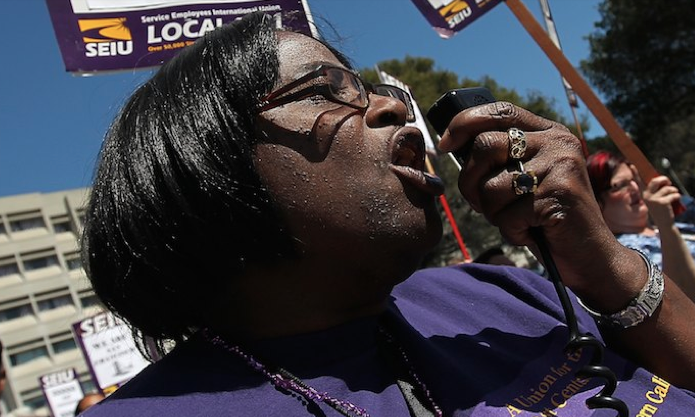
Tens of thousands of teachers are walking out of the classroom today in protest against pay, workload pressures and pension changes as the Coalition government downplays the extent of the strike. As many as one million public sector workers are staging industrial action, with health workers and civil servants joining teachers in a mass demonstration against austerity measures. The National Union of Teachers (NUT) says more than 20,000 teachers could take part, with nationwide rallies and pickets planned for towns and cities ranging from Cambridge, Leicester, Swansea, Torquay and the Isle of Wight. The strike has been condemned by the Department of Education (DfE) as disrupting to pupils’ education and harming the reputation of the teaching profession, while the government said that it actually expects most schools to open their doors. A Cabinet Office spokesman said: “The vast majority of dedicated public sector workers did not vote for today's action, and early indications are that most are turning up for work as usual.

Cameron Plans Strike Crackdown On 1 Million Public Workers

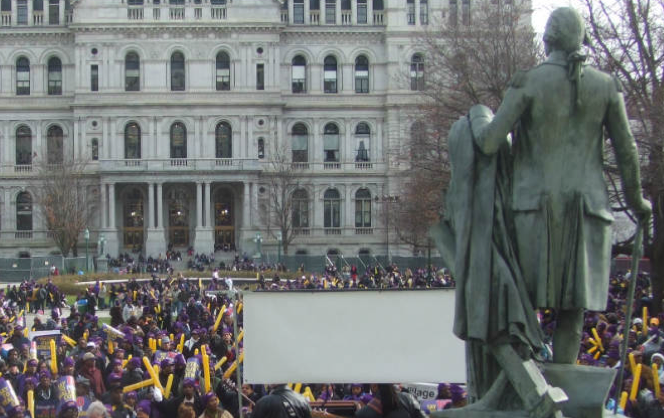
David Cameron has been accused by union leaders of being a "Bullingdon bully" after he vowed that the Conservative election manifesto would tighten the screw on strike laws in response to what he regards as Thursday's illegitimate mass walkout of up to 1 million public-sector workers. Cameron attacked the low turnout thresholds in union strike ballots and challenged the validity of mandates to take industrial action derived from ballots conducted more than a year ago in some cases. The prime minister said: "I think the time has come for setting a threshold. It is time to legislate and it will be in the Conservative manifesto." In a sign of how the political battle may unfold, the education secretary, Michael Gove, will accuse the teaching unions of not standing up for education but for their pay and pensions. On Newsnight on Thursday, Gove said teachers who were joining the strike were a minority.

The Limitations And Possibilities Of Student-Labor Coalitions

In April, New York University found itself the subject of uncomfortable scrutiny when Michael Powell reported in the New York Times that Daniel E. Straus, owner of the HealthBridge and CareOne nursing home companies in New Jersey and Connecticut and a board member at NYU law school, had subpoenaed the emails, text messages and personal writings of two NYU law students, Luke Herrine and Leo Gertner. The two were part of a growing movement of NYU undergraduates and law students calling attention to working conditions at Straus's facilities, and they had been helping to circulate a petition to the law school dean asking for a meeting to discuss Straus's presence on the board. The next day, with somewhat less fanfare, a one-line memo was sent to NYU law students by their dean, informing them that Straus would no longer be on the school's board. The Straus Institute for the Advanced Study of Law and Justice, which Straus has funded since 2009, will close at the end of the year. (Although the timeline of the closure decision is unclear, Herrine, one of the subpoenaed students, believes it was due to the controversy.)

Union Election At Mississippi Nissan Plant

The June 27 pro-union rally by an estimated 400 students, activists, ministers and workers in front of the mile-long Nissan plant here was the perfect culmination of the Mississippi Freedom Summer 50th Anniversary Conference in nearby Jackson. College students from as far away as New York and Missouri joined with students from historically black schools in the area such as Jackson State University and Tougaloo College to demand that Nissan allow a fair election for the thousands of workers in Canton to decide if they want to join the United Auto Workers. At the event were legendary civil and labor rights activists like Bob Zellner, still working in the trenches today in Wilson, N.C., prominent actor Danny Glover, veteran labor organizers Bruce Raynor and Richard Bensinger, labor priest Fr. Jeremy Tobin, political strategist Marshall Ganz, and many more. Of course, the students were central to the event, chanting "Ain't No Power But The Power Of The People!" and joining Glover in delivering a petition to company security officers at the front gate that declared: "Labor rights are civil rights."

Inspiration In The History Of Public Worker Strikes

Politicians want to turn the clock back 50 years by restricting the bargaining rights of millions of public workers. Unions would do well to look back, too, to the great public employee strike upsurge of the 1960s. Today’s unions, in both the public and private sectors, have a lot to learn from this little-discussed period in labor history. Here are seven lessons: Strikes Worked. Entering the 1960s, public employee unions were weak, engaging in “collective begging” rather than “collective bargaining.” But then public workers rose up in one of the great upsurges in U.S. labor history. Public workers marched on school board meetings. They conducted slowdowns. And they struck, by hundreds of thousands over the next two decades, to win union recognition. The civil rights movement inspired sanitation workers’ strikes throughout the South. Teachers in Florida and Utah pulled off statewide walkouts.

Cops Call In Sick In ‘Blue Flu’ Protest

More than 13 percent of the officers in the Memphis Police Department have called in sick since June 30, the so-called Blue Flu that officials acknowledged Sunday was a deliberate work action. A total of 308 Memphis officers have called in sick over the last week, MPD Director Toney Armstrong said in a Sunday afternoon press conference outside City Hall. That's 13.5 percent of the estimated 2,280 officers in the department. That's also a big jump from the 181 who had called in sick through Saturday, a number that led MPD to ask the Shelby County Sheriff's Department for help. About 50 deputies and reserve officers helped patrol Downtown Saturday night, and at least eight more were on loan Sunday. The job action, which does not appear to have spread to the city's fire department, comes in protest to a recent City Council vote that will reduce health care subsidies for current and retired city employees to redirect that money to the city's troubled pension fund.

Thousands Rally Across Australia

Thousands of people have attended rallies across Australia to protest the Abbott Government's first budget. Large Bust the Budget protests were held in Sydney, Melbourne, Canberra, Brisbane, Perth, Adelaide and Darwin. Smaller rallies took place in regional areas including Lismore in New South Wales, and Wodonga in Victoria. Union groups including the Australian Council of Trade Unions (ACTU) marched at the protests. ACTU secretary Dave Oliver says a wide range of people, including families, students, retirees and pensioners, were marching to send a strong message to the Government. "This budget is going to hit the most vulnerable in our society," he said. "What this budget is doing is sending our country down the same path to where the United States is today ... they have a country that is divided by a nation of haves and have-nots."

Bookstore Fires Employees For Union Vote, Then Rehires Them

The owners of a bookstore in New York City’s Upper West Side announced Thursday that they have re-hired four employees, days after they were controversially fired following their votes in a union election. According to a post on Book Culture’s website, store owners Chris Doeblin and Annie Hedrick stated that they “have re-hired all four store managers who were terminated last week,” adding that “there is no longer a labor dispute.” The announcement marks the end of a turbulent week for the bookstore, which operates two locations near Columbia University. The employees’ terminations followed a vote by workers at Book Culture to join the Retail, Wholesale, and Department Store Union. Only two of the bookstore’s employees voted not to unionize, but the day after the vote, several of them were abruptly let go, as The Huffington Post reported. A company-wide email from Doeblin confirmed that the employees were fired because of their union votes: “It was indicated to me … that two people in our management group voted in the union and effectively undermined the interests of the store. The store always being in opposition to the Union. Unfortunately there is no other recourse but to remove these people from our employ effective immediately.”

Parecon: Envisioning A Life Beyond Capitalism

ROAR: In spite of having been around for eight years, I’m sure that there are still a number of our readers who are unfamiliar with your idea of ‘participatory economics’, or ‘parecon’, in short. Could you provide us with a brief introduction to this concept? Michael Albert: It is hard to be too brief trying to explain to someone totally unfamiliar with it, but I will try. Also, I wouldn’t call parecon my idea because it can convey a wrong impression. And this is not just because the initial presentations were by myself and also Robin Hahnel, and it is not just because since then, many others have taken up the effort. Even more relevant, parecon’s features owe to a long history of intellectual and activist efforts trying to advance human well-being in economic settings, including critiquing some past efforts for example, in the Soviet Union, and working hard on new ones. That said, parecon is a proposal or vision for how to accomplish economic functions consistent with classlessness, self-management, solidarity, equity, diversity, and ecological good sense. Parecon is not, however, a blueprint, but is rather a formulation of some critical attributes a few key aspects of economics need to have if we are to accomplish desirable aims.

Police, Fire Employees Protest Benefit Cuts

Dozens of Memphis police and fire employees and their families and friends gathered in a protest outside Memphis City Hall Tuesday against what they said were unfair cuts to their benefits. Tents, placards, and huge signs could be found in front of City Hall Tuesday. So could a swarm of public safety supporters milling around in the heat on foot or in camp chairs. The atmosphere was even festive despite the hard facts that brought the group together and despite the handful of police cruisers parked across Civic Plaza watching the crowd. Many in the crowd wore shirts that read: “MPD, MFD - Negatively Affected.” Placards read: “”Stop Fraud” and “We Risk Our Lives, You Take Away Our Livelihoods.” One sign stuck in the ground had photos of Memphis Mayor A C Wharton, key members of his administration, and several city council members (who had voted for a budget that included cuts to employee health care benefits) that read: “Shame On You!” Those cuts mean more money will have to come from the pockets of city employees and many retired employees to pay their health insurance premiums and more.

Supreme Court Backs Koch-Funded Anti-Union Case

In a 5-to-4 decision today, the U.S. Supreme Court ruled that Illinois home care workers who benefit from higher wages and better working conditions that their union negotiated for—but who choose not to join—do not have to pay their fair share of the cost of the union’s bargaining for and representation of all workers. Text STRENGTH to 235246 to fight back against these attacks on working families. The suit was filed in 2010 by the National Right to Work Legal Defense Foundation, an extreme anti-worker group whose funders include billionaires like the Charles Koch Charitable Foundation and the Walton Family [of Walmart] Foundation. But the suit was dismissed first by a federal district court and then again on appeal by the 7th U.S. Circuit Court of Appeals. The Supreme Court agreed to hear it in October. Said AFL-CIO President Richard Trumka: The extreme views of today’s Supreme Court aimed at home care workers aren’t just bad for unions—they’re bad for all workers and the middle class. But the attacks on the freedom of workers to come together are nothing new. They are part of an onslaught from anti-worker organizations hostile to raising wages or improving benefits for millions of people. These attacks are a direct cause of an economy in which middle-class families can’t get a break because their wages have stagnated and their incomes have declined.

Supreme Court Creates Impossible Standard For Unions To Meet

The Supreme Court on Monday issued a wide-ranging opinion that will heavily impact the future of labor in America. The majority opinion in Harris v. Quinn held that home healthcare workers in Illinois and every other state that has a similar program are only “partial” or “quasi” public employees—as opposed to “full-fledged public employees”—and thus don't have to pay fees for labor representation. While the majority, led by Justice Samuel Alito, did not go so far as to fully gut the ability of public sector unions to finance their existence, the decision in the case was by no means a moderate one. Harris v. Quinn has set the stage for the eventual overruling of Abood; it has confused and perverted the concept of free-riders; and it has created an impossible standard for unions to meet. Monday's 5-4 ruling goes against decades of Supreme Court precedent allowing fair-share provisions, starting with the seminal case of Abood v. Detroit Board of Education in 1977. (Fair share provisions require workers who choose not to join the union to pay a portion of the dues that is spent in representing them, thereby not allowing them to become free-riders.) The majority’s treatment of the balance created by Abood is problematic on several grounds.

Bread And Roses A Hundred Years On

One hundred years ago, in the dead of a Massachusetts winter, the great 1912 Lawrence Textile Strike—commonly referred to as the “Bread and Roses” strike—began. Accounts differ as to whether a woman striker actually held a sign that read “We Want Bread and We Want Roses, Too.” No matter. It’s a wonderful phrase, as appropriate for the Lawrence strikers as for any group at any time: the notion that, in addition to the necessities for survival, people should have “a sharing of life’s glories,” as James Oppenheim put it in his poem “Bread and Roses.” Though 100 years have passed, the Lawrence strike resonates as one of the most important in the history of the United States. Like many labor conflicts of the 19th and early 20th centuries, the strike was marked by obscene disparities in wealth and power, open collusion between the state and business owners, large scale violence against unarmed strikers, and great ingenuity and solidarity on the part of workers. In important ways, though, the strike was also unique. It was the first large-scale industrial strike, the overwhelming majority of the strikers were immigrants, most were women and children, and the strike was guided in large part by the revolutionary strategy and vision of the Industrial Workers of the World (IWW).

As Good As It Gets? Hard Lessons From NYC Contracts

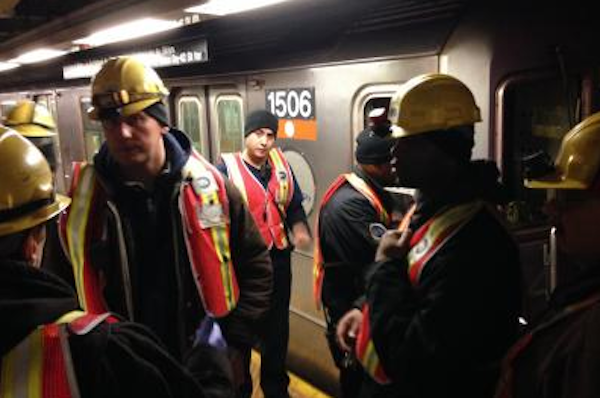
New York City teachers and transit workers just ratified contracts that will define what’s possible for the 250,000 city workers still in negotiations. The deals show how little juice is left for public sector unions trying to deliver using traditional tools at the bargaining table or in the political arena. If these are the limits in a union stronghold like New York—where one in four workers is a union member and 70 percent of the public sector is organized—the news isn’t good for conventional strategies elsewhere. What can be done better? To avoid a collision course with taxpayers, public sector unions need to upend the bipartisan consensus and put raising taxes back on the table. To achieve that, they’ll have to make an aggressive case to voters that strong public services, and the workers who provide them, are worth it—and that corporations and the super-rich should pay the tab. They’ll also have to challenge politicians, especially Democrats, who’ve made their peace with austerity.

MA Teachers Go Radical In Fight For Public Ed

EduShyster: I’ve heard you described as *bellicose,* *unapologetically adversarial,* a *firebrand,* and *alarming.* Which of these would you say best describes you? Barbara Madeloni: Aren’t you forgetting *shrill*? One of the narratives about my victory is that I accessed anger at the rank-and-file level. That’s true, but I also tried to hold up a more positive vision for re-engaging the world. We’re not helpless. We’re not hopeless. We can work together to change things. We can do something. That said, I think we are at a critical moment in history for public education in this country. If we don’t fight, we’re going to lose everything. We’re done. EduShyster: That’s what a lot of people have been saying about teachers unions in the wake of the recent Vergara decision in California—that they’re done. You don’t appear to have gotten that memo. Madeloni: This is a critical moment in our history and we have to protect public education or we’re going to lose it.
assetto corsa mods

Urgent End Of Year Fundraising Campaign

Online donations are back! Keep independent media alive. 

Due to the attacks on our fiscal sponsor, we were unable to raise funds online for nearly two years.  As the bills pile up, your help is needed now to cover the monthly costs of operating Popular Resistance.

Urgent End Of Year Fundraising Campaign

Online donations are back! 

Keep independent media alive. 

Due to the attacks on our fiscal sponsor, we were unable to raise funds online for nearly two years.  As the bills pile up, your help is needed now to cover the monthly costs of operating Popular Resistance.

Sign Up To Our Daily Digest

Independent media outlets are being suppressed and dropped by corporations like Google, Facebook and Twitter. Sign up for our daily email digest before it’s too late so you don’t miss the latest movement news.