Skip to content

SCOTUS

SCOTUS Enters New Term: These Cases May Grant Trump Unbridled Authority

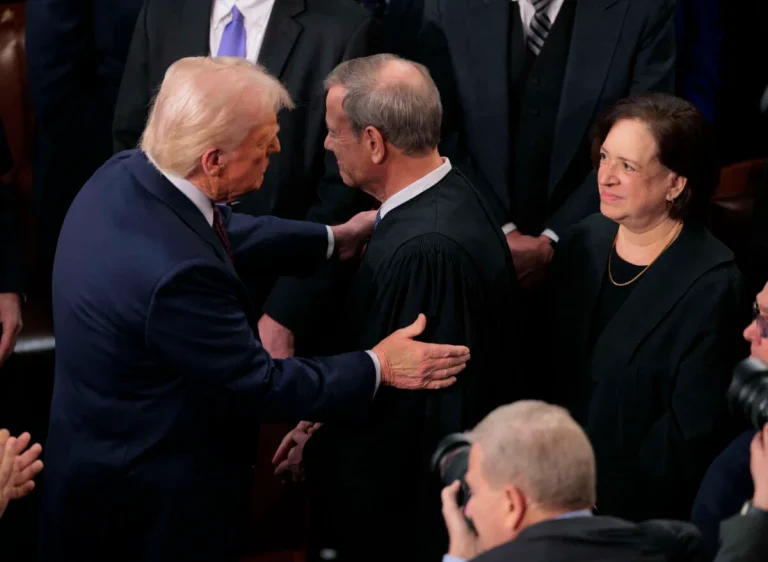
The Supreme Court’s new term, which began last week, presents the court with a monumental opportunity to hand Donald Trump unbridled executive authority and eviscerate the separation of powers enshrined in the Constitution. The court appears poised to rubber stamp many of Trump’s worst abuses, from the imposition of massive tariffs to seizing control of federal agencies created by Congress. Although there are 39 cases on the court’s regular docket, it has already handled nearly 30 cases with temporary unsigned orders on its “emergency docket.” In those cases, the high court granted Trump’s requests to block orders from lower courts 20 times and ruled against his administration in only three cases; the others led to mixed rulings.
Critics Decry Scotus Ruling Upholding Ban On Gender-Affirming Care

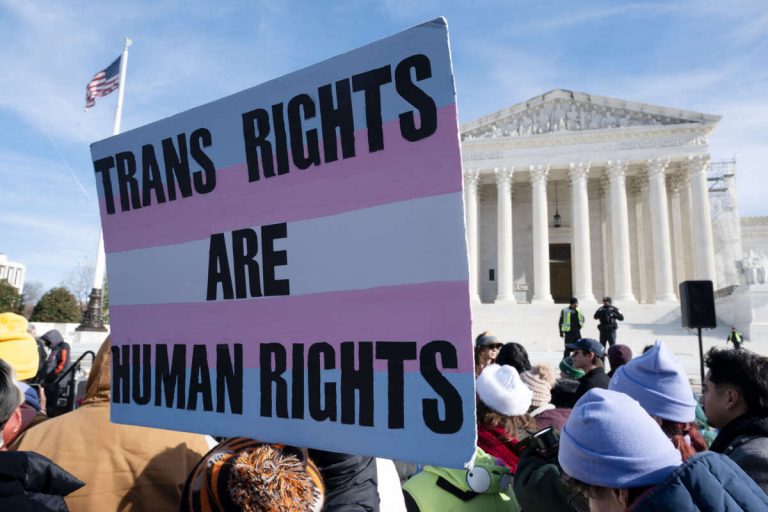
On Wednesday, the United States Supreme Court ruled to uphold a Tennessee law that bans physicians from providing gender-affirming care to transgender children, a decision that will likely reverberate across the more than two dozen states that have similar bans. Critics decried the decision as denying trans kids access to safe and critical health care options. Gender-affirming care, including for youth, is endorsed by the vast majority of respected health organizations, and is considered to be life-saving by many who receive it. All six conservative justices on the high court sided with Tennessee lawmakers, who argued that their ban should be allowed to operate.

Seven Supreme Court Cases That Black Americans Should Track This Summer

From voting rights to health care to workplace equality, the U.S. Supreme Court will weigh in on a number of issues this summer that could have major implications for Black Americans. “In America, for Black people, we’ve had a long season where our rights were generally respected,” said Andrea Young, executive director of the ACLU, who has been closely following the Trump administration’s legal moves. “We have Black elected officials … Black leaders in corporate America, we have extreme poverty, but we also have thriving middle class communities. We have many areas where we have lots of highly educated black people. All of those things rest on a legal framework that allows those rights to be protected.”

Ruling On Homelessness Raises Risks For Domestic Violence Survivors

In a 6-3 decision, the Supreme Court has ruled in the case of Grants Pass, Oregon v. Gloria Johnson, to uphold a law enacted by a small Oregon town that bars those experiencing homelessness from using blankets, pillows and cardboard boxes while sleeping outdoors within city limits. Those who are found doing so can impose fines for camping in public on first-time offenders and up to 30 days of jail time for repeat offenders. It’s a case that has major implications for survivors of domestic violence, experts say. Lawyers for the plaintiffs in this case have argued that barring camping on public property effectively criminalizes people for being unhoused.

The Supreme Court And The Sackler Bankruptcy Settlement

Allen Frances, M.D., distinguished former chair of psychiatry at Duke University school of medicine wrote in a Oct., 2017 New Yorker magazine expose, “Their name (Sackler/Purdue Pharma) has been pushed forward as the epitome of good works and of the fruits of the capitalist system. But, when it comes down to it, they’ve earned this fortune at the expense of millions of people who are addicted. It’s shocking how they have gotten away with it.” Long overdue, the Sacklers and Big Pharma are finally starting to pay for the opioid crisis. In a recent 5-4 decision, the U.S. Supreme Court rejected Purdue Pharma’s controversial bankruptcy settlement that protected the billionaire Sackler family from further liability for the opioid epidemic in the USA.

SCOTUS Overturns ‘Chevron’ Deference, Massive Transfer Of Power To Courts

The Supreme Court ruled along ideological lines on Friday to overturn a 40-year-old doctrine known as Chevron deference in a seismic decision that could see a major erosion of federal administrative rule in issues of public health, labor rights, environmental protection, food safety, and more. The Court ruled 6 to 3 in a pair of decisions that hands a massive amount of control over federal regulatory powers to the courts, overturning the doctrine that allowed federal agencies to have interpretive authority when there was any ambiguity in a law. Chevron deference allowed experts at federal agencies — as people better situated to make decisions on issues within their regulatory purview — to interpret statutes rather than judges.

Anti-BDS Law Remains In Effect Because SCOTUS Refused To Review It

While the far right Israeli regime escalates its repression of Palestinians, the U.S. Supreme Court has refused to disturb an Arkansas law that requires government contractors to certify they are not boycotting Israel or “Israeli-controlled territories.” The high court didn’t specifically uphold Arkansas’s anti-boycott law. However, the court declined to review the case because there were not four “justices” who agreed to hear it. So Arkansas’s anti-Boycott, Divestment, Sanctions (BDS) law remains in effect. The BDS movement was launched in 2005, when 170 Palestinian civil society organizations called for boycott, divestment and sanctions — “non-violent punitive measures” — to last until Israel fully complies with international law.

SCOTUS Upholds Oklahoma’s McGirt Decision: Governor And Big Oil Lose

On Monday, November 29, anti-Indigenous Oklahoma Governor Kevin Stitt’s futile attempts to undermine and destroy tribal sovereignty through legal avenues ended for good when the US Supreme Court refused his request to reexamine their 2020 McGirt ruling. That decision declared that Oklahoma rightfully remains Indian Territory for criminal jurisdiction, and ever since, Governor Kevin Stitt and his pro-oil “Commission on Cooperative Sovereignty” have fought desperately to overturn it in every legal space available. Chaired by Devon Energy CEO’s Larry Nichols, the commission also includes Continental Resources’ Harold Hamm, pipeline giant Williams Companies’ Alan Armstrong, as well as a litany of fossil fuel industry lobbyists and executives dead set on destroying Oklahoma’s land, air, and water.

Roe V. Wade In Grave Danger

A draconian Texas law banning abortions beyond around six weeks of pregnancy took effect at midnight after the conservative U.S. Supreme Court did not act to block it on Tuesday, a decision that could have major implications for reproductive rights across the country. While the Supreme Court could still grant an emergency request to suspend the law in the coming hours, the justices' decision to remain silent Tuesday allows Texas to begin implementing what rights groups have characterized as the most restrictive state-level abortion ban since the 1973 Roe v. Wade decision. Abortion providers estimate that the measure could bar care for "at least 85% of Texas abortion patients."

Supreme Court Mercury Decision Threatens Public Health

By Mary Anne Hitt in Sierra Club - Today's ruling by the U.S. Supreme Court to send the Mercury and Air Toxics Standard (MATS) back to the EPA for further proceedings is a decision that endangers public health, but it won't revive the fortunes of Big Coal. These standards were designed to safeguard local communities against dangerous pollution from power plants. Unfortunately, today millions of Americans won't yet be able to breathe more easily. Practically speaking, today's decision won't revive the fortunes of Big Coal or slow down our nation's transition to clean energy. Most utilities have long since made decisions about how to meet the standard, since the compliance deadline was April 2015. Only a few dozen coal plants are still operating today with no pollution controls for mercury and air toxics and no clear plans to install them.

Reprieve In Texas, Assault On Reproductive Rights Continues

By John Queally in Common Dreams - Advocates for reproductive rights welcomed the ruling of the U.S. Supreme Court on Monday which put a block on a Texas law that would have shuttered nearly every abortion clinic in the state. In a 5-4 decision (pdf), the ruling came in the form of a stay that will delay enforcement of the law—originally passed in the Texas legislature as H.B. 2 and signed into law in 2013—until a full challenge is taken up by the court. The stay, in effect, suspends a ruling from the U.S. Court of Appeals for the Fifth Circuit earlier this month which upheld specific provisions of the law that would have likely resulted in the closure of all but nine abortion clinics in the state.

Historic Gay Pride Parades Follow Supreme Court Ruling

Hundreds of thousands of people on Sunday packed gay pride events from Chicago to New York City, Seattle to San Francisco, with overall attendance expected in the millions for what amounted to a celebration of a freshly endorsed right to marry. In San Francisco, a parade that at times resembled a rainbow-colored dance party snaked through downtown. Cheerleaders, dancers and proud families of lesbians and gays swooped up Market Street as spectators flocked 10 to 15 people deep along both sides. There were "Hooray for Gay" and "Love Won" signs. There were rainbow flags and knee socks, umbrellas and tutus. SF Pride Board President Gary Virginia said the exuberance was amplified given last week's U.S. Supreme Court ruling that same-sex couples can wed in all 50 states. Still, he said more needs to be done in housing and job discrimination in the United States and for lesbian, gay, bisexual and transgender people around the world.

Court Ruling On Marriage Equality Shocking, Especially To US LGBT

By Glenn Greenwald in The Intercept - In the 1970s — just 40 years ago — the existence of gay people was all but unmentionable, particularly outside of small enclaves in New York, Los Angeles and San Francisco. If your first inkling of a gay identity took place in that decade, as mine did, you necessarily assumed that you were alone, that you were plagued with some sort of rare, aberrational disease, since there was no way even to know gayness existed except from the most malicious and casual mockery of it. It simply wasn’t meaningfully discussed: anywhere. It was so unmentionable that Liberace, of all people, long insisted to his fans that he was a “bachelor” due to his inability to recover from his tragic break-up with his fianceé, the Norwegian figure skater Sonja Henie.

Why I Disrupted SCOTUS, Risked 150 Day Imprisonment

As I sat quietly in the back corner of the lofty courtroom, attempting to casually observe the ornate sculptures that rimmed the chamber's high ceilings, I fingered the little scrap of yellow paper folded in my pocket. My lifeline. I moved my hand as naturally as possible to rest on my lap. I glanced at the two security personnel stationed in the central aisle, not letting my gaze rest on either for longer than what I hoped would be perceived as benign curiosity. They looked like secret service agents: white, 40ish, dressed in black suits and equipped with transparent coiled ear pieces. I focused on physical sensations, how it felt to breathe and sit and wait. It was just after 10 am when the Supreme Court justices entered the chamber through a door behind the bench and were introduced with various ecclesiastical slogans, ending with "God save the United States and this honorable court!" Our cue.

Supreme Court Has Become The Corporate Court, Not For People

A Reuters examination of nine years of cases shows that 66 of the 17,000 lawyers who petitioned the Supreme Court succeeded at getting their clients’ appeals heard at a remarkable rate. Their appeals were at least six times more likely to be accepted by the court than were all others filed by private lawyers during that period. They are the elite of the elite: Although they account for far less than 1 percent of lawyers who filed appeals to the Supreme Court, these attorneys were involved in 43 percent of the cases the high court chose to decide from 2004 through 2012. The Reuters examination of the Supreme Court’s docket, the most comprehensive ever, suggests that the justices essentially have added a new criterion to whether the court takes an appeal – one that goes beyond the merits of a case and extends to the merits of the lawyer who is bringing it. The results: a decided advantage for corporate America, and a growing insularity at the court.
assetto corsa mods

Urgent End Of Year Fundraising Campaign

Online donations are back! Keep independent media alive. 

Due to the attacks on our fiscal sponsor, we were unable to raise funds online for nearly two years.  As the bills pile up, your help is needed now to cover the monthly costs of operating Popular Resistance.

Urgent End Of Year Fundraising Campaign

Online donations are back! 

Keep independent media alive. 

Due to the attacks on our fiscal sponsor, we were unable to raise funds online for nearly two years.  As the bills pile up, your help is needed now to cover the monthly costs of operating Popular Resistance.

Sign Up To Our Daily Digest

Independent media outlets are being suppressed and dropped by corporations like Google, Facebook and Twitter. Sign up for our daily email digest before it’s too late so you don’t miss the latest movement news.