Skip to content

Social Media

Dominion CEO Worried About Grassroots Social Media Organizing

By Glen Boshart in We Are Cove Point - Farrell experienced firsthand the power of social media when Dominion’s Cove Point LNG export project came under heavy fire by activists, who also protested the project in person at FERC by repeatedly disrupting that agency’s meetings. The executive acknowledged that the power industry has not always been “on the cutting edge” with respect to using social media tools, but added, “we’re going to have to learn how to do it and we’re going to have to learn how to respond.” Farrell said that ability to respond has become even more important with the emergence of a new coalition of opponents. He noted that opponents of new projects in the past tended to be mostly people who did not want a project to involve the use of their property. This new coalition, however, includes these people teaming up with environmental groups that want no fossil fuel use at all, as well as Tea Party conservatives who oppose government intrusion on principle, Farrell said.

How To Deal When Protests Disrupt Your Day

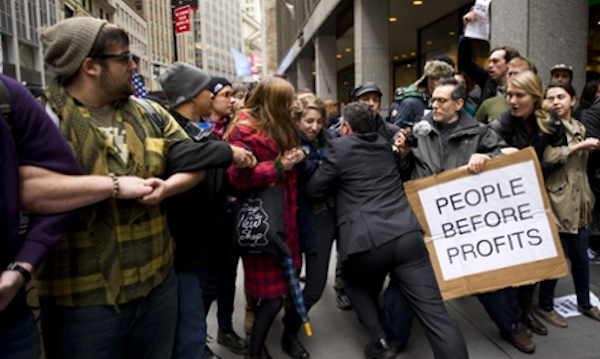
Your "normal" may consist of a commute or a meal, activities ranging from acceptable to pleasant, so the disruption of that routine annoys you. But the protest happens because someone else's "normal" is intolerable. It consists of routine injustice, exploitation, and even violence – sometimes lethal violence. For these people's "normal," disruption is a vital exercise. By and large, people only take to the streets reluctantly, after a situation has become so fraught that it compels them to protest. In hundreds of encampments across the country in 2011-2012 could be found debt-overburdened people chucked into a painful, hopeless economy by a bailed-out billionaire financial class.

‘Cease And Censor’ In Turkey’s War On Social Media

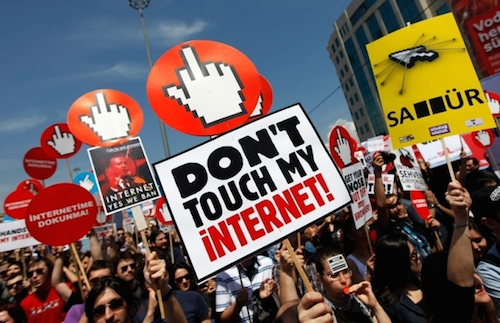
The Turkish government is no longer blocking the likes of Twitter thus keeping a façade of freedom, but it blazes the trail in a new type of censorship regime. I call it “cease and censor.” The worst part is that Twitter seems to be helping it by implementing its “country-withheld content” policy. First employed in 2012 to block neo-Nazi accounts in Germany, the policy complies with the concerned country’s local laws and blocks a tweet or an account only in that country when faced with a legal order. This is understandable in cases of hate speech or criminal offenses, but the policy becomes awfully problematic when it interferes with freedom of expression and is applied according to local laws that are designed to censor freedom of expression at all costs, such as Turkey’s internet law. Facebook also complies with the Turkish government’s requests to block and censor political content. @Madigudisi in Twitter and Ötekilerin Postası (The Other’s Post) on Facebook are two victims of this new censorship regime. I talked to them to learn their stories and to better understand how this new regime of censorship works.

German Cops Kettle Demo & Confiscate Smart Phones

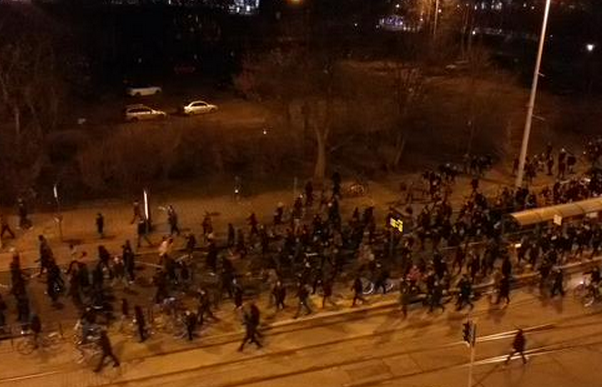
On Thursday, about 1200 people demonstrated in Leipzig for Khaled Idris Bahray, an Eritrean refugee who was seemingly murdered by neo nazis after a Pegida demonstration. The Dresden police have been implicated in a cover up of his murder, and will soon be under investigation as a result of a complaint filed by a Green MP. During the demonstration, there were some clashes between demonstrators and police, and eventually a smaller portion of the protest was kettled. Police let the protestors go, but not before collecting all of their cell phones. This was seemingly illegal, and police have yet to explain their actions. The clear motive for this is surveillance.

The Role Of Twitter In The Movement

To understand how Ferguson and the stories around it captivated the mainstream media, it's essential to understand Black Twitter. "Black Twitter" is the somewhat controversial shorthand for the conversations that happen among African-Americans on Twitter. African-Americans use the social network in greater numbers than members of any other racial group, and have earned a reputation for steering Twitter's trending topics. In a 2014 piece explaining the phenomenon, the Washington Post's Soraya Nadia McDonald called Black Twitter "a virtual community ready to hashtag a response to cultural issues." In some cases this means sharing inside jokes that send African-American cultural references viral. In others, like this one, it means uniting as a potent force to force issues of race and racism to the top of the national agenda.

Peabody Coal Fakes Social Media Campaign To Pressure G20 Leaders

Earlier this year US coal giant Peabody Energy launched a social media campaign to promote coal as an “advanced energy” that will solve energy poverty in the developing world. Called Advanced Energy for Life, the campaign was launched in February, 2014 and now has, according to the company “prompted500,000 people to lobby G20 leaders on the issue of energy poverty”. This refers to its approximately 430,000 Facebook Likes and 124,000 Twitter followers. However, this campaign support has been faked. Scratch the surface and you see its accounts added hundreds of thousands of Facebook supporters and Twitter followers in a few months, with minimal engagement on either platform or promotion of its campaign.

Tweeting About A Revolution

Social media thrives on divisive, polarising points of view, and that's not happening with OCLP. "The most mentioned topics of Occupy Central include 'Hong Kong', 'Hong Kong Police', 'OccupyCentral protests' and others in a similar vain," Alobeid says. "The crux of their movement, occupying with 'love and peace' was not one of the most discussed topics." Although Twitter is painted as being critical to a conversation, successful campaigns usually show activity on multiple platforms. Facebook is the obvious second choice, but without hashtags and handles, it can be harder to navigate than Twitter for those after information on a single issue. However, this network of 1.2 billion people can help create far-reaching discussion. Just look at the summer #IceBucketChallenge craze.

#FergusonFridays: White Anti-Racism, Social Media, & Self-Serving Allying

One of the most insidious privileges accessible to whites in a white supremacist culture is that claiming anti-racism regularly functions in the service of self-promotion and, in fact, anti-racism can translate into status for whites. Under no circumstance would this be okay, but when state sanctioned violence directed at Black lives is epidemic, this pattern amplifies injustice. We live in a society that is structured by white supremacy, post-racial and colorblind rhetoric, alongside policies that promote a de-politicized version of multiculturalism. In a time characterized by these cultural contradictions, anti-racist whites are celebrated as evidence of progress.

#BlackTwitter, The New CNN

#BlackTwitter has always been that special place in the Twitterverse where African Americans have congregated to discuss issues germane to the black experience, but recent events in Ferguson, Mo., have solidified it as something more: a vital 24-hour news source. After unarmed 18-year-olf Michael Brown was shot dead by Ferguson Police Officer Darren Wilson on Aug. 9, national media began to parachute in to the St. Louis suburb. Right behind them (or some would argue ahead of them), black bloggers and activists were online, critiquing the stories and tweets of reporters on the ground for cultural accuracy. In any story involving a black young person killed by a white one, the subject of race tends to lead the narrative. Many critics believed from the onset that media coverage of the unrest--esepcially the looting that followed--unfairly described the residents' grievances. Nikole Hannah-Jones at ESSENCE wrote that initial coverage of the rioting overshawdowed the fact that a teenager's life was taken. "As a journalist, I get it," she wrote. "The images of the rioting were gripping. But coverage of the riots should not overshadow the cause of the riots. The real story has taken a backseat to the sensational.

University Fires Professor After Gaza Massacre Tweets

Steven Salaita was fired from his position as associate professor in the American Indian Studies program at the University of Illinois at Urbana-Champaign (UIUC) apparently over views critical of Israel, especially its current massacre in Gaza. Meanwhile, Cary Nelson, former president of the American Association of University Professors (AAUP), who has publicly supported the university’s decision to remove Salaita, gave frank comments to The Electronic Intifada revealing the extent of his own pro-Israel views. Nelson acknowledged that he had been monitoring Salaita’s social media use for months. This indicates Salaita may be the victim of a retaliation campaign. Salaita is the author of Israel’s Dead Soul and The Uncultured Wars, Arabs, Muslims and the Poverty of Liberal Thought, as well as a contributor to a number of publications including Salon and The Electronic Intifada. He was a prominent campaigner for the American Studies Association’s decision to boycott Israeli academic institutions last December. In May, Salaita wrote a post for The Electronic Intifada called “How to practice BDS in academe.”

Israeli War Room Spreads Propaganda On Social Media

Students at the IDC Herzliya “war room,” seen here in a screenshot, focus on posting propaganda justifying Israel’s attack on Gaza on Facebook. As the death toll from Israel’s savage bombardment of Gaza continues to climb, Israel has once again turned to students to sell the slaughter online. “Although they haven’t been called up to the army yet, they’ve decided to enlist in a civilian mission that is no less important – Israeli propaganda [hasbara],” Ynet’s Hebrew edition reported about a massive initiative organized by the Israeli student union branch at theInterdisciplinary Center Herzliya (IDC Herzliya), a prestigious private university. Hasbara war room “Hasbara,” literally “explaining,” is the term used in Israel for government propaganda aimed at overseas audiences. “The goal is to deliver a very clear message to people abroad – Israel has the right to defend itself,” Lidor Bar David told Ynet. Bar David, a student, and one of the organizers of the “war room,” adds, “We want people abroad who don’t know our reality to understand exactly what is going on here.”

Use Your Social Media Accounts To Stop Wars

A student of history will say that television brought the Vietnam War into America’s living room. The nightly barrage of images of the dead and maimed was a major contributor to the anti-war movement. It was the first war that saw non-government correspondents in a war zone equipped with video cameras, and it was the first time the United States government saw major opposition to a war effort. The measure by which social media is impacting propaganda efforts by the government is exponentially greater than television. At the moment, the internet is largely uncontrolled and unregulated. Images directly from the front lines are instantaneously available on your laptop, tablet, and phone. Those images of brutality and love, death and triumph, victory and defeat, are images that could have never been viewed a generation ago without actually being in harm’s way. There is very little censorship on the internet. The images show the grim realities of armed combat in high-definition. Most Americans only had Hollywood’s sanitized picture of war

Another US Military Study Of Social Media Users

The activities of users of Twitter and other social media services were recorded and analysed as part of a major project funded by the US military, in a program that covers ground similar to Facebook’s controversial experiment into how to control emotions by manipulating news feeds. Research funded directly or indirectly by the US Department of Defense’s military research department, known as Darpa, has involved users of some of the internet’s largest destinations, including Facebook, Twitter, Pinterest and Kickstarter, for studies of social connections and how messages spread. While some elements of the multi-million dollar project might raise a wry smile – research has included analysis of the tweets of celebrities such as Lady Gaga and Justin Bieber, in an attempt to understand influence on Twitter – others have resulted in the buildup of massive datasets of tweets and additional types social media posts. Several of the DoD-funded studies went further than merely monitoring what users were communicating on their own, instead messaging unwitting participants in order to track and study how they responded.

Top 10 Reasons Why Corporate Social Media is Not Your Friend

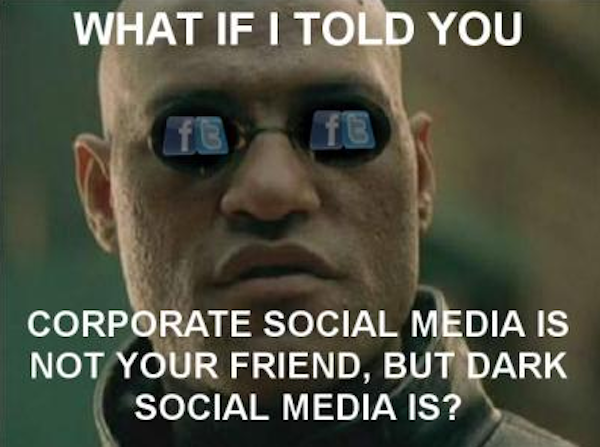
It's new, it's now, it's cool, learn how... everybody's on it, everybody's doing it. For some time now, we've been told you cannot build a business, find old friends or organize much of anything without the indispensable aid of corporate social media, especially Facebook and Twitter. But what if this is about as true as other stuff the supposedly wise and informed told us in recent years, like that real estate prices could be counted on to always go up? Human societies are based on lots of horizontal communication. What if corporate social media is little more than a gigantic scam to extract revenue from the otherwise ordinary communication the internet permits between groups and individuals, between people and businesses, and among communities of interest. What if corporate social media ultimately aims not to open up but to throttle and restrict those conversations to make them artificially scarce and valuable commodities. What if corporate social media's business model is to thrive on content its proprietors don't create, and to place itself between that content and prospective audiences, even to substitute itself for the web sites, email lists and media offerings of content creators?

Where Are The Occupy Protestors Now?

Where have all the chanters gone; the gospel-minded Christians and the denouncers of ‘banksters’ and tyrants; the homeless and the indebted and unemployed who filled our urban squares in 2011-12, crying out such slogans as "We are the 99 percent" and "The people want the end of the regime"? Where are the leaderless revolutionaries who turned cities around the world upside down? The simple answer is: they were dispersed. When the sometimes public parks were swept clear of troublemakers, many dispersed into a scatter of left-wing campaigns. Other activists now escort visitors around bare, fenced-off Zuccotti Park near Wall Street. In London, free bus tours with guides in top hats carry the curious around the City and Canary Wharf (“Make your very own ‘credit default swap’ and find out how to create money out of thin air!”). One Occupy London stalwart, a sermon-on-the-mount Christian who negotiated with the Bishop of London at St Paul’s in 2011, emails me to say: “Many of us from Occupy London have ended up going all over the world. Our decisions to travel to the far-reaches were probably inspired by Occupy in many cases, although not all of us are working as activists in other countries. We remain in touch with each other, and support the hardcore group that are fighting fracking in the UK now … B returned to the USA, C is in Pakistan, D in Spain, E in Tunisia, F in Greece, others are in India, Africa, Thailand … I am currently living in Kuwait, teaching the young to be critical thinkers.”
assetto corsa mods

Urgent End Of Year Fundraising Campaign

Online donations are back! Keep independent media alive. 

Due to the attacks on our fiscal sponsor, we were unable to raise funds online for nearly two years.  As the bills pile up, your help is needed now to cover the monthly costs of operating Popular Resistance.

Urgent End Of Year Fundraising Campaign

Online donations are back! 

Keep independent media alive. 

Due to the attacks on our fiscal sponsor, we were unable to raise funds online for nearly two years.  As the bills pile up, your help is needed now to cover the monthly costs of operating Popular Resistance.

Sign Up To Our Daily Digest

Independent media outlets are being suppressed and dropped by corporations like Google, Facebook and Twitter. Sign up for our daily email digest before it’s too late so you don’t miss the latest movement news.