Skip to content

Spain

A New Political Force Emerges In Spain

n Spain this past May, the usually dull and boring elections to the European Union’s Parliament produced a sudden shock to the political system. A new two-month-old party led by a 35-year-old, pony-tailed political scientist, appeared out of nowhere—but clearly from the Left—to sweep up a surprising 8 percent of the votes. The result was good to win five European seats, transforming the infant organization into the country’s 4th largest political force. One of the party’s founders, political scientist Juan Carlos Monedero, spoke with us in late August. The unexpected European triumph of Spain’s newcomer on the Left underscored the affirmative simplicity of its name—PODEMOS: We Can. Or perhaps better: Together We Can Do It. The party’s rise has been meteoric. PODEMOS began as a grassroots movement in January 2014 and did not register as a party until March. Since the May elections, it has multiplied its support; according to an August 31 poll PODEMOS would earn 21 percent of the votes, only one percent less than the Socialist Party.

Eco-Friendly Agriculture Puts Down Roots In Spain

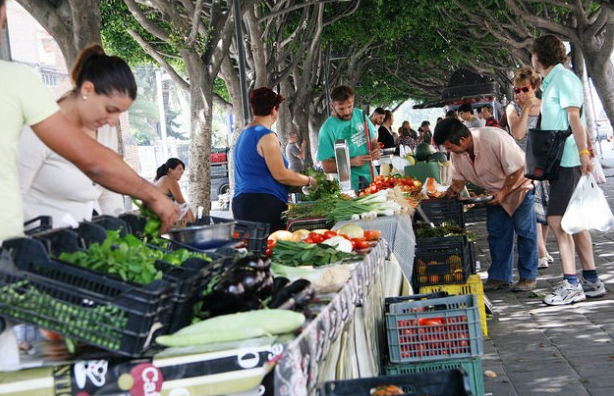
José María Gómez squats and pulls up a bunch of carrots from the soil as well as a few leeks. This farmer from southern Spain believes organic farming is more than just not using pesticides and other chemicals – it’s a way of life, he says, which requires creativity and respect for nature. Gómez, 44, goes to organic food markets in Málaga to sell the vegetables and citrus fruits he grows on his three-hectare farm in the Valle del Guadalhorce, 40 km west of Málaga, a city in southern Spain, And every week Gómez, whose parents and grandparents were farmers, does home deliveries of several dozen baskets of fresh produce, “thus closing the circle from the field to the table,” he told Tierramérica on his farm. The economic crisis in Spain, where the unemployment rate stands at 25 percent, hasn’t put a curb on ecological farming. In 2012, organic farming covered 1.7 million hectares of land, compared to 988,323 in 2007, according to the latest statistics from the Ministry of Agriculture and Environment. Organic farming generated 913,610 euros (1.22 million dollars) in 2012, 9.6 percent more than in 2011.

Spanish Trade Unionists Will Occupy Gibraltar In Tax Haven Protest

The Andalusian Workers’ Union (SAT) says it will attempt to cross the border with 1,000 members, flags and banners to protest in front of government buildings. An activist trade union in Spain’s southern region of Andalusia, the Andalusian Workers’ Union (SAT), has announced it intends to “occupy the Rock of Gibraltar” with 1,000 protestors, flags and banners on August 29 to demonstrate against tax havens, fishing rights, the British military base and sovereignty. Diego Cañamero, the spokesman for the SAT trade union, told The Spain Report by phone that: “Our action is about justice. There is an economic crisis, with 37% unemployment in Andalusia, and on the Rock there are 80,000 public companies, and millions and millions of euros from all the corruption on the Costa del Sol”. The SAT, which has members all over Andalusia, took the decision during its national assembly meeting on July 13 and would like the protest to take place in front of Gibraltar government buildings, once across the border.

Village Where People Come Before Profit

In the south of Spain, the street is the collective living room. Vibrant sidewalk cafes are interspersed between configurations of two to five lawn chairs where neighbors come together to chat over the day’s events late into the night. In mid-June the weather peaks well over 40 degrees Celsius and the smells of fresh seafood waft from kitchens and restaurants as the seasonably-late dining hour begins to approach. The scene is archetypally Spanish, particularly for the Andalusian region to the country’s south, where life is lived more in public than in private, when given half a chance. Specifically, this imagery above describes Marinaleda. Initially indistinguishable from several of its local counterparts in the Sierra Sur southern mountain range, were it not for a few tell-tale signs. Maybe it’s the street names (Ernesto Che Guevara, Solidarity and Salvador Allende Plaza, to name a few); maybe it’s the graffiti (hand drawn hammers-and-sickles sit happily alongside encircled A’s, oblivious to the differences the two ideologies have shared, even in the country’s recent past); maybe it’s the two-story Che head which emblazons the outer wall of the local sports stadium. Marinaleda has been called Spain’s ‘communist utopia,’ though the local variation bears little resemblance to the Soviet model most associate with the phrase. Classifications aside, this is a town whose social fabric has been woven from very different economic threads to the rest of the country since the fall of the Franco dictatorship in the mid 1970s.

Fight For Can Vies Social Centre

In May Barcelona was shook by four days of rioting and protest against the eviction of an established social centre, Can Vies. Juana Belén Gutiérrez de Mendoza looks at the history of the building, and interviews the organisers currently fighting its eviction. Self organised social centre (Centre social autogestionat) Can Vies has been a space for radical politics and community organising for 17 years. It’s been a place where different generations of activists can meet and learn from each other, where hundreds of people have learnt to be a part of a community, participating in the assembly with consensus decision making and collective responsibility. The CSA is also part of the Sants Neighbourhood Assembly (ABS) which coordinates political and social movements in the area, and several campaigns: against gentrification, migrant solidarity, worker’s struggles, and against state repression. Just having a look at their website you’ll find events from an alternative Pride to radical history, with the spirit of community organising always at its heart. Built in 1879, it was initially a storage space used during the construction of Barcelona’s underground tube system.

Spain: Leader of Podemos Has High Hopes

Across Spain, everyone has an opinion about Pablo Iglesias. Mere mention of the ponytailed leader of the insurgent leftwing party Podemos (We Can), who is only 35, elicits a barrage of adjectives that range from honest to dangerous. There was the woman in Barcelona who gushed that "he seems like such a decent person" as she explained why she had cast her first vote in a decade and given it to Podemos. Or the worries expressed by the monarchist from San Sebastián who spent hours waiting on a sunny morning in Madrid to catch a glimpse of Felipe VI on his first day as the new king of Spain. "Iglesias wants to turn Spain into the next Venezuela." In only a month, Iglesias has gone from well-known political pundit to member of the European parliament and one of Spain's most polarising personalities. Soft-spoken and calm, Iglesias shrugs off the attention. "I'm a normal person," he said. Active in left-leaning politics since he was 14, he describes himself as "a guy who worked in the university for many years, as a researcher, then as a professor". Wearing a shirt lined with the red, yellow and purple colours of the Spanish republic, Iglesias pulled loose his ponytail as the interview started, his long brown hair falling over his shoulders for a moment before he tied it back into his signature style.

Spanish Social Movement Releases “A Charter For Democracy”

Whatever happened to the 15-M Movement? Where did Occupy go? Three years after the groundbreaking revolutionary ruptures of 2011, violent repression and media invisibility have relegated these thriving movements to a grey area. The perception seems to shift between mainstream derision and niche-group interest. Occupy’s roots have spread out and sprouted a multitude of initiatives, though perhaps the source inspiration is not always publicly recognized. But in Spain, the popular experience of austerity – the murderous palliative prescribed as a cure for the crisis – and the resulting political movements in reaction have been giving the lie to the mainstream narrative that 15-M is a “has been.” The movement undeniably lives. Its form has been mutated, re-imagined, distributed, and coalesced into a multitude of initiatives and hacks to the system. We live here, we see it every day. These initiatives are not as easily seen, defined – or, for that matter, targeted – as a physical occupation may be; yet they permeate the hegemony, creating new possibilities and spaces. You need only look at the recent EU Parliamentary election results to see how Spanish voters have reacted to austerity and debt – and how that reaction contrasted strongly with that of some other European nations. One of the most important evolutions of 15-M is undoubtedly the “Movimiento por la Democracia” (Movement for Democracy).

New Party Arises In Spain: Podemos

On the afternoon of May 15, 2011, thousands of citizens suddenly began filling the streets and occupying the squares of more than 50 Spanish cities. Some of them camped out there for months. They had been summoned to a protest march by a group called Democracia Real Ya (Real Democracy Now) through the social networks. With local and regional elections scheduled for May 22, very few media outlets saw the 15-M movement coming. And Spain’s political parties certainly did not. Three years later, Podemos (We Can), a party that rose out of the ashes of that movement, became the fourth-most-voted political force in Spain at the European elections on Sunday. Nobody saw that coming, either. Podemos was registered as a party just three months ago, after heated debate among neighborhood assemblies.

Activists Launch Referendum Over Future Of Monarchy

Emboldened by the tens of thousands of Spaniards who have taken to the streets to demand a say in the future of Spain's monarchy, activist groups have announced they will be holding their own referendum in the five days leading up to the coronation of Prince Felipe. The idea came about on the night King Juan Carlos announced his abdication, after an estimated 20,000 people dressed in the red, yellow and purple of the former Spanish republic descended upon the Puerta del Sol square in Madrid calling for an end to the monarchy. "It seems absurd to us that in a democracy nobody is asking the citizens if they want a monarchy or a republic," said Kike Castelló of ¡Democracia Real Ya! (Real Democracy Now!), one of the dozen or so collectives involved in organising the referendum. The referendum will begin on Saturday morning and run until 19 June, the day of the coronation. About 60 polling stations staffed by volunteers will be set up along major streets in cities across the country, with voting also taking place online.

Spanish Cities March Against Monarchy

Thousands of Spaniards flooded Madrid’s downtown Puerta del Sol on Saturday, relentless in their pursuit of a referendum to do away with what they see as an out-of-touch and outdated monarchy. Fifty cities have erupted in protest. Public sentiment in a country struggling with a huge recession and plagued by several years of bad government decision-making reached a new tipping point when on Monday, June 2, when King Juan Carlos announced his abdication in favor of his son, 46-year-old Crown Prince Felipe. Fifty of Spain’s largest cities have now joined in the chorus of national discontent. Protesters waved the red, purple and gold flags of the Second Spanish Republic and banners reading "No more kings! Referendum! Real democracy without kings" and "Referendum for a constitutional process." The same scene could be seen Monday after the abdication led to a spontaneous outpouring of 20,000 people onto Madrid’s streets in a protest coordinated by the 15-M anti-austerity movement. “Spain, tomorrow, will be Republican,” protesters chanted. On Saturday, the protesters repeated their demands. The crowds wish to change the course of Spain’s political history ahead of June 19, when Felipe’s coronation is due to take place.

European Days Of Action Against Austerity Begin May 15

The programs of austerity and privatizations imposed by the Troika decide on the lives of millions of people in Europe. Together with people in Europe and the whole world we resist the rehabilitation of capitalism on the backs of employees as well as unemployed, retirees, migrants and the youth. Together with them we say: “We don’t owe, we won’t pay!” While the European Union crisis regime builds more and more borders in order to divide, exploit and oppress us, new transnational movements are arising. We are social movement activists, altermondialists, migrants, precarious and industry workers, party members and unionists and many more, who want to connect our struggles and powers beyond nation-state lines. During the week before the elections for the European Parliament we call for the spirit of the multitude of these social movements to build real democracy from below. We call for an international week of decentralised actions from May 15-25, 2014. Be part of it!

Madrid People’s Creative Response to Imposed Austerity

This short documentary explores ongoing resistance and self-organization in the midst of the economic and social crisis in Madrid, Spain. As social conditions continue to deteriorate across the country, people have been turning to the streets and to each other to find for solutions to the crisis. This film tells a story of the massive mobilization that saw millions of people converge on Madrid on March 22nd 2014, the story of the proliferation of social centers, community gardens, self-organized food banks, and the story of large-scale housing occupations by and for families that have been evicted. The film pieces together many of the creative ways that people have been coping with crisis and asks what the future may hold for Spain. Filmed and edited in March/April 2014, it is part of the Global Uprisings documentary series. View more at globaluprisings.org.

Managing Disorder: Towards A Global State Of Control?

It’s not just right-wing or military regimes that are leading the assault on hard-fought popular freedoms. In Brazil, the ruling Workers’ Party announced this week that it would send the army into Rio’s favelas to pacify the slums ahead of the World Cup. Ostensibly targeted at violent drug gangs, this pacification scheme has led to a situation in which hundreds of slum dwellers are killed by state troops every year. Under President Rousseff — a former Marxist guerrilla who was tortured and imprisoned by the military dictatorship — state brutality against the “unruly” poor and excluded remains the order of the day. Just last week, Brazilian military police were caught on camera after shooting and killing a 38-year-old mother of four and dragging her lifeless body 200 meters down the street in their police van. It is no coincidence that the intensification of long-standing patterns of state repression appears to be particularly acute in the countries that experienced large-scale street protest in the past three years.

‘Disobedience 2014’: Mass Protest To End Austerity In Spain

Thousands gathered in the center of Barcelona in an event the organizers dubbed “Disobedience 2014”in protest of government austerity measures. The protesters marched under a large banner saying:“Disobedience 2014. They can’t control us if we disobey. Let’s stop [Justice Minister Alberto Ruiz-Gallardon’s] laws!” The demonstration turned violent when the police moved in to try and stop protesters from reaching Barcelona’s Cataluna Square. Activists tussled with police, while others smashed the windows of banks and financial institutions and set fire to bins. The idea behind the demonstration is to protest austerity and cuts through “acts of mass civil disobedience,” one of the organizers told Spanish newspaper La Nacion. “Through disobedience we will rebel against a system that is dragging us into an abyss and replace it with one that respects people,” said Luis Lopez who was holding a flag representing a Spanish anarchist group.

Photos: Students Occupy University In Madrid

(AP) Students set fires and made barricades during the first day of a student strike to protest a government education reform and cutbacks in grants and staffing, at Complutense University, in Madrid, Spain, Wednesday, March 26, 2014. Spanish police say they have arrested more than 50 students when the police moved in to end the occupation of a campus building after the university had asked them to intervene. Students, many with their faces covered, set fire to trash containers and set up barricades on at least two streets in the university complex during the protest.
assetto corsa mods

Urgent End Of Year Fundraising Campaign

Online donations are back! Keep independent media alive. 

Due to the attacks on our fiscal sponsor, we were unable to raise funds online for nearly two years.  As the bills pile up, your help is needed now to cover the monthly costs of operating Popular Resistance.

Urgent End Of Year Fundraising Campaign

Online donations are back! 

Keep independent media alive. 

Due to the attacks on our fiscal sponsor, we were unable to raise funds online for nearly two years.  As the bills pile up, your help is needed now to cover the monthly costs of operating Popular Resistance.

Sign Up To Our Daily Digest

Independent media outlets are being suppressed and dropped by corporations like Google, Facebook and Twitter. Sign up for our daily email digest before it’s too late so you don’t miss the latest movement news.