Skip to content

Technology

Engineers Say “No Thanks” To Silicon Valley Recruiters, Citing Ethical Concerns

Anna Geiduschek usually has no time to respond to recruitment emails that arrive in her inbox each week. But Geiduschek, a software engineer at Dropbox, recently made a point of turning down an Amazon Web Services recruiter by citing her personal opposition to Amazon’s role in hosting another tech company’s service used by U.S. government agents to target illegal immigrants for detention and deportation. "I'm sure you're working on some very exciting technical problems over there at AWS [Amazon Web Services], however, I would never consider working for Amazon until you drop your AWS contract with Palantir," Geiduschek wrote in her email response, which she shared on Twitter. Tech companies such as Amazon, Facebook, Google, and Microsoft have faced growing internal unrest from employees who raise ethical concerns about how the companies deploy their high-tech services and products.
How Tech Workers Are Organizing For Social Change

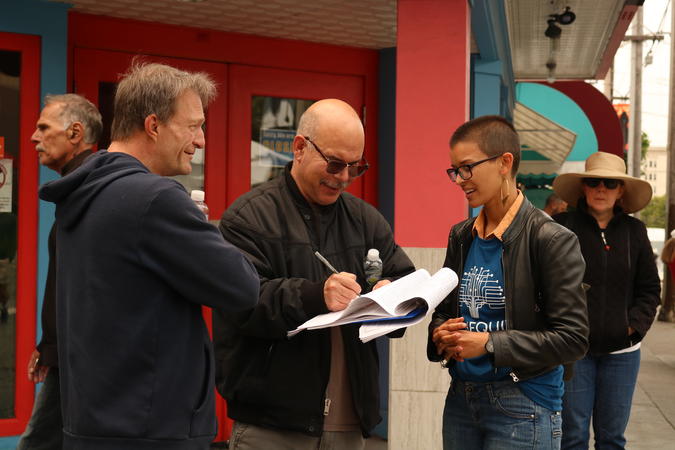
Coworker.org, a nonprofit based in the U.S. that enables workers to start campaigns to change their workplaces, received more inquiries from employees at tech firms about using the platform following the election in 2016, Yana Calou, the group's engagement and training manager said: "They were really concerned about their jobs being used towards things that they were not really comfortable with." Another organization leading this effort in the San Francisco Bay Area, home to several of the world's largest technology companies, is the TechEquity Collaborative, which is taking more of a grassroots approach. "No one was looking at the rank and file tech worker as a constituent group to be organized in a political way," says Catherine Bracy, executive director of the TechEquity Collaborative. "There is a critical mass of tech workers who feel a huge sense of shame and guilt about the role that the industry is playing in creating these inequitable conditions, and want to do something different about it.

Meet Noah, The Circular Car Of The Future

Meet Noah. This lightweight plug-in electric city car scoots two people and their stuff around for up to 149 miles (240 km) on a single charge and can reach speeds of 68 miles per hour (110 km/hr). But that's mundane. What makes Noah special is the circle. The circle represents the complete closure of the materials life cycle: the only materials used in a product can be recycled, ideally back into the same product or a product of similar position in the value chain (as opposed to down-cycling in which materials are re-used in products of inferior quality or value). Noah's chassis was made without any traditional plastic and without metal. Instead, the engineers relied on sandwich panels of the natural fiber flax and a biopolymer made from sugar, Lumina PLA. The car was sponsored by the French petrochemical giant TOTAL, the supplier of Lumina PLA, and conceived by the ecomotive team at the Technical University of Eindhoven...

Technology Giants Hold Censorship Meeting With US Intelligence Agencies

The New York Times and Washington Post this week published reports of a private meeting last month between eight major technology and social media corporations and the US intelligence agencies, to discuss their censorship operations in the lead-up to the November 2018 mid-term elections. The meeting was convened at Facebook's Menlo Park, California, headquarters on May 23, and was attended by representatives from Amazon, Apple, Google, Microsoft, Snap, Twitter and Oath, owner of Yahoo! and a subsidiary of the telecommunications giant Verizon, along with agents from the FBI and the Department of Homeland Security. The Post described the meeting, organized at the request of Facebook, as a “new overture by the technology industry to develop closer ties to law enforcement.”

SF Protesters Say No To “Techsploitation,” Block Buses With Scooters

Fifty people blocked 14 tech buses by piling scooters in their path and lighting an orange flare at 24th and Valencia. One bus driver tried to move the scooters, but soon resigned himself to just waiting. A passerby sprayed graffiti on one of the idle buses. The group of housing activists reject what they see as tech companies “littering the city,” while homeless encampments are swept away. “This is a message from the community,” said Tony Robles, a community organizer focused on housing for seniors with disabilities. He says that tech companies like Bird, a scooter company, act with impunity and dump stuff in the neighborhoods without considering the needs of current residents. People testified on a PA system about how their lives have been transformed by what they call a tech takeover.

Time For Technology To Develop From The Bottom-Up

“We got to do something now, the company are not going to do anything and we got to protect ourselves”, proclaimed a shop steward at Lucas Aerospace when filmed by a 1978 documentary by the Open University. He was explaining the rationale behind the so-called Alternative Corporate Plan, better known as the Lucas Plan. It was proposed by shop stewards in seventies England at the factories of Lucas Aerospace. To stave off pending layoffs, a shop steward committee established a plan that outlined a range of new, socially useful technologies for Lucas to build. With it, they fundamentally challenged the capitalist conception of technology design. Essentially, they proposed that workers establish control over the design of technology.

Citing ‘Don’t Be Evil’ Motto, 3,000+ Google Employees Demand Company End Work On Pentagon Drone Project

"By entering into this contract, Google will join the ranks of companies like Palantir, Raytheon, and General Dynamics." More than 3,000 Google employees have signed a letter that's circulating in the company demanding that the tech giant end its involvement in Project Maven, a Pentagon program that could be used to develop drone technology. The project, the workers argue, runs counter to the company's stated mission and motto. "By entering into this contract, Google will join the ranks of companies like Palantir, Raytheon, and General Dynamics," wrote the employees, who include senior engineers. "The argument that other firms, like Microsoft and Amazon, are also participating doesn't make this any less risky for Google. Google's unique history, its motto 'Don’t Be Evil,' and its direct reach into the lives of billions of users set it apart."

The Robot, Unemployment, And Immigrants

Going out, you swipe the card, which goes to your bank account or to a credit card, and that it is. No ques, no cashiers, fast and easy. The first shop, in Seattle, has a roaring success. Nobody is in charge with restocking the items. An automatic system does that. And soon two robots will replace the items on the shelves, now done by two employees. Even the cleaning of the floor is being done by a robot. The goal is to have a totally automatic shop, where no human can make mistakes, get ill, go on strike, take holidays, or bring into the work personal problems. The American petrol industry calculates that will reduce within three years the staff required at each well, from 20 to five. Small hotels within three years will have a fully automated reception. You will arrive, swipe your credit card, a key for your room will come out, and you are done.

We Can Pull CO2 From Air, But It’s No Silver Bullet For Climate Change

While technologies are being developed that can remove carbon dioxide from the air, they aren't yet feasible on the scale needed to slow global warming, Europe's national science academies warn in a new report. A wide array of technologies—from land management to ocean fertilization to capturing carbon dioxide from the air and storing it—are in various stages of testing and use, but according to the European Academies' Science Advisory Council, climate scientists and policymakers are being "seriously over-optimistic" about how much these approaches can help deal with the global warming crisis. In recent years, climate experts have suggested that it's not enough to just decrease the amount of greenhouse gases emitted.

Barcelona Kicks Microsoft Out In Favor Of Open Source

A Spanish newspaper, El País, has reported that the City of Barcelona is in the process of migrating its computer system to Open Source technologies. According to the news report, the city plans to first replace all its user applications with alternative open source applications. This will go on until the only remaining proprietary software will be Windows where it will finally be replaced with a Linux distribution. The City has plans for 70% of its software budget to be invested in open source software in the coming year. The transition period, according to Francesca Bria (Commissioner of Technology and Digital Innovation at the City Council) will be completed before the mandate of the present administrators come to an end in Spring 2019.

Tribute To James Dolan, Co-Creator Of SecureDrop; Tragically Passed Away

Beyond a couple references on our website, that New Yorker story is virtually all that is in the public domain about James’s involvement in the project—and that’s how he preferred it. James was an intensely private and modest person, and despite the fact the SecureDrop soon got a lot of attention when Freedom of the Press Foundation (FPF) took the project over, he constantly insisted that Aaron deserved all the credit. Yet SecureDrop would not currently exist without James, and he deserves all the commendation in the world for making it what it is today. In January 2013, Aaron Swartz himself committed suicide as the US government was attempting to prosecute him for violating the Computer Fraud and Abuse Act related to allegedly copying academic articles from JSTOR. SecureDrop was an unrelated side project he was working on at the time.

Snowden’s New App Turns Phones Into Home Security Systems

YOUR DIGITAL SECURITY, any sufficiently paranoid person will remind you, is only as good as your physical security. The world's most sensitive users of technology, like dissidents, activists, or journalists in repressive regimes, have to fear not just hacking and online surveillance, but the reality that police, intelligence agents, or other intruders can simply break into your home, office, or hotel room. They can tamper with your computers, steal them, or bodily detain you until you cough up passwords or other secrets. To help combat that threat, one of the world's most well-known activists against digital surveillance has released what's intended to be a cheap, mobile, and flexible version of a physical security system.

‘Shrinking The Technosphere’ Review

When the average person thinks about technology, the first thing that comes to mind isn't a family dog or cat. Nor would one likely consider a flock of chickens, a packet of seeds or a sack of potatoes to be examples of technology. But technology thinker Dmitry Orlov, in his book Shrinking the Technosphere, argues that that's exactly what they are. In the context of a rural homestead, a dog is a highly advanced home security system, cats and chickens are a pest control service (the former targeting rodents and the latter insects) and potatoes and seed packets play an indispensable role in meeting the dietary and medicinal needs for which city dwellers are dependent on factory farms and pharmaceutical plants. These are all instances of "naturelike" technologies, or those that represent, in Orlov's words, "human adaptations of things nature has produced as evolved traits in other species."

TSA Facial Recognition; Part Of Growing Biometric Surveillance System

By Michael Maharrey for Activist Post - The federal government plans to use a TSA program advertised as a way to avoid lines at airport security checkpoints to harvest photos and other biometric information that will ultimately end up in multiple federal databases. The TSA touts its PreCheck program as a way to avoid the hassle of security screening. Members of the program do not have to remove shoes, laptops, liquids, belts and light jackets. But according to a report by the Electronic Frontier Foundation (EFF), the Department of Homeland Security has developed this program with a broader purpose in mind. PreCheck will facilitate the collection of face images and iris scans on a nationwide scale. Once that happens, this biometric data will almost certainly be widely shared with other federal agencies and even private corporations. DHS’s programs will become a massive violation of privacy that could serve as a gateway to the collection of biometric data to identify and track every traveler at every airport and border crossing in the country. The TSA currently collects fingerprints during the PreCheck application process. Over the summer, the agency ran a pilot program at the Atlanta Airport using fingerprints to verify passengers’ identities. According to the EFF, the TSA wants to roll out the program to airports across the country and expand it to include facial recognition, iris scans, and other biometric data. This TSA will almost certainly share this information with other federal agencies, including the FBI.

Madrid As A Democracy Lab

By Bernardo Gutierrez for Open Democracy - During the occupation of Puerta del Sol in Madrid in 2011, the hackers at the core of Madrid's 15M developed a platform for anyone to make political proposals. Designed in free software, the Propongo platform allowed users to put forward ideas which could then be voted on. The operational arrangement was pretty simple: decentralized proposals, from the bottom up. The State of Rio Grande do Sul (Brazil), where participatory budgets came to light in 1989, used part of the Propongo code and its philosophy for the Digital Cabinet, its star citizen participation project. In Spain, the political class turned its back on the Indignados. On the other side of Propongo, no one was there. No local, regional or state government listened to the new music coming out of the squares – and even less to the proposals. Meanwhile, collective intelligence and networking in the squares were developing sophisticated mechanisms for participation and deliberation, both online and face-to-face. The powerful technopolitics made in Spain conquered the hearts of activists all over the world. And the hearts of some foreign academics and politicians too.
assetto corsa mods

Urgent End Of Year Fundraising Campaign

Online donations are back! Keep independent media alive. 

Due to the attacks on our fiscal sponsor, we were unable to raise funds online for nearly two years.  As the bills pile up, your help is needed now to cover the monthly costs of operating Popular Resistance.

Urgent End Of Year Fundraising Campaign

Online donations are back! 

Keep independent media alive. 

Due to the attacks on our fiscal sponsor, we were unable to raise funds online for nearly two years.  As the bills pile up, your help is needed now to cover the monthly costs of operating Popular Resistance.

Sign Up To Our Daily Digest

Independent media outlets are being suppressed and dropped by corporations like Google, Facebook and Twitter. Sign up for our daily email digest before it’s too late so you don’t miss the latest movement news.