Skip to content

Türkiye

Thousands Protest New Internet Law In Turkey

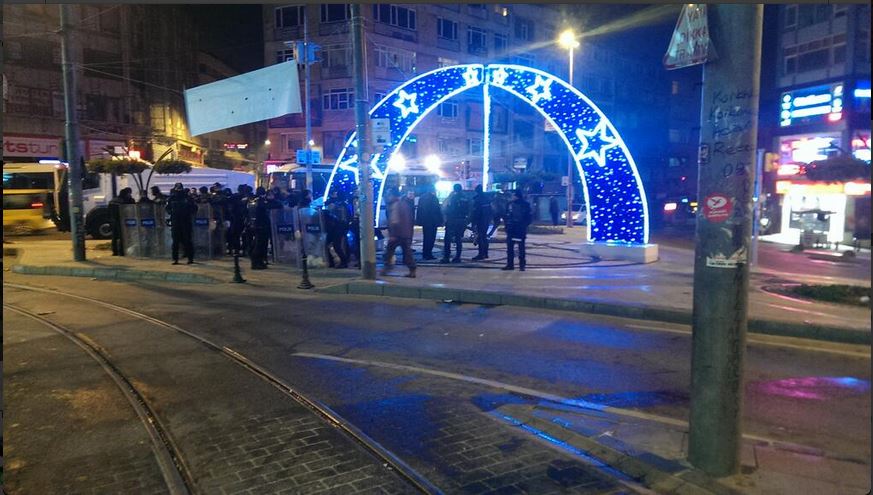
Turkish police have fired tear gas and water cannons to disperse crowds of protesters rallying against “draconian” internet laws approved by parliament. Police approached the crowd along Istanbul's Istiklal Avenue and fired water cannons from behind armored vehicles as protesters tried to march to the city’s main square. "Everywhere is bribery, everywhere is corruption," protesters chanted. As riot police fired water cannons at protesters, some of them responded by throwing stones or setting off fireworks aimed at law enforcement officers. The new bill was passed late Wednesday by the parliament dominated by the Erdogan’s AKP party. If the president approves the legislation, it would give authorities the power to block web pages without a court order within just hours.
Tight Security As Trial Into Gezi Protester’s Death Begins

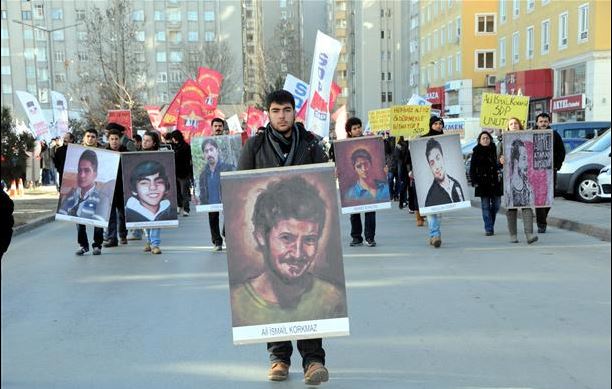
Police took extensive measures to cordon off the Central Anatolian city of Kayseri as the first hearing into the murder of Gezi protester Ali İsmail Korkmaz started today after the trial was controversially moved outside Eskişehir, where the 19-year old was living when he was beaten to death, for “security reasons.” The victim’s family was greeted with applause as they entered the courtroom. Emel Korkmaz, the victim’s mother, displayed photographs at the murder suspects. “How could you kill my son without pity? What has he done to you? How can you look at your own children?” she said, daily Hürriyet reported. A total of eight murder suspects, including four police officers, are being tried in Kayseri’s old courthouse, because it has bigger rooms than the new one, as well as due to security measures.

Analysis Of The Gezi Uprising

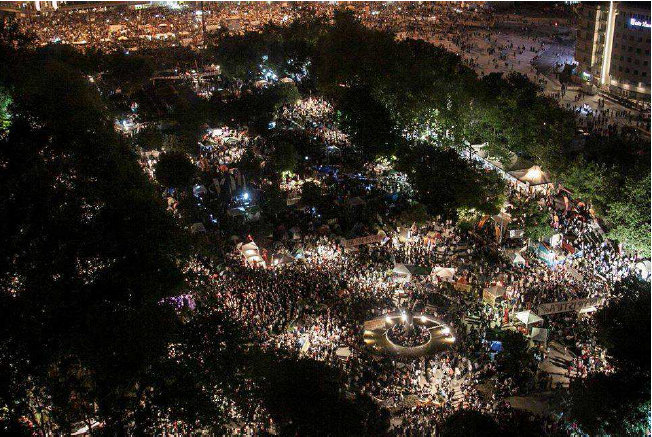
Gezi protests, having positioned itself as a common struggle of various diverse groups representing different ideological, political, religious, social and cultural backgrounds, were quite successful in orienting public towards this end. Bringing together the socialists with businessmen, (anti-capitalist) Muslims with Atheists, nationalists with Kurds, and other previously divided segments of society in a platform of joint action and a shared living space, Gezi Park became a symbolic place providing the entire public an example of peaceful coexistence, sharing and solidarity based on commons. People from all backgrounds, who hardly knew each other, stood up together for their freedom and rights and acted jointly against police violence on the streets.

Turkish Court Accuses Documentary Film of “Inciting Public Hatred”

The Turkish government is pursuing a criminal investigation into a documentary film on last year’s nationwide protests originating in Istanbul’s Gezi Park. On January 2, the film’s director, whom the government regards as a “suspect,” is scheduled to testify in court in Istanbul. Serkan Koç, director of the documentary The Beginning, was notified on December 25 that state authorities would examine the film for “objectionable content” and determine whether there was reason to file charges. According to a press release by the film’s production company 49/51 Film, “The documentary is charged with assault to the Prime Minister and instigating public hatred and animosity.” Koç has been named a “suspect” and will testify at the January 2 hearing. 49/51 Film posted announced on its Facebook page that it would request that prosecutors open an investigation against Prime Minister Erdogan instead on the same charge of inciting hatred. It cites a statement in which Erdogan boasts that a thousand protestors in Taksim Square are no problem: “…we will put five thousand, ten thousand youth against them.”

The Culmination of Resistance Against Urban Neoliberalism

On December 17, 2013, Turkey woke up to another morning of dawn operations involving raids, home and office searches, and arrests that have become a routine in the legal and political landscape of the country in recent years. What was anomalous this time, though, was that among the people who were the target of the allegations and taken into custody were there the sons of three Justice and Development Party (AKP) ministers — the Minister of Economics, the Minister of Environment and Urbanism, and the Minister of Internal Affairs.

Turkish Police Crack Down On Anti-Govt Protest

Clashes started at around 17:30 GMT on Friday, with police using water cannons to disperse the crowd which gathered to voice their anger against the government’s actions, Firth reports from the site. This comes amid an ongoing high-profile corruption scandal. “It's very symbolic of the anger we've seen that has been building over the last couple of days,” she says.“Bits of rock and marble are everywhere you look,” with protesters throwing them at law enforcement officers. According to posts on Twitter, police followed protesters into side streets and fired rubber bullets, prompting them to respond with empty glasses. A reporter for Turkey's liberal Radikal newspaper “was shot by a rubber bullet,” but despite being hurt “bravely keeps on reporting” from Taksim Square.

Turkey’s Erdogan Replaces Cabinet Over Graft Inquiry

Move comes after three cabinet ministers tender resignation over spiraling corruption scandal. Turkey's Prime Minister Recep Tayyip Erdogan said he replaced ten cabinet ministers, half of his total roster, after three ministers resigned over a high-level graft inquiry on Wednesday. The replaced ministers included EU Minister Egemen Bagis, who was allegedly named in the corruption probe but had not resigned yet, and key positions such as the Economy and justice ministers.

Turks In Istanbul Seek To Revive The Gezi Spirit

“Reclaim the city” was the hopeful slogan of the protest organized in Kadiköy, on the Asian side of Istanbul today. Around noon two large marches culminated at the sea-side center of the neighborhood, where a large stage surrounded by police barriers would form the epicenter of the protest. How the çapulers imagined to be able to reclaim the city while being caged-up, voluntarily stopped and searched, and obediently repeating the slogans they were served from the MC’s on stage remains a mystery, but as a test-case to see whether the Gezi battle cries could still muster the çapuling troops, the protest can be considered a success. Each of the two marches consisted of thousands and thousands of angry citizens, defiant students, rebellious workers, marching communists, anarchists and environmentalists, all up in arms. Banners were carried proudly on this sunny Sunday afternoon, and the slogans being shouted resonated in the small alleys and backstreets of this old, densely populated neighborhood. The police was present in full riot gear — obviously — hiding in the side streets along the main marching routes, the majority of them relatively young guys, joking about, having a cigarette or absent-mindedly staring into the void while leaning on their over-sized shields. They seem like guys you could probably have a beer with, in different circumstances. They look normal enough, without their gas masks and riot helmets.

Riot Granny from Istanbul in Jail

Remember “Riot Granny” from Istanbul? She has been in jail for two months now. Emine Cansever (53), a.k.a. Riot Granny, was arrested with 18 other people in home raids in Gülsuyu neighborhood two months ago. Emine Cansever is accused of being a member of a “terrorist organization”. Pro-government media started a smear campaign right after her image with a sling shot went viral in both local and international media. Based on police reports, the media incriminated her of being a member of DİH (Revolutionary Worker’s Movement) and leading “illegal” protests on behalf of the organization. These allegedly terroristic activities included legal protests such as Hey Textile workers’ struggle against the company that refuses to pay their compensations and three months of salary, and protests against drug gangs in her neighborhood.

Police Kill Protesters In Turkey Hundreds Of Thousands Mourn In Streets

Thousands staged a march in Hakkari's Yüksekova district on Friday evening to protest against the ongoing attacks on the cemetery of eight HPG (People's Defense Forces) guerrillas in the Orman neighborhood. Among the demonstrators were also BDP (Peace and Democracy Party) executives, mayors, activists of Peace Mothers Initiative, MEYADER, TUHAD-FED, KURDÎ-DER and Gever Culture and Art Centre. Police attacked the mass without any warning, using rubber bullets and intense tear gas, and pressure water. Clashes erupted as youths responded to the police attack. Two people, Reşit İşbilir (35) and Veysel İşbilir (34), were killed as police opened fire on demonstrators. Two men are said to be industrial workers. Witnesses speaking to DIHA (Dicle News Agency) said Reşit İşbilir was hit by two bullets, one on the heart and the other on the right hand. People rushed to Yüksekova state hospital after bodies were taken there. Special operation teams surrounded the hospital with armored vehicles and blocked the relatives of the casualties. Police teams also threw tear gas canisters into the hospital, and broke the windows and doors with their guns.

Documentary Gezi Park Chat With Filmmaker And Protesters

Tonight at 5pm eastern is 12am in Turkey. Come in & CHAT w/protestors & filmmaker @GeziDoc http://www.livestream.com/activistworldnewsnow … The Gezi Park protests which began on May 28th, 2013 was one of the biggest uprisings against neoliberalism and a conservative Turkish government that was encroaching on secularism. The protest began when plans were announced to develop the park, one of the last remaining green spaces in Istanbul. Sparked by an aggressive police action against the revolt, subsequently protests and strikes spread across Turkey raising a wide range of concerns, at the core of which were issues of freedom of the press, freedom of expression, freedom of assembly, and the government's encroachment on Turkey's secularism. Below are two movies on the Gezi Park revolt in Turkey.

Upcoming Book: An Activist Armed With A Camera

One of the great photojournalists to come out of the Occupy Movement is Jenna Pope, she is crowd-funding her book. We urge you to support Jenna's efforts. "In February of 2011, the massive protests against Wisconsin Governor Scott Walker awoke me from my slumber and changed my life completely. I immersed myself within the front lines of the fight for justice and equality, and I haven't looked back even once. Fast forward two years and nine months and I am now living in New York City, traveling all over the US and internationally to stand with others who are striving for a better world. In the process, I have been arrested, pepper sprayed, tear gassed, hit with water cannons, and shot at with plastic bullets. I have slept on planes, trains, and buses, outside in the rain and snow, and on strangers' couches. And, everywhere I go, I have my camera in my hands. It has been an exciting, intense, and unpredictable journey where I am constantly being inspired by the people and movements I capture through the lens of my camera."

Don’t Move, Occupy! Social Movement Vs Social Arrest

Regardless of their final present political fate, the global uprisings since 2011 have already established mass continuous occupation of public space as the dominant form of political struggle in the early 21st century: the coming together of people who have both withdrawn their consent to be governed by the existing order and, equally importantly, discovered the responsibility, dignity, difficulty, and — above all — joy of instituting a society outside of it. In so doing, they have challenged the periodization that separated a mass political uprising from the democracy that may follow it. The common feature of all these occupations was the creation of democratic forms within the space and time of the uprising itself. This was made possible not through a politics predicated on movement, but rather one of arrest, of occupation, in order to create sites for the collective restructuring of social relations and space.

‘Defending Future Commons: The Gezi Experience’

The 2013 uprising in Turkey commenced with a call by a handful of activists to guard a park located adjacent to Taksim Square – the most centrally-located public square in Istanbul – from the Istanbul Municipality’s bulldozers. As a part of the redevelopment plan for the whole square, the PM Erdoğan and the Istanbul mayor had repeatedly informed the public of their decision to redevelop Gezi Park into a building complex, to contain a parking garage, museum, shopping mall, and high-end housing. The demolition team arrived on the night of May 27, but was not able to proceed thanks to the resistance of the activists on guard, some of whom lay in front of the bulldozers. The following day the bulldozers were accompanied by a substantial police force, which brutally quashed the protestors through extensive use of tear gas and brute force. A small portion of the Gezi Park was demolished that day.

The Catastrophic Management Of Catastrophe

The catastrophic management of catastrophe. If there is one line that describes the nature of neoliberal crisis management, that must be it. From Mexico and Latin America in 1982 to the South-East Asian crisis of 1997-’98, and from Turkey and Argentina in the early 2000s to the European debt crisis from 2010 onward — the most catastrophic thing about neoliberal crisis management is not only that it has a penchant to turn already catastrophic financial crises caused by runaway private speculation into an immense source of private gain for the same very financiers responsible for the catastrophe to begin with; but, even more nefariously, that it makes those catastrophes so much more catastrophic than they really need to be for almost everyone else. Notwithstanding all the propaganda and rhetoric about “free markets” promoting democracy and development, the massive bank bailouts of the neoliberal era have invariably shown that those so-called neoliberals in fact care very little even about free markets — let alone about democracy or development.
assetto corsa mods

Urgent End Of Year Fundraising Campaign

Online donations are back! Keep independent media alive. 

Due to the attacks on our fiscal sponsor, we were unable to raise funds online for nearly two years.  As the bills pile up, your help is needed now to cover the monthly costs of operating Popular Resistance.

Urgent End Of Year Fundraising Campaign

Online donations are back! 

Keep independent media alive. 

Due to the attacks on our fiscal sponsor, we were unable to raise funds online for nearly two years.  As the bills pile up, your help is needed now to cover the monthly costs of operating Popular Resistance.

Sign Up To Our Daily Digest

Independent media outlets are being suppressed and dropped by corporations like Google, Facebook and Twitter. Sign up for our daily email digest before it’s too late so you don’t miss the latest movement news.