Skip to content

Corporatism

Tradition Continues: 2014 Rose Bowl Parade Occupied

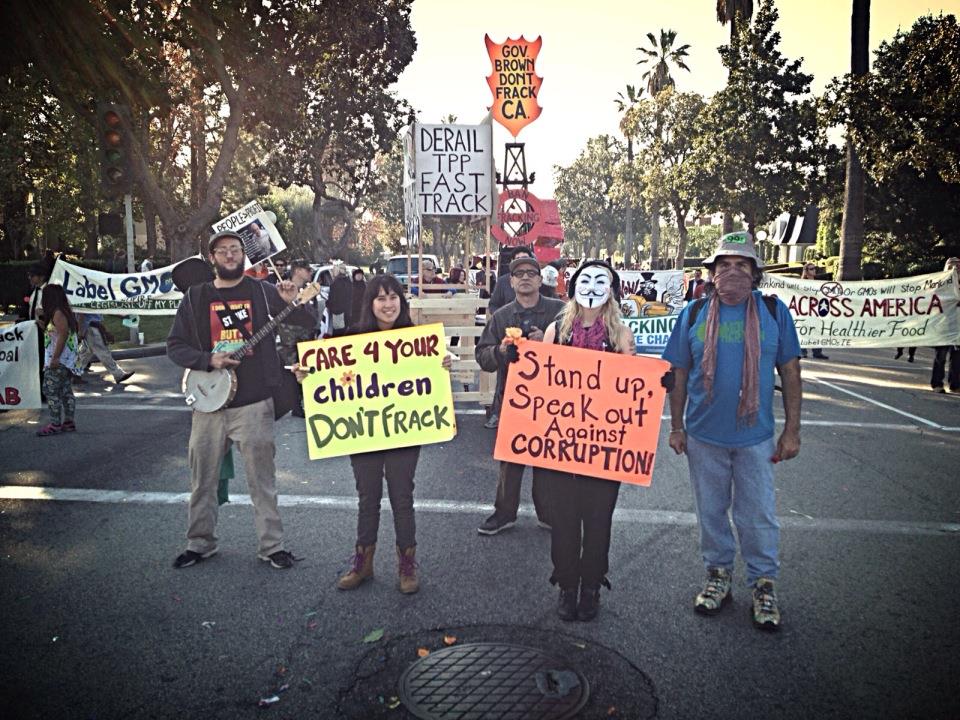
Starting with the 2012 Tournament of Roses Parade, Occupiers have followed the parade with their own version to bring attention to important issues. This year, the official theme of the Rose Bowl Parade was "Dreams Come True." Occupy Rose Parade responded with the theme "#WakeUp2014." Occupy Rpse Parade floats and banners focused on the Tran-Pacific Partnership, fracking and home foreclosures. Occupiers came from San Diego, Venice, Los Angeles and Menifee. Moms Across America were present to protest GMOs and PETA was on hand to protest Seaworld's torture of orcas. Nineteen PETA participants were arrested and the Seaworld float was guarded by police officers as it passed along the parade route. In all, it was a very successful day. One occupy member, Donna Piranha, said, "The two questions I heard repeated all day were: 1. 'What's fracking?' & 2. 'What's the TPP?'" All signs indicate that 2014 will be a very interesting year.
The Story So Far

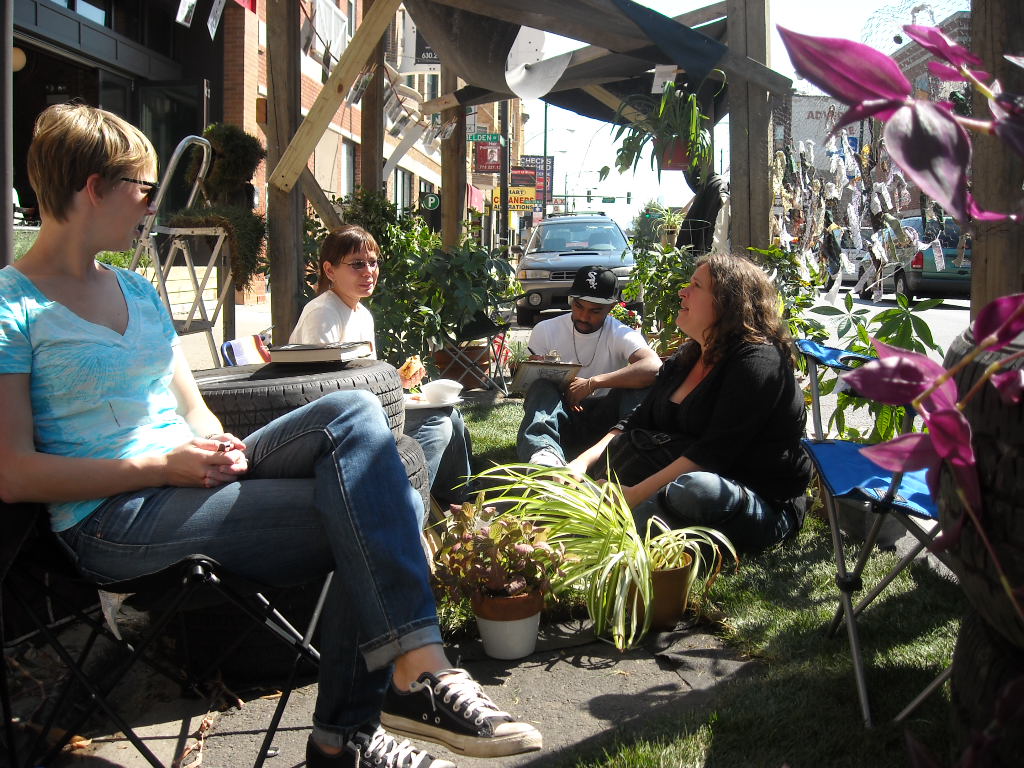
Dismal as this may all appear, it helps to remember that history is full of times when those at the top gorged their greed and created vast gaps between the strong and the weak. During such times the weak have found all sorts of solutions such as the self-sufficiency of farmers and fishers, tradesmen carrying out business far from the castles whose moats and walls symbolized not only power but fear, and the monks in the monastery. Further, all across America there are places and people practicing the values our leaders have scrapped. While contemporary liberals are trapped in the illusion that salvation always comes from the top, we have no choice to save our country but from the bottom up.

The Plight Of US Workers

In the aftermath of the Great Financial Crisis, and the rise of the Tea Party as a right-wing adjunct to the Republican Party, the assault on workers intensified still further. A report by the Economic Policy Institute that reviewed state-level legislative changes in labor policy and labor standards since 2010 found that "the changes undermine the wages, working conditions, legal protections, or bargaining power of either organized or unorganized employees.... The consequence of this legislative agenda is to undermine the ability of workers to earn middle-class wages and to enhance the power of employers in the labor market. These changes did not just happen but were the results of an intentional and persistent political campaign by business groups."

5 Overlooked Activist Victories In 2013

In February, Filipino President Benigno Aquino III — whose father was assassinated by the former dictator Ferdinand Marcos in 1983 — signed a law that will take more than $220 million from Marcos-controlled Swiss bank accounts to compensate people who were tortured, raped and jailed under the U.S.-backed dictatorship. Although the sum represents only a tiny fraction of the billions believed to have been stolen and then hidden by Marcos in international banks, Waging Nonviolence columnist Ken Butigan described the law as “a significant step toward healing and restorative justice,” as well as “a reminder that nonviolent action doesn’t end when the last demonstrator goes home. ”

2013 Resistance Report Year In Review

What an amazing year for the movement of movements that continues to develop here in the United States and around the world, and what an amazing first season of The Resistance Report. In this week’s special expanded episode, we take a look back at some of the most amazing stories of the year. In addition to coverage of Edward Snowden, the Acronym TV 2013 Person of the Year, we also remember 2013 as a time when people took power and reversed what seemed like the inevitable march to war with Syria. In 2013, The Resistance Report served as an antidote to the hear-no-evil see no evil attitude of mainstream media outlets here in the United States about the ongoing crisis at the Fukushima nuclear facility in Japan. In the attempt mitigate future catastrophic damage; the global community is faced with challenges unique in the history of humankind. While The Resistance Report launched this year on July 29, 2013, and so our review of Resistance Reports is but a half year old, but there is still enough Manning, Snowden, Greenwald, Keystone X-L protests, Stop the TPP Protests, Dream Defenders, Fast Food Strikers, Hunger Strikers, and neo-liberal shenanigans to jam pack this 60 minute year in review.

Connecting The Dots: Bhopal To Hammond, Stratfor And Dow

Bhopal - In 1984, a Union Carbide Corporation plant expelled a deadly gas in the Indian city of Bhopal, killing an estimated 15,000 people. Thirty years later, the story continues and has involved people and corporations all over the world. Activist Reena Shadaan discussed the winding road leading from the plant’s opening, to the first safety issues, to the disaster, though the court cases, the Dow purchase, the intelligence gathering activities that followed, the Jeremy Hammond leak, all the way to the current campaign in support of the residents in Bhopal, which has received a major boost from an award-winning documentary.

“Unfathomable”: Commission Trying To Close California’s Largest Public College

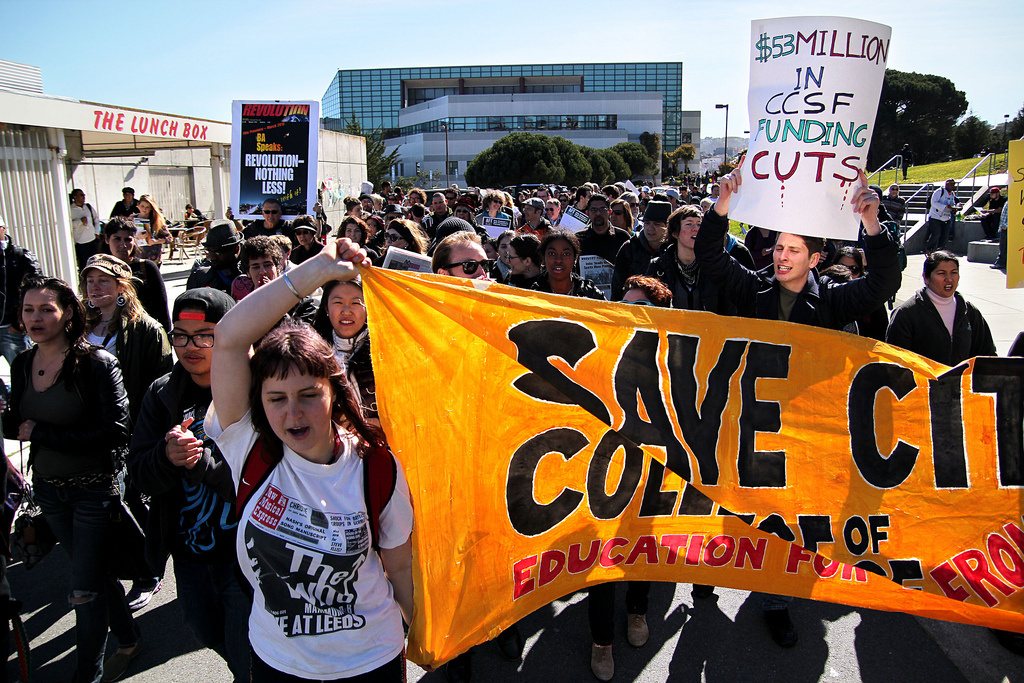
A little-known but powerful organization called the Accrediting Commission for Community and Junior Colleges (ACCJC) has announced plans to revoke CCSF’s accreditation on July 31, 2014, subject to appeals and a one-year review. The loss of accreditation would certainly mean that CCSF, which has about 80,000 students and is California’s largest public college, would be forced to close – possibly during its 80th anniversary. Students at unaccredited colleges are not eligible for student loans or other types of financial aid through government agencies. The decision to impose sanctions on CCSF has set in motion a fierce yearlong struggle that is being played out on its 11 campuses, in hearing rooms in Sacramento and Washington, D.C., and in San Francisco courtrooms. San Francisco City Attorney Dennis Herrera, the California Federation of Teachers and the Save CCSF Coalition have filed lawsuits alleging that ACCJC allowed its advocacy and political bias to prejudice its evaluation of college accreditation standards.

71 US Navy Crew Sue TEPCO, Half Have Cancer

After U.S. Navy sailors on the USS Ronald Reagan responded to the 2011 Fukushima disaster in Japan for four days, many returned to the U.S. with thyroid cancer, Leukemia, brain tumors and more. At least 71 sailors—many in their 20s—reported radiation sickness and will file a lawsuit against Tokyo Electric Power Co. (TEPCO), which operates the Fukushima Daiichi energy plant. The men and women accuse TEPCO of downplaying the danger of nuclear radiation on the site. The water contaminated the ship’s supply, which led to crew members drinking, washing their bodies and brushing their teeth with contaminated water. Paul Garner, an attorney representing 51 sailors, said at least half of the 70-plus sailors have some form of cancer.

Dark Money In Climate Change

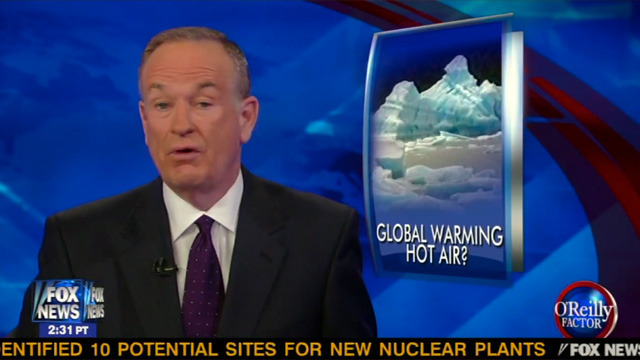
In his speech at Georgetown University this year, President Obama made it clear that tackling climate change will be one of the key priorities for the remainder of his term. “I refuse to condemn your generation and future generations to a planet that’s beyond fixing,” he said. But as virtually everyone who follows that debate knows, climate denialists are aggressive and particularly well-funded. A new study from Drexel University has broken down the financial structure of the climate-denial movement, and the findings are essential for plotting out a map to success on combating global warming. It’s the first peer-reviewed analysis of its kind.

The Biggest Food Labeling Scam Of All Time

The New York Times obtained the letter from the Environmental Working Group, an advocacy organization in Washington that favors labeling, and a spokesman for the grocery association confirmed its authenticity. But the spokesman, Brian Kennedy, said no one from the association was available to comment because of holiday travel. Scott Faber, vice president of the Environmental Working Group, called the association's request "audacious." He added, "It's like they're trying to get the government to say night is day and black is white." The association's request was sent just weeks before the end of the year, when the F.D.A. is expected to establish voluntary guidelines for the labeling of foods containing biotech ingredients, based on the priorities it has identified for itself.

Wall Streeters Cheer Villainous Protagonist

But my one major gripe was pretty simple: Jordan Belfort defrauded a lot of people — and by the nature of his penny stock transgressions, many low-income people — out of a ton of money. He then used that money, as one does, on cocaine, hookers, cars, and yachts. It may be great cinema to document his exploits, but there's a fine line between satirizing Wall Street's excess and celebrating Belfort's lifestyle. Put simply, the film could have done a better job making Belfort look like a villain. Or maybe the film did do that, and we were just watching with the wrong crowd. There were a lot of finance pros there. The theater is in Manhattan's financial district and the movie has "Wall Street" in the name, after all.

Trading Nature For Profit

People of the Pacific Rim, their communities and the ecosystems, on which all life depends, are at the mercy of big energy and agriculture corporations, which are among the thousands of global corporations advising the Trans-Pacific Partnership (TPP) process. The Investor-to-State Rules of the TPP will allow foreign corporations to by-pass a country’s domestic court system and go directly to a secret international tribunal to challenge our environmental laws as a “regulatory taking” that lowers “expected future profits.” Each country has hundreds or thousands of foreign corporations doing business in its territory that can challenge their domestic environmental laws.

Oil Regulation Being Privatized In Alberta, Canada

More than 75 environment officers who watched over oil industry activities left the provincial environment department this fall, to take higher paying jobs with the new industry-funded Alberta Energy Regulator. Another 75-plus are expected to leave in the spring. In mid-November, the department also began handing over to the regulator thousands of files on oil industry activity pertaining to the Public Lands Act, according to documents obtained by the Journal. This shift in staffing and the moving of years of files out of a government department to the new arm’s length regulator are key steps in the government’s plan, announced last spring, to create a more streamlined approval process for oil companies that wanted “one window” to get permits for new projects. Previously, companies had to apply to the environment department for some permits and to the old regulator, the now defunct Energy Resources Conservation Board.

Bacardi: The First MultiNational Corporation

Long before oil dominated geopolitics, rum was the original global commodity, tying Europe, the Americas, Africa and the Caribbean in a complex web of trade and credit. And Bacardi was the original multinational. Rum has always tended to favor and flavor rebellion, from the pirates and buccaneers of the seventeenth century to the American Revolution onward. In addition, sugar and rum pretty much introduced globalization to a waiting world, tying together Europe, the Americas, Africa and the Caribbean in a complex alcoholic web of trade and credit. Not until oil was any single commodity so important for world trade. So it is not surprising that the Bacardi Corporation has become one of the world's first transnationals. Even before Fidel Castro took power, the Bacardi family moved its headquarters from its Cuban home to the Bahamas, allowing it to get British imperial trade preferences, while opening a large distillery in Puerto Rico to allow penetration of the American market. Now its management is mostly living in exile in Florida, monopolizing the local markets across the Caribbean and the world with its bland, branded spirit.

Precarious Democracy

Millions of Americans face a precarious financial future, thanks to the democratic institutions that are meant to represent them. In our January 2014 issue, In These Times explores how life has become increasingly precarious for the many Americans who lack job security—a trend that is the predictable result of the ongoing disempowerment of the American worker. But it is not only the corporate system that is impoverishing our citizens. Millions of Americans face a precarious financial future, thanks to the democratic institutions that are meant to represent them. Seniors who rely on Social Security are beset by D.C. budget-cutters bent on reducing cost-of-living increases. The poor go hungry in the wake of congressional cuts to food stamps. Retirees in the public sector face uncertain futures as state and local governments turn away from their pension obligations. Our elected leaders—Democrats and Republicans alike—depend on the largesse of the rich to win re-election. And faith in the idea that government is a source of reform is in deep decline. Case in point: the Obamacare rollout debacle. We hope and trust that the ACA will right itself and constitute a measurable improvement over the status quo. But we are equally confident that Obamacare must ultimately be replaced by a more comprehensive social democratic solution: universal single-payer health insurance. A guarantee of healthcare would improve the bargaining position of workers, raise the expectations of citizens, and embolden seniors, parents, patients and the disabled. This should be a key political objective of the precariat.
assetto corsa mods

Urgent End Of Year Fundraising Campaign

Online donations are back! Keep independent media alive. 

Due to the attacks on our fiscal sponsor, we were unable to raise funds online for nearly two years.  As the bills pile up, your help is needed now to cover the monthly costs of operating Popular Resistance.

Urgent End Of Year Fundraising Campaign

Online donations are back! 

Keep independent media alive. 

Due to the attacks on our fiscal sponsor, we were unable to raise funds online for nearly two years.  As the bills pile up, your help is needed now to cover the monthly costs of operating Popular Resistance.

Sign Up To Our Daily Digest

Independent media outlets are being suppressed and dropped by corporations like Google, Facebook and Twitter. Sign up for our daily email digest before it’s too late so you don’t miss the latest movement news.