Skip to content

Democracy

New Lawsuit Aims To Be ‘Death Of The Super PAC’

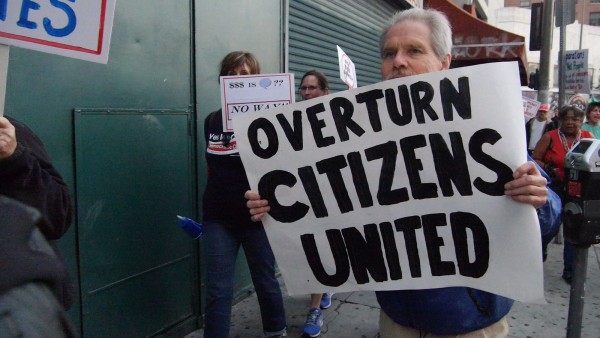
By Deirdre Fulton for Common Dreams - While most people point to Citizens United as the case that opened the door to big money in U.S. elections, the lesser-known 2010 appeals court ruling in SpeechNow.org v. FEC is perhaps just as blameworthy—one legal scholar says the decision "gave birth to the super PAC takeover of American politics." Now, a bipartisan group of lawmakers, congressional candidates, and campaign reform advocates is taking aim at that ruling, filing a lawsuit on Friday that they say "will provide the U.S. Supreme Court the opportunity to end the super PAC threat facing our democracy today."
Eight Ways To Strengthen Our Democracy Beyond Voting

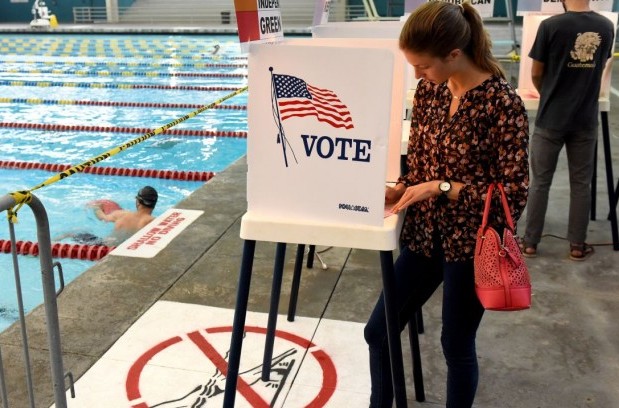
By Chuck Collins for Other Worlds - The strength of our civic life depends on what we do outside elections. Throughout this trying election season, we’ve been told how much is at stake with our vote. But the success of any democracy depends on continuing to pay attention long after we cast our ballots. So let’s pledge to strengthen our democracy with a few resolutions to focus our intentions and keep us moving forward over the next four years.

Trickle-Up Democracy: State And Local Ballots Give Voters A Say

By Frances Moore Lappé And Adam Eichen for Moyers and Company - Even in a presidential campaign where both candidates are speaking out against the influence of big money in politics, it’s easy to be cynical about the prospects for reform. The failure of Congress to take even baby steps in the right direction is enough to dishearten even the most idealistic among us. But there is hope for our political system coming from the grass roots. Citizens across the country may well turn the 2016 election into a watershed moment for democracy.

Three Voter Initiatives That Have Not Gotten Much Attention

By David Morris for the Institute for Local Self-Reliance. We believe in direct democracy, where people make the decisions rather than elected representatives. This article describes initiatives in three state that take on different issues. California has an initiative that takes on pharmaceutical prices. It is imperfect but a step toward controlling the out-of-control prices of pharmaceutical drugs in the United States. South Dakota takes on multiple democracy initiatives, i.e. one does away with partisan elections, a second creates a commission to redraw legislative districts every ten years, and the final vote is on a series of steps to reduce money in politics, one of the changes would be democracy credits donate to state legislative candidates who agree to participate in at least three public debates and cap the amount of private money they receive per contributor. We do not support doing away with partisan elections because what this ends up doing is doing away with third parties who do not have the money to compete, and can result in having two Democrats or two Republicans running against each other . . .

Income Sharing Could Save Our Lives

By Matt Stannard for Occupy.com. “Being poor is hoping the toothache goes away,” Hugo Award-winning author John Scalzi wrote in a personal blog post over a decade ago. “Being poor is a heater in only one room of the house... Being poor is needing that 35-cent raise... Being poor is six dollars short on the utility bill and no way to close the gap... Being poor is knowing you work as hard as anyone, anywhere.” Economic insecurity is the American nightmare. It kills us earlier, messes up our mental health, saps the life out of us. Since Scalzi’s 2005 post, we’ve learned that more than 60 percent of us can’t afford a $500 emergency – which roughly translates to hoping the toothache goes away. That’s a pretty raw deal in exchange for an economic system that’s also killing the planet. And only rarely can we count on others to help us out. They’re either broke themselves, or profiting from our financial instability.

Social Democracy And Radical Left: Why We Continue To Build Left Unity

By Kate Hudson for Defend Democracy Press - Jeremy Corbyn’s re-election to the leadership of the Labour Party on an increased vote is a significant victory for the left in the Labour Party and for progressive politics in Britain. It is a victory that everyone on the left celebrates. It demonstrates the strength of support that exists for changing the politics of the Labour Party: for shifting the balance of power within our society, away from the political and economic elites towards the majority, to empower and enfranchise the working class and communities hardest hit by the long run attacks upon the welfare state.

Plutocratic Forces Crippled Democracy, And Why It’s Up To Us To Fight Back

By Ralph Nader for Alternet - In the 1920s, near the end of his spectacular career as our country’s most prominent fighter for working people, labor leader, presidential candidate, orator, and all-around progressive Eugene Debs was asked by a reporter: “Mr. Debs, what do you regret the most in your lifelong struggle for justice?” Debs looked at him and replied: “What do I regret the most? I regret that the American people can have almost anything they want under our Constitution, but they seem not to want much of anything at all.”

The Democratic Swindle: Hillary Or Trump?

By Luciana Bohne for Counter Punch - We have political democracy in America but scarce economic democracy. We have the political structures of democracy, but they teeter on foundations of exceptions. These check the advance of genuine democracy from below. We have democracy for the few and exclusion for the many. We have socialism for capital and capitalism for the rest. Every political right or freedom, moreover, is provisional.

Newsletter: Elections Expose the Oligarchs

By Kevin Zeese and Margaret Flowers for Popular Resistance. The 2016 presidential election has shown how the duopoly, the two parties that represent big business interests and the wealthiest, are corrupted in ways that prevent the people’s voices from being heard, their necessities being met and the planet being protected from human greed. During the campaigns, leaks have given people a behind-the-scenes look at how the parties operate and research on the candidates shows their personal failures. They give voters an image of elites who behave as if the law does not apply to them and who put themselves ahead of the public interest. Last Friday was a day of embarrassment for both the Republican and Democratic Parties. A tape showing Donald Trump bragging about sexual assault in lewd ways has gotten the bulk of attention, but Wikileaks also released thousands of pages of The Podesta Emails, 2,060 emails and 170 attachments. John Podesta is the ultimate insider.

US Hypocrisy: Urges Inclusive Debates Around The World But Not In US

By Lee Fang for The Intercept - When it comes to presidential debates, the United States does not practice what it preaches: When advising debate organizers in foreign countries, government officials advise them to include minor party candidates. USAID, the government agency charged with promoting foreign development, funded a guide for “organizers around the globe seeking to hold candidate debates for elected offices.” The guide, published in 2014, recommends that debates be as inclusive as possible.

Thinking Dangerously In Age Of Normalized Ignorance

By Henry Giroux for CounterPunch. What happens to a society when thinking is eviscerated and is disdained in favor of raw emotion? [1] What happens when political discourse functions as a bunker rather than a bridge? What happens when the spheres of morality and spirituality give way to the naked instrumentalism of a savage market rationality? What happens when time becomes a burden for most people and surviving becomes more crucial than trying to lead a life with dignity? What happens when domestic terrorism, disposability, and social death become the new signposts and defining features of a society? What happens to a social order ruled by an “economics of contempt” that blames the poor for their condition and wallows in a culture of shaming?[2] What happens when loneliness and isolation become the preferred modes of sociality?

Newsletter: Living In The Illusion Of Democracy

By Kevin Zeese and Margaret Flowers for Popular Resistance. The hubris and manipulation of the two establishment parties is evident in the presidential debates. The two Wall Street funded parties decide who is allowed to participate in the debates. The so-called debate ‘commission’ is a disguise of the Democratic and Republican parties. It is a commission in name only, in reality it is a corporation created by the two parties and controlled by the two parties. When the disguise is removed, it becomes obvious that the Democrats and Republicans are choosing to only debate Democrats and Republicans, and preventing any competition. In 1988, the Republican co-founder, Frank Fahrenkopf, who remains a co-chair, indicated at the news conference announcing the ‘commission’ that they were “not likely to look with favor on including third-party candidates in the debates.” The New York Times quoted the Democratic co-founder, Paul Kirk, saying: “As a party chairman, it’s my responsibility to strengthen the two-party system.”

Texas Defied Court’s Voting Rights Order And The Court Is Angry

By Ian Millhiser for Think Progress. Earlier this month, the Justice Department informed a federal court that Texas is violating a recent court order that sought to keep the state from disenfranchising voters. After an appeals court struck down the state’s voter ID law, a common form of voter suppression favored by conservative lawmakers, the state agreed to be bound by an order that would permit voters to cast a ballot in the 2016 election if they “cannot reasonably obtain” photo ID. Despite this order, Texas published press releases, voter education materials, and training manuals for poll workers that effectively stated that a voter without ID cannot vote unless it is literally impossible for that voter to obtain a photo ID. Thus, for example, a voter who had to make multiple day long trips to a government office and make burdensome document requests to obtain an ID would not be able to vote, under Texas’ standard, unless that voter was willing to jump through all of these considerable hoops. On Tuesday, Judge Nelva Gonzales Ramos, the judge overseeing this case, weighed in on Texas’ defiance of the court order. And, if the order she issued on Tuesday is any indication, she’s pissed.

Europe’s Left After Brexit

By Yanis Varoufakis for Yanis Varoufakis - In the space of thirteen months two referenda shook up not only the European Union but also Europe’s Left: the Greek OXI in July 2015 and Brexit in June 2016. Exasperated by the EU’s mixture of authoritarianism and economic failure, a segment of Europe’s Left is now calling for a “break with the EU”,[2] a stance that has come to be associated with the term Lexit.[3] DiEM25, the transnational Democracy in Europe Movement, rejects the Lexit logic and offers an alternative Progressive Agenda for Europe.

Occupy The Debates

By Kevin Zeese for OpEd News. A recent USA Today poll found 76% of voters want debates with four candidates including not just the two most hated candidates in history, the Republican and Democratic nominees and their vice presidential running mates, but Jill Stein and Ajamu Baraka of the Greens, and Gary Johnson and Bill Weld of the Libertarians. Any candidate on enough ballots to achieve 270 electoral college votes should be in the debates. The people have a right to see all candidates debating the issues who are on their ballots. The deceptive debate commission, which is called a debate commission just to hide the truth: it is a corporation of the Democrats and Republicans whose purpose is to limit debates to their two parties, has no legitimacy. It has a major conflict of interest -- why should the two establishment parties decide their opponents cannot debate? It is an obvious conflict of interest that the media should be calling out. The media should join the demand of the people -- open debate are essential for democracy.
assetto corsa mods

Urgent End Of Year Fundraising Campaign

Online donations are back! Keep independent media alive. 

Due to the attacks on our fiscal sponsor, we were unable to raise funds online for nearly two years.  As the bills pile up, your help is needed now to cover the monthly costs of operating Popular Resistance.

Urgent End Of Year Fundraising Campaign

Online donations are back! 

Keep independent media alive. 

Due to the attacks on our fiscal sponsor, we were unable to raise funds online for nearly two years.  As the bills pile up, your help is needed now to cover the monthly costs of operating Popular Resistance.

Sign Up To Our Daily Digest

Independent media outlets are being suppressed and dropped by corporations like Google, Facebook and Twitter. Sign up for our daily email digest before it’s too late so you don’t miss the latest movement news.