Skip to content

Student Debt

Newsletter: Youth Recognize Their Power & Build It

By Kevin Zeese and Margaret Flowers for Popular Resistance. Youth are rising up. They have been showing leadership on multiple fronts of struggle. They see a broken system dysfunctional government that is corrupted by money. It is unable to respond to the crisis of climate change; the reality of systemic racism; students graduating with massive debt in a poor job market and so many other issues. Politicians aren’t the only voices with power. We have power, too. And we have more power when we act together. Young people don’t live single-issue lives. We live at the intersection of the most pressing problems today. Our movements are connected and our purpose is huge. Martin Luther King described the civil rights movement as a time when the “people moved their leaders, not the leaders who moved the people.” If enough of us push together toward a new vision, the world will begin to move. That is a message we should all take to heart. We should continue to exercise our power, continue to fight injustices and as we do so, our power will grow.

Obama Administration Hits Back At Student Debtors Seeking Relief

By Natalie Kitroeff for Bloomberg Business - On a day when Democratic presidential candidates sparred in a national debate over who would do more to help indebted students, the U.S. government launched a new attack on student debtors seeking loan relief. On Tuesday, the Department of Education intervened in the case of Robert Murphy, an unemployed 65-year-old who has waged a three-year legal battle to erase his student loans in bankruptcy. Unlike almost every single form of consumer debt, student loans can be erased only in very rare circumstances. Murphy’s case, which is currently being heard in a federal court in Boston, could make things a little easier for certain borrowers.

Student Loan Crisis Driven By For-Profit Colleges, Report Shows

By Dan Wright in Shadow Proof - A new report [PDF] by the Brookings Institution claims the recent increases in student loan defaults are tied to an increased use of for-profit colleges. Through researching information from the Treasury Department and other sources, Brookings found that “most of the increase in default is because of an upsurge in the number of borrowers attending for-profit schools and, to a lesser-extent, community colleges and other non-selective institutions whose students had historically composed only a small share of student borrowing.” During the Great Recession brought on by Wall Street’s fraudulent activity in the mortgage market, many Americans went back to school in hopes of gaining skills to improve their financial position.

‘I Learned More Leading Student-Debt Strike Than I Did at College’

By Nathan Hornes for Yes! Magazine - Soon after we started our campaign, Debt Collective, a debt resistance group that grew out of Occupy Wall Street, contacted us. They had heard some of the complaints about Everest and had also heard about our activism. When we met with them they told us how they had recently figured out a way to buy medical debt for pennies on the dollar and abolish it. They wanted to start doing the same for student loan debt. The people we met through Debt Collective also told us about how Corinthian Colleges—the group of colleges Everest belongs to—had been screwing over students across the country. Up until then I’d thought it was just my campus, but then I began to understand that tons of people were dealing with our same problems. Debt Collective helped us take our campaign to the next level. Now I’m known as the guy who helped shape the very first student debt strike.

Why Liberals Have To Be Radicals

By Robert Kuttner in Prospect - Just about nothing being proposed in mainstream politics is radical enough to fix what ails the economy. Consider everything that is destroying the life chances of ordinary people: Young adults are staggered by $1.3 trillion in student debt. Yet even those with college degrees are losing ground in terms of incomes. The economy of regular payroll jobs and career paths has given way to a gig economy of short-term employment that will soon hit four workers in 10. The income distribution has become so extreme, with the one percent capturing such a large share of the pie, that even a $15/hour national minimum wage would not be sufficient to restore anything like the more equal economy of three decades ago. Even the mainstream press acknowledges these gaps.

Hoax Asks Why Free College Tuition Not Being Discussed

By Sarah Lazare in Common Dreams - A group of anti-debt camaigners pulled off a creative hoax on Monday by falsely announcing it had won a coveted prize offered by the nation's student "aid" industry with this innovative proposal: "end student debt for good by making higher education tuition free for all." Debt Collective, which is a new debtors' union that formed as an offshoot of Strike Debt, created a fake Twitter handle, blog post, and image announcing the group's receipt of the National Association of Student Financial Aid Administrators' Big Idea award. The announcements were released right in the middle of a New Orleans conference of the NASFAA, which says it represents "20,000 student financial assistance professionals at approximately 3,000 colleges, universities." While Debt Collective's award announcement was fake, their proposal was completely real.

Arne Duncan’s False Promise To Forgive Debts At For-Profit Schools

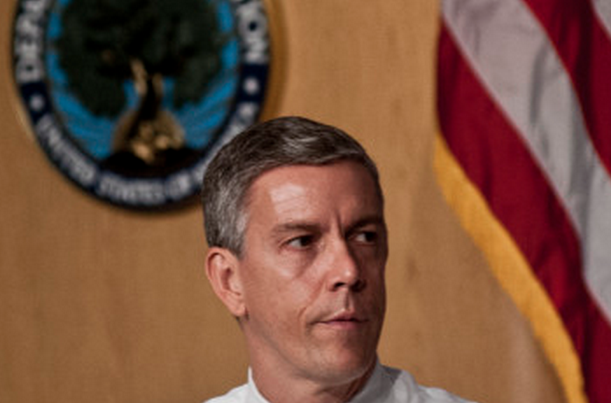
By Glen Ford in Black Agenda Report - Arne Duncan, President Obama’s Secretary of Education, claims his department is prepared toforgive the debts of thousands of students who attended the Corinthian Colleges, the for-profit rip-off conglomerate that filed for bankruptcy last month. Duncan chose his words carefully, claiming that the federal government is putting together a process that would forgive the loans of any student who can show that she had been defrauded by any college – Coriinthian or some other school. Duncan is, of course, lying. His own department estimates it would cost as much as $3.5 billion to provide debt relief to the 350,000 students that have had the misfortune to attend Corinthian schools over the past five years.

Debt Resistors Protests Dept Of Education Debt Relief Program

By Debt Collective - Just as Corinthian Colleges portrayed its programs as a path to a better life when they were in fact debt traps, the Department of Education is portraying a process that re-victimizes students as a solution to a problem they created. If Education Secretary Arne Duncan was truly “committed to making sure students receive every penny of relief they are entitled to under law” he would sign the “Order for Discharge of Federal Student Loan Debts” the Debt Collective sent him last week, immediately and automatically discharging Corinthian students' debts. Students are entitled to receive full relief under law.

College Has Gotten 12 Times More Expensive in One Generation

By Katie Rose Quandt in Mother Jones. In the 2012-13 school year, first-year, on-campus tuition averaged $43,000 at four-year, private schools and $21,700 at in-state public schools. It wasn't always like this: The cost of undergraduate education is 12 times higher than it was 35 years ago, far outpacing inflation. While the indexed price of college tuition and fees skyrocketed by more than 1,122 percent since 1978, the cost of medical care rose less than 600 percent, and the cost of housing and food went up less than 300. Back in 1993, 47 percent of college students graduated with debt, owing an average of $9,450 per grad. As tuition rates have shot up, so has student debt: 71 percent of the class of 2012 graduated with outstanding loans, owing an average of $29,400. That's more than 65 percent of the entire first-year salary of an average recent grad. That debt has lasting consequences. Households headed by a young adult (under 40) with a college education and student debt have a median net worth of just $8,700. Student debt constrains young people's ability to start a business, buy a home, or pursue a public-interest career.

For Profit College Closes 28 Schools After Debt Resistance

Controversial for-profit giant Corinthian Colleges said Sunday it is closing the doors of its remaining 28 schools, capping the year-long collapse of one of the country’s largest career college chains. The closure will leave some 16,000 students without certificates or degrees but with a good chance of having their federal student loans forgiven. Corinthian said it is working with other schools to find a home for its displaced student body, but those efforts depend on the cooperation of the institutions and the Education Department. “As Corinthian closes its doors for good…department staff will immediately begin outreach to Corinthian students to review all their options, which may include loan discharges for students whose school closed,” Undersecretary of Education Ted Mitchell said in a statement. “What these students have experienced is unacceptable.”

Lessons And Tactics From Past Debt Resistance Movements

What are the lessons we can take from these movements that apply to today? With regards to Shays' Rebellion, we can look at two things: • The protesters had a clear, coherent message and stuck with it • They escalated the situation over time. With regards to a clear message, the best thing student debt activists can do today is to get on the same page with one another so that there is one, coherent message that gets repeated again and again. This will help serve as a guiding point for the goal that is to be achieved. This means activists can up the ante and bring more attention to their cause by doing things like blocking roads and disrupting the status quo in a variety of peaceful, nonviolent ways.

Why Students Are Marching For Better Wages

Among the protesters rallying this week were students at more than 200 college campuses across the country. In New York, undergrads, high schoolers, grad students, adjunct professors and campus workers from around the city gathered at Columbia University to discuss their experiences in low-wage industries and the need for better wages and working conditions. Some drew connections between economic justice and movements including Black Lives Matter, environmental justice and improving resources for sexual violence survivors. A few participants held a long banner with a black prohibition sign covering Ronald McDonald's image. Below the drawing, the banner read, "FIGHT FOR $15." Above it, "STUDENTS ARE NOT LOVIN IT." For many students, raising the minimum wage is more than an abstract political issue. Some students work low-wage jobs to help pay tuition or cover their living expenses; others might do so after graduation, when they will have an average of almost $30,000 in student loan debt.

Tuition Hikes, Nova Scotia Students Occupy Finance Minister’s Office

A group of disgruntled Halifax university students brought their issues with the new provincial budget right to Finance Minister Diana Whalen’s doorstep. Coming from Dalhousie and St. Mary’s universities, as well as the University of King’s College and NSCAD University, the group of about 15 students held a study-in on Monday at Whalen’s constituency office on Lacewood Drive. “We’re here because this government has proposed the most radical changes to tuition policy in our lifetime, the total deregulation of fees,” said John Hutton, 25, a Dal economics and international development student. “Nova Scotia’s students already graduate, on average, $35,000 in debt. This budget will only make what’s already a crisis worse.”

The Tax Trap Of Student Debt Cancellation

There’s just one catch. Under current federal tax rules, when student debts are cancelled, millions of families will get blindsided by a staggering tax bill. It will force many folks into sudden, unexpected financial ruin. Many people will lose their homes or be forced to sell. Many will go bankrupt. And many will trade student-debt collectors for even more powerful IRS debt collectors. Without a change in tax rules, it could be “out of the frying pan, into the fire” for cash-strapped families. The problem: Uncle Sam treats forgiven debt as income. Under normal circumstances, this policy helps prevent tax fraud. Imagine, if any forgiven debt were tax-free, your employer could “loan” you your salary.

‘Corinthian 100’ Ask Education Department: What About Us?

Fourteen federal student loan borrowers refusing to make their monthly payments to protest the U.S. Department of Education's shoddy oversight of for-profit colleges met with senior government officials on Tuesday to share their stories and learn about the department's plan to help them. The Education Department’s answer, in short: Keep on waiting. The borrowers are part of the so-called Corinthian 100, a growing group of roughly 100 former students of schools once owned by Corinthian Colleges Inc., the troubled owner of what was once one of the largest chains of for-profit campuses, and are now struggling with their debts.
assetto corsa mods

Urgent End Of Year Fundraising Campaign

Online donations are back! Keep independent media alive. 

Due to the attacks on our fiscal sponsor, we were unable to raise funds online for nearly two years.  As the bills pile up, your help is needed now to cover the monthly costs of operating Popular Resistance.

Urgent End Of Year Fundraising Campaign

Online donations are back! 

Keep independent media alive. 

Due to the attacks on our fiscal sponsor, we were unable to raise funds online for nearly two years.  As the bills pile up, your help is needed now to cover the monthly costs of operating Popular Resistance.

Sign Up To Our Daily Digest

Independent media outlets are being suppressed and dropped by corporations like Google, Facebook and Twitter. Sign up for our daily email digest before it’s too late so you don’t miss the latest movement news.