Skip to content

TPP

TPP Talks Come To DC: Time To Release The Text!

We've just learned that the Trans-Pacific Partnership (TPP) negotiators are coming to Washington, DC in early December so that the President can finalize the text. As you may well know, the parts of the TPP that we've seen show that this agreement will severely undermine our ability to protect our communities and the planet. The TPP extends way beyond a traditional trade agreement and puts in place laws that would not pass through Congress in the light of day. The TPP deregulates corporations and gives them enhanced power to sue from the local to the national level if laws interfere with their expected profits. And the court that would be used operates outside of our legal system and can't be challenged. Imagine life if the TPP passes: we would not be able to ban fracking or stop corporations from other toxic practices; we would not be able to give preference to local producers of goods and services; and we would lose more jobs to countries with lower wages and worker protections which would hasten the race to the bottom.

It’s Our Digital Future Video Launch

At it's best, the Internet encourages us to share, use our creativity, and express ourselves freely. But these freedoms are being threatened by big media conglomerates who are trying to use copyright laws to control the Internet. While copyright laws were originally created to protect people's ability to make a living from their inventions, today they have been corrupted by big media conglomerates, abusing them for their advantage. It will be easy to fail to follow the rules without even knowing it. Now, big media conglomerates are trying to change the rules again to be even more restrictive through the Trans-Pacific Partnership (TPP). Under the TPP, Internet Service Providers (ISPs) could be forced to police your internet use and forced to kick you off line if you are just suspicious of breaking rules without a jury, judge, or due process.

Close To Home: Partnership Would Threaten Local Control

Though fast track has been used before, it raises constitutional issues and arouses suspicion about the proponents’ priorities and secret provisions of the pact. This process does not meet the minimal standards of transparency and accountability. Fair trade agreements do not have to be fast tracked. As with NAFTA and the World Trade Organization, the Trans-Pacific Partnership would favor the free flow of capital, remove restrictions on trade and investment, eliminate subsidies, protect intellectual property rights and promote privatization of public services. It is more about protecting investments than about trade.

Letter To Trade Activists: While They Play Poker, Let’s Play Chess

Is President Obama really going to sell us out on trade? Did Sen. McConnell have a full or half smile in the last press conference where he talked about Fast Track? Is Rep. Boehner really going to have a showdown with President Obama over immigration and how will that impact Fast Track? What about the news stories stating that TPP will be signed next month? Oh, and how do the XL pipeline and deal with China on carbon emissions factor in? Comrades, don’t let the results of the elections, and the political posturing that’s happened since, drive you crazy, distract you, or cause you to lose hope. We have a path to victory! Democrats lost control of the Senate, but we did not lose control over our campaign to stop corporate-driven, job-offshoring, democracy-stifling “free trade” agreements by stopping President Obama from getting Fast Track trade authority. In fact, we have a chance to bury Fast Track once and for all.

As TPP Trade Talks Miss Third Deadline, Opponents Claim Momentum

For the third year in a row, government negotiators for 12 Pacific Rim countries have missed an internal deadline to reach agreement on a controversial U.S.-led trade deal. And though negotiators for the accord, known as the Trans Pacific Partnership (TPP), say the process is nearing completion, critics of the deal are expressing optimism that both public opinion and political timing are increasingly against the deal. “TPP proponents know they’re under the clock. The resistance against the TPP is as strong as it’s ever been, and is only growing stronger.” -- Arthur Stamoulis of the Citizens Trade Campaign. TPP negotiators confirmed the news on Monday at a regional summit in Beijing. President Barack Obama’s administration, which has been spearheading the TPP talks, had set the meeting of the Asia-Pacific Economic Cooperation (APEC) grouping as a key target for agreement.

TPP Trade Talks Must Stop

Sharan Burrow, ITUC General Secretary, said “This secretive trade deal is good for some multinational corporations, but deeply damaging to ordinary people and the very role of governments. Corporate interests are at the negotiating table, but national parliaments and other democratic actors are being kept in the dark. What we do know, much of it through leaks, is that this proposed deal is not about ensuring better livelihoods for people, but about giving multinational companies a big boost to profits. Governments should shut down the negotiations, and not re-open them unless they get genuine and transparent public mandates at home that put people’s interest in the centre.” Proposals for protection of workers’ rights have met with heavy resistance from some countries, and appear to not cover all ILO Conventions that establish Fundamental Rights at Work or subnational (state and province) labour legislation. The proposals also contain no enforcement for environmental provisions, and fail to address the need for action to mitigate climate change.

Politics And A Food Fight Are Stalling A Major U.S.-Asia Trade Deal

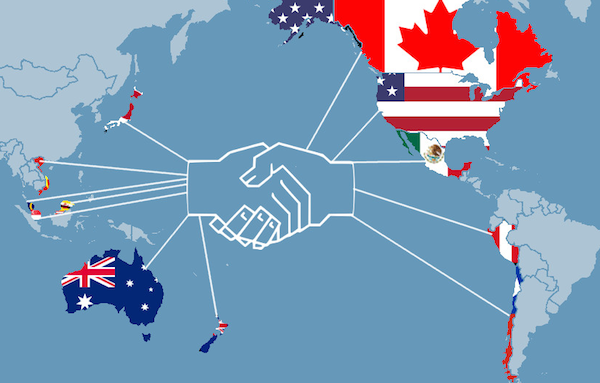
Earlier this year, some trade supporters had predicted this week's APEC summit would bring a breakthrough on a comprehensive trade deal. They had hoped that when the 21 global leaders met at the Asia-Pacific Economic Cooperation Summit, Obama would be able to use a smaller side meeting to conclude the Trans-Pacific Partnership, a trade deal involving the United States, Canada, Australia and New Zealand, as well as eight Asian and Latin American countries. But the deal wasn't reached, and there's no telling when it will be. "There are still significant divides that need to be bridged, especially between Japan and the United States," said Joshua Kurlantzick, a Southeast Asia expert with the Council on Foreign Relations.

‘European Disintegration, Unemployment & Instability’ From TTIP

The problems of TTIP are so many - total lack of meaningful transparency, the unnecessary inclusion of an ISDS chapter, the threat to Europe's high standards governing health, safety, the environment, labour etc. - that the agreement's supporters have been forced to fight back with the only thing they claim to offer: money. TTIP, they argue in multiple ways, will take us to the land of milk and honey, boost the GDP massively, and lead to lots of extra dosh for every family in the EU. But as I've explained, none of this is true. Even the European Commission's own research shows that the most ambitious outcome - that is, one that is already totally unrealistic given the resistance that TTIP is meeting - would produce a boost to Europe's GDP of 0.5% - just 119 billion euros. However, as I and many others have pointed out, this is after ten years, and therefore represents a *cumulative* boost to GDP, which works out at around 0.05% GDP boost per year on average. Here's someone else joining that chorus:

Thousands Rally Against Trade Agreement

There's been an outcry against secretive trade talks, with thousands joining rallies around the country. The target of the protesters' anger in 17 towns and cities is the Trans-Pacific Partnership Agreement. "TPPA, no way," they chanted. The cry rang out from thousands of protesters in Auckland, with the other main centres seeing similar marches and outrage throughout the afternoon. "I just wish that we could have more transparency. And then we would feel more comfortable about things," one protester told ONE News. Twelve countries around the Pacific are involved in negotiations. The Ministry of Foreign Affairs and Trade says a deal would open up trade in goods and services, boost investment flows and promote closer links across the region.

Popular Resistance Newsletter: Link Arms We Are All Connected

For five days in a row this week a federal agency was blockaded by protesters, delaying workers, sending a strong message of demands and resulting in scores of arrests. Did you hear about the blockades in the corporate, mass media? The blockades were just a driveway's distance from CNN, just around the corner from NPR and in a mass media center, Washington, DC. Do you wonder why they did not report that there were blockades outside of the Federal Energy Regulatory Commission (FERC)? The protests were because FERC has been rubber stamping fracked gas infrastructure permits without considering the environmental and health impacts, especially ignoring climate change, and ignoring the views of the communities. Gas companies are very big advertisers in the mass media. . . . Each of the issues raised that day impact all of us and all of the issues we work on: climate change, war and militarism, media corruption, Internet access and global trade. Other days brought in the issues of the corrupt corporate duopoly and a government bought and paid for by big corporations and the wealthy; and the racially unfair impact of environmental toxicity and other issues. There is power in recognizing how our issues are connected. Working together we are stronger. Challenging the system and seeking transformative change is the only way we will create the change that is needed.

TPP Will Put Meat Agribusiness Into Overdrive

The handful of big meat and poultry companies driving factory-style production in the U.S. do not consider themselves U.S. companies. They are global corporations, some with foreign parent companies, operating in multiple TPP countries. An alarmingly few companies control the U.S. protein market (as the industry refers to it). They are all global players operating in multiple sectors and multiple countries, including: JBS USA (beef, pork and poultry), Cargill (beef, feed), Tyson Foods (poultry, beef), Shuanghui/Smithfield (pork). If the meat companies get their way in TPP, rising exports from the U.S. could shift into overdrive. This means there will be more CAFOs in U.S. rural communities, more land needed for animal feed (yes, more corn and soybeans), more antibiotics used to raise these animals, and more water and air pollution from their giant manure lagoons.

Now Is The Time To Step Up To Protest Corporate Trade

There is a mythology that the TPPA will never happen. That is a reckless assumption. It encourages complacency and inaction. And it is seriously wrong. The political leaders of the twelve countries know they have to do the deal soon or it will become paralysed. That won’t happen when the trade ministers meet on 8th November in Beijing on the margins of APEC. But it could happen within a couple of months. No one should doubt how serious they are. That was obvious at the ministerial meeting ten days ago in Sydney. The pressure on the negotiators in the handful of remaining sensitive chapters is intense, as if they have instructions to finish their technical work so the ministers can finalise the deal. What has been saving us all is the continued standoff between the US and Japan over agriculture and automobiles.

Peruvian Patients Reject TPP: Will Affect Their Access To Medication

Leaks on the secret trade agreement, the TPP, are worrying social organizations that deal with health issues in Peru. They predict that the adoption of such a treaty will result in many deaths. On Monday, after the release of new information by Wikileaks, social organizations defending the interests of health patients have spoken out against the TPP. Representatives from the Peruvian Network for Patients and Users claim the treaty will allow for pharmaceutical companies to dominate the use of a drug for decades. The Trans Pacific-Partnership agreement (TPP) is a free trade agreement that is being negotiated in secret by 12 countries including Peru. One of the most controversial aspects of the treaty is the one that protects medicine patents, benefiting the interests of large pharmaceutical companies.

Popular Resistance Newsletter: Communities Stand Up

This week we are inspired by the communities that are standing up to police abuse and by the students in Mexico and Hong Kong who are placing themselves at risk in order to fight for their rights. Ferguson Protests Inspire Last weekend was the national gathering in Ferguson, MO to demand the arrest of Officer Darren Wilson and justice for the families of slain black men such as Mike Brown and Vonderrit Myers. Thousands of people participated in 4 days of nonviolent actions beginning with a march to the police station on Friday night, a massive march through downtown St. Louis on Saturday, direct action training on Sunday, an occupation at St. Louis University and multiple actions on ‘Moral Monday’ including clergy being arrested at the police station, protests that shut down several Walmarts, an action at a mall, a protest inside the City Hall and protests at political fundraisers.

Wikileaks Publishes Updated Intellectual Property TPP Chapter

Today, Thursday 16 October 2014, WikiLeaks released a second updated version of the Trans-Pacific Partnership (TPP) Intellectual Property Rights Chapter. The TPP is the world's largest economic trade agreement that will, if it comes into force, encompass more than 40 per cent of the world's GDP. The IP Chapter covers topics from pharmaceuticals, patent registrations and copyright issues to digital rights. Experts say it will affect freedom of information, civil liberties and access to medicines globally. The WikiLeaks release comes ahead of a Chief Negotiators' meeting in Canberra on 19 October 2014, which is followed by what is meant to be a decisive Ministerial meeting in Sydney on 25–27 October. Despite the wide-ranging effects on the global population, the TPP is currently being negotiated in total secrecy by 12 countries. Few people, even within the negotiating countries' governments, have access to the full text of the draft agreement and the public, who it will affect most, none at all.
assetto corsa mods

Urgent End Of Year Fundraising Campaign

Online donations are back! Keep independent media alive. 

Due to the attacks on our fiscal sponsor, we were unable to raise funds online for nearly two years.  As the bills pile up, your help is needed now to cover the monthly costs of operating Popular Resistance.

Urgent End Of Year Fundraising Campaign

Online donations are back! 

Keep independent media alive. 

Due to the attacks on our fiscal sponsor, we were unable to raise funds online for nearly two years.  As the bills pile up, your help is needed now to cover the monthly costs of operating Popular Resistance.

Sign Up To Our Daily Digest

Independent media outlets are being suppressed and dropped by corporations like Google, Facebook and Twitter. Sign up for our daily email digest before it’s too late so you don’t miss the latest movement news.