Skip to content

Banks

Big Banks Just Flunked Their Own Test On Climate, Indigenous Rights

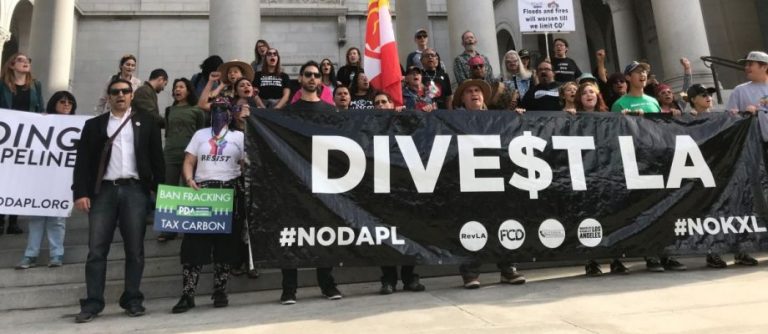
On October 16, JPMorgan Chase, Wells Fargo, Crédit Agricole and 91 other global banks met in Washington, DC, to revise the Equator Principles, industry-led due diligence standards meant to prevent banks from supporting environmentally and socially harmful projects. On the very same day, in a bitter irony, many of those same banks re-upped their support for Enbridge, the Canadian company behind the Line 3 tar sands pipeline, which tramples Indigenous rights and is flatly incompatible with the goals of the Paris climate agreement. They did so just days after the publication of a landmark United Nations report showing the desperate urgency of taking concrete steps to tackle the climate crisis. It’s as if the banks wanted to supply their own headline example of exactly why the Equator Principles are broken and in dire need of repair.
Three Cities, Three Actions, One Target: PNC Bank

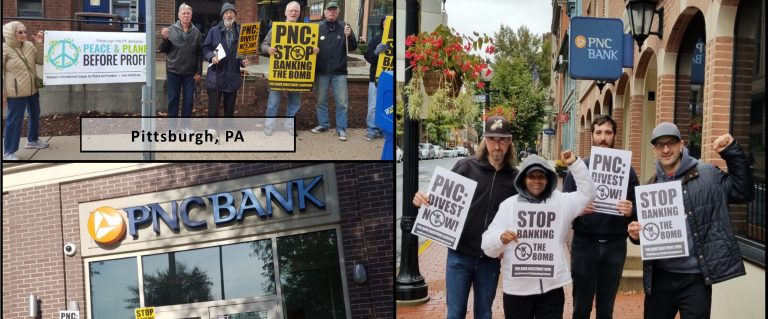
October 13 marked just over a year since Stop Banking the Bomb began its campaign against PNC Bank. Starting with just a handful of Pittsburgh volunteers from the ANSWER Coalition, Veterans For Peace, the Party for Socialism and Liberation and a few other anti-war activists, the campaign is now sponsored by over 30 local, regional and national anti-imperialist organizations. Since launching in late September 2017, the campaign has conducted over 40 actions against PNC Bank in Pittsburgh and around the country. The Stop Banking the Bomb campaign against PNC Bank was started because a few Pittsburgh-based anti-war organizers wanted to bring to the public’s attention that PNC Bank, which is the nation’s seventh largest bank, was a notorious investor in U.S. weapons of mass destruction.

Comparing Crises: 1929 With 2008 And The Next

It is often said that the initial months of the 2008-09 crash set the US economy on a trajectory of collapse eerily similar to that of 1929-30. Job losses were occurring at a rate of 1 million a month on average from October 2008 through March 2009. One might therefore think that mainstream economists would look closely at the two time periods—i.e. 1929-30 and 2008-09—to determine with patterns or similar causes were occurring. Or to a deep analysis of the periods immediately preceding 1929 and 2008 to see what similarities prevailed. But they haven’t.

Disrupt And Protest These Bank Recruitment Events

In the next few months several of the banks that are financing the Bayou Bridge Pipeline and Energy Transfer Partners (ETP) are hosting recruitment events at college campuses. The banks use these events to recruit students to internship programs and for jobs in the finance industry. They speak glowingly about what it means to work for their bank, but leave out the part about how they are financing violent companies like ETP and destructive projects like the Bayou Bridge Pipeline. Water Protectors resisting the Bayou Bridge Pipeline have been beaten, tased and charged with felonies. Stand in solidarity with the frontlines by disrupting and demonstrating at these campus recruitment events and telling students the truth about the banks that are bankrolling the Bayou Bridge Pipeline.

St. Louis: Rally And Bank Shutdown In Solidarity With L’eau Est La Vie Camp

ST. LOUIS: In response to a call from a camp in Louisiana resisting the #BayouBridgePipeline, L’eau Est La Vie Camp, for a day of global solidarity, St. Louis residents who have been to the resistance encampment organized a local action to bring attention to the struggle and put pressure on local targets in St. Louis. The action started at the Bank of America Plaza Downton with a rally that hosted a variety of speakers, after that a march proceeded which ended at a U.S. Bank branch, where 10 activists took over the lobby and shut it down, while the rest of the march remained outside as auxiliary support. The activists inside shutdown the branch for the last hour it was open and left the space without arrest at the end of the day.

Central Banks Have Gone Rogue, Putting Us All At Risk

The U.S. Federal Reserve, which bailed out General Motors in a rescue operation in 2009, was prohibited from lending to individual companies under the Dodd-Frank Act of 2010, and it is legally barred from owning equities. It parks its reserves instead in bonds and other government-backed securities. But other countries have different rules, and central banks are now buying individual stocks as investments, with a preference for big tech companies like Amazon, Apple, Facebook and Microsoft. Those are the stocks that dominate the market, and central banks are aggressively driving up their value. Markets, including the U.S. stock market, are thus literally being rigged by foreign central banks.

To Stop The Next Financial Crisis, We Need Public Ownership Of Banks—Now

In mid-September, a secret party is scheduled to take place in London. The participants will be hundreds of alumni from the defunct global investment bank Lehman Brothers. The occasion? The 10-year anniversary of the bank’s collapse in the midst of the Great Financial Crisis. For many Americans, the sight of those very same bankers walking out into the streets of New York City in 2008, with cardboard boxes containing their belongings and shocked looks on their faces, was the first sign that something was truly wrong. But the subsequent publicly funded rescue of America’s giant financial corporations and the “1 percent” demonstrated how unable and unwilling the nation’s political leadership was to address that wrong by fundamentally reshaping the industry responsible for the crisis in the first place. A decade later, we are still experiencing the political, economic and social ramifications of that failure.

Banks Are Becoming Obsolete In China—Could The U.S. Be Next?

The nightmare for the U.S. financial industry is that a major technology company—whether one from China or a U.S. giant such as Amazon or Facebook—might replicate the success of the Chinese mobile payment systems, cutting banks out. According to John Engen, writing in American Banker in May 2018, “China processed a whopping $12.8 trillion in mobile payments” in the first ten months of 2017. Today even China’s street merchants don’t want cash. Payment for everything is handled with a phone and a QR code (a type of barcode). More than 90 percent of Chinese mobile payments are run through Alipay and WeChat Pay, rival platforms backed by the country’s two largest internet conglomerates, Alibaba and Tencent Holdings. Alibaba is the Amazon of China, while Tencent Holdings is the owner of WeChat, a messaging and social media app with more than a billion users.

Depositors – Not Taxpayers – Will Take The Hit For Next ‘2008’ Crash Because Major Banks May Use ‘Bail-In’ System

What’s likely to happen to depositors’ money in a major commercial bank in another 2008 crash? And for months, financial pundits and experts such as William Cohen have been warning an even bigger one is on its way because nothing has essentially changed.  If it’s one of those giant too-big-to-fail types that caused that global catastrophe, chances are they’ve been planning what’s called a “bail-in” system to seize depositors’ money—temporarily, of course. But whether depositors want to withdraw $50 from the ATM for the weekend, write a cheque at the supermarket, or cash in a CD, they’ll be shut out by their banks. And when the furious confront those banks, they’ll be told it’s an emergency and, until Monday, would they like to start procedures with the FDIC for a refund? Or accept the bank’s IOU (stocks) immediately for it?

Trump’s Treasury Department Hands Banks A Windfall

Do “financial services” include banking? Not according to the Trump administration, whose new rule, issued Wednesday by the Treasury Department, argues there is a difference — and then cites the alleged difference as a means of extending lucrative tax breaks to the banking industry. The new rule represents more than semantic hairsplitting and hands a huge windfall to the banking industry. At issue is the Trump tax bill’s treatment of so-called pass-through income — or income that is gleaned from partnerships, LLCs and S corporations. The 2017 Republican tax legislation dramatically slashed tax rates on income from such entities, generating a firestorm of criticism that it was a giveaway to real estate moguls like Trump, U.S. Senator Bob Corker (R-TN) and other Republican backers of the legislation who have such entities in their personal portfolios.

The Crisis Next Time: Planning For Public Ownership As An Alternative To Corporate Bank Bailouts

The next financial crisis is all but inevitable. While its exact timing and severity cannot be predicted, both the accelerating frequency of crises in recent decades and the continued consolidation of the banking sector in an increasingly financialized economy suggest that we should be prepared for a crisis sooner rather than later. In the Great Financial Crisis of 2007-2008, the US federal government intervened at an unprecedented scale to bailout our largest commercial banks after they became entangled in the mess of risky financial products built on top of an unsustainable housing bubble. The effect of these massive bailouts was, in the end, to preserve the status quo: the modest attempts made to regulate the financial sector to protect consumers and avert further devastating financial crises have largely been rolled back, and the banks that were then “too big to fail” are today even bigger.

California Leads The Way In Resistance To The Rule Of Bankers

When former British Prime Minister Margaret Thatcher set her nation on the path of wholesale privatization and austerity in the 1980s, she declared that “resistance is futile.” “There is no alternative,” she decreed, to the rule of “markets,” not just in Great Britain, but for all of humanity and for all time. Thatcher found a soul mate in President Ronald Reagan, whose assault on the public sector in the U.S. -- packaged for a racist American electorate as a campaign to purge “welfare queens,” and accompanied by a fierce anti-drugs and crime crusade -- was soon joined by the most shamelessly corporatist wing of the Democratic Party. President Bill Clinton completed Reagan’s welfare and crime agenda and, as a final gift to Wall Street, deregulated the banks.

Taking Back Agency And Accountability For The Banking System

Community organizer Carlos Marroquin, 57, of Hollywood, is a housing advocate who knows of homeless people who are employed but do not make enough to put a roof over their heads. He envisions a city-owned bank that would work directly with community banks and credit unions, “providing them the money they need to be able to give reasonable and affordable mortgage rates to people.” It might sound like an outlandish plan, but he’s far from alone. In New York City, for example, dozens of residents and community organizers in early June gathered in front of the New York Stock Exchange to launch the Public Bank NYC Coalition, a group calling for the creation of a New York City-owned bank. Oakland and San Francisco are exploring the idea. New Jersey and Michigan are also considering setting up state-owned banks.

Nationalizing The Banks Is A Popular Demand, So Let’s Demand It

I’m honored to be among the folks that Paul Street invited to think with him about what an “authentic” left would look like in the United States. It’s something that many of us think about all the time. The left would look very much as it does right now -- you start from where you are-- but it would begin behaving quite differently. I think that what we are actually talking about is: How do we make a movement -- a ruling class-destroying movement -- in the United States? That’s a simple proposition, and I think certain things flow from that proposition. Of course, we’d be talking about setting in motion several mass-based movements that are linked in their shared enemy: the ruling class and its organs of coercion and control, the organs that people come up against every time they move -- and even when they don’t move.

The Coming Collapse

The Trump administration did not rise, prima facie, like Venus on a half shell from the sea. Donald Trump is the result of a long process of political, cultural and social decay. He is a product of our failed democracy. The longer we perpetuate the fiction that we live in a functioning democracy, that Trump and the political mutations around him are somehow an aberrant deviation that can be vanquished in the next election, the more we will hurtle toward tyranny. The problem is not Trump. It is a political system, dominated by corporate power and the mandarins of the two major political parties, in which we don’t count.
assetto corsa mods

Urgent End Of Year Fundraising Campaign

Online donations are back! Keep independent media alive. 

Due to the attacks on our fiscal sponsor, we were unable to raise funds online for nearly two years.  As the bills pile up, your help is needed now to cover the monthly costs of operating Popular Resistance.

Urgent End Of Year Fundraising Campaign

Online donations are back! 

Keep independent media alive. 

Due to the attacks on our fiscal sponsor, we were unable to raise funds online for nearly two years.  As the bills pile up, your help is needed now to cover the monthly costs of operating Popular Resistance.

Sign Up To Our Daily Digest

Independent media outlets are being suppressed and dropped by corporations like Google, Facebook and Twitter. Sign up for our daily email digest before it’s too late so you don’t miss the latest movement news.