Skip to content

Food Insecurity

The Shutdown Is Over, But Millions Are Set To Lose Food Stamps

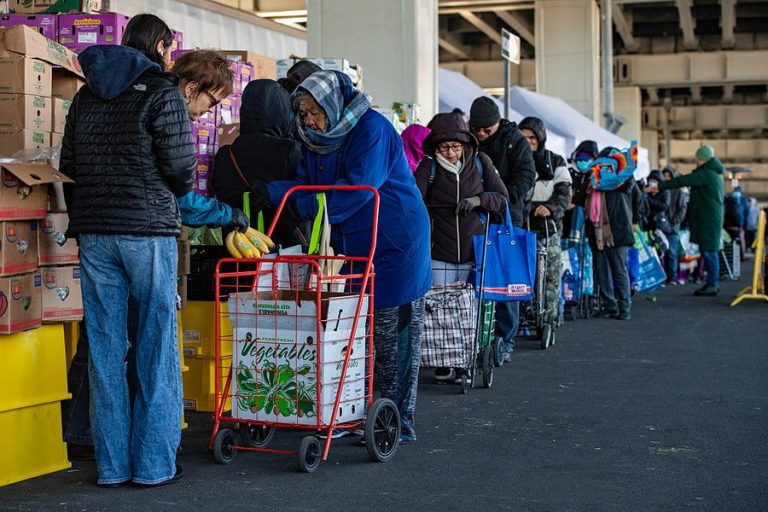
The roughly 42 million Americans who rely on food stamps did not receive their November 1 SNAP benefits as the government shutdown dragged on. The missed payments came just as the holiday season began, leaving many families struggling to put food on the table. Lines at food banks backed up traffic across the country. The Trump administration defied federal court orders to restore full funding to the program before the Supreme Court’s conservative majority temporarily greenlit the freeze. The White House even tried to claw back funding from states that had already distributed it to hungry families.
Linking City And Countryside To Solve Food Insecurity

There’s more than enough food to go around, say food access organizers across landscapes. That’s hard to imagine in Kentucky, home to some of the lowest-income and food insecure counties nationwide. The true surplus becomes apparent when a dozen pallets of peaches are loaded in for the Hazel Green Food Project, stretching across the stockyard lot in rural Wolfe County. Someone hollers for volunteers to sort through the haul, so they don vests and plastic gloves and get to work. Good fruit will be sifted into bags and packed into a family’s car later that morning. The rest will become animal feed for local farmers. Drive an hour west, and the words ring equally true in the Commonwealth’s urban centers.

How Farmers Responded When Trump Administration Stopped Paying Them

Every year brings its own unique challenges for California farmers: water shortages, fires, finding laborers to do the work, bureaucrats in Sacramento adding new requirements and fees, and more. But the second term of President Donald Trump has made this year very different. As part of deep cuts across much of the government, the administration of President Donald Trump chopped $1 billion from the U.S. Department of Agriculture almost without warning. This led to widespread financial pain that affected already struggling farmers and left hungry patrons of food banks in many parts of the country desperate for other sources of healthy food. On Feb. 28, California officials warned farmers who had grown food for schools and food banks that there was funding only for work done up to Jan. 19, despite the fact that farmers had submitted invoices for work and harvests past that date.

Escalating Climate Impacts Threaten Health Worldwide

Human-driven climate change is causing temperatures to rise to dangerous new heights, while worsening drought and impeding food security, according to the ninth Lancet Countdown report. The report by health experts and doctors warned that people all over the world are facing unparalleled health threats because of the climate crisis. “This year’s stocktake of the imminent health threats of climate inaction reveals the most concerning findings yet,” said Dr. Marina Romanello, executive director of the University College London-led Lancet Countdown, as The Guardian reported.

US Food Insecurity Rate Rose To 13.5% In 2023

The official U.S. food insecurity rate rose to 13.5% in 2023 from 12.8% in 2022, according to data the U.S. Department of Agriculture released on Sept. 4, 2024. That means more than 1 in 8 Americans – about 47 million people – couldn’t get enough food for themselves or their families at least some of the time. This is a significant increase from a recent low of 10.2% in 2021. Food insecurity grew in the two years that followed due to a sharp decline in government benefits, including money for groceries from the Supplemental Nutrition Assistance Program and the program that pays for students to get lunch and breakfast for free at school.

Norway Farmed Salmon Industry Accused Of ‘Food Colonialism’

Producers in Norway, the world’s top supplier of farmed salmon, are pushing up to four million people in West Africa into food insecurity and depriving them of critical nutrients, according to a new report. Published by food and farming campaign group Feedback Global, the research states that major farmed fish and aquafeed producers – including European transnational companies Mowi, BioMar, Cargill, and Skretting – are between them extracting nearly two million tonnes of whole, wild fish annually from the world’s oceans, according to 2020 data. The majority of these small, highly nutritious fish are being turned into fish oil, a key ingredient in salmon aquaculture feed, as well as fishmeal.

WFP Is Halting Food Distribution In Houthi-Held Northern Yemen

The World Food Programme (WFP) announced on Tuesday, December 5 that it is suspending its food distribution program in areas controlled by the government in Yemen’s capital Sana’a due to lack of funds and lack of agreement with the authorities. The government in Sanaa is backed by the Ansar Allah (Houthi) group which also controls most of northern Yemen. “This difficult decision, made in consultation with donors, comes after nearly a year of negotiations, during which no agreement was reached to reduce the number of people served from 9.5 million to 6.5 million,” the WFP statement read.

Lula Launches New Plan To Lift Country Out Of Food Insecurity

On Thursday Brazilian President Luiz Inácio Lula da Silva presented an ambitious plan to take the South American country off of the world hunger map. “The problem is not a lack of food, it is not a lack of crops, the problem is that the people do not have enough to buy food,” Lula said in a public event in the city of Teresina. In his speech he reminded that his program to fight poverty has as a connecting axis to address the structural causes of hunger that it is not limited to just economic aid but also must have an articulated policy. For this reason, he stressed that the Bolsa Familia program is not enough and does not represent a definitive solution, but a necessary step to ensure that the wealth produced in the country is distributed more equitably.

Debt Ceiling Agreement Improved, But Harmful Provisions Remain

While the debt ceiling agreement announced last night is a significant improvement over the radical House bill, it is not the deal the country deserves. There are a number of troubling elements, including the provision that will put at risk food assistance for very low-income older adults. This policy will increase hunger and poverty among that group, runs contrary to our nation’s values, and should be rejected. The nation must pay its bills — but that shouldn’t mean enacting legislation that leaves people who already struggle to afford the basics worse off. We should never have been in this situation. We are here only because House Republicans twisted the rules of democracy.

The Movement To Stop Dollar Stores From Suffocating Black Communities

For years, the Rev. Donald Perryman wondered why the formerly thriving Black downtown of Toledo, Ohio, couldn’t get a grocery store. His suspicions were confirmed after a city study found in 2020 that the opening of new Dollar General stores drove other companies out of business, deterring potential grocers from investing there. He, along with a group of ministers, knew that in order to get a supermarket, they had to stop new chain dollar stores from plaguing their communities. They made great strides when the Toledo City Council passed a moratorium the same year that required new small-box retail stores to apply for a special-use permit.

CUNY Administration Cracks Down On Student And Worker-Run Food Pantry

Three years ago this month, the City University of New York (CUNY) pivoted to remote operations during the first wave of the coronavirus pandemic. When the university began to gradually reopen in-person operations after vaccines were widely available, dining services on many campuses — which students rely on for affordable meals — remained closed. At the same time, wages have not kept up with inflation, and budget cuts from the city and the state are gutting many of CUNY’s other services. Not only are affordable campus dining options important, but students and workers are struggling more than ever to afford basic needs.

Empty Tables

My long-dead father used to say, “Every human being deserves to taste a piece of cake.” Though at the time his words meant little to me, as I grew older I realized both what they meant, symbolically speaking, and the grim reality they disguised so charmingly. That saying of his arose from a basic reality of our lives then — the eternal scarcity of food in our household, just as in so many other homes in New York City’s South Bronx where I grew up. This was during the 1940s and 1950s, but hunger still haunts millions of American households more than three-quarters of a century later.

Fighting Food Insecurity Through Urban Farming

Reno, Nevada - On a recent sunny morning in Reno, Nevada, volunteers worked diligently to harvest fresh vegetables from plots of rich soil, collecting tomatoes, eggplants, and cucumbers while a few farm goats bleated behind them. The freshly harvested produce would be washed, sorted, and stored in a solar-powered refrigerator until ending up on the dinner plates of local families. But this is no typical farm. The five-acre plot of land is situated in the middle of a busy suburban neighborhood, juxtaposed near a Reno intersection where cars almost constantly whiz by. Dubbed the “Park Farm,” the operation is run by the non-profit Reno Food Systems (RFS) as a demonstration farm to train others in organic farming practices and as a means to provide local restaurants and community groups with fresh organic produce.

Food Insecurity Increases In The US While It Declines In Nicaragua

In 2018, 48% of U.S.-based churches had their own food-distribution ministry or supported efforts run by other churches or organizations such as food pantries or food banks. These faith-based ministries, unlike government programs, provide immediate help to hungry people with no requirements. And more than two million people volunteer at a food pantry, soup kitchen, emergency shelter or after-school programs in the U.S., working more than 100 million volunteer hours a year—according to Hunger in America 2014, a study conducted by Feeding America. This wave of charity recognizes a serious problem in the United States: Despite being a wealthy nation, food insecurity remains high.

National Day Of Action: Love To Afghanistan

After 20 years of war in Afghanistan, Peace Action welcomed the withdrawal of troops from the country and an end to the war. Yet when the United States military pulled out of Afghanistan, the Biden administration also responded by choking off assets to Afghan banks and the economy by freezing the reserves of the Afghan Central Bank held in the U.S. They also imposed sanctions on those doing business with Afghanistan and cut aid. Jobs and income disappeared, people cannot afford to buy food and mass starvation is now occurring. The Afghan people are suffering now more than ever. Hunger could kill more now than in two decades of war.
assetto corsa mods

Urgent End Of Year Fundraising Campaign

Online donations are back! Keep independent media alive. 

Due to the attacks on our fiscal sponsor, we were unable to raise funds online for nearly two years.  As the bills pile up, your help is needed now to cover the monthly costs of operating Popular Resistance.

Urgent End Of Year Fundraising Campaign

Online donations are back! 

Keep independent media alive. 

Due to the attacks on our fiscal sponsor, we were unable to raise funds online for nearly two years.  As the bills pile up, your help is needed now to cover the monthly costs of operating Popular Resistance.

Sign Up To Our Daily Digest

Independent media outlets are being suppressed and dropped by corporations like Google, Facebook and Twitter. Sign up for our daily email digest before it’s too late so you don’t miss the latest movement news.