Skip to content

Poverty

Skid Row Residents: Heart Of Hope

As he, Sabo and other tenants organized similar committees in other hotels, they all began to develop a greater sense of themselves as a low-income community. That victory was one of several partial ones at the Frontier from about 2003 to 2008. Together, the tenants also succeeded in getting Los Angeles to pass a hotel preservation ordinance that requires no net loss of low-income housing, covering 17,000 to 18,000 units citywide. That includes about 8,000 downtown. The final ordinance gained approval in 2008. Diaz, who now works for LA CAN, points out that at the Alexandria all the rooms are covered by Section 8, the federal government’s low-income rent subsidy program, and rents start at $56 a month.

Cecily McMillan Interview From Prison: Even More Committed

A former banker visits the only member of Occupy Wall Street to receive a prison sentence: it sounds like the set-up of a joke or a parable of the modern age. Instead, it was a real scene last Thursday, when I went to see jailed OWS activist Cecily McMillan at Rikers Island. That the opposite would never have happened was not lost on Cecily or me: bankers don't get sent to jail, and, when they rarely do, they certainly don't get sent to Rikers. Rikers is New York City's largest jail, housing a population that is overwhelmingly poor – mostly people who can't post bail, which in some cases is as low as $50. It has become a short-term holding facility for those who can't muster $2,000 in a pinch, or who don't have the 10% of bail to lose to a bondsman. Since her 19 May sentencing for an assault on an officer, Cecily McMillan has lived in a barracks-like room with close to a hundred other women. Cecily herself is a banker-like rarity in Rikers: she has resources, both from the media obsession with her case and the OWS movement that she has come to partly symbolize.

Comcast’s False Promise To Poor Americans Of Cheap Internet

As Comcast Corp. tries to convince the federal government to permit it to buy Time Warner Cable Inc. for $45 billion, opponents of the deal will inevitably bring up people like Ed. Every morning at 8:15, Ed climbs into his red, 1999 Mazda sedan and drives 15 miles down Main Street in Scranton, Pa. He passes mom-and-pop sandwich shops, a shuttered elementary school and a computerized shooting gallery for archery on his way to a friend’s 86-year-old house where coal miners once lived — and where there’s an Internet connection. Ed, who comes here because he can’t afford the parking fees at a library six miles away, first reads his email and then turns his attention to job sites such as snapjobsearch, glassdoor, Monster and Craigslist. He’s been following this routine for nearly four years, looking for an opening in the hotel or restaurant business where he’s got some experience, but he has yet to land a job. Without the Internet connection, he’d have no hope.

Protests Dampen World Cup Fever In Brazil

It seemed like “a good deal” at the time, but then things changed. That description of the 2006 purchase of a U.S. refinery, one of the oil industry scandals hanging over the Brazilian government’s head, could also apply to attitudes towards the FIFA World Cup. In 2007, the fact that Brazil was chosen to host the 2014 International Federation of Association Football (FIFA) global championship triggered a sense of national euphoria. The mega sporting event would crown the economic ascent of this emerging power, which has won the most World Cups – five out of 18. But now, instead of planning welcome parties for the Jun. 12-Jul. 13 tournament, Brazilians are taking to the streets in protests that are blocking traffic and bringing cities to a halt, holding strikes to demand wage hikes, and complaining about corruption and rights violations during the public works to prepare for the global event. The country of football and joy is turning its back on its stereotype. In Rio de Janeiro, the few streets decorated in green and yellow – the colours of the national team – contrast with the celebrations and sense of anticipation ahead of previous World Cups. The enthusiasm has been dampened just when Brazil is hosting the world’s biggest single-sport event.

UN: Austerity Crippling Planet, One-Quarter Of Europe In Poverty

The United Nation's labor agency has denounced "premature" austerity measures brought in by governments around the world during the financial crisis, saying they have hurt the world's most vulnerable people. Isabel Ortiz, director of social welfare of the International Labor Organization (ILO), said on Tuesday that in 2014 alone at least 122 governments cut public spending, including in 82 developing countries. In the European Union, where many states brought in severe budget cuts in response to the debt crisis, she estimated that as many as 123 million people – or a quarter of the bloc's population – were now classified as poor because of cuts in social protection. Now, more than 70 percent of the world's population was not adequately covered by social protection, the ILO said. But China, the world's second-largest economy, has almost succeeded in rolling out universal pension coverage and has increased the wages of its lowest-paid workers. In 'Time of Most Need' Cuts to "pensions, the health system and social security... the removal of subsidies, downsizing among social workers and health personnel" hit poor people at a time when they were most in need of support, she said.

Media Doesn’t Cover Poverty, Despite Record Poverty

With poverty at 15 percent, inequality rising and Republican politicians talking about addressing the problem by cutting federal programs that help the poor, one might expect poverty to occupy a solid spot on media agendas. This isn’t the case, according to a new FAIR study of nightly network news shows. The study looked at ABC World News, CBS Evening News and NBC Nightly News for a 14-month period (1/1/13– 2/28/14) in the wake of the 2012 elections. FAIR examined stories in the Nexis news database that included and discussed the terms “poverty,” “low income,” “food stamps,” “welfare” or “homeless.” (Stories that included only passing mentions of these terms, without even a minimal discussion, were excluded.) A total of 23 such segments were found, three of which were “rip and read” briefs, anchor-read stories containing no sources. The other pieces included a total of 54 sources, less than half of which—22—were people personally affected by poverty. That means, on average, someone affected by poverty appeared on any nightly news show only once every 20 days.

The Science of Inequality

In 79 C.E., the year Mount Vesuvius destroyed it, Pompeii was not one city but two. Its wealthiest families owned slaves and lived in multistoried, seaside mansions, one of which was more than half the size of the White House. They dined in rooms with costly frescoes, strolled in private gardens, and soaked in private baths. Meanwhile, at least one-third of all Pompeiian households scraped to make ends meet, with families dwelling in single rooms behind workshops, in dark service quarters, or in small houses. Such economic disparities were common in the Roman Empire, where 1.5% of the empire's households controlled 20% of the income by the late 2nd century C.E., according to one recent study. Inequality has deep archaeological roots. Yet if existing traditional societies are any guide, our hunter-gatherer ancestors were mostly egalitarian. How and when did a few members of society begin to amass wealth?

Detroit Cuts Off Water To Thousands Unable To Pay Their Bills

Thousands of the some 700,000 people who call Detroit home are currently living without access to water after the Detroit Water and Sewerage Department turned off their water because they hadn’t paid their bills. As the shut-offs occur without warning from the department, residents don’t have time to fill buckets, sinks and tubs with water. This concerns human rights activists, who point out that as a result, “Sick people are left without running water and running toilets. People recovering from surgery cannot wash and change bandages. Children cannot bathe and parents cannot cook.” It’s a practice that has been in place in Detroit for years, even though residents of the city plagued by high unemployment and a poverty rate of around 40 percent have struggled to keep up with water rates that have increased about 119 percent over the past decade.

Food Not Bombs Pilsen Turns Police Station Into Garden

In a globalized city at the heart of advanced capitalism, where bond traders exchange billions of dollars in our financial markets, people are still allowed to die of starvation, malnutrition and lack of permanent shelter. In the wealthiest country of the world, the most extreme forms of poverty persist unabated, while buildings that could be urban farms, social centers, living spaces, radical libraries, free schools or free medical clinics are kept off limits through the unending threat of the prison cell and the barrel of the gun. Today Food Not Bombs Pilsen has taken a small step in our neighborhood to combat the ruthless inequality of capitalist society. Instead of allowing the abandoned police precinct to remain privatized and wasted, we have decided to make a garden to grow food and build community power through autonomous food security. In the garden, we will grow fresh vegetables that we will hand out for free at our weekly food distribution.

Spring Days of Action at Hancock Air National Guard Base

The Upstate Coalition to Ground the Drones and End the Wars had a surprise ending to their April action this year. On April 27, they hosted Cornel West at Tucker Missionary Baptist Church, to talk about Connecting the Dots: Poverty, Racism and Drones. The 600 people in attendance gave a standing ovation to Dr. West as he took the stage. He said “none of us wants to engage in that sanitized sterilized, deodorized, truncated discourse that passes for political dialog” in a market driven “news” which creates a “consensus that hides and conceals the catastrophes taking place every day” in the world. Also on the program, Buffalo Hip Hop artist Quadir Lateef presented a new rap about drones and drone victims that he had created for the occasion called "While You Were Watching TV" and Vicki Ross sang her latest song, "Drones Bury Beautiful Lives", a ballad based on the testimony of Afghan youth, Raz Mohammad, about the death of his brother-in-law in a drone attack.

In Washington, DC The Poor Are Not Allowed To Testify About Poverty

On Wednesday, Rep. Paul Ryan (R-WI) will hold a hearing on poverty called “A Progress Report on the War on Poverty: Lessons from the Frontlines.” While it will feature three experts, none of them are actually low-income Americans who struggle to get by. But that’s not for lack of trying from some poor people themselves. Witnesses to Hunger, an advocacy project that shares the stories of low-income Americans, has tried and failed twice to have some of their members who live in poverty speak at Ryan’s poverty hearings. “When Ryan had his first hearing last July,” Director Mariana Chilton told ThinkProgress, “we wrote to his office to see if we could testify, but they weren’t interested.” While Rep. Barbara Lee (D-CA) tried to get one of their low-income members to speak, it was too late. They were asked to submit written testimony instead. Chilton’s organization stayed in touch with his office and immediately called his press team when they saw the announcement for Wednesday’s hearing. “They said, ‘It’s too late, we’ve already chosen our people.’” There was one slot left to be filled by Democrats, but that went to Marian Wright Edelman, president of the Children’s Defense Fund.

McDonald’s Worker: ‘I Can Barely Afford My Children’s Shoes’

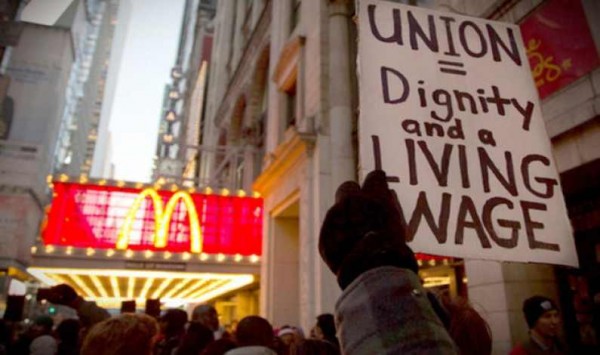
“Each payday I choose, do I pay the light bill or do I pay the gas bill?” said Melinda Topel, a McDonald’s worker for 10 years in various cities. “Do I pay all of my rent or do I pay some of the rent and some for the lights? Do I pay a utility or do I buy food?” Topel has to face difficult decisions like these on a daily basis. But she isn’t alone. She’s one of about four million fast-food employees nationwide struggling to survive on low-wage work. While fast-food corporations rake in billions each year, workers are paid the minimum wage or slightly above it. In turn, workers like Topel not only struggle with bills, but have to rely on public assistance. And like most fast-food workers, although she works full-time, Topel doesn’t receive any kind of benefits or paid sick days.

Kenya: Artivists Versus The State

Cross-posted at CreativeResistance.org. Against this calamitous backdrop, we are starting to see hope in the country’s next generation of campaigners, organisers and even artists. These new hybrid cultural activists have been dubbed “artivists” and are continuing the struggles of their predecessors with a new approach. The author MK Assante describes the artivist as someone who “uses her artistic talents to fight and struggle against injustice and oppression by any medium necessary”. For two weeks in February, I had the privilege of joining almost 200 activists, organisers and artivists in a Nairobi community centre (unnamed for security reasons) for an Artivism Lab.

New! Debt Resisters Operations Manual

The Debt Resisters’ Operations Manual (DROM) seeks to provide widely applicable yet detailed information about debt as well as strategies for resistance. It highlights our commonalities—namely, that people are not alone in their struggles against debt—as well as our different relationships to debt. We strive to analyze debt from many different angles, always maintaining a nuanced, critical analysis that is conscious of race, gender, class, sexuality, age, ability, and their intersections. We strive to write in simple language and will work to translate the manual into languages other than English. A 120-page pamphlet version of the manual was collectively researched and written in August 2012 as a contribution to strengthening and expanding the debt resistance movement.

VIDEO: Clearly Demonstrates That Most Welfare Goes To Rich

And there are millions of other families who enjoy the same benefits. Here is just one statistic to make this point. In 1999 as the American century came to a close the U.S. government spent $24 billion on public housing and rental subsidies for the poor. But in that same year it spend $72 billion in home ownership subsidies for the middle classes and the wealthy. Subsidies that are never considered to be welfare and there is no stigma attached to this dependency. In fact, it is seen as an entitlement. Why is this so? History matters. The America welfare stage was setup in the wake of the great depression to create a new deal of social programs. But from the very start it was divided into two channels; social insurance programs made available as entitlements and public assistants programs made available as welfare. Need I point out the race and gender dimensions of this divide? It is time for America to reconsider who is dependent on welfare. Take a listen.
assetto corsa mods

Urgent End Of Year Fundraising Campaign

Online donations are back! Keep independent media alive. 

Due to the attacks on our fiscal sponsor, we were unable to raise funds online for nearly two years.  As the bills pile up, your help is needed now to cover the monthly costs of operating Popular Resistance.

Urgent End Of Year Fundraising Campaign

Online donations are back! 

Keep independent media alive. 

Due to the attacks on our fiscal sponsor, we were unable to raise funds online for nearly two years.  As the bills pile up, your help is needed now to cover the monthly costs of operating Popular Resistance.

Sign Up To Our Daily Digest

Independent media outlets are being suppressed and dropped by corporations like Google, Facebook and Twitter. Sign up for our daily email digest before it’s too late so you don’t miss the latest movement news.