Skip to content

Spain

Podemos March For Change

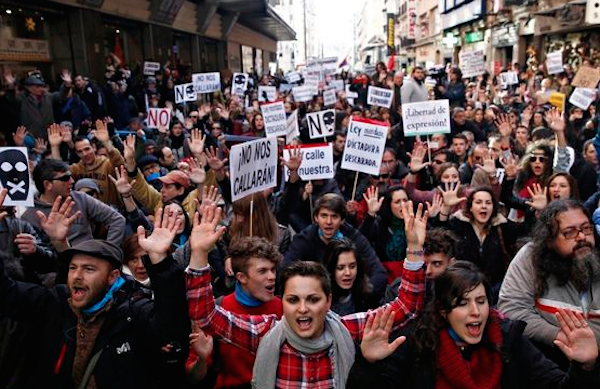
A week on from the seismic political shift delivered by the people of Greece, tens of thousands gathered in the Spanish capital today to tell their ruling elite that they too had had enough. People of all ages, from babies carried by their mothers, to the elderly, came to express support for Podemos, a leftist, anti-austerity political party that is just 12 months old, and later this year is promising to end the dominance of Spain’s two main parties. Wearing the party’s purple and chanting “Yes, we can”, Spaniards from all walks of life turned out to show their support. They came from across Spain in more than 260 buses that had been laid on for the “March of Change”, and from midday packed Madrid’s busiest central avenues around the square of Puerta del Sol – a hub for shoppers, tourists, and often protests too.

Newsletter: What Would Zinn Do?

This week marks the fifth anniversary of the death of Howard Zinn who is best known for his “People’s History of the United States” which looks at history from the bottom up, through the lenses of classism, racism and sexism. We remember Zinn for the advice he gave activists a year before his death. When he was asked what should people be doing, he gave advice that is good no matter what the era: Go where you are not supposed to go; Say what you are not supposed to say; and Stay when they tell you to leave. We are pleased to see people around the world instinctively following the advice that Howard Zinn gave to US activists. The world over we are facing governments corrupted by money and not representing the people. Zinn’s recipe for change – Go, Say and Stay – one we should be consciously following.

First We Take Athens: Europe’s Debt Colony Revolts

In the past four years Greece’s economy has shrunk by a quarter. Child poverty is at 40%. A quarter of a million people are without electricity. Unemployment stands at 26%, and most of these people do not receive benefits. For those in work, job security and wages have been cut and 33% of the population has no health insurance. The list goes on. The story is a familiar one. The Greek state was lent huge amounts by the IMF and Eurozone countries — it is 175% of it’s GDP in debt — in exchange for brutal austerity conditions to be imposed. Syriza want to stop all of this. The newFinance Minister described the bailout deals, with characteristic Greek flair, as “fiscal waterboarding policies that have turned Greece into a debt colony.” He is now aiming to negotiate 50% of their debt to be wiped off (such a thing has happened many times before, including to Germany in 1953).

Europe’s Ascendant Left Declares ‘Subservience Is Over’

Syriza and Podemos have become the mouthpiece of the anti-austerity movement in southern Europe while Tsipras and Iglesias have emerged as key political leaders who emerged from the grassroots, street-level protest movements which rose in opposition to the severe economic policies imposed by elite forces following the financial crisis that began in 2008. In relatively short time, both Syriza and Podemos went from being non-existent political entities to standing on the doorstep of taking power. With national elections in Greece just days away, and Syriza's polling numbers only improving, Alexis Tsipras announced that his party is prepared to "overthrow" the status quo and vowed to implement swift changes to undo the austerity policies—imposed at the behest of foreign creditors and attached to a bailout package offered by the European Central Bank and the IMF—that have left the Greek economy in tatters.

Security Is Not A Crime

On Tuesday December 16th, a large police operation took place in the Spanish State. Fourteen houses and social centers were raided in Barcelona, Sabadell, Manresa, and Madrid. Books, leaflets, computers were seized and eleven people were arrested and sent to the Audiencia Nacional, a special court handling issues of “national interest”, in Madrid. They are accused of incorporation, promotion, management, and membership of a terrorist organisation. However, lawyers for the defence denounce a lack of transparency, saying that their clients have had to make statements without knowing what they are accused of. “[They] speak of terrorism without specifying concrete criminal acts, or concrete individualized facts attributed to each of them.”

Thousands March In Barcelona In Support Of Anarchist Prisoners

Thousands of people took the streets of Barcelona Saturday to demand the release of 11 anarchists arrested by the police last week. The demonstration comes after a judge sentenced seven of the 11 anarchists to serve prison time without bail. The remaining will be released on probation. Tens of thousands of people also marched in Madrid in solidarity with the Barcelona protests. Anarchist groups consider the ongoing investigation on the 2012-2013 bomb plots – dubbed Operation Pandora – as an excuse to crack down on the strong Spanish anarchist movement. Critics have pointed at the fact that authorities arrested the 11 activists and then claimed they had found evidence after the raid of their possible involvement in the plots, which shows their arrest was not based on previously obtained elements. Lawmaker David Companyon from the local Parliament has accused the government of using Operation Pandora and the arrest of the 11 activists as stunt to garner support for the recently approved “gag law,” which was received with massive demonstrations and widespread criticism over concerns that it will lead to government-sanctioned human rights abuses.

Spain’s New Security Law Sparks Protests Across Country

Thousands of people have been protesting in Spanish cities against a new law that sets hefty fines for offences such as burning the national flag and demonstrating outside parliament buildings or strategic installations. The public security law, which was approved last week by parliament, has been heavily criticised by opposition parties and human rights groups as an attempt by the conservative government to muzzle protests over its handling of Spain’s financial crisis. Saturday’s largest demonstrations occurred in cities such as Barcelona, Bilbao and Madrid, while smaller ones took place in Almeria, Granada and Valencia. Some protesters wore tape covering their mouths and carried placards calling the measures a “gagging law”.

Greenpeace Activists Acquitted Of Nuclear Protest Charges

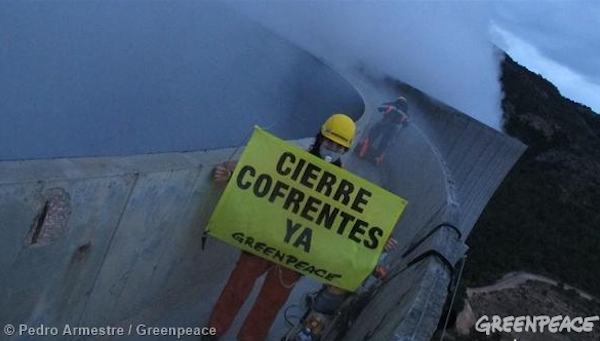
In a victory for the freedom to engage in peaceful protest, 16 activists from Greenpeace Spain, along with a freelance photojournalist – together known as the #Cofrentes17 – were yesterday acquitted by a court in Valencia of causing public disorder and injury for calling attention to the dangers of nuclear power, during a protest in February 2011. Nearly four years ago, the activists entered the 30-year old Cofrentes nuclear power plant, some 60 km from Valencia, and painted "Peligro Nuclear" (Nuclear Danger) on one of the plant's cooling towers. Their argument rested in part on Article 45 of the Spanish Constitution that, "Everyone has the right to enjoy an environment suitable for the development of the person, as well as the duty to preserve it". This didn't stop prosecutors from demanding prison sentences of two years and eight months for each of the #Cofrentes17.

‘Let’s Win Back Barcelona’: The Rise Of Guanyem

Guanyem Barcelona (Catalan for ‘let’s win back Barcelona’) launched in June this year, a citizen platform whose aim is to “take back the city and its public institutions and put democracy back at the service of the people.” The platform’s likely mayoral candidate is the popular anti-evictions activist,Ada Colau. She became politically prominent after she accused a representative of the Spanish banking association of being a ‘criminal’ during a parliamentary hearing. Her popularity and oratory flair are undoubtedly powerful weapons in the movement’s bid for mass media attention. Nevertheless, the platform also has deep roots in the city’s social and political activists networks. Guanyem Barcelona is a joint initiative of members of Colau’s Platform for People Affected by Mortgages, local neighborhood associations and anti-corruption campaigners, as well as a number of Barcelona-based academics, journalists and artists.

Spanish Ram Greenpeace Boat Then Seize It

Spanish navy boats protecting an oil drilling ship rammed Greenpeace boats during a protest, leaving one activist with a broken leg and another with minor cuts. Dramatic footage filmed off the Canary Islands of Lanzarote and Fuerteventura on Saturday shows the moment when a navy rhib – a fast rigid hull inflatable boat – appeared to deliberately collide with a Greenpeace rhib which was approaching the oil ship Rowan Renaissance. Matilda Brunetti, a 23 year-old Italian, can be heard screaming in pain in the video as her leg was broken and she was thrown into the water. According to a colleague, she then received cuts to her legs from a propeller, before she was taken by the Spanish navy to a hospital in Las Palmas, Gran Canaria, where she is now recovering. Spain has seized and detained the Greenpeace boat, Arctic Sunrise, that they rammed earlier this week. Neither the captain or crew are being detained. Spain was protecting oil drilling from a non-violent direct action by Greenpeace against the oil ship Rowan Renaissance, owned by the company Repsol, which has been approved by Spain to drill for oil in the Fuerteventura and Lanzarote islands. The Spanish government is investigating the captain of the ship for an "infringement against marine traffic rules."

Video: Activist Hospitalised After Boats Rammed During Peaceful Protest

At stake are two of the Canary Islands (Fuerteventura and Lanzarote), Spanish islands off the coast of Morocco. A company called Repsol has been given a permit to drill there, despite the risks to the ecology and tourist economy. Greenpeace Spain sided with island locals in opposing this drilling, but their warnings about safety and legal issues have so far been ignored by the Spanish government. This morning, activists from the Arctic Sunrise went on small boats to protest the drilling vessel. The Spanish authorities reacted violently as you can see in the video below - deliberately ramming the boats and putting the lives of peaceful activists at risk. The 23 year old Italian who was knocked overboard and had her leg broken, has been taken to a hospital on shore by a navy helicopter, and is in good condition. Another activist was treated on board the Arctic Sunrise for minor cuts.

8 Reflections On The Rise Of Podemos

The story of Podemos’s success is inseparable from the story of Pablo Iglesias’s increasing prominence in the Spanish media. Iglesias is the party’s figurehead, if not formally the leader. Formerly a professor of Political Science at the Complutense University of Madrid, Iglesias started out blogging for a smaller national newspaper before being offered his own TV shows (La Tuerka and Fort Apache). Although not prime-time successes, they picked up a cult following and crucially created an independent space for Iglesias to develop his own media profile and narrative. From his position as host of these programmes, Iglesias became an increasingly common prime-time commentator.

Catalonia Vote – Independence Unresolved

When the Catalans finally had their say on Sunday, more than 80 percent of those who cast their ballots voted to split from Spain. But despite the massive majority, the restive region may be no closer to independence. Denied a real referendum by Spain's constitutional court, Catalan separatists instead set up voting booths across the northeastern region to host an informal, non-binding "consultation" asking citizens if they want Catalonia to become an independent state. The region's nationalist prime minister, Artur Mas, declared the vote a "total success" as figures showed 80.76 percent of voters backed independence. "Catalonia has proven that it wants to govern itself,” Mas told a news conference in the regional capital Barcelona. "Catalonia has made a quantum leap in its quest to be able to decide its own political future.”

Defying Government, Catalonia Pushes Independence Bid

The leader of the Spanish region of Catalonia has set up a panel to supervise a contested independence referendum next month, despite the opposition of Spain's central government, which has gone to the courts to block the vote. Spain's constitutional court said on Monday it would review the legality of the independence vote, effectively suspending it. José Manuel García-Margallo, Spain's Foreign Minister, had previously told journalists that his government would use "all means necessary" to stop the planned referendum, currently scheduled for November 9. But Catalonia's leaders, cognizant of the majority's pro-independence stance, appear determined to push forward.

Catalan Separatists Call Street Protests Over Referendum Ruling

Just hours after the Constitutional Court accepted the government’s appeal of the Catalan referendum on self-rule, the northeastern Spanish region registered its first protests. Around 300 people congregated in front of the government delegation in Barcelona to express support for the plebiscite, which is scheduled for November 9, and to condemn Madrid’s attempt to get it ruled illegal by a top Spanish court. This early protest was the beginning of a series of region-wide demonstrations planned for Tuesday by a pro-independence group called National Catalan Assembly (ANC).
assetto corsa mods

Urgent End Of Year Fundraising Campaign

Online donations are back! Keep independent media alive. 

Due to the attacks on our fiscal sponsor, we were unable to raise funds online for nearly two years.  As the bills pile up, your help is needed now to cover the monthly costs of operating Popular Resistance.

Urgent End Of Year Fundraising Campaign

Online donations are back! 

Keep independent media alive. 

Due to the attacks on our fiscal sponsor, we were unable to raise funds online for nearly two years.  As the bills pile up, your help is needed now to cover the monthly costs of operating Popular Resistance.

Sign Up To Our Daily Digest

Independent media outlets are being suppressed and dropped by corporations like Google, Facebook and Twitter. Sign up for our daily email digest before it’s too late so you don’t miss the latest movement news.