Skip to content

Bolivia

US Secretly Targeted Evo Morales Of Bolivia

By Ryan Grim and Nick Wing in The Huffington Post - The United States has secretly indicted top officials connected to the government of Bolivian President Evo Morales for their alleged involvement in a cocaine trafficking scheme. The indictments, secured in a U.S. Drug Enforcement Administration sting called "Operation Naked King," have not been previously reported. Morales, a former leader of Bolivia's coca growers union, has long been at loggerheads with the DEA. In 2008, Morales expelled the agency from the country and embarked on his own strategy of combatting drug trafficking, acknowledging the traditional uses of coca in Bolivian culture and working cooperatively with coca growers to regulate some legal activity and to promote alternative development elsewhere. Morales' plan has been effective at reducing cultivation, according to the United Nations.

Pope Francis Seeks Forgiveness For Crimes Against ‘Native People’

By Al Jazeera - Pope Francis cast himself as the spiritual and political leader of the world's oppressed on Thursday evening with a remarkable mea culpa for the sins and crimes of the Catholic Church against the indigenous peoples during the colonial conquest of the Americas. Francis “humbly” begged forgiveness at a gathering of indigenous leaders in Bolivia in the presence of Bolivia's first-ever indigenous president, Evo Morales, the climactic high of Francis' weeklong South American tour. In the speech, Francis noted that Latin American church leaders in the past had acknowledged that “grave sins were committed against the native peoples of America in the name of God.” St. John Paul II, for his part, apologized to the continent's indigenous for the “pain and suffering” caused during the 500 years of the church's presence in the Americas during a 1992 visit to the Dominican Republic.

Fifteen Years Of Community-Controlled Water In Bolivia

By Marina Sitrin in Roar Mag - This year marks the fifteenth anniversary of the victory of the communities of Bolivia over private water corporations. Not only did popular power reverse the plan to privatize the water, but the many hundreds of communities surrounding Cochabamba managed to keep their water as a common good, controlled and managed by the community directly and democratically. Other places around the world have also been successful in at least holding back privatizations and mining, such as in Thessaloniki, with the struggle to keep water public and in the Halkidiki region of Greece. In these examples, as in so many others, the struggles are grounded in a particular form of popular power. As with the experience in Cochabamba, it was regular people and communities organized in the streets (not parties, unions or other sectors) using direct action and directly democratic assemblies to make decisions.

Bolivia’s Conamaq Indigenous Movement

Bolivia's Conamaq indigenous movement is currently a major grassroots critic of the policies of the Evo Morales government and its Movement Toward Socialism (MAS) party. Because of this critical stance, the government helped to violently oust the Conamaq from their offices in La Paz this past December, and create a parallel, pro-MAS Conamaq. Mama Nilda Rojas is a leader of the dissident, or organic, Conamaq, and is interviewed here by Pablo Peralta M. of Bolivia's Página Siete newspaper. While ex-Conamaq leader Rafael Quispe is seeking to run for president against Morales, the current Conamaq of Nilda Rojas rejects all political parties and alliances with any governments, and remains one of the few critical social movements outside the umbrella of the MAS party, along with a radical base of followers and a progressive vision for the country.

How Bolivia Leads The Global Fight Against Climate Disaster

We are “ecosocialists” because the climate crisis now bearing down on us is the major issue facing the world’s peoples. It threatens the very survival of human life. It is directly caused by capitalism as a system. The alternative to capitalism is socialism, and our socialism must reflect the centrality of climate crisis in our thinking and actions. On a global scale, Bolivia is punching way above its size in drawing attention to this crisis and formulating answers to it — within the limits of its situation as a small landlocked country in South America. And its government is moving to implement its proposals through developing an “economic, social and communitarian productive model” that takes immediate steps toward dismantling the dependent legacy of colonialism, neo-colonialism and capitalism while pointing the way toward what it terms “the socialist horizon.”

Bolivia Shows How To Dismantle Corporate Sovereignty

As Techdirt has reported, corporate sovereignty chapters in TAFTA/TTIP and TPP have emerged as some of the most controversial elements in those agreements. Meanwhile, countries that already have bilateral investment treaties (BITs) with investor-state dispute settlement (ISDS) mechanisms are looking for ways to get rid of them in order to avoid the loss of sovereignty they imply. One nation that already has considerable experience in this area is Bolivia. A new report provides fascinating background information on exactly how it has gone about this (pdf), with valuable lessons for others looking to do the same. Things began back in 2000, during what was called the "Water war." After Aguas del Tunari, a subsidiary of the US company Bechtel, had taken control of water supplies in the central Bolivian city of Cochabamba, it raised prices to such an extent that the poorest citizens struggled to pay for drinking supplies. This led to demonstrations in the streets, with many people injured (original in Spanish.) Control of the water company was removed from Bechtel, which demanded $50 million compensation for the loss of its investment. The case was finally settled in 2006, when Bechtel agreed to sell its shares in the water company to the Bolivian state -- for 2 Bolivianos (then about $ 0.30).

The Complicated Extraction Issues In Latin America

A recent spate of high-profile campaigns against projects based on extracting raw materials has opened up an important new dynamic within the broad processes of change sweeping South America. Understanding their nature and significance is crucial to grasping the complexities involved in bringing about social change and how best to build solidarity with peoples' struggles. Many of the campaigns that target specific mining, oil, agribusiness or logging ventures share common elements. They have raised public awareness around a variety of important environmental issues such as water scarcity, forest preservation and sustainable land usage. In some cases, particularly in Ecuador and Bolivia, these campaigns have influenced existing discussions on issues such as climate change, the rights of Mother Earth and the kinds of alternative development models needed to achieve radical change. Another common aspect has been the central role played by rural indigenous communities. This is due not only to the fact many of these extractive ventures occur in indigenous territories, but also the leading role indigenous movements have played in recent years in the global environment movement.

In Bolivia, Being Journalist And Organizer Go Together

Susana Pacara, one of the founders of Radio Lachiwana in Cochabamba, Bolivia, believes that communication work is a key part of the defense of territory. She doesn’t mean this in an abstract way. Over the years, Pacara has fought the privatization of water, the construction of mega highways and the attacks on the rights of coca growers. She’s braved tear gas and repression with such bravery that she’s earned the title “Mamá Susana.”And now she’s fulfilled her dream of transmitting these stories of resistance and defense at the national level. In Quechua, “lachiwana” refers to a little bee that makes its hive in the most secret of places. The word could almost just as easily describe Pacara herself. At 49 years old, she has a small build, which she says helps her get to all sorts of places, and a curious expression.

Bolivia’s Indigenous Future: A Balance Of Preservation, Protection And Connection

Evo Morales’s very name seems to suggest his destiny of leading Bolivia in a valiant attempt at ‘moral evolution’ with all other Nation States in tow. Tasked with the difficult role of representing his Indigenous roots at the national and international levels of government and policy, Morales continues to make great strides that by all appearances bridge the dichotomy of tradition and modernity. Recent evolutions in Bolivian national policy regarding the protection and preservation of indigenous cultures continue to gain legal traction. Simultaneously, more Bolivians than ever before are poised to claim their rightful place in the interconnected web that is the information age.

At the UN, A Latin American Rebellion

Without a doubt, the 68th UN General Assembly will be remembered as a watershed. Nations reached an agreement on control of chemical weapons that could avoid a global war in Syria. The volatile stalemate on the Iran nuclear program came a step closer to diplomacy. What failed to make the headlines, however, could have the longest-term significance of all: the Latin American rebellion. For Latin American leaders, this year’s UN general debate became a forum for widespread dissent and anger at U.S. policies that seek to control a hemisphere that has clear aspirations for greater independence. In a region long considered the United States’ primary zone of influence, Washington’s relations with many Latin American nations have gone from bad to worse under the Bush II and Obama administrations.

Latin America Condemns US Espionage at United Nations Security Council

The foreign ministers of Brazil , Venezuela , Uruguay , Bolivia and Ecuador fiercely condemned the United States plan for worldwide espionage, which posed a lethal threat to the democratically elected governments of these Latin American nations and jeopardized their survival. It is not surprising that this expression of alarm was voiced by Latin America, from Argentina through Uruguay, Bolivia, Ecuador, Brazil, Venezuela – in other words from the Southernmost tip of the huge southern continent to the Caribbean, for this continent, viewed imperialistically as the “backyard” of the United States, was for many tragic decades, crushed by military dictatorships inflicting state terror with impunity, following the blueprint of destabilization and overthrow, by the CIA and multinational corporate controlled entities, of their own democratically elected leaders.

Bolivian President Proposes Taking U.S. to International Tribunal

Evo Morales, President of Bolivia, announced yesterday that he will propose UNASUR to bring the US before an international tribunal for human rights violations after his plane was denied airspace in Europe in the beginning of July. Speaking yesterday to local newspaper La Razón, Morales announced that “I’m going to propose in the next UNASUR meeting with all the other presidents to bring the United States before an international court in respect to human rights and international diplomacy treaties. This action is fundamental so that other presidents in the world will not have to go through what I went.”

S. American States Recall Ambassadors Over Bolivian Plane Incident

“What the United States government is seeking is to obstruct Edward Snowden’s bid to seek asylum. Not to get asylum, but to seek asylum,” Tatchell said. “It has bullied and threatened and menaced other countries around the world to not grant him asylum and to not grant airspace so that a flight can take him to another country. That is a direct attack upon the United Nations’ refugee conventions, and it is shocking and appalling that a supposedly democratic government, in collusion with European governments - including the government in Britain - has been conspiring to not allow Mr. Snowden to make a valid asylum application.”

Activists Thank Countries for Asylum for Snowden

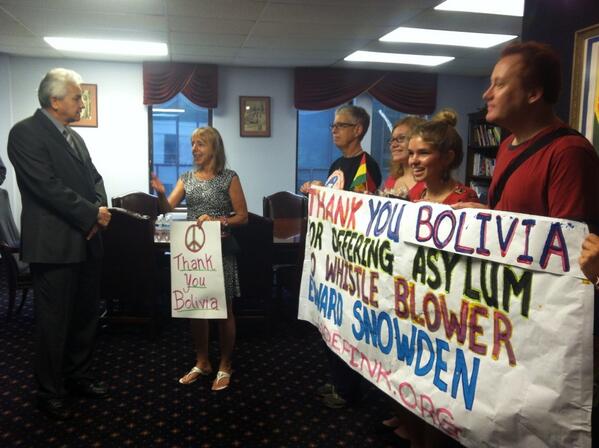
Activists have thanked Bolivia, Nicaragua and Venezuela for offering asylum for Edward Snowden and have delivered a letter to Russia urging President Putin to provide Snowden with travel documents to allow him to go to one of those countries. They make the argument that Snowden's revelations are not "damaging" Russia's "partner," the United States but are actually strengthening democracy in the US as they give the American people the opportunity to stop these illegal activities.

Venezuela Rejects US Extradition Request

Maduro told the Telesur TV channel that Venezuela had received an extradition request from the US, which he had already rejected. A copy of the request, seen by the Guardian, notes that Snowden "unlawfully released classified information and documents to international media outlets" and names the Guardian and the Washington Post. Dated 3 July and sent in English and Spanish, it says: "The United States seeks Snowden's provisional arrest should Snowden seek to travel to or transit through Venezuela. Snowden is a flight risk because of the substantial charges he is facing and his current and active attempts to remain a fugitive." Maduro said he did not accept the grounds for the charges. "He has told the truth, in the spirit of rebellion, about the US spying on the whole world," Maduro said in his latest speech. "Who is the guilty one?
assetto corsa mods

Urgent End Of Year Fundraising Campaign

Online donations are back! Keep independent media alive. 

Due to the attacks on our fiscal sponsor, we were unable to raise funds online for nearly two years.  As the bills pile up, your help is needed now to cover the monthly costs of operating Popular Resistance.

Urgent End Of Year Fundraising Campaign

Online donations are back! 

Keep independent media alive. 

Due to the attacks on our fiscal sponsor, we were unable to raise funds online for nearly two years.  As the bills pile up, your help is needed now to cover the monthly costs of operating Popular Resistance.

Sign Up To Our Daily Digest

Independent media outlets are being suppressed and dropped by corporations like Google, Facebook and Twitter. Sign up for our daily email digest before it’s too late so you don’t miss the latest movement news.