Skip to content

Brazil

Politicians Demand US Drop Assange Charges On Anniversary Of Arrest

Elected politicians in Australia, Brazil, Mexico, and the United Kingdom signed on to letters to United States Attorney General Merrick Garland demanding that the Justice Department drop the charges against WikiLeaks founder Julian Assange. A letter of opposition signed by four members of the U.S. House of Representatives, including Representative Rashida Tlaib, who initiated the letter, was prepared. However, it had not yet been sent to Garland at the time of publication. The letters were timed to mark the fourth anniversary of Assange’s arrest and detention. On April 11, 2019, Ecuador President Lenin Moreno expelled Assange from the country’s London embassy.
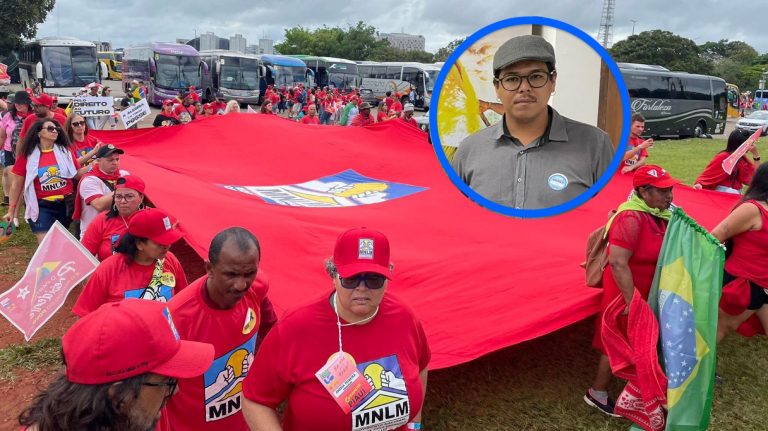
Anti-Imperialist Push From The Brazilian Grassroots

Overshadowed by the media frenzy surrounding Lula’s new term in office, Brazil’s social movements are vowing to remain mobilized to push for policies favorable to the working majority. They’re also engaged in the fight against imperialism with hopes of steering foreign policy towards solidarity, amid pressure by North America and Europe to join intervention campaigns currently targeting several countries. We contacted the National Movement for the Fight for Housing (MNLM) after seeing that representatives of the urban movement had visited the embassy of Nicaragua, in a show of solidarity.

Chinese Currency Displaces Euro In Brazil’s Foreign Reserves

The Chinese currency, referred to as the yuan, surpassed the euro and became the second most important currency of Brazil’s foreign reserves in 2022, according to a report published this Friday by the Central Bank of the South American country. Until 2019, the yuan was virtually absent from Brazil’s foreign exchange reserves. However, by the end of 2022, the Chinese currency came to represent 5.37% of the holdings of the Brazilian Central Bank, surpassing the 4.74% share of the euro. In 2021 the share of the yuan constituted 4.99% and that of the euro 5.04%. Meanwhile, the US dollar continues to dominate, holding 80.42% of total foreign exchange reserves in Brazil’s Central Bank, which is currently being questioned by President Luiz Inácio Lula da Silva.

Life Inside An MST Landless Workers’ Settlement In Brazil

For nearly 40 years, Brazil’s Landless Workers’ Movement (MST) has been fighting the concentration of landownership among the country’s elite through the direct occupation and settlement of fallow lands. Founded at the end of Brazil’s military dictatorship, the MST now has settlements and occupations throughout the nation. TRNN contributor Michael Fox reports from an MST settlement in the state of Paraná, where landless workers have built their own homes, schools, and cooperative farms. Brazil’s Landless Workers Movement, or MST; the largest social movement in the Americas, one and a half million members.

Reasons For An Argentina-Brazil Currency Union

Even before German Chancellor Olaf Scholz met newly re-elected President Lula da Silva in Brasília last week, the latter had visited neighbouring Argentina, where he floated the idea of creating a common currency union for the two countries. The international response? Shaking heads. “It’s a terrible idea,” tweeted Paul Krugman, Nobel laureate in economics. In the German weekly Die Zeit, Thomas Fischermann wrote about a “dream money of the South.” So, was the announcement of a common currency for southern Latin America just talk? A monetary union of all of Latin America would cover 5 percent of global gross domestic product (GDP) – in comparison with the euro’s 14 percent, estimates the Financial Times.

Latin America Refuses To Send Ukraine Weapons, Despite Western Pressure

Brazil, Argentina, and Colombia have refused to send weapons to Ukraine, despite pressure by the US and EU. Latin American left-wing leaders have urged peace with Russia and called for neutrality in the West’s new cold war. Brazil, Argentina, and Colombia have rejected requests by the United States and European Union that they send weapons to Ukraine. The commander of the US military’s Southern Command (Southcom), which operates in Latin America and the Caribbean, revealed on January 19 that Washington has been pressuring countries in the region to arm Ukraine. Southcom wants Latin American nations to “replace [their] Russian equipment with United States equipment – if those countries want to donate it to Ukraine”, said Army General Laura J. Richardson.

Buenos Aires Hosts Historic Meeting Of Latin American And Caribbean Leaders

The 7th Summit of Heads of State and Government of the Community of Latin American and Caribbean States (CELAC) will be held on Tuesday, January 24, in Buenos Aires, Argentina, which currently holds the pro tempore presidency of the bloc. The upcoming summit is considered historic especially since it marks the return of Brazil to the regional integration mechanism after three years, and will see the participation of Brazilian President Luiz Inacio Lula da Silva, who played an important role in the creation of the body. In December 2008, Brazil hosted the first summit of Latin American and Caribbean Countries (CALC) in Costa do Sauípe, Bahia, an event which helped establish CELAC three years later. The Buenos Aires Summit will also have participation of the majority of the newly-elected progressive leaders leaders of the region. In addition to Argentine President Alberto Fernández and Brazilian President Lula da Silva, Bolivian President Luis Arce, Chilean President Gabriel Boric, Colombian President Gustavo Petro, Cuban President Miguel Díaz-Canel, Honduran President Xiomara Castro, Barbados’ Prime Minister Mia Mottley, Saint Vincent and the Grenadines’ Prime Minister Ralph Gonsalves, among others, have confirmed their participation.

Brazil And Argentina To Advance South American Currency

Alberto Fernandez and Luiz Inacio Lula da Silva are preparing to relaunch the strategic alliance between Argentina and Brazil this week in Buenos Aires. The two will meet for the first presidential meeting between Brazil and Argentina in more than three years. Immediately after, the VII Summit of CELAC will take place in the same city. The forum that brings together the 33 countries of the Latin American and Caribbean region and which, since last year, has been under the presidency of Argentina. The event will mark the return of Brazil to this mechanism of dialogue and regional consultation. According to a statement published by the two presidents, there are multiple areas in which the two countries will work together to improve the quality of life of their citizens; “such as the fight against hunger and poverty, health, education, sustainable development, climate change and the reduction of all forms of inequalities.”

The Role Of The Brazilian Military In The Coup Attempt

The far-right mob that invaded the federal building, Congress, and the Supreme Court and vandalized government buildings at Three Powers Plaza in Brasília on January 8, demanded a “military intervention” in Brazil. They had set up camps that had assembled in front of army barracks throughout the country since November demanding the “military to overturn” the election of Brazilian President Luiz Inácio Lula da Silva (known as Lula). On November 11, 2022, the commanders of the armed forces released a note giving the coup camps a safe haven—not only physically but also legally. It is important to note two elements of that document: first, the commanders stated, through an illogical interpretation, that the camps in favor of a coup were legal because the protesters were peaceful, and that “both possible restrictions on rights by public agents and possible excesses committed in demonstrations” would be reprehensible, despite the fact that demanding the military to stage a coup is a crime (Article 286).

When The People Have Nothing More To Eat, They Will Eat The Rich

On 8 January, large crowds of people dressed in colours of the Brazilian flag descended on the country’s capital, Brasília. They invaded federal buildings, including the Congress, Supreme Court, and presidential palace, and vandalised public property. The attack, carried out by supporters of former President Jair Bolsonaro, came as no surprise, since the rioters had been planning ‘weekend demonstrations’ on social media for days. When Luiz Inácio Lula da Silva (known as Lula) was formally sworn in as Brazil’s new president one week prior, on 1 January, there was no such melee; it appears that the vandals were waiting until the city was quiet and Lula was out of town. For all its bluster, the attack was an act of extreme cowardice. Meanwhile, the defeated Bolsonaro was nowhere near Brasília. He fled Brazil prior to the inauguration – presumably to escape prosecution – and sought haven in Orlando, Florida (in the United States).

The New World Economy

Belém, Brazil – I inaugurate this new series of columns in a New Year and a new beginning for Brazil with the inauguration of President Lula da Silva. His well-wishers poured out across the country in a revival of hope for Brazil after four years of disastrous rule under his right-wing predecessor, Jair Bolsonaro, who had fled Brazil for Florida on the eve of Lula’s inauguration. Bolsonaro left behind a mob that rampaged government office buildings before being arrested in large numbers by the police. The mob tactics will not stop Lula, nor will they have a long-term effect in the US, where Donald Trump’s similar maneuvers on January 6, 2021, were also shut down. In both cases, demagogic politicians used social media to rile up a mob; in both cases, the mob was put down within the day. The real issue, in my mind, is not the mob, but the deeper changes in the world that are generating growing tensions in world politics and economy.

Lula: The Coup And The Importance Of Popular Mobilization

The attempted fascist Bolsonarist coup d’état of January 8 in Brasilia is not a merely local event. Everything indicates that it had international sponsorship. It is far from being a spontaneous revolt, as there are countless facts that demonstrate a high degree of organization, coordination and financing prior to the assault and vandalizing of the main institutions representing the three branches of state power in Brazil, no less than the Congress, the Planalto Palace and the headquarters of the Federal Supreme Court. This relationship with the support of an international organization behind the coup attempt and other serious subversive attempts occurring in our region has been pointed out by several analysts but I have not read any as precise as that of the Cuban Hedelberto López Blanch.

Bolsonaro Supporters Attack The Brazilian Government

On January 8, 2023 thousands of supporters of former Brazilian president Jair Bolsonaro attacked and vandalized that nation's Congress, Supreme Court, and presidential palace in the capital of Brasilia. Bolsonaro claims that election fraud was responsible for his defeat by Lula da Silva in the 2022 election. His supporters had demonstrated previously after the election and used social media to publicize their gathering in the preceding days and weeks. Black Agenda Report Executive Editor Margaret Kimberley spoke with Brazilian based journalist Brian Mier of Telesur English who provided analysis of these events.

Coup Attempt In Brazil Condemned By Leaders From Across The Globe

On Sunday January 8, supporters of former far-right Brazilian president Jair Bolsonaro invaded the Supreme Federal Court, the National Congress, and the Planalto Palace, the office of the president, breaking through the blockade of the Military Police and the National Security Force at the Esplanade of Ministers in the capital Brasília. After invading the headquarters of the three branches of government, the violent groups vandalized the buildings, looted the armory at the Planalto Palace, and caused tremendous damage to public institutions. Following the acts of violence, President Luiz Inácio Lula da Silva condemned the situation, criticized the complicity of Brasília’s public security forces in the attacks, and decreed federal intervention in public security of Brasília until January 31.

China Pushes De-Dollarization With Gold, Currency Swap Deal

China’s central bank has taken a series of steps to accelerate the global drive toward de-dollarization, challenging the hegemony of the greenback. The People’s Bank of China is increasing the share of gold in its foreign-exchange holdings, bucking the US dollar, which has for decades been dominant in reserves. This January, China also signed an agreement with Argentina’s central bank for a currency swap deal, in which Beijing will provide 130 billion Chinese yuan (roughly $19 billion USD) to help Buenos Aires stabilize its currency and economy. The South American nation said it is “committed to deepen the use of the RMB [renminbi] in the Argentine market for bilateral exchange”. (Renminbi is the official name for the Chinese currency, also known as the yuan.)
assetto corsa mods

Urgent End Of Year Fundraising Campaign

Online donations are back! Keep independent media alive. 

Due to the attacks on our fiscal sponsor, we were unable to raise funds online for nearly two years.  As the bills pile up, your help is needed now to cover the monthly costs of operating Popular Resistance.

Urgent End Of Year Fundraising Campaign

Online donations are back! 

Keep independent media alive. 

Due to the attacks on our fiscal sponsor, we were unable to raise funds online for nearly two years.  As the bills pile up, your help is needed now to cover the monthly costs of operating Popular Resistance.

Sign Up To Our Daily Digest

Independent media outlets are being suppressed and dropped by corporations like Google, Facebook and Twitter. Sign up for our daily email digest before it’s too late so you don’t miss the latest movement news.