Skip to content

Coal

More Coal Capacity Closed In 2018 Than First 3 Years Of Obama Admin

Last week, the Sierra Club announced the latest U.S. coal plant to close: FirstEnergy’s Pleasants Power Station in West Virginia. It’s No. 268 in a long line of U.S. coal plants that have shut down since 2010, and among several to suspend operations this month. The environmental organization lauded the closure as a victory in its Beyond Coal campaign and an affirmation that coal continues to lose when pitted against other fuel sources. The latest Sustainable Energy in America Factbook from Bloomberg New Energy Finance and the Business Council for Sustainable Energy noted that the steady march of coal plant closures did slow somewhat in 2017, with just six plants closing compared to the previous year’s eight. But BNEF expects the closure trend to resume next year, with nearly as much plant capacity set to shut down 2018 as during the 2015 peak, when the coal industry dropped 15 gigawatts.

Industry-Friendly FERC Rejects Perry’s Coal & Nukes Bailout

“Secretary Perry likes to use flash and glitz to cover over imperfections in form. Like the wise judges on Dancing with the Stars, FERC saw through the act. “This was an easy decision to make for FERC. Secretary Perry’s proposal was nothing more than a massive bailout for the coal and nuclear industries. It’s no surprise it was resoundingly rejected by even the industry-friendly commission, just as it’s no surprise that Secretary Perry continues to demonstrate he has no idea what he’s doing overseeing our nation’s energy infrastructure. “We’ll know FERC is really intent on setting a course for a brighter future when they actually start taking our climate crisis seriously.

100-Year Capitalist Experiment Keeps Appalachia Poor & Stuck On Coal

The first time Nick Mullins entered Deep Mine 26, a coal mine in southwestern Virginia, the irony hit him hard. Once, his ancestors had owned the coal-seamed cavern that he was now descending into, his trainee miner hard-hat secure. His people had settled the Clintwood and George’s Fork area, along the Appalachian edge of southern Virginia, in the early 17th century. Around the turn of the 1900s, smooth-talking land agents from back east swept through the area, coaxing mountain people into selling the rights to the ground beneath them for cheap. One of Mullins’ ancestors received 12 rifles and 13 hogs—one apiece for each of his children, plus a hog for himself—in exchange for the rights to land that has since produced billions of dollars worth of coal.

Adani Activists Stop Coal Train Before Being Arrested

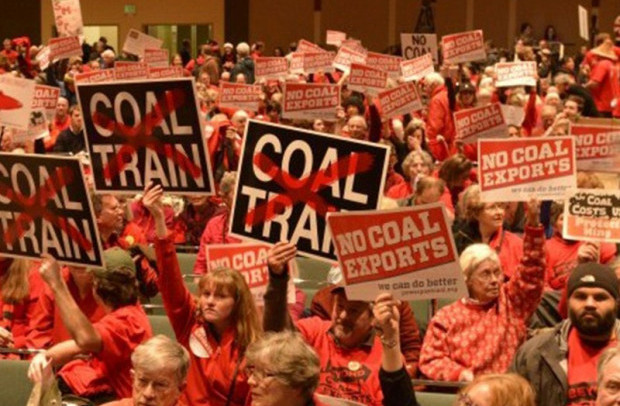
ACTIVISTS have halted a train carrying hundreds of tonnes of coal headed for the Abbott Point Coal Terminal. Anti-Adani protest group Front Line Action on Coal reported two activists climbed on top of a coal train and hung a banner across a 15-metre-long carriage. After over three hours occupying the coal train, Anna Hush and Gareth Davies were arrested at 10aam. Anna Hush said: "I am stopping this coal train today because I believe coal has no place in our future. The destruction of land and water for corporate profit is deeply exploitative, and ecologically devastating" Another of the climate activists, environmental consultant Gareth Davies said: "Adani is just one part of this struggle - if this rail line is built, there are a whole bunch of companies ready to begin mining the Galilee Basin.

When Companies Deny Climate Science, Their Workers Pay

After decades spreading misinformation about greenhouse gas emissions’ role as a driver of climate change, the deceptive tactics of the fossil fuel industry are slowly beginning to backfire. In December, for instance, General Electric announced major cuts to its fossil-fuel-heavy power department — and the pain of this unplanned transition is already being felt by the people least responsible for the company’s decisions: its workers. In the last two years, many stories have surfaced on the knowledge major fossil fuel companies like Exxon-Mobil had about the climate impacts of their activities, and the many tactics these same companies employed to deceive the public about these impacts. But they may have also managed to deceive themselves.

Activists Disrupt White House’s Pro-Coal Panel At Bonn Climate Summit

By Dharna Noor The Real News Network - The UN Framework Convention on Climate Change is in full swing in Bonn, Germany and all eyes are now on the US, now the only country in the world to reject the Paris Climate Accord. In Bonn on Monday, the Trump administration held a presentation they called "The Role of Cleaner and More Efficient Fossil Fuels and Nuclear Power in Climate Mitigation". The presentation sought to pose coal, natural gas and nuclear energy as the solutions to the climate crisis. Climate activists disrupted the panel during opening remarks. Joining us to talk a little bit about the Trump administration's Bonn panel, for the first time in our studio in Baltimore, is Steve Horn. Steve is a research fellow for Desmog.com and a freelance investigative journalist. His writing has appeared in Al Jazeera America, The Intercept, The Guardian, Vice News, The Young Turks Project: TYT Investigates and many others. Thanks for being here today, Steve. STEVE HORN: Good to finally be here. Thanks for having me. DHARNA NOOR: So, today during George David Banks opening remarks on this Trump administration panel, climate activists came in, they disrupted, they started singing songs. Talk a little bit about him and generally about this panel pushing clean coal and nuclear power as solutions to climate change.

Fossil Fuel Emissions Set To Hit All-Time High In 2017

By Alexander C. Kaufman for The Huffington Post - Global carbon dioxide emissions from fossil fuels are surging again after staying flat for three years, climate scientists reported on Monday, a sign that efforts to rein in planet-warming gases still have a long way to go. Emissions from fossil fuels and industrial uses are projected to grow 2 percent this year, reaching 41 billion tons by the end of 2017, according to the report presented at the United Nations’ climate summit in Bonn, Germany. The increase was predicted to continue in 2018. Total greenhouse gas emissions remained level, at about 36 billion tons per year from 2014 to 2016, even as the global economy grew, which suggested carbon dioxide emissions had crested with the rise of renewable electricity sources and improved fuel efficiency standards. But emissions from fossil fuels will hit 37 billion tons this year, a report from the Global Carbon Project finds. The report draws from three papers in the journals Nature Climate Change, Environmental Research Letters and Earth System Science Data Discussions. “This is very disappointing,” Corinne Le Quéré, director of the Tyndall Centre for Climate Change Research at the University of East Anglia, said in a statement. “We need to reach a peak in global emissions in the next few years and drive emissions down rapidly afterwards to address climate change and limit its impacts.”

Thousands March To Keep Coal In Ground Ahead Of Climate Summit

By Staff of Tele Sur - Implementation of the Paris accord will be discussed at the 195-nation climate meeting in Bonn between November 6 and 17. Thousands of people took to the streets of Bonn on Saturday to call for the phasing out of coal as a source of power ahead of global talks on climate change in the German city next week. The issue of whether to end coal production has been one of the main sticking points in coalition negotiations between German Chancellor Angela Merkel and her would-be allies: the Greens and the pro-business Free Democrats (FDP). Organizers of the march called for the German government to implement the 2015 Paris plan to shift the world economy away from reliance on fossil fuels this century.

To Close Climate Goals Gap: Drop Coal, Ramp Up Renewables

By Georgina Gustin for Inside Climate News - Countries will have to phase out coal and invest in renewable energy even faster than previously expected to keep global warming below perilous levels and fend off the most dangerous impacts of climate change, according to a United Nations report released just before the next round of international climate talks. The United Nations Environment Program on Tuesday released its annual report on the "emissions gap"—the distance between countries' pledged commitments for meeting the targets of the 2015 Paris climate agreement and the pathways that scientists estimate could actually achieve those targets. The report, prepared by dozens of scientists and incorporating the latest scientific findings, includes new information to help negotiators zero in on more ambitious commitments that might achieve the Paris Agreement's most stringent target: keeping the rise in temperatures to 1.5 degrees Celsius since the start of the industrial era. "The overarching conclusions of the report are that there is an urgent need for accelerated short-term action and enhanced longer-term national ambition, if the goals of the Paris Agreement are to remain achievable," the report says. "And that practical and cost-effective options are available to make this possible." In other words, the world's countries need to get moving—and fast. But there's hope.

State Denies Key Water Quality Permit For Longview Coal Project

By Jan Hasselman for Earth Justice - The Washington Department of Ecology denied a necessary water quality permit for the proposed Millennium Bulk Terminals coal export facility in Longview today, citing the project’s negative impacts on climate, clean air and water. Absent a successful legal challenge to the decision, the denial renders the project formally dead. If built, Millennium would have been the largest coal export facility in North America, sending up to 44 million tons of Powder River and Uinta Basin coal per year to Asian markets that are quickly turning away from coal-fired power. The state’s own analysis, found that the climate pollution from this project would be equivalent to adding 8 million cars to the road at a time when our changing climate is contributing to catastrophic forest fires and stronger hurricanes. Millennium would also add up to sixteen trains a day traveling between the Powder River Basin and Longview, tying up traffic and impacting public safety response times in rail communities across the Pacific Northwest and contributing to higher rates of cancer in low-income communities, including Longview’s Highlands neighborhood.

After Generations In Coal, West Virginians Finding Jobs In Solar

By Jason Margolis for PRI - Nobody from his graduating class is working in coal, says Swiger. “[They’re] honestly working in fast food, or not working at all.” Not Swiger. He has a job installing rooftop solar panels. He says his family is delighted with it. "They’re excited that I’m actually doing something different,” says Swiger. “A lot of people ain’t doing this in West Virginia, a lot of people are against it actually. A lot of people want to go back to coal. “I ain’t against it, I love solar. It’s way better than coal, I think.” Solar panels can save people money on their electricity bills and cut down on greenhouse gas emissions, which fuel climate change. With battery storage, found in some home set-ups, solar can also allow people to continue to power their homes off the grid during power outages. Swiger is working as an apprentice with Solar Holler, which was founded four years ago by 32-year-old Dan Conant. Conant doesn’t see solar energy and coal at odds with each other. “The way I think about it, as a West Virginian, is that West Virginia has always been an energy state, and this is just the next step. It’s the next iteration,” says Conant. West Virginia’s economy has long been reliant on coal. Metallurgical coal, which is found in the state, is used in the steel-making process.

Navajo Solar Plant To Replace Coal Plant

By Staff of the Associated Press - FLAGSTAFF, Ariz. (AP) — A giant array of solar panels near the famed sandstone buttes of Monument Valley has begun producing electricity for the Navajo Nation at a time when the tribe is bracing for the loss of hundreds of jobs from the impending closure of a nearby coal-fired power plant. The Kayenta Solar Facility is the first utility-scale solar project on the Navajo Nation, producing enough electricity to power about 13,000 Navajo homes. The plant comes at a time when the area’s energy landscape is shifting. The coal-fired Navajo Generating Station near Page is set to close in December 2019, leaving a site that both tribal and private entities say has potential for renewable energy development. The Navajo Tribal Utility Authority, which owns the solar plant, said the project advances clean energy on the reservation long known for fossil fuel development, the Arizona Daily Sun reported. Walter Haase, general manager of the tribal utility, said the plant proves to investors, developers and tribal communities that renewable energy projects are possible on the reservation.

Citizens Begin Reclaiming Coal Country After Decades Of Corporate Land Grabs

By Emma Eisenberg for Yes! Magazine - “Land is the most important thing to us, yet it’s not clear at all who owns it,” says Karen Rignall, assistant professor of community and leadership development at the University of Kentucky. “Without broad-scale knowledge of the patterns of land ownership this region cannot work together to move forward. But who owns it on paper is not always who owns it in actuality. That takes time and money to find out.” The coal industry of central Appalachia has been on the decline for more than 30 years, with West Virginia and Kentucky losing more than 38,000 coal jobs in that time. As coal companies pulled out, they took with them the dollars that small towns used to use to fund their schools and infrastructure, and left behind abandoned mines, polluted rivers and vast swaths of vacant land. All over Appalachia, communities and organizations are working around the clock to come up with a way to “justly transition” the Appalachian economy to whatever comes next. Rignall and postdoctoral researcher Lindsay Shade are collaborating with a growing group of citizens that think a part of the answer to a post-coal economy may lie with an old land ownership study—and have been inspired by it to do a new one.

Coastal Communities Sue 37 Oil, Gas And Coal Companies Over Climate Change

By Georgina Gustin for Inside Climate News - Two California counties and a city are suing 37 fossil fuel companies, accusing them of knowingly emitting dangerous greenhouse gases that have contributed to global warming that threatens their communities with sea level rise. It won't be an easy case to make, legal experts say, but it's drawing the interest of private attorneys who see enough potential to take it on. Marin and San Mateo counties, near San Francisco, and the city of Imperial Beach, south of San Diego, filed the new lawsuits in California Superior Court on Monday against Exxon, Shell and 35 other oil, gas and coal companies. Their lawsuits accuse the companies of having known, for nearly five decades, "that greenhouse gas pollution from their fossil fuel products had a significant impact on the Earth's climate and sea levels." They say the companies' "awareness of the negative implications of their behavior corresponds" with rising greenhouse gas emissions. Together, the lawsuits say, the companies were responsible for roughly 20 percent of total emissions from 1965 to 2015. The lawsuits contend that the companies "concealed the dangers, sought to undermine public support for greenhouse gas regulation, and engaged in massive campaigns to promote the ever-increasing use of their products at ever greater volumes."

Climate Activists Crashed Global Insurance Meeting To Demand Exit From Coal Companies

By Peter Bosshard for Alternet - By divesting from coal companies, insurers can fulfill their basic mission: to protect us from catastrophic risk. Climate activists brought their message that insurance companies need to stop supporting coal projects to a global meeting of insurance CEOs in San Francisco. On June 15, activists interrupted the opening session of the CEO gathering at the Ritz Carlton Hotel and raised a banner that read, "The World’s Best Insurance? Keeping Coal in the Ground." The banner display was part of a series of climate protests welcoming the insurance CEOs, who met in San Francisco at the invitation of the Geneva Association, an insurance think-tank. A letter was also sent to the individual CEOs, calling for them to move away from coal and invest in renewables. Then, on the following day, activists conveyed their message with a public rally of insurance mascots to greet the CEOs, and circled the executives' closing dinner at a landmark hotel tower with a plane displaying the message, "Insurers: Unfriend Coal Now."
assetto corsa mods

Urgent End Of Year Fundraising Campaign

Online donations are back! Keep independent media alive. 

Due to the attacks on our fiscal sponsor, we were unable to raise funds online for nearly two years.  As the bills pile up, your help is needed now to cover the monthly costs of operating Popular Resistance.

Urgent End Of Year Fundraising Campaign

Online donations are back! 

Keep independent media alive. 

Due to the attacks on our fiscal sponsor, we were unable to raise funds online for nearly two years.  As the bills pile up, your help is needed now to cover the monthly costs of operating Popular Resistance.

Sign Up To Our Daily Digest

Independent media outlets are being suppressed and dropped by corporations like Google, Facebook and Twitter. Sign up for our daily email digest before it’s too late so you don’t miss the latest movement news.