Skip to content

Colombia

Empire Files: Deadliest Country For Unions And Social Leaders

In 2017, murders of social leaders, union organizers and indigenous activists in Colombia hit a new high since the historic peace agreement. Empire Files' Abby Martin goes to Colombia to document the increasingly deadly situation for human rights activists. Hear from an Afro-Colombian union leader under threat of assassination, and how the US Empire created this epidemic today.

Paramilitary Attack On Colombian Peace Community

December 29, 2017, four paramilitary persons entered the Peace Community of San Jose de Apartado in San Josecito for the purpose of murdering the Peace Community’s legal representative, German Graciano Posso. The paramilitaries had threatened to assassinate German for several weeks. Their attack was thwarted, although German suffered a wound in his hand and another Peace Community member was injured in his leg. The Peace Community members who responded with 20 or more Community members to protect German, captured two of the four paramilitary men, including the one who fired against German.

Ex-FARC Members Create Self-Sufficient, Socialist-Modeled Town

Ximena Narvaez, delegate to the Territorial Council of Reincorporation, explained that the community "works collectively, each person has a role." Colombia's first town of former Revolutionary Armed Forces of Colombia rebels was established between gorges and mountains in the south of the department of Caqueta just two months ago. In La Montanita, now called Hector Ramirez zone in honor of a guerrilla fighter from the FARC's southern bloc where some 200 former fighters have settled and created a socialist village after handing over their weapons as part of the November 2016 peace accord signed between the FARC and the Colombian government. They've built about 60 homes of drywall that are raised on concrete bases, assigned collective work projects, and created an equitable economy where all of the local resources are shared among the community.

Colombia: Paramilitaries Kill Land Rights Activist

Hernan Bedoya was the second activist from the group, Communities Constructing Peace, Conpaz, to be killed in 10 days. Another land rights activists, Hernan Bedoya, was killed by hired paramilitary members in a rural sector of the Choco Department in Colombia. Bedoya was the second activist from the group, Communities Constructing Peace, Conpaz, to be killed in 10 days. The Gaitanist Self-Defense Forces of Colombia, AGC, took responsibility for shooting Bedoya 14 times as he was traveling home by horse. The Colombian human rights groups, The People’s Defense and the Intercelestial Commission for Justice and Peace in Colombia, announced the killing on their twitter accounts and called for authorities to “quickly investigate” the killing. The AGC continually threatened the Conpaz activist since 2015 for his work in trying to protect Conpaz members’ communal lands from the company, Association of Agroindustrial Campesinos, Agromar, an industrial African palm and banana producer and exporter. 

Activists Call On Colombia To Provide Infrastructure Improvements

By Staff of Black Alliance for Peace - The undersigned gender, racial, social and environmental justice organizations and advocates from around the world applaud the inclusion of the Ethnic Chapter and other racial and gender rights measures in Colombia’s Final Agreement to End the Armed Conflict and Build a Stable and Lasting Peace. If implemented, these provisions will allow Colombia to set a global example of holistic peacebuilding—one that meaningfully addresses the social inequalities that help fuel conflict. We are, however, deeply concerned about the inadequate consultation with and recognition of Afro-Colombian and Indigenous authorities in peace implementation activities to date, and the ways in which this endangers the lives, security, and territorial and human rights of Afro-Descendant and Indigenous Peoples, including women and girls. We encourage the Government to act in good faith to ensure that Indigenous and Afro-Descendant Peoples’ rights are maintained and furthered in peace implementation. It is crucial that the framework plan for implementing the Peace Accord contain indicators to measure the progress and outcomes of policies, programs and reforms in a manner that corresponds to the needs, values, and rights of Indigenous and Afro-Descendant Peoples, including their gender-based rights. These can only be developed with meaningful participation of their respective authorities and organizations.

CIA Working With Mexico & Colombia To Overthrow Venezuela

By Staff of Tele Sur - The comments come after CIA Director Mike Pompeo confirmed the United States is advising Mexico and Colombia on developments in Venezuela. Venezuelan President Nicolas Maduro has demanded the governments of Colombia and Mexico respond to allegations that they are working with the CIA to overthrow the Venezuelan government. In a televised interview, Maduro said, “The director of the CIA has said, ‘The CIA and the U.S. government work in direct collaboration with the Mexican government and the Colombian government to overthrow the constitutional government in Venezuela and to intervene in our beloved Venezuela.’" “I demand the government of Mexico and the government of Colombia to properly clarify the declarations from the CIA and I will make political and diplomatic decisions accordingly before this audacity,” he added. The comments come after CIA Director Mike Pompeo confirmed the United States is advising Mexico and Colombia on developments in Venezuela.

Will There Finally Be Peace With Justice In Colombia?

By Staff of Colombia Support Network - We have now reached the final days for the disarming of the FARC guerrillas, as established by the Peace Accord provisions agreed upon by the Santos Administration and the FARC leadership. What, we may reasonably ask, are the prospects for achieving a lasting peace? There are a number of considerations to take into account in assessing whether the FARC’s demobilization will bring peace with justice. First, there is a serious question whether the Colombian government will be able (and willing!) to dismantle paramilitary forces which are active in many parts of the country. In some areas, such as in the municipality of Apartado in northern Antioquia, the presence of paramilitary forces has been a constant dating back to the time when General Rito Alejo del Rio told a Colombia Support Network (CSN) delegation to Apartado that he as commander of the Seventeenth Brigade of the Colombia Army could vouch for the safety for investors in the region based upon what we later learned was active collaboration of the Brigade with paramilitary forces. I met a few days ago with representatives of the Peace Community of San Jose de Apartado, and they informed me that the paramilitary presence and threats to the Community continue and that Seventeenth Brigade troops on occasion accompany paramilitaries and convey threats to the community...

Three Nations With Most Refugees Were Targets Of US Intervention

By Whitney Webb for Mintpress News. CHILE– A United Nations report has shed light on the world’s burgeoning crisis of displaced peoples, finding that a record 65.6 million were forced to vacate their homes in 2016 alone. More than half of them were minors. The Office of the UN High Commissioner for Refugees (UNHCR), which drafted the report, put the figure into perspective, stating that increasing conflict and persecution worldwide have led to “one person being displaced every three seconds – less than the time it takes to read this sentence.” UN High Commissioner Filippo Grandi called the figure “unacceptable” and called for “solidarity and a common purpose in preventing and resolving the crisis.” However, what the UN report failed to mention was the role of U.S. foreign intervention, indirect or direct, in fomenting the conflicts responsible for producing most of the world’s refugees.

Statement Of Support For Civic Strike In Buenaventura, Colombia

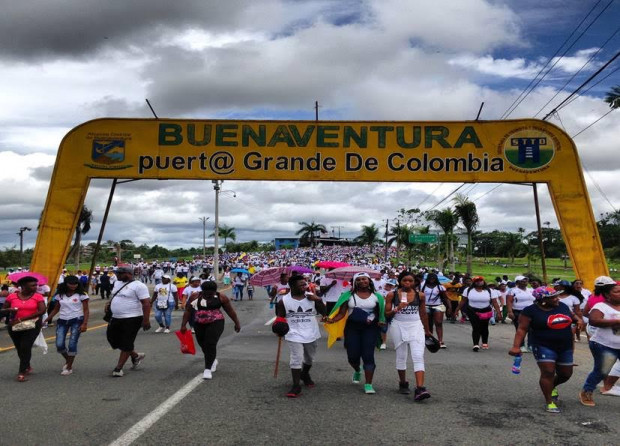
By Kevin Zeese and Margaret Flowers for Popular Resistance. Popular Resistance has been closely following and reporting on the civic strike in the port city of Buenaventura, Colombia. As the strike is suspended we are issuing this statement of support and solidarity. We applaud the political clarity and the uncompromising demands of the people of Buenaventura in response to the long-term prejudice and mistreatment of Afro-Colombians. The organization that the civic strike showed, especially in the face of harsh treatment by the security state in Colombia, demonstrated great strength and courage which made the strike successful. Your effort has brought massive attention to the indifference of the Colombian government to centuries of racism that has led to abject poverty and mistreatment of black people in Colombia. The agreement that led to the suspension of the strike is a clear victory for Afro-Colombians in Buenaventura.

Peaceful Strikers Being Attacked By Armed Police

By Esther Ojulari for Black Alliance for Peace. Buenaventura, Colombia - “I know you’re fighting a just cause…We go all round the country and we see people fighting just causes all the time…But this is our job…our role here is to attack, so that’s what we do.” These were the words my friend was told when he engaged in conversation the other night with an agent of the ESMAD (Mobile Anti-Disturbances Squadron) on the streets of Buenaventura, Colombia, in the context of the ongoing civic strike. The mainly Afro-descendant and indigenous community of Buenaventura on the Pacific Coast of Colombia has been on a civic strike now for 16 days. 16 days in which business, banks, shops and schools have been closed down and taxis and buses have stopped working to demand that the national government fulfills its basic human rights obligations to its citizens.

Strike In Buenaventura For People Centered Human Rights

By Esther Ojulari for Black Alliance for Peace. Since the Buenaventura port was privatized in 1991, the vast majority of income generated goes straight into the pockets of private business owners from outside of the city, while the community suffers from a lack of investment and neglect. 64% of the population lives in poverty and 9.1% in extreme poverty. The child mortality rate in Buenaventura is 27.6 per 1000. The sewage system covers only 60% of the city, and only 76% receives running water. For most of the population that water arrives in homes for only a few hours a day and in some communities only a couple of times a week. The city’s public hospital was closed in 2015 leaving the population with access only to primary health care and meaning that patients often have to travel to other cities to receive adequate medical attention. Only 22% of the population have access to secondary education, and schools not only lack materials and infrastructure but resources to provide a culturally relevant education. The privatisation of the port contributed to a rise in unemployment as many of the jobs were given outsiders leaving an unemployment rate today of 62%. Much of the working population are engaged in informal labour, with lack of job security and safe working conditions.

Esther Ojulari: National Strike in Buenaventura Colombia

Esther Ojulari for Black Alliance for Peace. The city of Buenaventura on Colombia’s Pacific coast is home to the country’s main international port through which billions of dollars of imports and exports pass every year. Since last Tuesday 16th May the community of Buenaventura (along with communities in the Chocó region of Colombia) has been on general strike demanding that the government fulfils basic human rights to water, education, health, culture, land and freedom from racism and violence. Businesses were closed, road blocks were set up at several points along the main road and peaceful protestors chanted, sang, danced and banged cooking pots to call attention to the desperate situation. On the first day along the Chamber of Commerce reported the strikes had caused up to 10,000 million pesos (about $3.5 million USD) in losses.

International Civil Society Statement In Support Of Miller Dussán & ASOQUIMBO

By Staff of The Democracy Center - ASOQUIMBO has been resisting this hydroelectric project for several years, highlighting its social and environmental impacts as well as a series of legal irregularities on the part of EMGESA (an Enel subsidiary in Colombia). They have also called into question current energy and mining policy in Colombia, demanding in its place the construction of a policy based on national sovereignty and local control of renewable energy sources to meet the needs of local communities. Miller Dussan now faces up to twelve years in prison as a result of two legal charges being brought against him based on accusations made by Emgesa.

An Open Letter To Fensuagro, Marcha Patriótica And All Colombian People

By Staff of AFGJ - It is with deep sorrow that we write to express our condolences for the recent assaults against your organizations and against the entire process for peace. We have learned that 72 human and labor rights defenders, peace activists, indigenous leaders and environmentalists were assassinated in 2016 alone. In the four years of its existence, 125 members of the Marcha Patriótica (Patriotic March) popular movement for peace have lost their lives. We are dismayed by the campaign of paramilitary violence that has occurred leading up to and following the October 2nd Peace Referendum.

What’s New About Colombia’s ‘New’ FARC-Govt Peace Deal?

By Staff of Tele Sur - Opponents of the peace deal submitted over 400 proposals for drastic changes, but negotiators largely tweaked the agreement rather than overhauling it. Colombia’s fraught peace process hit a breakthrough Saturday as the government and the largest rebel army, the FARC, signed a revised agreement to bring an end to over half a century of civil war after the deal was narrowly defeated at the ballot box last month.
assetto corsa mods

Urgent End Of Year Fundraising Campaign

Online donations are back! Keep independent media alive. 

Due to the attacks on our fiscal sponsor, we were unable to raise funds online for nearly two years.  As the bills pile up, your help is needed now to cover the monthly costs of operating Popular Resistance.

Urgent End Of Year Fundraising Campaign

Online donations are back! 

Keep independent media alive. 

Due to the attacks on our fiscal sponsor, we were unable to raise funds online for nearly two years.  As the bills pile up, your help is needed now to cover the monthly costs of operating Popular Resistance.

Sign Up To Our Daily Digest

Independent media outlets are being suppressed and dropped by corporations like Google, Facebook and Twitter. Sign up for our daily email digest before it’s too late so you don’t miss the latest movement news.