Skip to content

Democracy

The Power And Potential Of Democratic Public Ownership

In most cases, it would be absurd to think that the same approach that created a problem would also be the one best suited to solve it. Yet this is exactly what we are expected to believe regarding the existential ecological threats our world now faces. As predicted by many since its inception, capitalism and its core interconnected tenants — private ownership of the means of production, market allocation, and exponential economic growth — have brought us to the precipice of both environmental and social disaster. Yet, year after year we continue to be told that capitalism will save us. Just a few more dashes of regulation here, some different market incentives there, and the turning point is right around the corner. All the while, temperatures climb, species disappear, the air is choked with smog, waters rise, forests burn, and storms rage.

The Future We Need: Economic Democracy

As economists and policymakers are seeking to explain the “Great Resignation” sweeping the labor market, the traditional wage and hour issues became less important to employees than in the recent past, according to a recent report. A big takeaway from the data is that organizing people as workers is not enough. Economic democracy in the twenty-first century cannot be achieved solely within a framework focused exclusively on worksites. Rather we must explore a more expansive definition of collective bargaining that adapts to the context of global capitalism and all its features, including addressing the material and cultural needs of the modern worker—who, shockingly, does not solely identify as a worker, but sees themselves as having a diverse array of identities.

Cuba Prepares For Disaster

The September 2021 Scientific American included a description by the editors of the deplorable state of disaster relief in the US.  They traced the root cause of problems with relief programs as their “focus on restoring private property,” which results in little attention to those “with the least capacity to deal with disasters.”  The book Disaster Preparedness and Climate Change in Cuba: Adaptation and Management (2021) came out the next month. It traced the highly successful source of the island nation’s efforts to the way it put human welfare above property.  This collection of 14 essays by Emily J. Kirk, Isabel Story, and Anna Clayfield is an extraordinary assemblage of articles, each addressing specific issues.  Writers are well aware that Cuban approaches are adapted to the unique geography and history of the island.

Lebanon’s Economic Collapse

A friend in Beirut asked me teasingly as we walked the darkened streets, “Are you happy now? You wanted degrowth and you’re getting it.” He was referencing the economic crisis and recession Lebanon is experiencing — although he knows very well the stark difference between this deep recession and degrowth. Recession happens when growth dependent economies stop growing, i.e., GDP goes into the negative. This typically ends up in the loss of jobs, economic uncertainty, and sometimes austerity measures with long-term impacts. Degrowth, on the other hand, is an intentional shift in economic activity, revolving around a rethinking of measures of progress and what gets to grow and why. Its policy-making revolves around the wellbeing of people and planet.

Protests Continue In Sudan; Resistance Committees Release A Key Charter

The long-awaited “Charter for the Establishment of the People’s Authority” was proposed by the Khartoum Coordination of Resistance Committees (RCs) in Sudan on Monday, February 28. Mass demonstrations against the military coup were reported from at least 14 cities in Sudan on the same day. The security forces unleashed a violent crackdown against the protests. Two people were killed, including a 15-year-old, and at least 210 protesters were injured, according to the Central Committee of Sudanese Doctors (CCSD). At least 27 of the injuries were caused by gunshot wounds. 47 people were injured after being directly hit by stun grenades and tear gas canisters, which the forces reportedly fired directly onto the bodies of the protesters.

‘Politics As Usual’ Will Never Be A Solution To The Current Climate Threat

There is an ever-growing consensus that the climate crisis represents humanity’s greatest problem. Indeed, global warming is more than an environmental crisis — there are social, political, ethical and economic dimensions to it. Even the role of science should be exposed to critical inquiry when discussing the dimensions of the climate crisis, considering that technology bears such responsibility for bringing us to the brink of global disaster. This is the theme of my interview with renowned scholar Richard Falk. For decades, Richard Falk has made immense contributions in the areas of international affairs and international law from what may be loosely defined as the humanist perspective, which makes a break with political realism and its emphasis on the nation-state and military power.

Puerto Rico Hasn’t Had The Opportunity To Develop Its Own Economic Future

“Puerto Rico received approval from a federal judge on Tuesday to leave bankruptcy under the largest public sector debt-restructuring deal in the history of the United States.” The executive director of the unelected Fiscal Oversight and Management Board declared it “truly a momentous day,” and a “new day for Puerto Rico.” How new, exactly, is the question of many who don’t see this debt deal as fundamentally changing the story for most Puerto Ricans, because that story has everything to do with the more than 100-year colonial relationship to the United States, and their enforced inability to determine their own economic future. Nor does it upend the notion that increased austerity is somehow, despite what you see, ultimately the way to shared prosperity and well-being.

Honduran Campesina Wendy Cruz On Challenges For Xiomara Castro

Wendy Cruz of La Via Campesina speaks about the challenges facing Honduran women and women of the peasant movement ahead of the inauguration of President Xiomara Castro of the left-wing Libre party.

Xiomara Castro Denounces Hijack Of Legislative Power

The elected president of Honduras, Xiomara Castro (Libertad y Refundación, Libre), denounced this Sunday, outside the National Congress, that a dictatorship is trying to hijack the Legislative Branch in a bid not to respond to the popular mandate. Hundreds of people continue to mobilize in the vicinity of the Parliament in defense of democracy and respect for the popular vote. Addressing the crowds of her supporters, Castro recalled that the elections of November 2021 were to remove from power the dictatorship of the current president, Juan Orlando Hernandez, and banish its unlawful practices. She stressed that on November 28, the people cast their votes and that their will must be respected.

The Disintegrating Façade Of US Democracy

A poll taken in December 2021 reflecting that a majority of “Americans” now “believe that democracy in the United State is in danger of disappearing” accommodates the bipartisan erasure of those colonized by US settler colonialism. Several US news outlets have reported that the Schoen Cooperman Research poll on “U.S. Perceptions of Government” reflects the opinions and concerns of “Americans” at large. The poll reflects that 51-percent of respondents agree with the statement that democracy in the US is at risk of extinction, a position shared almost equally between party affiliations. The sentiment is most acute among the younger generation. However, there is a deeply flawed premise in not just the poll itself but likely in the respondents to it as well.

Unions Are Not Only Good For Workers

We know that unions promote economic equality and build worker power, helping workers to win increases in pay, better benefits, and safer working conditions. But that’s not all unions do. Unions also have powerful effects on workers’ lives outside of work. In this report, we document the correlation between higher levels of unionization in states and a range of economic, personal, and democratic well-being measures. In the same way unions give workers a voice at work, with a direct impact on wages and working conditions, the data suggest that unions also give workers a voice in shaping their communities. Where workers have this power, states have more equitable economic structures, social structures, and democracies.

What Are The Fundamental Differences Between Capitalist And Socialist Democracy?

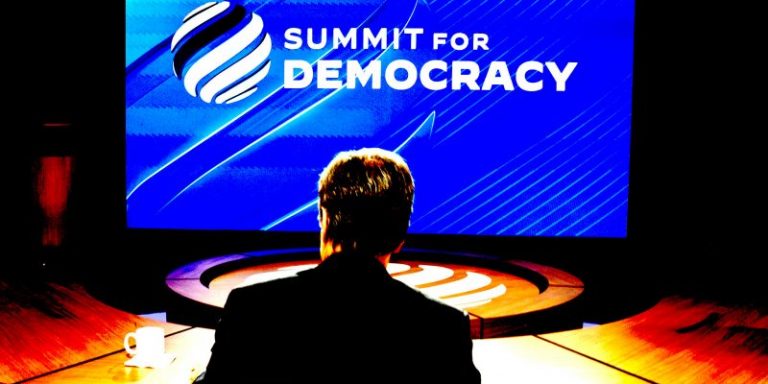
The United States hosted a “Summit for Democracy” on December 9th and 10th in an obvious attempt to legitimize its unipolar and hegemonic claim of leadership over the so-called “rules-based international order.” While on the surface this appeared to be an unproductive move on the part of the world hegemon, it aligned well with the U.S. strategy of cloaking its aggressive and exploitative policies under the guise of “democracy.” Joe Biden’s administration has repeatedly hyped the differences between “autocracy” and U.S.-led “democracy.” So-called allies were summoned to give the U.S.’s vision for democracy credibility on the international stage.

First ‘Summit For Democracy’ Should Be The Last

More than 100 nations’ presidents, prime ministers, and kings met virtually at the Summit for Democracy on Dec. 9 and 10. It was the first meeting in history on this scale where the application — or ostensible application — of the democratic principle in the governance of national affairs was used as a criterion to invite participants to an international meeting. There are three ways to look at the summit. A naïve view is to consider it as a meeting of like-minded states, interested in learning from each other about how to improve the application of democratic principles at home. (For that, however, there are already many other venues.) More realistic is to see it as an attempt to create a loose association of states, which would promote abroad their model of governance, assuming it is the only one compatible with the aspirations of the Universal Declaration of Human Rights.

20th ALBA-TCP Summit Declaration

The Heads of State and Government and the Heads of Delegations of the countries of the Bolivarian Alliance for the Peoples of Our America – Peoples’ Trade Treaty (ALBA-TCP), meet in Havana, Cuba, on December 14, 2021 to commemorate the 17th Anniversary of the Alliance. In signing this Declaration, we renew our commitment to strengthen this mechanism of political coordination based on the principles of solidarity, social justice, cooperation and economic complementarity, a result of the political will of its founders, the Commanders Fidel Castro Ruz and Hugo Rafael Chávez Frías.

Democratic Deficits At The Summit For Democracy

The so-called “Summit for Democracy” should first agree on a definition of what democracy means. Whereas etymologically we know that the definition of democracy means rule by the people, instinctively we feel that people power must be more than a slogan, that it must be concretized by genuine public participation in the conduct of public affairs. There are, of course, many manifestations or “models” of democracy, exercised nationally as well as locally in provinces and communities. The spectrum of democratic governance goes from direct democracy by way of citizen power of initiative and the possibility to challenge legislation by way of referenda, to participatory democracy through public meetings and voting on specific issues by ballot (or even show of hands!), to representative democracy through the election of parliamentarians with specific mandates, to presidential democracy by electing a president with wide-ranging powers.
assetto corsa mods

Urgent End Of Year Fundraising Campaign

Online donations are back! Keep independent media alive. 

Due to the attacks on our fiscal sponsor, we were unable to raise funds online for nearly two years.  As the bills pile up, your help is needed now to cover the monthly costs of operating Popular Resistance.

Urgent End Of Year Fundraising Campaign

Online donations are back! 

Keep independent media alive. 

Due to the attacks on our fiscal sponsor, we were unable to raise funds online for nearly two years.  As the bills pile up, your help is needed now to cover the monthly costs of operating Popular Resistance.

Sign Up To Our Daily Digest

Independent media outlets are being suppressed and dropped by corporations like Google, Facebook and Twitter. Sign up for our daily email digest before it’s too late so you don’t miss the latest movement news.