Skip to content

Nicaragua

In Nicaragua, The Latest Zombie Megaproject

By Jennifer Goett for Nacla - Most recent media coverage on Nicaragua’s Interoceanic Grand Canal conveys a good deal of skepticism about the project’s viability. Since the Nicaraguan state granted rights to build and operate the canal to a Chinese corporation in 2013, the project has become the centerpiece of Sandinista development policy for this economically impoverished nation. One of the world’s largest infrastructure projects to date, the canal comes with a $50 billon price tag and a host of environmental and social costs that have provoked wide ranging opposition.

The US Returns To Latin America

By Vijay Prashad for the Hindu and Counterpunch. The financial crisis of 2007-08 dented China’s economy and saw the slow deterioration of commodity prices. It took a few years for the economic impact to strike Latin America with ferocity. A sharp tumble in oil prices in the summer of 2008 put the brakes on many of the social programmes that had become essential to the Bolivarian dynamic. It signalled the weakness in the experiment against Western domination. President Barack Obama’s administration focussed intently on Latin America. Opportunity struck with the 2009 coup in Honduras against the Left-wing government of Manuel Zelaya. Mr. Obama recognised the new military-backed government. It opened the door to a more aggressive stance vis-à-vis Latin American states. The presidency of Peru’s Ollanta Humala (2011) and the second presidency of Chile’s Michelle Bachelet (2014) — both ostensibly of the Left — hastily drew in cabinet members vetted by the bankers and made their peace with the hegemony of the U.S. Chávez’s death in 2012 meant that the Bolivarians lost their most charismatic champion. The impact of the Honduran coup and Chávez’s death had made itself felt along the spine of Latin America. The U.S., it was being said, is back.

Francisca Ramirez, A Leader In Struggle To Stop Nicaragua Canal Project

By Arlen Cerda for Havana Times – The campesino movement demanding the repeal of the law for an inter-oceanic canal in Nicaragua – a project that the government has awarded to Chinese businessman Wang Jing – is autonomous, affirms Francisca Ramírez. It acts in defense of the earth and national sovereignty and isn’t motivated by any political interests. Ramírez, who remains on the land she farms in the community of La Fonseca, Nueva Guinea, serves as leader of the campesino movement. She insists that she doesn’t aspire to any public or party office in this electoral year.

Mass Protests In Nicaragua, Canal Will ‘Sell Country To Chinese’

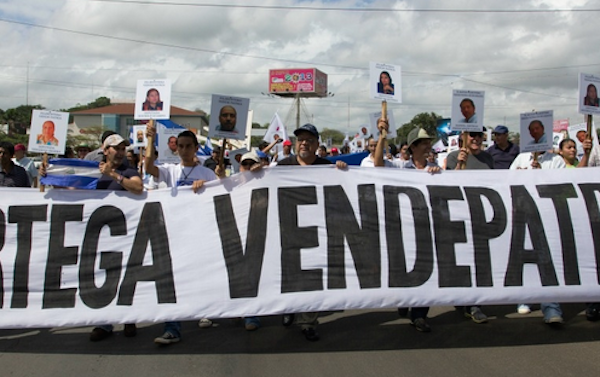
By Alexander Ward in The Independent - Thousands of locals in Nicaragua have demonstrated against plans to construct a canal linking the Atlantic and Pacific oceans. Mass protests in Nicaragua as farmers claim planned canal will 'sell country to the Chinese' The project, billed as longer and deeper than the Panama canal, will cost $50bn (£32bn) and is to be built by Chinese contractors. While the Nicaraguan government have said that the canal will bring vital investment to the country, demonstrators are concerned that it will have a dramatic effect on the environment. Protestors have also accused the Nicaraguan president, Daniel Ortega, of “selling the country to the Chinese,” although this has been refuted by authorities. According to various sources, the number of protestors gathered in Juigalpa is between 15,000 and 30,000. They believe that up to 120,000 people could be displaced by the project.

Amid Uproar, Nicaragua To Break Ground On Massive Canal Scheme

In the face of months of growing opposition and protests by local people, a Chinese firm on Monday will begin construction on a $50 billion project to link the Caribbean Sea to the Pacific Ocean that critics say will displace tens of thousands of people and bring untold environmental damage to the region. One day ahead of the groundbreaking ceremony, dozens of furious Nicaraguans blockaded roads, stopping workers with the Hong Kong-based firm Hong Kong Nicaragua Development (HKND) from accessing the construction site. In videos shared online by an activist group, protesters shouted "Viva Nicaragua!" while they blocked streets with a banner reading: "No to the canal." "This project will bring no benefit to the people of Nicaragua, it will only benefit the Chinese," the South China Morning Post quoted 24-year-old protest leader Danilo Lorio as saying. "The compensation offer for our lands is ridiculous."

Nicaragua: A Canal At What Cost?

What does a canal have to do with human rights? Plenty, according to the thousands of Nicaraguan protesters who filled Managua’s streetson December 10, International Human Rights Day. With banners, flags, chants, and a petition submitted to the Nicaraguan Center for Human Rights, they came out in opposition to a proposed canal that would pass through Nicaragua, linking the Atlantic and Pacific oceans. No doubt, the canal would increase Nicaragua’s economic importance in the region, bring in much needed income, and generate jobs. But those benefits come at steep costs: The canal is expected to devastate the environment. Moreover, it would displace indigenous communities and hurt some of the nation’s most marginalized peoples.

35 Years Since The Triumph Of The Sandinista Revolution

July 19, 2014 marks the 35th anniversary of the triumph of the Sandinista Revolution in Nicaragua. On that day, the Sandinista troops led by the nine commanders of the Sandinista Front for National Liberation (FSLN) entered the capital city of Managua where they were greeted by hundreds of thousands of jubilant Nicaraguans. The triumphant guerrillas found a country in ruins. The previous ruler of the country, dictator Anastasio Somoza Debayle, had bombed the cities during the final offensive. When he fled the country two days earlier, he took not only the caskets containing his parents’ remains, but all the money in the national treasury as well. The Sandinistas were left with no money and a $1.9 billion international debt. Despite these handicaps, the Sandinistas set up a nine member National Directorate and five member Junta de Reconstrucción as the executive branch, and a Council of State which included political parties and popular organizations as the legislature. They launched an ambitious and revolutionary political program.

Politicians On Both Sides Of The Border Dishonest About Migrant Crisis

What neither corporate media nor US Latino politicians will point out is that none of the current wave of refugees are coming from Nicaragua, although it has a similar history to Guatemala, Hondruas and El Salvador, and its just as poor. Why? According to NicaNet.Org, a project of the Nicaragua Solidary Committee. . . “The problem of the children migrants is blowback from US policy in the 1980s when our government trained and funded Salvadoran and Guatemalan military and police to prevent popular revolutions and more recently when the US supported the coup against President Manuel Zelaya in Honduras. Those countries were left with brutal, corrupt armies and police forces whereas Nicaragua, with its successful 1979 revolution, got rid of Somoza's brutal National Guard and formed a new army and a new police made up of upstanding citizens.

Activists Thank Countries for Asylum for Snowden

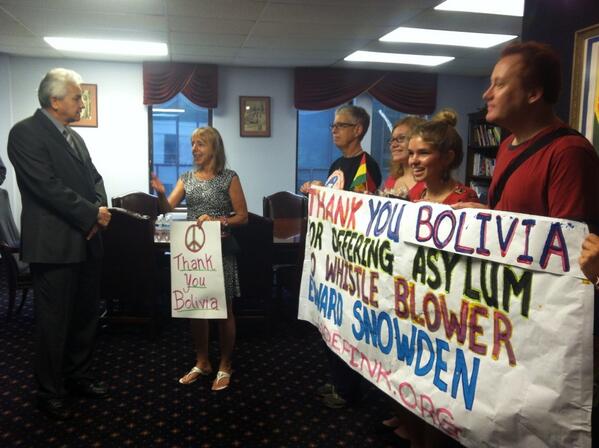
Activists have thanked Bolivia, Nicaragua and Venezuela for offering asylum for Edward Snowden and have delivered a letter to Russia urging President Putin to provide Snowden with travel documents to allow him to go to one of those countries. They make the argument that Snowden's revelations are not "damaging" Russia's "partner," the United States but are actually strengthening democracy in the US as they give the American people the opportunity to stop these illegal activities.

Venezuela Rejects US Extradition Request

Maduro told the Telesur TV channel that Venezuela had received an extradition request from the US, which he had already rejected. A copy of the request, seen by the Guardian, notes that Snowden "unlawfully released classified information and documents to international media outlets" and names the Guardian and the Washington Post. Dated 3 July and sent in English and Spanish, it says: "The United States seeks Snowden's provisional arrest should Snowden seek to travel to or transit through Venezuela. Snowden is a flight risk because of the substantial charges he is facing and his current and active attempts to remain a fugitive." Maduro said he did not accept the grounds for the charges. "He has told the truth, in the spirit of rebellion, about the US spying on the whole world," Maduro said in his latest speech. "Who is the guilty one?
assetto corsa mods

Urgent End Of Year Fundraising Campaign

Online donations are back! Keep independent media alive. 

Due to the attacks on our fiscal sponsor, we were unable to raise funds online for nearly two years.  As the bills pile up, your help is needed now to cover the monthly costs of operating Popular Resistance.

Urgent End Of Year Fundraising Campaign

Online donations are back! 

Keep independent media alive. 

Due to the attacks on our fiscal sponsor, we were unable to raise funds online for nearly two years.  As the bills pile up, your help is needed now to cover the monthly costs of operating Popular Resistance.

Sign Up To Our Daily Digest

Independent media outlets are being suppressed and dropped by corporations like Google, Facebook and Twitter. Sign up for our daily email digest before it’s too late so you don’t miss the latest movement news.