Skip to content

Worker Rights

Hotels Don’t Waste A Crisis

Javier Gonzalez used to send money every two weeks to his 85- and 90-year-old parents in his home country. He had to stop because his employer, Boston Marriott Copley Place, terminated Gonzalez and 230 of his co-workers last September, after temporarily laying them off at the start of the pandemic. They made up more than half the hotel’s workforce. Gonzalez is one of 500,000 hotel workers in the U.S. and tens of thousands in Canada who have lost their jobs since Covid hit. Pre-pandemic, there were roughly 1.7 million hotel and motel workers in the United States and 156,000 in Canada. Gonzalez worked as a lead supervisor in the utility department. Despite the title, he wasn’t management; he helped clean the kitchen and organize banquets at Boston’s second-biggest hotel.
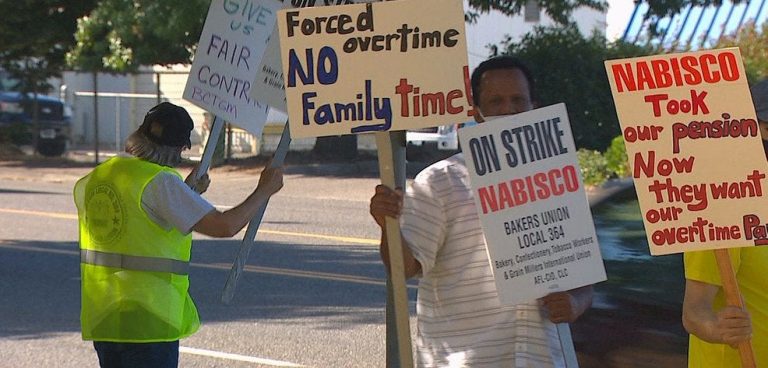
Nabisco Workers Are Striking For Normal Hours

A strike that began at a Nabisco factory in Portland, Oregon last week has now spread across the country to Nabisco facilities in Aurora, Colorado, and Richmond, Virginia, where Oreos, Ritz crackers, Chips Ahoy, and other popular cookies and crackers are baked and packaged. Hundreds of striking Nabisco bakery and distribution workers who are members of the Bakery, Confectionary, Tobacco Workers, and Grain Millers International Union have been forced to work 12 to 16-hour shifts during the pandemic, often six or seven days a week.  Meanwhile, the snacks giant has proposed turning eight-hour shifts into 12-hour shifts without overtime, increasing mandatory work on weekends, and creating a two-tier healthcare plan that costs significantly more for new hires, workers say.

A Miners’ Strike Fed By Solidarity

Over 1,100 union coal miners in Brookwood, Alabama, have been on an unfair labor practices strike against Warrior Met Coal for over five months. For five months, workers and their families have been holding the line, demanding to get back what was stolen from them with their last contract, demanding to actually have time to spend with their families, demanding to be treated with the respect they deserve for making this mine more productive than ever. The UMWA’s strike motto is ​“One day longer, one day stronger,” and workers are showing no signs that they plan to back down. In Part I of this special two-part update on the miners’ strike, our brother-in-arms Jacob Morrison from The Valley Labor Report interviews striking workers and supporters who attended a solidarity rally that the union held in Brookwood last week.

Scheer Intelligence: Prisons Enable America’s Obscene Wealth

The story of Marshall “Eddie” Conway, a military veteran and former Black Panther who was imprisoned for 43 years for a crime he didn’t commit, is one that gets to the heart of systemic racism in the United States. Despite grueling conditions, in prison Conway pursued three college degrees, and was considered an “exemplary” prisoner for starting a prison literacy program and organizing the prison library. On the other hand, his efforts to organize a union among his fellow convict laborers was crushed by the authorities. After being released in 2014 following an appellate court judgment that his jury had been given improper instructions, Conway has become executive producer of The Real News Network (TRNN), a progressive media organization based in Baltimore, MD, with his own show, “Rattling the Bars” that focuses on the many social justice issues that intersect with mass incarceration in the U.S.

At A Massive Union Rally, The Promise Of A Better South

To get to the big ballpark in Brookwood, Alabama, you drive down the Miners Memorial Parkway. The road goes by the local headquarters of the United Mine Workers of America (UMWA), and close to the Miners Memorial monument, which remembers 13 miners killed in a 2001 explosion. A lot of coal miners work in Brookwood, and a lot have died here. Right now, more than a thousand are on strike there, at the Warrior Met Coal. It sits just off the same road.  On Wednesday morning, a line of buses lumbered down the winding road through the woods, and a line of pickup trucks piled up behind them. All passed the ​“We Are One” UMWA signs lining the road for miles before turning into the ballpark, where the sprawling open grass was dotted with tents and a stage.

Identifying The Policy Levers Generating Wage Suppression And Inequality

Inequalities abound in the U.S. economy, and a central driver in recent decades is the widening gap between the hourly compensation of a typical (median) worker and productivity—the income generated per hour of work. This growing divergence has been driven by two other widening gaps, that between the compensation received by the vast majority of workers and those at the top, and that between labor’s share of income and capital’s. This paper presents evidence that the divorce between the growth of median compensation and productivity, the inequality of compensation, and the erosion of labor’s share of income has been generated primarily through intentional policy decisions designed to suppress typical workers’ wage growth, the failure to improve and update existing policies, and the failure to thwart new corporate practices and structures aimed at wage suppression.

Child Care Should Be Universal And Well-Paid

Queen Freelove of New Haven, Connecticut, remembers when the pandemic transformed the daycare she ran out of her home, abruptly turning the atmosphere from cozy to clinical: “Things got extremely traumatic for us,” she recalled. She was constantly trying to keep the environment sanitized, keeping a stockpile of masks, wipes, and other equipment, stopping parents in the hallway when they arrived to pick up their kids to take their temperature and give them a squirt of sanitizer — the protocol for “contactless” drop-offs and pick-ups. Keeping parents outside to minimize direct interaction, she said, was “hard, because we look forward to having that great relationship with the parents, and that really helps. But we could no longer have that relationship that we once had, because of the pandemic.”

Organizers Calling To Close Loophole That Enables Prison Slavery

While the 13th Amendment abolished chattel slavery, an often ignored clause still allows for slavery and involuntary servitude as “punishment for a crime.” This “slavery clause” is now the target of #EndTheException, a new campaign launched this year on Juneteenth weekend. #EndTheException is pushing for the passage of the Abolition Amendment, a joint resolution cosponsored by Sen. Jeff Merkley and Rep. Nikema Williams, which would strike the slavery clause from the 13th Amendment making it so that “neither slavery nor involuntary servitude may be imposed as a punishment for a crime.” On Saturday, June 19, as communities across the country celebrated Juneteenth—a long celebrated holiday by Black Americans, particularly Black Texans—Merkley and Williams joined advocates from groups including WorthRises, LatinoJustice PRLDF, JustLeadershipUSA, and the Anti-Recidivism Coalition for an online discussion about the #EndTheException campaign and to explain how the promise of freedom has yet to be unfulfilled.

Four Day Work Week Trial In Iceland ‘Overwhelming Success’

The world’s largest ever trial of a four-day working week and reduced working time in Iceland was an “overwhelming success” and should be tested in the UK, researchers have said. More than 1 per cent of Iceland’s working population took part in the pilot programme which cut the working week to 35-36 hours with no reduction in overall pay. Joint analysis by think tanks in Iceland and the UK found that the trials, which ran from 2015 to 2019 and involved more than 2,500 people, boosted productivity and wellbeing and are already leading to permanent changes. Icelandic trade union federations, which collectively negotiate wages and conditions for most Icelandic employees, have already begun to negotiate reduced working hours as a result.

Members Of Topeka’s Local Frito-Lay Union Just Voted To Strike

Members of the local union representing Frito-Lay workers have voted to strike. After multiple rounds of mediated contract negotiations with the company yielded little progress, members of Local 218 of the Bakery, Confectionery, Tobacco Workers & Grain Millers Union on Saturday voted to strike starting early next month. According to Mark Benaka, business manager for Local 218, a total of 383 union members turned out for a series of membership meetings held Saturday in Topeka. He indicated a strike vote was taken during those meetings, with members overwhelmingly voting in favor of the boycott. "A vote of 353-30 took them into a strike direction," Benaka said. He said the strike is expected to take effect just after midnight on Monday, July 5. However, he noted Frito-Lay representatives indicated Sunday they wished to meet again with the union's contract negotiating committee before that date.

Volvo Truck Workers In Virginia Return To The Picket Lines

Following Sunday’s massive repudiation of the second sellout contract negotiated by the pro-corporate United Auto Workers, 3,000 workers at the Volvo Truck North America’s New River Valley Plant in Dublin, Virginia, are back on the picket line. Inasmuch as the struggle of the Volvo truck workers has been scarcely reported on in the national media and all but ignored in the publications of the middle-class pseudo-left organizations, it is necessary to provide a concise review of the events leading up to Sunday’s vote. Volvo workers originally went out on strike on April 17, determined to reverse the concessions that had been granted by the UAW to the Sweden-based transnational corporation over the last three contracts.

Nestlé Workers Demand Equal Pay For Equal Work

Amidst the COVID-19 pandemic, workers at the Nestlé manufacturing plant in Toronto’s west end are facing unfair conditions including part-time pay, pension cuts and precarious employment, and management is unwilling to negotiate a reasonable contract with its employees. As of May 19, more than 470 workers are on indefinite strike. Workers at the factory, which produces Kit Kat bars and is the the only manufacturer of Coffee Crisp in the world, started their picket line on May Day 2021. Long-term disputes around the security of permanent employment and a defined benefit pension plan have previously disrupted production at the facility. Negotiations toward a new contract fell through over the central issue of a “tiered” workforce, which is being used by the company to deny employees equal pay for equal work, according to Unifor Local 252, the union representing chocolate production and skilled trades workers.

Workers At Steel Giant ArcelorMittal Go On Strike

Canada - In northeastern Quebec, 2,500 ArcelorMittal workers have been on strike since May 10. The strikers, who work in mines, port facilities, rail lines and offices belonging to the Luxembourg-based multinational, are represented by five locals of the United Steelworkers (USW/ Métallos ) and are affiliated with the Quebec Federation of Labour (QFL), the largest labour organization in Quebec with more than 600,000 members. The strike follows workers’ unequivocal rejection of ArcelorMittal’s “final and comprehensive” offer. Workers voted against the company’s May 7 offer by percentages ranging from 97 percent to 99 percent. Union bargaining committees had recommended that the offer be rejected.

Tribune Publishing Shareholders Let Everyone Down

Thousands of NewsGuild-CWA members, myself included, were upset by Tribune Publishing’s announcement today that shareholders approved the company’s takeover by Alden Global Capital, a hedge fund known as “the destroyer of newspapers.” There were several hours of confusion after Patrick Soon-Shiong, owner of 24% of Tribune shares, announced that he had abstained from voting. A marked “Abstain” vote, according to the proxy proposal, would serve as a rejection of Alden’s attempted takeover. However, several reports indicated Dr. Soon-Shiong submitted a blank proxy card, allowing his shares to count as favoring the takeover. I’ve reached out to Tribune Publishing and people close to Dr. Soon-Shiong for clarification. Tribune replied linking to a report by the Chicago Tribune as providing the best clarification.

How corporations buy and sell food made with prison labor

In 2011, Leprino Foods, the $3 billion company that supplies all the mozzarella to Papa John’s, Pizza Hut, and Domino’s pizza chains, lost its buffalo milk supplier in India. Water buffalo milk isn’t easy to find in the United States, especially not as much as a company as big as Denver-based Leprino could use. The animals are finicky, sometimes refusing to give milk at the sight of a stranger, and they produce only a fraction of the milk that cows make. But Leprino was in luck: One of its existing suppliers, which soon became one of the largest buffalo dairies in the United States, agreed to step in, and the milk began to flow. Leprino trademarked the slogan “with a kiss of buffalo milk” for Bacio, its premium mozzarella line marketed to independent pizzerias.
assetto corsa mods

Urgent End Of Year Fundraising Campaign

Online donations are back! Keep independent media alive. 

Due to the attacks on our fiscal sponsor, we were unable to raise funds online for nearly two years.  As the bills pile up, your help is needed now to cover the monthly costs of operating Popular Resistance.

Urgent End Of Year Fundraising Campaign

Online donations are back! 

Keep independent media alive. 

Due to the attacks on our fiscal sponsor, we were unable to raise funds online for nearly two years.  As the bills pile up, your help is needed now to cover the monthly costs of operating Popular Resistance.

Sign Up To Our Daily Digest

Independent media outlets are being suppressed and dropped by corporations like Google, Facebook and Twitter. Sign up for our daily email digest before it’s too late so you don’t miss the latest movement news.