Skip to content

Class Struggle

Teen Voices In The Fight To Raise The Minimum Wage In Massachusetts

Norma Meza is an 18-year-old student at Charlestown High School in Charlestown, Massachusetts. Growing up, she watched her mother battle health issues such as kidney failure, lupus, and ulcers. Despite working full-time, her mother struggled financially to keep the family afloat. Norma knew as early as 14 years old that she would have to get a job to help her mother pay the bills and put food on the table. Since then she’s worked a number of jobs to help contribute to her family’s income while gaining important work skills. “I’ve worked as an office assistant and learned in the process how to answer phone calls, assisting families who spoke Spanish,” said Norma. “After that I worked as a camp counselor for 2 years where I learned leadership, communication skills, and how to be a role model.”

Sarbanand: A “Dirty Dozen” Corporation Contesting Being Fined In District Court For Working A Farmworker To Death In Whatcom County

On Wednesday May 23rd at 9:00am Sarbanand Farms is scheduled to appear in the Whatcom County District Court to appeal a fine that was imposed on them by the WA State Dept of Labor and Industries after the death of a worker on August 6, 2017. This is happening in a courtroom that normally handles driving citations. This is the level of disrespect we are receiving for a farmworker’s death in Whatcom County. We believe the WA State Dept of Labor and Industries has given permission to agricultural corporations and the courts to normalize the deaths of farmworkers by exploitation. This past February, Sarbanand was fined over $150,000 for not allowing workers to take their rest breaks and lunches.

Years Of Civil Society Protest Bring Change To Iraq

Forming a government, following the recent parliamentary elections in Iraq, will take time, but there is now hope for significant change and reform. The strong showing of the Saeroun Lil-Islah (“Marching for Reform”) alliance, which won 55 seats in the parliament, was a clear endorsement for ending government corruption by the appointment of qualified technocrats to head government agencies and refusing to award ministries on the basis of sectarian quotas. The alliance, whose optimistic slogan is “To Build a Civil State, a State of Citizenship and Social Justice,”brought together communists, business leaders, and religious community activists under the leadership of the Shiite cleric Muqtada al-Sadr.

Supreme Court Rules Against Workers In Arbitration Case

ON MONDAY, THE Supreme Court slowed recent momentum to give workers—including many in the tech sector—the right to a day in court. The Supreme Court case centered around clauses in employment contracts that require employees to resolve disputes through arbitration, and preclude them from joining with others to file class-action lawsuits. In a 5-to-4 decision, the court ruled that those clauses are enforceable under federal law, which means companies can prohibit employees from banding together both privately or in court. Such binding-arbitration clauses are widely used at technology companies, and critics say they helped allow sexual harassment to flourish by hiding complaints. More recently, some firms have taken steps to limit the practice. Uber last week said it would eliminate arbitration agreements for employees, riders, and drivers with sexual misconduct claims.

20,000 North Carolina Teachers Walk Out, Demanding More Resources And Better Pay

Twenty thousand teachers staged a school walkout in North Carolina on Wednesday, demanding better salaries and more money for education. Forty school districts canceled classes in what The New York Times reports is the first walkout for teachers in that state. North Carolina, as The Guardian reports, “stood 39th nationwide in terms of public school teacher pay in 2017 and teachers’ wages have fallen by 9.4% in real terms over the last decade. Over the same period, spending on public schools here has dropped by 8%.” Both the low pay and the lack of resources have taken a toll on teachers’ morale. “I have to work other jobs,” Kaitlyn Davis, 26, a fourth-grade teacher, told The Guardian. “And it’s not fair because it takes away from the energy that I have to put into teaching.”

The Moral Revolution America Needs

Poor people of all races are shifting the national conversation on poverty and race from "right vs. left" to "right vs. wrong." Thousands of civil rights advocates, low-wage workers, and religious leaders kicked off massive protests on May 14, launching a 40-day campaign across the nation in an effort to revive Martin Luther King’s Poor People’s Campaign. The Poor People’s Campaign brings together poor and marginalized people from all backgrounds, places, and religions to stand up for their lives and rights by calling for a “revolution of American values.” They’re taking aim at the evils of systemic racism, poverty, the war economy, and ecological devastation. The first Poor People’s Campaign in 1968 brought thousands of Americans of all races together to fight for fair incomes and living standards.

University Of California Workers Start 3-Day Strike Over Pay

SAN FRANCISCO (AP) — Thousands of custodians, security guards, gardeners and other service workers at University of California campuses started a three-day strike Monday to address pay inequalities and demand higher wages. Strikers gathered at sunrise on the 10 campuses throughout the state, wearing green T-shirts and carrying signs that call for “equality, fairness, respect.” The strike was called last week by American Federation of State, County and Municipal Employees Local 3299, which represents 25,000 service workers, after the union and the university could not agree on a new contract and mediation efforts failed. Another 29,000 nurses, pharmacists, radiologists and other medical workers heeded the service workers’ call for a sympathy strike and will join the walkouts Tuesday and Wednesday, which is expected to disrupt thousands of surgeries and other appointments.

Academic Alienation: Freeing Cognitive Labor From The Grip Of Capitalism

Sitting in a coffee shop in a typical American college town, I overhear a conversation between two twenty-somethings. They lament, in educated and self-critical fashion, the failure of the academic system. Reflecting on their dedication and work ethic, they keep returning to the same question: What’s the point of four years of rigorous studying, of amassing student loans, of backbreaking night and weekend jobs, if there are almost zero job prospects out there? And, worse, what is their money going toward if not the kind of quality education they have been promised? With most classes no longer being taught by professors but by graduate students or adjunct teachers, they find the US educational system to be a scam. The experiences of these college students speak to a contradiction at the heart of the neoliberal economy.

We Are Living Through A Golden Age Of Protest

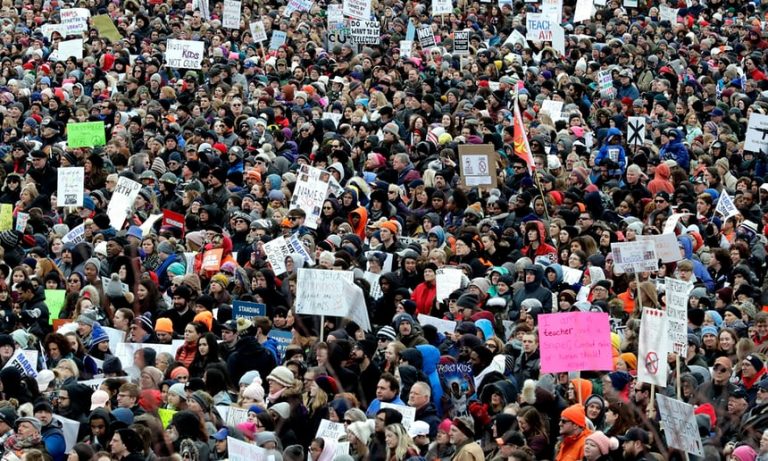
We are in an extraordinary era of protest. Over the course of the first 15 months of the 45th presidency, more people have joined demonstrations than at any other time in American history. Take a minute and digest that: never before have as many Americans taken to the streets for political causes as are marching and rallying now. Protest numbers are always difficult to pin down, but thanks to researchers from the Crowd Counting Consortium and CountLove, we have very solid data on demonstrations since Donald Trump took office, and the numbers are huge. The overall turnout for marches, rallies, vigils and other protests since the 2017 presidential inauguration falls somewhere between 10 and 15 million. (Not all of these events have been anti-Trump, but almost 90% have.) That is certainly more people in absolute terms than have ever protested before in the US.

8 Lessons For Today’s Youth-Led Movements From A Decade Of Youth Climate Organizing

On March 24, I stood in the rain in front of City Hall in Bellingham, Washington with some 3,000 people for the local March for Our Lives demonstration. It was one of 800 similar events happening nationwide that day, with about two million people participating coast to coast. The March for Our Lives against gun violence is one example of the wave of massive demonstrations that have swept the country since the Trump administration took office. From the Women’s March, to responses to Trump’s attacks on Muslims and immigrants, to protests against police violence, rallies for healthcare, and uprisings against pipelines, the last two years have been characterized by mass movements unparalleled in the United States in decades. Many, like the March for Our Lives, involve young people in leading roles. As someone who spent most of the past decade as a “youth activist” — in my case, a climate activist — I’ve been waiting for this moment for a long time.

Let’s Not Negotiate Against Ourselves: Demand Medicare For All

Like Medicare and Social Security, the proposals in the House (HR 676) and Senate (S 1804) for Expanded and Improved Medicare for All are social insurance programs. All Americans would receive comprehensive cradle to grave coverage. Healthcare would be equitably financed through taxes with no significant financial barriers to care. Choose Medicare, on the other hand, would create a “Medicare Part E” plan that would effectively be a private insurance product purchased in the marketplace. Access would be limited to those who choose to buy it (and can afford to do so) or whose employer deigns to offer it as a benefit. Except for those currently eligible for Medicaid under the ACA, its costs would be fully paid for by premiums–with, as in the ACA, some income-based subsidies– not public financing.

A Labor Movement For The New Guilded Age

When Ronald Reagan stood before the Brandenburg Gate on June 12, 1987, he not only invoked the rising supremacy of the United States by demanding “Mr. Gorbachev, tear down this wall!”, he ushered in a new era of individualism focused on the “freedom”(Bruner, 1989) that was libertarian in nature and encouraged the material success of the US economic model. This beginning of a new “Gilded Age” focused on the creation of individual wealth and individual prosperity. Roy H. Williams sees this moment as the zenith of the “Me Generation” (Williams, 2016), in which the relative strengths of individual achievement turn back on themselves. In this continuum between the “we” and the “me”, observers can understand the general debate over labor between the collective nature of the Republic and the desire for individualism.

The Real Driver Of Rising Inequality

Income distribution and employment are crucial macroeconomic indicators. Profits are key to distribution. Ther share in the value of output has risen steadily since around 1980. Households near the top of the size distribution of income receive business profits through various channels including interest, dividends, capital gains, proprietors’ incomes, and even labor compensation—which in US statistics includes profit-related items such as bonuses and stock options. Rising household inequality can be traced directly to higher profits fed by slower growth of real wages than of productivity (Taylor and Ömer, 2018).

An Ode To Eugene V. Debs And The End Of Capitalism

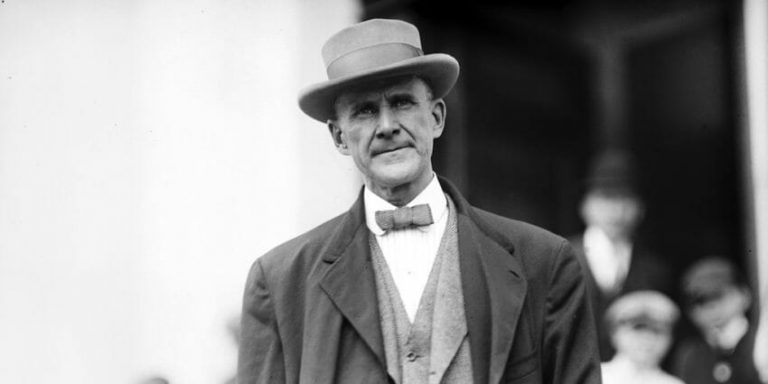
Once upon a time, the word “socialist” wasn’t considered a dirty word. In fact, in 1912, roughly a million people (6 percent of the popular vote), voted for a socialist for president. He is the subject of filmmaker Yale Strom’s new documentary, “American Socialist: The Life and Times of Eugene Victor Debs,” in limited release in New York from April 27 through May 3 and in Los Angeles from May 4 through May 10. A straight chronology using archival photos and footage, Strom’s movie tells the story of the pioneering union leader and founding member of International Workers of the World (IWW). Early in his career, Debs was a member of the Democratic Party with a focus on union issues and workers’ rights. He co-founded the American Railway Union (ARU), which galvanized a wildcat strike over pay cuts into a nationwide Pullman Strike that landed him six months in prison.

For His 200th Birthday, Honoring Marx As An Activist

In 1848, Marx wrote, “philosophers have only interpreted the world, in various ways; the point, however, is to change it.” On this 200th anniversary of the birth of Karl Marx we focus on Marx as a political activist, rather than what he is best known for, an economist and philosopher who wrote some of the most important analyses explaining capitalism and putting forward an alternative economic model. In the "Communist Manifesto", Marx wrote, "The history of all previous societies has been the history of class struggles." He believed political change stems from the history of conflicts between people who are exploited against the people who are exploiting them.
assetto corsa mods

Urgent End Of Year Fundraising Campaign

Online donations are back! Keep independent media alive. 

Due to the attacks on our fiscal sponsor, we were unable to raise funds online for nearly two years.  As the bills pile up, your help is needed now to cover the monthly costs of operating Popular Resistance.

Urgent End Of Year Fundraising Campaign

Online donations are back! 

Keep independent media alive. 

Due to the attacks on our fiscal sponsor, we were unable to raise funds online for nearly two years.  As the bills pile up, your help is needed now to cover the monthly costs of operating Popular Resistance.

Sign Up To Our Daily Digest

Independent media outlets are being suppressed and dropped by corporations like Google, Facebook and Twitter. Sign up for our daily email digest before it’s too late so you don’t miss the latest movement news.