Skip to content

Food and Agriculture

Activists Dump Ben And Jerry’s Ice Cream

By Organic Consumers Association. FINLAND, Minn. – The Organic Consumers Association (OCA) held protests today against Ben & Jerry’s, a subsidiary of Unilever, in seven US cities, and Mexico City. US cities are: Austin, Texas; Burlington, Vt., Chicago; Los Angeles; Minneapolis; New York; and Washington, D.C. “Ben & Jerry’s charges a premium for its ice cream based on claims that its products are “natural” and “GMO-Free,” and that the company is committed to a program of “social responsibility,” which includes concern about environmental issues, global warming, fair labor practices, animal welfare, and economic success for all its partners, including dairy farmers,” said Ronnie Cummins, OCA’s international director. “Serving up ice cream made with milk from cows raised on GMO animal feed and contaminated with Monsanto’s Roundup weedkiller violates all these promises.

Five Indigenous Farming Practices Enhancing Food Security

By Staff for FoodTank - On the 2017 International Day of the World’s Indigenous Peoples, the United Nations is celebrating the 10th anniversary of the Declaration on the Rights of Indigenous Peoples (UNDRIP). The Declaration, formally adopted in 2007, is an international human rights instrument that sets a standard for the protection of indigenous rights. UNDRIP addresses the most significant issues affecting indigenous peoples regarding their civil, political, social, economic, and cultural rights. It recognizes a range of fundamental freedoms of indigenous peoples including their right to self-determination, spirituality, language, lands, territories, resources, and free, prior, and informed consent. Over the centuries, indigenous peoples have provided a series of ecological and cultural services to humankind. The preservation of traditional forms of farming knowledge and practices help maintain biodiversity, enhance food security, and protect the world’s natural resources. There are approximately 370 million indigenous peoples in the world occupying or using up to 22 percent of the global land area, which is home to 80 percent of the world’s biological diversity.

Monsanto Papers And Weedkiller In Ben & Jerry’s Ice Cream—What’s The Connection?

By Katherine Paul for Organic Consumers Association - Not long after the Organic Consumers Association (OCA) announced that Ben & Jerry’s ice cream tested positive for glyphosate, the key ingredient in Monsanto’s Roundup weedkiller, another story broke—one that validates the importance of finding glyphosate, even at low doses, in any food. According to internal Monsanto documents (and as reported by GM Watch, Sustainable Pulse and other news outlets), Monsanto forced the retraction of a critical long-term study, first published in 2012, showing that very low doses of Monsanto’s Roundup herbicide—lower than those detected in Ben & Jerry’s ice cream—caused serious liver and kidney damage in rats. (We also tested four organic brands—Alden's, Julies, Three Twins and Whole Foods 365 Organic. All tested clean, except the 365 store brand, which had a trace of AMPA, a glyphosate metabolite). Shortly before the study was retracted, the editor of the journal that originally published the study, began working for Monsanto, under a consulting contract. (The study, led by G.E. Séralini, was republished in 2014, by the Environmental Sciences Europe).

Dirty Dairy: Why Consumers Need To Force Ben And Jerry’s To Go Organic

By Ronnie Cummins for Organic Consumers Association - The Vermont brand has been built on a bucolic image of cows grazing on endless pastures . . . Ben & Jerry’s ice cream and other Vermont companies have used this idyllic imagery to sell their products. Gone are the days, however, when most of Vermont’s cows were grazing in spectacularly scenic landscapes. Now a majority of Vermont’s cows are locked up in . . . ‘confined animal feeding operations’ or CAFOs . . . grazing on concrete with a diet rich in GMO corn and pesticides. - “Vermont’s GMO Addiction: Pesticides, Polluted Water and Climate Destruction,” Regeneration Vermont The most important thing we can do today as conscious consumers, farmers and food workers is to regenerate public health, the environment and climate stability. We can do this most readily by moving away from industrial, GMO and factory-farm food toward an organic, pasture-based, soil-regenerative, humane, carbon-sequestering and climate-friendly agriculture system. What’s standing in the way of this life-or-death transformation? Rampant greenwashing. The proliferation of $90 billion worth of fraudulently labeled or advertised “natural” and “socially responsible” food products in the U.S. confuses even the most well-intentioned of consumers and lures them away from purchasing genuine organic or grass-fed products.

Toxic Industrial Chemicals Found In 10 Types Of Macaroni And Cheese Powders

By Staff of Earth Justice - Laboratory testing of 10 varieties of macaroni and cheese products has revealed toxic industrial chemicals (known as phthalates) in the cheese powders of all of the tested items, according to the Coalition for Safer Food Processing & Packaging, a national alliance of leading public health and food safety groups. In recognition of National Macaroni and Cheese Day, the coalition has issued a call to The Kraft Heinz Company—the dominant seller of boxed macaroni and cheese, with 76 percent of market share—to drive industry-wide change by eliminating any sources of phthalates (THAL-eights) that may end up in its cheese products. Detailed information and a public petition are available at http://www.KleanUpKraft.org. "Serving up one of America's favorite comfort foods shouldn't mean exposing your children and family to harmful chemicals," said Mike Belliveau, executive director of the Environmental Health Strategy Center, a coalition member. "Our test results underscore the need for industry to comprehensively test their products for phthalates and determine the steps needed to eliminate them." Two million boxes of macaroni and cheese are sold every day in the U.S.

U.S. Blocking Food Shipments To Venezuela, Says Minister

By Staff of Xinhua Net - CARACAS, July 12 (Xinhua) -- The United States is blocking food shipments to Venezuela, a country struggling with shortages of staple goods, Venezuelan Minister of Urban Agriculture Freddy Bernal said on Wednesday. Bernal said U.S. threats of sanctions against companies doing business with Venezuela was interfering with the country's supply of imported foodstuffs. "The United States pressures shipping companies that if they make purchases, sales or transactions with Venezuela, they will be sanctioned," Bernal said in an interview with Caracas-based Union Radio. Bernal has coordinated a government program to deliver basic goods to families, which was put in place after Venezuela's political and economic crises led to shortages. That aid includes both domestic products and tons of grains and meats imported from Nicaragua, Panama and Mexico, said Bernal, adding U.S. interference was impeding the national distribution of the foodstuffs. Shortages of dietary staples and other basic goods have fueled discontent in Venezuela. Bernal also denounced recent stepped-up anti-government demonstrations for destroying "30 food warehouses" that support the food aid program.

The Attitude Of Solutions

By Paul Glover. The United States’ largest problems — job loss, wage cuts, foreclosures, crumbling bridges, medical costs, school taxes, pollution, crime, hunger, national debt and war — each have many solutions. Real solutions do not wait for government or corporations. They depend on each of us, starting where we live, with whoever is ready to begin. For 45 years, I’ve responded to news with solutions. When I hear bad news, my reflex is to imagine a solution, design it, then begin it. Guided by common sense alone, and without waiting for precise diploma, I’ve started 20 organizations and campaigns.They provide practical alternatives for food, fuel, housing, health care, urban design, education, transportation, sanitation, finance, and jobs. Millions of lively patriots are already enjoying building a new America.

Maine’s Food Sovereignty Law Touted As Nationwide First

By Julia Bayly for Bangor Daily News - With a stroke of his pen, Gov. Paul LePage last week enacted landmark legislation putting Maine in the forefront of the food sovereignty movement. LePage signed LD 725, An Act to Recognize Local Control Regarding Food Systems, Friday legitimizing the authority of towns and communities to enact ordinances regulating local food distribution free from state regulatory control. According to food sovereignty advocates, the law is the first of its kind in the country. “This is a great day for rural economic development and the environmental and social wealth of rural communities,” said Rep. Craig Hickman, D-Winthrop. “The Governor has signed into law a first-in-the-nation piece of landmark legislation [and] the state of Maine will [now] recognize, at last, the right of municipalities to regulate local food systems as they see fit.” Sponsored by Sen. Troy Jackson, D-Allagash, LD 725 does not include food grown or processed for wholesale or retail distribution outside of the community from which it comes. Supporters of food sovereignty want local food producers to be exempt from state licensing and inspections governing the selling of food as long as the transactions are between the producers and the customers for home consumption or when the food is sold and consumed at community events such as church suppers.

True Food Systems Change From The Bottom Up

By Families United for Justice. On June 15th FUJ members turned out to overwhelmingly ratify the tentative collective bargaining agreement presented by their negotiations committee. After an overview of the contract the Mixteco and Triqui hand harvesters, men and women, lined up to cast their ballots. Official vote counters Jeff Johnson President of the WA State Labor Council and Steve Garey former President of the Steelworkers Local 12-591 tallied the vote and announced it was over 85% in favor of ratifying the tentative agreement. The harvesting season will begin soon with contractual benefits for members of FUJ hand harvesting the berries. Among the benefits union members will receive is an average $15 an hour wage. While this contract is truly a great victory, C2C's vision for a better food system stretches far beyond this moment.

Monsanto’s Mess–Four Signs Consumers Are Winning

By Katherine Paul for Organic Consumers Association - Next month will mark one year since Congress obliterated Vermont’s GMO labeling law and replaced it with its own faux-labeling measure. The DARK Act was an outright attack on consumer and states’ rights. Still, then-President Obama refused to veto it. We lost the right to labels on GMO foods. But we never lost our determination to expose Monsanto’s corrupt manipulation of government agencies, or the truth about just how harmful Roundup herbicide is to humans and the environment. Fast forward to today. Monsanto is facing down scores of lawsuits by people, or their families, who were diagnosed with non-Hodgkin lymphoma after being exposed to Roundup. Those lawsuits have led to revelations about possible collusion between Monsanto employees and former U.S. Environmental Protection Agency (EPA) officials to bury evidence of Roundup’s carcinogenicity. Meanwhile the EPA, perhaps fearing consumer backlash, refuses to rule on whether to renew the license for glyphosate (the active ingredient in Roundup), even though we’re now nearly two years past the deadline.

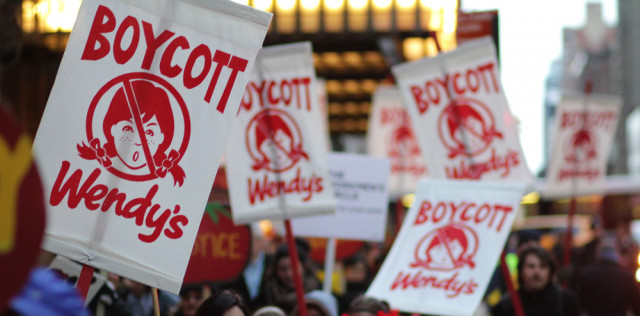
Boycott Wendy’s

By Coalition of Immokalee Workers. For over three years, farm workers and consumers have been demanding that Wendy’s join its major competitors – Taco Bell, McDonald’s, Subway and Burger King – in participating in the Fair Food Program. Yet, Wendy's has instead consciously and shamefully opted to profit from farm worker poverty and abuse, continuing to cling to the low-bar standards of the past when presented with an acclaimed and proven alternative. Rather than participate in what was called the "best workplace-monitoring program” in the U.S. in the New York Times, Wendy's ran from responsibility and abandoned the Florida tomato industry altogether. In response to increasing pressure from consumers to join the Fair Food Program, Wendy's released a new code of conduct for its suppliers, a perfect example of the failed, widely-discredited approach to corporate social responsibility that is completely void of effective enforcement mechanisms to protect farm workers’ human rights.

Dow’s Dastardly Deeds

By Staff of Organic Consumers Association - With Monsanto looking to be acquired by Germany-based Bayer, is Dow Chemical taking over Monsanto’s role of chief influence-buyer in Washington, D.C.? Dow wasted no time wooing Trump—the poison-peddler ponied up $1 million for the new president’s inauguration festivities. Trump swiftly rewarded Dow by naming CEO Andrew Liveris to head a new White House manufacturing working group. In February, after Trump signed an executive order aimed at rolling back regulations (including those on pesticides and GMOs), he handed the pen to Liveris. Fitting, given that Trump’s new EPA chief, Scott Pruitt, was quick to overturn the Obama administration’s proposed ban on one of Dow’s moneymakers, chlorpyrifos, an organophosphate pesticide. (Pruitt’s move prompted a lawsuit by environmental groups). Now, it seems, just banning organophosphates isn’t enough. A new report by the Associated Press (AP) says lawyers for Dow and two other manufacturers of organophosphates are asking Trump’s administration to throw out the EPA’s own studies on the dangerous effects of chlorpyrifos and other organophosphates, known to lower I.Q.s and cause neurological damage in children.

Documentary Explores David-and-Goliath Battle With Food Corporations

By Jordan Riefe for Truth Dig - Maybe Jack wasn’t the fool son when he traded the family cow for a handful of magic beans. Seeds are the givers of life, the minute building blocks of family farms and agri-empires alike. They are powerful and often sacred objects woven into local customs and cultures around the world. America’s own Thomas Jefferson was a famous horticulturist and seed saver who grew 330 varieties of vegetables and 170 varieties of fruit. Among his illustrious titles was that of patent examiner, basing his decisions on laws he himself had written. Items deliberately excluded from patents included plants and animals, placing public interest over private gain. Throughout human existence, seed diversity has been a constant, including drought-resistant strains, or those able to withstand floods or wide temperature swings. For countries plagued by war and poverty, this can mean the difference between life and death. “The Irish potato famine is a clear and elementary example of what happens when you rely on too little diversity—[you get a] mass refugee situation, many of them fleeing to the U.S.,” Jon Betz tells Truthdig. He and co-director Taggart Siegel are the filmmaking team of “Seed: The Untold Story,” a documentary that premieres on PBS’s Independent Lens on April 17, and streams online beginning April 18.

Ten Tips To Make Every Day Earth Day

By Lloyd Alter for Tree Hugger. Readers of a certain age will remember Pogo, the political satire strip that was probably the Doonesbury of the sixties. Walt Kelly did this great poster for the first Earth Day and really, nothing has changed. So many email pitches for green products, infographics and listicles (articles made of lists) come to me at TreeHugger. It is astounding, how many of them there are, and how trivial they can be. One that got me particularly cranked suggested that we could make a big difference in the state of the world by turning our TV brightness settings down and making the video game console go to sleep. A few years back, one of my sustainable design students asked what she could do to go green that did not involve buying replacement windows, electric cars or bamboo socks; Here is an Earth Day roundup of them, an update of an earlier version, listing the things that anyone can do.

Food Protests Erupt In Egypt As Bread Supplies Cut

By Neil Ketchley and Thoraya El-Rayyes for MERIP - On March 6, 2017, hundreds of local residents took to the streets of towns and cities in Upper Egypt and the Nile Delta after the Ministry of Supply cut their daily ration of subsidized baladi bread. By the following day, thousands were protesting in 17 districts across the country. In Alexandria, protestors blockaded a main road at the entrance of a major port for over four hours, while residents in the working class Giza suburb of Imbaba blocked the airport road. Elsewhere, women in the Nile Delta city of Dissuq staged a noisy sit-in on the tracks of the local train station, where they chanted, “One, two, where is the bread?” and called for the overthrow of President Abdel Fattah El-Sisi’s government.
assetto corsa mods

Urgent End Of Year Fundraising Campaign

Online donations are back! Keep independent media alive. 

Due to the attacks on our fiscal sponsor, we were unable to raise funds online for nearly two years.  As the bills pile up, your help is needed now to cover the monthly costs of operating Popular Resistance.

Urgent End Of Year Fundraising Campaign

Online donations are back! 

Keep independent media alive. 

Due to the attacks on our fiscal sponsor, we were unable to raise funds online for nearly two years.  As the bills pile up, your help is needed now to cover the monthly costs of operating Popular Resistance.

Sign Up To Our Daily Digest

Independent media outlets are being suppressed and dropped by corporations like Google, Facebook and Twitter. Sign up for our daily email digest before it’s too late so you don’t miss the latest movement news.