Skip to content

Social Movements

From Resistance To Governing Power In Honduras

A month after the coup d’état I was delegated by the new Front Against the Coup d’état to go to the U.S. to make known what had happened in Honduras. I had been working around international representation and communications in two formations, the National Coordinator of Popular Resistance and the Bloque Popular (Popular Block). These were spaces for coordination amongst the social movements that were confronting the impacts of neoliberalism, specifically the struggle against the Free Trade Agreement, which was impacting everything related to our agricultural capacity. Small and mid-sized Honduran producers had no possibility of competing against the big North American companies who were subsidized by the U.S. government and who generated a completely asymmetrical and unjust competition amongst producers.

The Nobodies Take Office In Colombia: An In-Depth Analysis

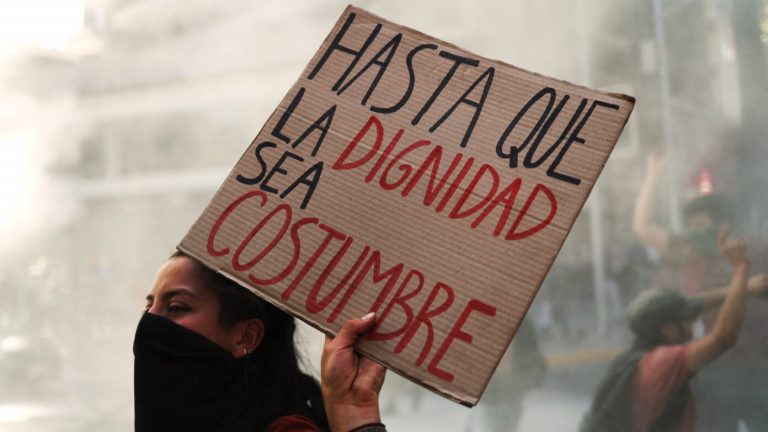
People are crying, embracing, yelling, as the streets fill with joy. Horns honk and people dance in the middle of avenues. They can’t believe that the news traveling by word of mouth, tweet to tweet, news show to news show, is really true. As the minutes and hours pass, they confirm that it is true: This June 19th they—the Nobodies—have won. “I am tingling from head to toes, overcome with emotion because I know that this is an historic accomplishment for all of us to remember. What joy! What happiness! Until dignity becomes customary!” says Ana Yuli Gamboa with a big smile—an Afro-Colombian woman from Cali who has come out to celebrate. Like Ana Yuli, little by little thousands took to the streets and plazas of the country to celebrate the victory of the Pacto Histórico, a victory that tastes like their own.

Colombia: Petro Is Now President; A Call For The Release Of Prisoners

“It is said that no one really knows a nation until he has been in one of its prisons.” Nelson Mandela’s sentence opens a petition addressed to Gustavo Petro and Francia Márquez, president and vice-president of Colombia, who officially takes office today. It is signed by the National Penitentiary Movement, accompanied by hundreds of organizations and personalities. The document offers a summary of the structural problems afflicting a country like Colombia, where the spaces for political viability of the opposition were closed with the assassination of Liberal leader Eliécer Gaitán, on April 9, 1948, and where violence has become structural. How much violence the oligarchy in the pay of Washington, which has crushed in blood any attempt to change the power structure by democratic means, has to answer for, is being demonstrated by the Truth Commission, contemplated in the peace accords between the government and the guerrillas, signed in Havana in 2016.

Sri Lanka Democracy Movement At The Crossroads

For several months the nation of Sri Lanka has been imperiled with the looming threat of complete economic collapse as fuel, food and other commodity prices skyrocketed. Former President Gotabaya Rajapaksa became the central focus of the youth-led democracy movement as the GotaGoGama encampment was established demanding the immediate resignation of Rajapaksa as president and the removal of his cabinet. At its height the camp’s activism attracted tens of thousands of people demanding an end to the former administration. Eventually the presidential compound was overrun by angry protesters necessitating the removal of Rajapaksa as president. These events have sparked a debate within the democracy movement on a possible shift in tactics and strategy.For several months the nation of Sri Lanka has been imperiled with the looming threat of complete economic collapse as fuel, food and other commodity prices skyrocketed. Former President Gotabaya Rajapaksa became the central focus of the youth-led democracy movement as the GotaGoGama encampment was established demanding the immediate resignation of Rajapaksa as president and the removal of his cabinet. At its height the camp’s activism attracted tens of thousands of people demanding an end to the former administration. Eventually the presidential compound was overrun by angry protesters necessitating the removal of Rajapaksa as president. These events have sparked a debate within the democracy movement on a possible shift in tactics and strategy.

We Can’t Build Real Power By Defending Democrats

The United States Constitution is failing: Its anti-democratic structures are creating a crisis of legitimacy and an inability to address a cascade of social crises. This is a problem endemic to liberal democracies, as the contradictions between political democracy on the one hand, and the tyranny of capital and ruling class control of politics on the other become heightened. Part of the crisis we face is the disjuncture between the sense of horror and urgency from the events of the last months and the gross inaction from politicians, particularly Democrats. Less than two weeks after a white supremacist attack on Black shoppers in Buffalo, New York, another gunman murdered children and their teachers in a school in Uvalde, Texas. In the same month as these mass murders, a leaked Supreme Court decision from an abortion case in Mississippi threatened to undo 50 years of legal precedent and end the right to abortion.

Ninth Assembly Of Caribbean People Meets In Cuba

Caribbean social movements and organizations, artists, and intellectuals, among others, gathered in Cuba’s Santiago for the IX Assembly of Caribbean People under the theme: “Culture, resistance, sovereignty, revolution.” Participants honored and paid visits to National Hero José Martí; Carlos M. de Céspedes, the Mother of the Homeland, Mariana Grajales, and to the historic leader of the Revolution, Fidel Castro. Welcoming remarks were made by René Berenguer Rivera, secretary general of the Central de Trabajadores de Cuba (CTC) in Santiago de Cuba. Camille Chalmers, organizing secretary of the Assembly of Caribbean People (APC) made the opening speech on behalf of the delegates, stressing the importance of this assembly being a forceful response to the hybrid wars and the new imperialist offensive.

Can Workers Overseas Provide Tips For US Labor Organizers?

The worldwide spread of Covid-19 created major challenges for workers and their unions throughout the globe. Very similar pandemic disruptions provided a timely reminder of the inter-connectedness of the global economy—and the need for cross-border links that enable workers to share information about their own struggles and learn from organized labor in other countries. What are some of the “best practices” abroad that might be reproducible in the U.S. to help strengthen workplace protections here? Two labor-oriented academics, Kim Scipes and Robert Ovetz, have recently published collections of case studies that answer that question in great detail. Their new books will be useful to both union organizers and campus-based observers of comparative labor movements.

Colombia’s New Dawn?

Colombians head to the polls this Sunday for a presidential election that will determine the country’s political trajectory for the next four years – and far beyond. With the two candidates offering vastly contrasting visions of the country, the tightly-poised contest carries ramifications likely to be felt long after the 2022-2026 electoral term ends. At the head of the progressive Historic Pact coalition, Gustavo Petro has campaigned on a platform of strengthening human rights and environmental protections, increased social investment and implementation of the 2016 peace agreement between the then-government of Juan Manuel Santos and the Revolutionary Armed Forces of Colombia (FARC). Petro and the Pact’s vice-presidential candidate, the African-Colombian social activist and feminist organizer Francia Márquez, have drawn strong support from social groups long marginalized under Colombia’s exclusionary political system.

A Tale Of Two Summits

There is growing criticism of US presumptions of supremacy and US foreign policy promoting division and conflict. This was expressed by leaders who stayed away from the Summit of Americas and also many leaders who attended. The Prime Minister of Barbados, Mia Amor Mottley, said frankly, “It’s wrong that Cuba and Venezuela and Nicaragua are not here, because as you heard from Bahamas, we need to speak with those with whom we disagree….There’s too much narrow-casting instead of broadcasting. There’s too much talking at, instead of talking with…. And the simple priority must be people, not ideology.” US exceptionalism and the exclusion of countries is increasingly being challenged. This matches the global criticisms of US unilateral sanctions. At the last UN General Assembly, the vote was 184-2 in denouncing US embargo on Cuba.  Seventy percent of world nations believes US sanctions violate international law.  

The Lethality Of Washington’s Global Monroe Doctrine

This past week, as part of its policy to dominate the American hemisphere, the United States government organised the 9th Summit of the Americas in Los Angeles. US President Joe Biden made it clear early on that three countries in the hemisphere (Cuba, Nicaragua, and Venezuela) would not be invited to the event, claiming that they are not democracies. At the same time, Biden was reportedly planning an upcoming visit to Saudi Arabia – a self-described theocracy. Mexico’s President Andrés Manuel López Obrador questioned the legitimacy of Biden’s exclusionary stance, and so Mexico, Bolivia, and Honduras refused to come to the event. As it turned out, the summit was a fiasco. Down the road, over a hundred organisations hosted a People’s Summit for Democracy, where thousands of people from across the hemisphere gathered to celebrate the actual democratic spirit which emerges from the struggles of peasants and workers, students and feminists, and all the people who are excluded from the gaze of the powerful.

Colombian Left May Be On The Verge Of Winning Power

The Colombian Left has seen its greatest electoral successes ever in 2022. In March, during the combined congressional general election and presidential primary (yes, they do both on the same day), for the first time ever, the Left party alliance won the most congressional seats of any party, and the two Left presidential candidates came in first and third, respectively, in votes received across all parties. The governing right-wing party has almost totally collapsed, winning only 12% of the vote. Those elected to Congress in March included a few leaders of an historic general strike last May, including a college student who went viral conducting an outdoor protest orchestra. Most U.S. news coverage of Colombia references gang violence and drug cartels, masking the vibrant web of Afro-Colombian, indigenous, feminist, student, campesino and worker movements that have shaken the country with mobilizations and now electoral wins over the last year.

Gustavo Petro Wins Today In Colombia

Gustavo Petro and Rodolfo Hernández are the candidates for the presidency of Colombia that will be measured in a second round, after not reaching the necessary number of votes defined by the Colombian rule of 50% plus 1. Colombia’s National Registry, the electoral authority, reported with 99.16% of the pre-counted votes that the candidates who will contest the second round on June 19 are Gustavo Petro and Rodolfo Hernández. Gustavo Petro, candidate for the Historical Pact, obtained 8,479,095 votes, equivalent to 40.31% of the votes, while Hernández obtained 5,931,722 votes, representing 28.20%. Although Petro’s result was expected, since he was the favorite in the polls, Hernández’s results on the contrary was a surprise given that he managed to consolidate himself during the last stretch of the campaign, when, in the polls, he began to approach the candidate of the right Federico Gutierrez.

Learning From Each Other’s Struggles Is Vital To Long-Term Success

When we’re up against the state or powerful corporations, patriarchal or racial structures, we can’t take success or even survival for granted. What we do and how — our strategy and tactics, our understanding and skill — matters for the outcome. The stakes are high, and the cost of defeat is severe. This makes movement learning an ethical, as well as a practical, necessity. Reinventing the wheel — only learning when we and our movements go through something ourselves — is a recipe for intensified and prolonged suffering. Meanwhile, a “Do something, anything” mentality is often justified by a macho celebration of action for its own sake, a preference for drama over results, or even our own past suffering. After all, if other people have successfully oppressed and exploited us for a long time, we have the moral high ground of having suffered, resisted and survived.

Bolivia: “We Are The Center Of The World”

Humanity is at a turning point. Not only war and climate change threaten life on our planet. Ideologies and some people as well. We know that money and the production of wealth and well-being have created a widening and deepening gap between people, neighborhoods, cities and countries that has been exacerbated in the wake of the pandemic. So I would like to stop thinking of ourselves as the poor periphery of an unequal, colonial and racist globalization. In Bolivia, since the beginning of this century, we have been struggling with some of the most important and decisive issues for the future of the human species: water, our sacred coca leaf, the goods that we can distribute thanks to the generosity of the Pachamama and – of course – the right to decide collectively about our lives.

‘It’s Time For Our America’: ALBA Movements Assembly Concludes

After four days of debates and reflection, the III Continental Assembly of ALBA Movements came to an end on Saturday, April 30. 300 delegates from 23 countries had gathered in Buenos Aires, Argentina to debate, discuss, and make concrete work plans for the next period. In the closing panel of the Assembly, leaders from across the region talked about the experiences of people’s movements and organizations in achieving the right to land and work, resisting attacks from the right-wing and imperialism, and building national and international unity of people in struggle. Speakers included Juan Grabois and Ofelia Fernandez, from Argentina’s Frente Patria Grande, Esteban “Gringo” Castro, from the Union of Workers from the Popular Economy (UTEP), Thays Carvalho from Movimiento Brasil Popular, Carlos Ron, Venezuelan Vice-Minister for North America, and Zaira Arias from the Free Peru party.
assetto corsa mods

Urgent End Of Year Fundraising Campaign

Online donations are back! Keep independent media alive. 

Due to the attacks on our fiscal sponsor, we were unable to raise funds online for nearly two years.  As the bills pile up, your help is needed now to cover the monthly costs of operating Popular Resistance.

Urgent End Of Year Fundraising Campaign

Online donations are back! 

Keep independent media alive. 

Due to the attacks on our fiscal sponsor, we were unable to raise funds online for nearly two years.  As the bills pile up, your help is needed now to cover the monthly costs of operating Popular Resistance.

Sign Up To Our Daily Digest

Independent media outlets are being suppressed and dropped by corporations like Google, Facebook and Twitter. Sign up for our daily email digest before it’s too late so you don’t miss the latest movement news.