Skip to content

Police violence

Newsletter – No Justice, No Peace

By Margaret Flowers and Kevin Zeese for Popular Resistance. Glen Ford of Black Agenda Report writes that “No justice, no peace” is “a vow by the movement to transform the crisis that is inflicted on Black people into a generalized crisis for the larger society, and for those who currently rule.” In reality, given the violence being inflicted upon people, particularly people of color, whether directly or indirectly through rising poverty, unemployment, homelessness, lack of access to health care and more, and the government’s failures to address these crises and listen to the people, disruption is a necessary element of political change. In 1968 the Rev. Dr. Martin Luther King, Jr., spoke outside a prison in California where people were being held for protesting the Vietnam War. In the speech he drew the connections between the Civil Rights movement and the peace movement against the Vietnam War. Today we see the links between racism, inequality, imperialism, militarism and ecocide and his comment on that day continues to ring true: "There can be no justice without peace. And there can be no peace without justice."

Civil Rights: The Next Generation

By Martha Biondi for In These Times. Is there a way to convert the energy of the recent protests into a sustained movement? FRANCES: People ask, “How can we transform movements into long-term, left, progressive organizations?” But the assumption that movements are a flash in the pan is wrong. Movements have considerable transformative power in themselves and can last a long time. The movement in Latin America that transformed South America began as anti-austerity, anti-structural-adjustment protests against the IMF. Several decades later, it had transformed the governments of many South American countries. It’s hard to know exactly when a movement begins and ends, but the civil rights movement certainly began by the mid-1950s and lasted at least 18 years, and in some senses continues to exist. CHARLENE: What’s happening right now is that a number of new folks are just being politicized. They are building their analyses and then figuring out what they want to do. One of the challenges is that you have folks who have been doing this work for decades in a very particular way that is in conflict with the values and the ideals of many folks who are also coming into this work for the first time because of police killings. The new folks are bringing a different analysis around things like queerness, blackness, feminism.

After The Uprising: Lessons From Rojava For Baltimore

By Ben Reynolds for ROAR. How can we create the fundamental change we so desperately need? We need a superior strategy to the failed strategies of the past; we need a means to turn an uprising into a revolution. History offers a few successful examples of popular organizing we can draw from. During the French Revolution, the popular assemblies of the Paris sections formed a radical base that pushed the developing revolution forward. The Russian Revolution of 1917 saw deliberative popular bodies known as “soviets” overthrow the provisional government in the name of bread and peace. These kinds of systems — based upon deliberative councils and assemblies — frequently appear in any period of unrest or upheaval, and have recently emerged in Argentina, Spain, and elsewhere. In the present, the Kurdish movement in Turkey and Syria employs a developed version of this system known as “democratic confederalism.” Face-to-face neighborhood assemblies form the base of political decision-making, while successive councils operate at the district, city and regional levels. The councils and assemblies deliberate upon all of the issues facing the community and attempt to organize the means to effect necessary changes.

Meet The People Ensuring Black Lives Matter Isn’t Just A Hashtag

By Julia Craven for Huffington Post. Facilitating meaningful conversations about race isn’t an easy feat, but a local collaborative effort is up to the challenge. Black Lives/White Light and TABLETRIBES, a D.C.-based tech startup, are coupling art and technology to create The Radius Project, which aims to take conversations surrounding Black Lives Matter beyond newsfeeds and comment sections. The collaborative is setting up three panel discussions in the Washington, D.C., area in hopes of turning online interactions into more meaningful face-to-face conversations . “A meaningful face-to-face conversation is a singular point of contact that has the power to activate a ripple effect in our communities,” Hosan Lee, the founder and CEO of TABLETRIBES, told The Huffington Post. “If we all work together, how far outwards can we extend the radius of progress?”

Standing Against Rampant Killings in Black Communities

By Don Rojas, Institute for a Black World. Black families across the country are being traumatized and whole neighborhoods are being destroyed by an epidemic of homicide that’s sweeping the nation and thousands plan to gather in Washington DC on Saturday, June 6 to demand that the country’s political leaders develop a public policy agenda that addresses homicide as a public health crisis. Led by Mothers in Charge (MIC), a grass roots Philadelphia-based organization with chapters in six states, families and community residents from Pennsylvania, New Jersey, Delaware, Maryland, New York and Washington DC are expected to gather at the Lincoln Memorial on Saturday morning to draw attention to homicide as a national tragedy. Two dozen organizations that are members of the Institute of the Black World’s (IBW) Black Family Summit, along with several other national organizations from around the country are supporting the MIC’s Washington rally under the banner of “Standing for Peace and Justice.”

Grassroots Organizing Shapes Response To Killing Of Walter Scott

By Kerry Taylor in Facing South. The city of North Charleston, South Carolina, has received strong praise for its handling of police officer Michael T. Slager's fatal shooting of 50-year-old African American Walter Scott during an April 4 traffic stop. According to various media commentaries, the city's quick response saved North Charleston from the outbreaks of vandalism and clashes with law enforcement that occurred in Ferguson, Missouri. At the local level, North Charleston's response was shaped by the emergence of a decentralized network of political activists who have been organizing around progressive causes, including labor rights and economic justice, LGBTQ equality, and racial disparities in policing. This network of activists sprang into action just hours after Scott's killing to offer a counter-narrative to the official version of events. They provided victims of police violence an outlet to express their pain and anger by organizing demonstrations, speak outs, and cultural events across the region. And they have carried out a range of protest activities aimed at securing reform. Their collective efforts at movement building, while diffuse and sometimes contradictory, represent an overlooked aspect of the Walter Scott story that has local political significance and strong national resonances.

Taxpayers Pay Hundreds Of Millions For Police Violence & Abuse

By Nick Wing in Huffington Post. In November 2014, a county judgeapproved a $3 million out-of-court settlement resulting from a wrongful death lawsuit, to be paid by the city of Cleveland to the victims' families and their lawyers. That money, like the rest of the police department's budget, comes from taxpayers. Some say this system of liability allows officers to do a difficult job without constant fear of being sued, while also ensuring that victims can seek damages. In many cases, however, it's hard not to feel that we are subsidizing negligent police behavior and misconduct, at a time when city budgets are tight and calls for improved accountability in law enforcement are louder than ever. As the Washington Post's Radley Balko noted in a 2014 blog post, these lawsuits are "supposed to inspire better oversight, better government and better policing." When the Baltimore Sun reports that the $5.7 million in taxpayer funds paid out to settle police misconduct cases between 2011 and 2014 could "cover the price of a state-of-the-art rec center or renovations at more than 30 playgrounds," for example, citizens are supposed to respond by demanding political change that will help address the root causes of these lawsuits and ensure their money goes to building playgrounds instead. It hasn't always played out like this at the voting booth, but maybe it's time we begin applying political pressure on the issue of policing.

Observations Of A White Protester Arrested In Baltimore

The difference is all there, so to speak, in black and white. Columbia activist-journalist Robert Brune was there at North and Pennsylvania avenues, recording video as a squad of police tried to clear the corner and enforce the curfew city officials imposed in the wake of the unrest that followed Freddie Gray's April 19 death in police custody. In Brune's footage, a police officer fires his pepper spray into the face of a black man wearing a T-shirt with the slogan "f--- the police." He staggers backward a step but does not fall. Another officer yanks the man to the pavement by his dreadlocks. As a third handcuffs the man, a number of onlookers approach, and more officers meet them and fire their pepper spray into the crowd. Officers hoist the arrestee by his bound wrists, his ankles and the waistband of his pants, carry him hurriedly toward the curb and lay him face-down on the sidewalk. A moment later, Kerridwen Henry, who is white, appears in a bright yellow T-shirt, carrying a placard. She exchanges some words with an officer, then drops to the sidewalk. She is handcuffed, and a pair of officers get her to her feet and escort her out of the frame.

Three Freedom Fighters On Building A Mass Movement

You will enjoy this discussion between Paul Jay of the Real News with three African American Freedom Fighters: Cornel West, Eddie Conway and Rev. Sekou as they discuss Building a Mass Movement. Jay pushes them on the issue of the role of elections in movements, why in his view it is important to seize the levers of power, i.e. government. He gets some pushback from the three and as a result the complexity of electoral politics and movement politics is clarified. The three basically say the elections too soon do not work as has been seen from the 1960s struggles when elected African Americans did not serve the community. The three put forward three stages: movement first, community second, electoral politics third. If we put our efforts into electoral politics before we have the independent mass movement and the self-sufficient community foundations to build from we get false prophet politicians -- the Obama, Clinton, Sanders, Warren line -- that will not be our saviors. They will still serve the power structure rather than the movement. We need to be our own saviors and when we get to the electoral phase, when we win office whether local, state or national, the movement continues.

New Limits On Police Use Of Military Equipment

President Barack Obama on Monday banned police departments from using certain military hardware and restricted the use of riot shields and other equipment, following unrest in U.S. cities over the deaths of black men at the hands of police officers. Obama announced the steps, which are the result of an executive order, during a visit to Camden, New Jersey, where he pushed efforts to encourage trust-building between police and the communities they serve. "We've seen how militarized gear can sometimes give people the feeling like there's an occupied force, as opposed to a force that is part of that community it is protecting and serving," Obama said in a speech at a community center in Camden, a city plagued by high rates of poverty and crime.

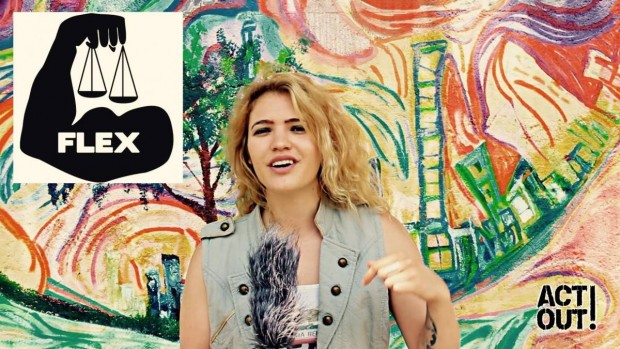
Act Out! Know Your Rights And Justice For Moms

Raise your fist, but not to fight. This week it’s about the power of the mind – to overcome, to evolve, to rise up and to stand resolute against injustice. We go through some bullet point rights, yours to flex any and every time you’re on U.S. soil. Knowledge is power. We go to LA to see how artists are manifesting justice through their various mediums: theater, discussions, forums, workshops on screen printing, spoken word, health and wellness. We then take you to the front lines of the Million Moms March, where mothers took a list of demands to the Department of Justice seeking answers for unsolved crimes that killed their children and destroyed their communities. Not one to end on a somber note, we wrap up this week with a rap/rock piece that reminds you to use your mind, find your fight and raise the floodlight.

Newsletter – Overcome Fear With Love

Instead of taking action to prevent or mitigate the next crisis, politicians are causing more harm as they work hand in hand with the wealthy elites who are trying to grab even greater power and extract even greater riches. Maryland's governor was quick to bring in the National Guard and militarized police, but just cut Baltimore education funding by $11.6 million to fund pensions, while last week the state approved funding for a youth jail the people in Baltimore don't want. This article provides five key facts about Baltimore and a graphic that shows how the United States built its wealth on slavery, Jim Crow and racially-based economic injustice and kept African Americans from benefiting the economy. Also, as a special addition to recognize BB King, he sings "Why I Sing the Blues" describing the history of African Americans from slavery until today.

Tony Robinson Protest In Madison Ends In Arrests

Police have arrested several demonstrators who stubbornly remained outside the Dane County Courthouse, following a day of protests over the District Attorney’s decision not to indict the officer who fatally shot Tony Robinson, 19, in March. Reporters on the scene estimate that anywhere from 15 to 25 arrests were made, as a group of protesters refused to leave the street outside the courthouse, several blocks away from the Wisconsin state capitol. Protesters linked their arms as they were being arrested, and some of them cried, reported AP. Organized by the Young, Gifted and Black Coalition (YGB), the marchers convened a “people’s court,” charging the Madison police with racism and police brutality and demanding Officer Matt Kenny be punished for the shooting of Robinson. Another group chained themselves together outside the Dane County Jail entrance, demanding the release of inmates inside.

Wednesday 30th Anniversary Of MOVE Bombing

On May 13, 1985, Philadelphia police dropped a bomb froma helicopter onto the MOVE organization, comprised of the Africa family, killing 11 people including five children, wounding scores and destroying 65 homes. John Africa, the founder of MOVE, said it stood for getting active, change and revolution. They had constant conflicts with mass arrests, hunger strikes in jail and police attacks. Would the Philadelphia police have bombed a white neighborhood? Such action is hard to imagine, therefore the racism of the MOVE bombing is hard not to see. But, the MOVE bombing also showed what happens when you give military power to a police force, problems we continue to see today.

On Mother’s Day Weekend, Moms Are Rising Up For Black Lives

This Mother’s Day weekend, moms across the United States are leading protests, vigils, and marches to demand justice for children slain by police and vigilante violence—and to send the message to parents and young people alike that Black Lives Matter. From Chicago to Washington, D.C., many of those organizing mobilizations on Saturday and Sunday are mothers who have lost their own children. “What better way to spend my Mother’s Day than to be fighting for my child,” said Panzy Edwards, whose 15-year-old son Dakota Bright was shot in the head and killed by a Chicago police officer in November 2012. “I’m marching to honor my son’s life that was taken by the Chicago police department,” Edwards told Common Dreams. “I’m marching to honor lives taken by police everywhere.”
assetto corsa mods

Urgent End Of Year Fundraising Campaign

Online donations are back! Keep independent media alive. 

Due to the attacks on our fiscal sponsor, we were unable to raise funds online for nearly two years.  As the bills pile up, your help is needed now to cover the monthly costs of operating Popular Resistance.

Urgent End Of Year Fundraising Campaign

Online donations are back! 

Keep independent media alive. 

Due to the attacks on our fiscal sponsor, we were unable to raise funds online for nearly two years.  As the bills pile up, your help is needed now to cover the monthly costs of operating Popular Resistance.

Sign Up To Our Daily Digest

Independent media outlets are being suppressed and dropped by corporations like Google, Facebook and Twitter. Sign up for our daily email digest before it’s too late so you don’t miss the latest movement news.