Skip to content

Housing

Vision For A New Urban Economy Based On Democracy

Tonight is the first night of the Building Our New Economy Together, Economic Democracy Conference in Baltimore. If you are unable to make it to the conference tonight, keep it tuned to this page for a live stream of our town hall at The Real News Network! You will also be able to catch the opening and closing plenary sessions on Saturday right here. For more on the event’s schedule, visit here. The evening will bring together top national experts on reframing our political situation with the folks in Baltimore who are already working on these issues. This session will be held from 7 to 9 PM, with doors opening at 6:30 PM and a reception following. Speakers will include (order TBD): Margaret Flowers of Popular Resistance and Its Our Economy Diane Bell McKoy, Associated Black Charities Gar Alperovitz, University of Maryland, College Park Jacqui Dunne, Author, Rethinking Money: How New Currencies Turn Scarcity into Prosperity Michael Coleman, United Workers

Mobilizing For The Common: Some Lessons From Italy

Saturday’s protest in Rome was the latest in a series of actions around a common project. What can organizers elsewhere learn from Italy’s movements? "The Italian movements may provide us with at least one clue on where to start: by sitting down together and carefully spelling out a common project behind which disparate political groups, autonomous movements and isolated individuals can unite. What is needed is a single banner capable of sustaining a broad popular coalition behind a set of shared aims and principles." Tens of thousands of protesters marched on Rome this Saturday to denounce the austerity measures and economic reforms of Matteo Renzi’s new government and to restate their call for income, housing and dignity for all.

How To Curb Gentrification

CJJC’s analysis busts the biggest “development” myth: Gentrification is not inevitable—it can be prevented before it starts and stopped in neighborhoods where the process is already underway. The report proposes a comprehensive policy agenda to mitigate the effects of ongoing gentrification and prevent further displacement. “Since the government has taken such a key role in creating gentrification,” Clark says, “it can also help fight it.” The proposals envision a “move away from overreliance on the private market to meet the housing needs of our communities.” The group hopes to put an initiative on the ballot in Oakland that would ban the kind of harassment techniques landlords use when they’re trying to evict tenants, including refusing to perform maintenance or threatening to report undocumented tenants to Immigration and Customs Enforcement.

March On Vanguard Properties Keep Benito Santiago’s In His Home

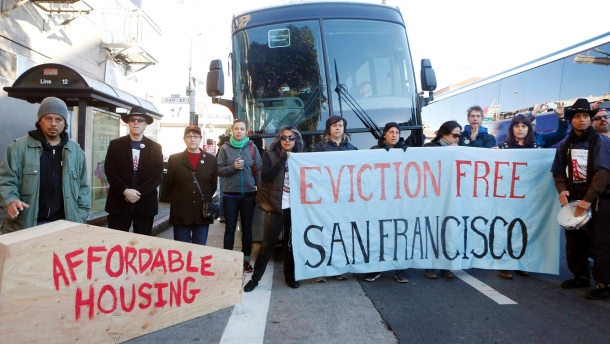
In an action organized by Eviction Free San Francisco, it was estimated that nearly 200 tenants and community supporters congregated at the 24th Street/Mission BART station at 11:30 a.m. to march to the offices of Vanguard Properties at 2501 Mission Street in support of San Francisco native Benito Santiago’s campaign to fend off an Ellis Act eviction from his home at 151 Duboce Avenue. 63-year-old Benito has lived in his one bedroom apartment since 1977, but is now facing an Ellis Act eviction at the hands of his new landlord, Pineapple Boy LLC, owned by Michael Harrison, one of the co-founders of Vanguard Properties.

You Call This A Middle Class? “I’m Trying Not to Lose My House”

“I wasn’t rich, but I felt like I had a life,” she said — as good a definition of middle class as any. That November, the company announced it was moving its office to Cleveland. All the employees were invited to go along. All declined, including Brown, who had lived in Chicago her entire adult life, since arriving to attend college. Having been laid off, Brown was eligible for unemployment benefits — which she figured would last until she found a new job. The last time she’d looked, in 1999, she’d found work right away. Despite sending out “hundreds of résumés each week,” Brown couldn’t land a full-time job. At age 46, with every month of unemployment making her less attractive to employers, she was wondering whether she ever would. She exhausted her 401K, and only a sympathetic landlord, who cut the rent to $800 a month, allowed Brown to hang on to her one-bedroom apartment. Brown’s benefits were cut off in July 2013, as a result of the federal government sequester. Two months later, she took a job as a telephone survey interviewer, for $8.50 an hour — 25 cents above the Illinois minimum wage.

Video: Landlords on Wall Street – The New Housing Scheme

Is the housing crisis over? If not, what is going on in the housing market? In this exclusive report, Laura Gottesdiener the author of A Dream Foreclosed: Black America and the Fight for a Place to Call Home, pulls back the curtain on a massive land grab that has once again turned our homes into dangerous financial products and reports on the growing movement of tenants and housing advocates are fighting back driven by a conviction that housing is not a market commodity, but a human right.

VIDEO: Class, Race, and War – Resistance Report One-Hour Pilot

Host Dennis Trainor, Jr. navigates a lively panel discussion with Nicole Carty (The Other 98%), Julianna Forlano (Absurdity Today), and Joel Northam (Resistance Report contributor). Special guests also include Mychal Denzel Smith (The Nation), Kateryna Ruban (expert in Ukraine and Russian history), and Cheri Honkala (Poor Peoples Economic Human Rights Campaign).

Hidden Homeless Camps In The Woods

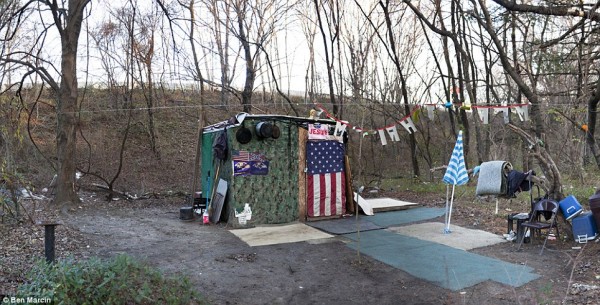
Marcin said he first stumbled upon the homeless dwellings as he hiked through the woods bordering the city during hunting season. When he saw a 'mini-fortress' made of milk crates just yards from a major thoroughfare, Marcin began searching for other transients 'living off the grid'. Most were based near railroad tracks, Walmarts, gas stations, and liquor stores. 'I have always been interested in the unique places people live in, particularly where there exists an element of defiance or desperation, or both. In these situations, a house can often reflect the dilemma of its owner. In the case of the hobo camps, this reflection is quite pronounced for obvious reasons,' he told The Atlantic Cities.

Learning From Manitoba’s Approach to Community

Manitoba has a long history of social justice movements. Manitoba was the first province to grant women the right to vote, home of the 1919 general strike, and is the location of one of the first Aboriginal friendship centres in the country. Our province is imbued with the spirit of solidarity and co-operation borne from a strong trade union movement and rural agricultural roots. First Nations teach us of the importance of considering the impact of our actions seven generations from now. These values inform community-organizing efforts towards social justice in Manitoba. Winnipeg's Inner City in the late 1980s and early 1990s was a place of divestment and concentrated urban decay. The rise of the suburbs had left the core of the city in trouble: boarded-up storefronts and arsons in abandoned buildings were coupled with low graduation rates and high unemployment.

B Of A Foreclosure Ruled Unconstitutional, Sets Precedent

This shows the scheme enacted by BoA to sanction this illegal and unconstitutional foreclosure which was proven because the DTA was not adhered to; as well as “failure to materially comply with that statute renders a foreclosure sale pursuant to it invalid.” Therefore the foreclosure implemented against the homeowner was illegal because there was a failure to appoint “a trustee that was independent.” Bowden clearly stated “I could not find that Fannie Mae as the claimed owner of the underlying note was a bona fide purchaser for value, even if it was not complicit in the violations of the DTA.” It was concluded that BoA and MERS action were “unfair [and] deceptive” in nature and the homeowner was “injured” because of this foreclosure.

Liberated Ads Confront San Francisco Eviction Crisis

On February 11, 2014, the CDC successfully apprehended, rehabilitated and discharged bus shelter advertisements throughout San Francisco. The ads were released into city districts with historically high rates of tenant displacement, including the Fillmore, the Mission and South of Market. One corrected ad sits at Valencia and 24th Street in the Mission District, a neighborhood with the city’s leading eviction rate from 2009 to 2013. Made with the assistance of a previously unknown agency, the U.S. Department of Home Security, the corrected advertisements feature silhouettes of people surrounding a house with their arms linked. Just above the image, a dramatic headline states EVICTION FORCES US TO MAKE A CHOICE. WE CAN BE AFRAID. OR WE CAN BE READY.

Sochi’s Internal Refugees Fight For Compensation

In the shadow of the Winter Games in Sochi, families kicked out of their homes to make way for Olympic construction are desperate for some compensation for their lost lives. Vova’s little eyes gleamed with a mischievous light upon hearing the word “games” and the three-year-old generously offered a visitor the chance to play with his colorful toy cars. He poured heaps of them onto a bed and set about sorting the jumble of tiny vehicles. “Games” was a word that Vova understood when the adults talked in serious conversation, but nobody seemed to be interested in playing with the boy. His grandmother, Lyudmila, was actually sobbing, looking at photographs of the family’s house, which had been demolished by authorities during the recent Olympic construction boom.

Eviction Resisters Using Stand-Your-Ground To Challenge Fannie Mae

He explains, "We oppose the Stand Your Ground law because it hurts people of color and poor people. But since it's on the books, we want to try to make it applicable to this situation and see if we can make American law really work for everyone. If it's supposed to apply to all Americans, let's see if it applies in this situation, where we have a big corporation hiding behind the law." The corporation in question is Fannie Mae, the government-run mortgage servicer that ordered Harris' eviction last August. Davis' goal is not only to save his clients from the 12- to 24-month jail sentences they face. The four defendants had a chance to take plea bargains that offered lesser punishments such as community service, probation and paying a fine. But they unanimously rejected the deals to take the case to trial. They want to use the opportunity to force transparency from the company that strung Harris along for years, leading him to believe he could save his house, then suddenly slammed the door on negotiations.

The Real Illness Plaguing U.S. Healthcare: Inequality

By encouraging officials to abscond with one of the few tradable assets possessed by those in the lowest (and even middle) tiers of our economy, the U.S. healthcare system reveals itself to be another cornerstone in the structure of American economic inequality. While the lower- and middle-classes have had a tough time securing stable investments in real estate, the wealthier have profited on this instability. Ironically, speculation in real estate and mortgage-backed securities and the concomitant bail-outs for irresponsible banking institutions dramatically reduced state revenues. Governments across the country have been forced to play an agonizing game of budgetary triage. Meanwhile, as more people have been forced into poverty by the massive wealth destruction of the Great Recession, the state has had to pay more into safety net programs while drawing less revenue from a poorer population.

DC’s Poorest Residents Fight Gentrification

Barry Farm, a public housing complex in southeast Washington, "is the line in the sand," says Schyla Pondexter-Moore, a community organizer. "If you take away Barry Farm, you're basically just giving away the whole Ward 8." Barry Farm is the latest battleground for grass-roots housing advocates in the nation's capital, where intense gentrification has altered the city's demographic landscape dramatically. Because Washington was America's first city to have a black majority, it came as a shock to many in 2011 when DC's black population dropped below 50 percent for the first time in more than 50 years. In the past decade, the district lost nearly 40,000 black residents, many driven out by skyrocketing rents fueled by an influx of mostly white professionals flocking to increasingly gentrified neighborhoods.
assetto corsa mods

Urgent End Of Year Fundraising Campaign

Online donations are back! Keep independent media alive. 

Due to the attacks on our fiscal sponsor, we were unable to raise funds online for nearly two years.  As the bills pile up, your help is needed now to cover the monthly costs of operating Popular Resistance.

Urgent End Of Year Fundraising Campaign

Online donations are back! 

Keep independent media alive. 

Due to the attacks on our fiscal sponsor, we were unable to raise funds online for nearly two years.  As the bills pile up, your help is needed now to cover the monthly costs of operating Popular Resistance.

Sign Up To Our Daily Digest

Independent media outlets are being suppressed and dropped by corporations like Google, Facebook and Twitter. Sign up for our daily email digest before it’s too late so you don’t miss the latest movement news.