Skip to content

Poverty

Majority Of Brazilians Think World Cup Is Bad

In this episode of Acronym TV, Derek Poppert of Global Exchange talks with Dennis about his Re-Think The Cup series. In a recent piece from the series, FIFA: Return The Beauty To The Beautiful Game, Derek writes: “So who wins the World Cup? While it may seem that decision is still getting played out in stadiums across Brazil, FIFA president Sepp Blatter is surely laughing from his luxury suite. The winner had already been decided well before the first match even began. FIFA’s 4 billion dollars in untaxed revenue from the event is the trophy. It appears to be of little interest to Mr. Blatter or other FIFA execs that this trophy has come on the backs of 200,000 low-income people being forcefully evicted from their homes to make room for the event, 8 construction workers dying in the frenzied rush to erect stadiums on time, or 14 billion dollars in Brazilian taxpayer money being spent on the tournament in the face of poverty, inequality, and widespread social issues within Brazil.”

Families Displaced By World Cup Wait For Relief

In preparation for hosting the World Cup, the Brazilian government spent the outrageous amount of $10 billion and displaced as many as 250,000 people–evicting the poorest from their homes and sweeping up homeless from the streets. Since the World Cup started, thousands have protested lavishing public resources on a sports event while poverty is rampant. Journalists Tim Eastman and Shay Horse have been in Brazil covering the protests and events outside the sports arenas. We had the opportunity to visit a group of families who were victims of these forced removals. One hundred days ago, military police evicted 160 families of the Telerj area of Rio de Janeiro from their homes. They lived in an area which had been gifted by the government of Dilma Roussef. For a short time, they occupied City Hall but were violently ejected by military police. Since then, they have traveled around and resettled in various areas of Rio, wandering from place to place without a home.

Preconditions For An Actually Democratic Society

As the Fourth of July is celebrated across the US – in the glow of unprecedented economic polarization, a ballooning prison population, and a barrage of dire climatological studies, among other pieces of evidence leading ever more people to consider whether our collective way of life is in need of a fundamental transformation – an examination of the ostensible objects of our celebration (independence and democracy) seems in order. Aside from the concept of independence (and the question it implies: independence from what?) democracy, it should be remarked, is an especially vague and ambiguous concept. Indeed, because democracy can refer to egalitarian, emancipatory politics, as well as to the political-economic systems of the slavery-based societies of the southern US or ancient Athens – an initial distinction should be drawn between egalitarian forms of democracy (which tend to be organized more or less horizontally, with social resources distributed more or less evenly) and what, in practical terms, are really plutocratic societies – or what, perhaps, can be termed market-based democracies (which tend to be more or less hierarchical and representational). And it’s the market-based or plutocratic society that, with only minor egalitarian democratic interruptions and adjustments, exists today and characterizes what democracy has meant since the bourgeois democratic revolutions of the late 18th century.

Americans Without Rights

Over sixty five million people in the US, perhaps a fifth of our sisters and brothers, are not enjoying the “unalienable rights” of “life, liberty and the pursuit of happiness” promised when the Declaration of Independence was adopted on July 4, 1776. They are about twenty percent of our US population. This July 4 can be an opportunity to remember them and rededicate ourselves and our country to making these promises real for all people in the US. More than two million people are in our jails and prisons making the US the world leader in incarceration, according to the Sentencing Project, a 500% increase in the last 30 years. Four million more people are on probation and parole, reports the US Bureau of Justice Statistics.

World Of Resistance Report: Inequality, Injustice And The Coming Unrest

In Part 1 of the World of Resistance (WoR) Report, I examined today's global order – or disorder – through the eyes of Zbigniew Brzezinski, a former U.S. National Security Adviser and long-time influential figure in foreign policy circles. Brzezinski articulated what he refers to as humanity's "global political awakening," spurred by access to education, technology and communications among much of the world’s population. Brzezinski has written and spoken extensively to elites at American and Western think tanks and journals, warning that this awakening poses the “central challenge” for the U.S. and other powerful countries, explaining that “most people know what is generally going on... in the world, and are consciously aware of global iniquities, inequalities, lack of respect, exploitation.” Mankind, Brzezinski said in a 2010 speech, “is now politically awakened and stirring.” But Brzezinski is hardly the only figure warning elites and elite institutions about the characteristics and challenges of an awakened humanity. The subject of inequality – raised to the central stage by the Occupy movement – has become a fundamental feature in the global social, political and economic discussion, as people become increasingly aware of the facts underlying the stark division between the haves and have nots.

The Pitchforks Are Coming… For Us Plutocrats

You probably don’t know me, but like you I am one of those .01%ers, a proud and unapologetic capitalist. I have founded, co-founded and funded more than 30 companies across a range of industries—from itsy-bitsy ones like the night club I started in my 20s to giant ones like Amazon.com, for which I was the first nonfamily investor. Then I founded aQuantive, an Internet advertising company that was sold to Microsoft in 2007 for $6.4 billion. In cash. My friends and I own a bank. I tell you all this to demonstrate that in many ways I’m no different from you. Like you, I have a broad perspective on business and capitalism. And also like you, I have been rewarded obscenely for my success, with a life that the other 99.99 percent of Americans can’t even imagine. Multiple homes, my own plane, etc., etc. You know what I’m talking about. In 1992, I was selling pillows made by my family’s business, Pacific Coast Feather Co., to retail stores across the country, and the Internet was a clunky novelty to which one hooked up with a loud squawk at 300 baud.

Leveling The Playing Field For Worker Cooperatives

A quiet revolution is rumbling through New York's municipal offices as they retool to support the creation of worker cooperatives as a way to fight poverty. Spurred by the powerful example of immigrant-owned cleaning cooperatives and the longstanding example of Cooperative Home Care Associates in the Bronx - the largest worker cooperative in the country - progressive city council members are allying with a new network of worker cooperatives, community based organizations that incubated immigrant-owned coops and the influential Federation of Protestant Welfare Agencies to figure out how the city can encourage this still-tiny economic sector. Once fully in place, New York City will be a national leader in providing municipal support for these democratic enterprises. The pace of change is dizzying. In January, the federation released a short report arguing that worker coops help improve traditionally low-wage jobs by channeling the enterprises' profits directly to their worker members, improving their lives in tangible ways. Then in February, Councilwoman Maria del Carmen Arroyo, chairwoman of the Committee on Community Development, held a hearing which put staff from the city's Small Business Services and Economic Development Agency in the hot seat about how they were promoting worker cooperatives.

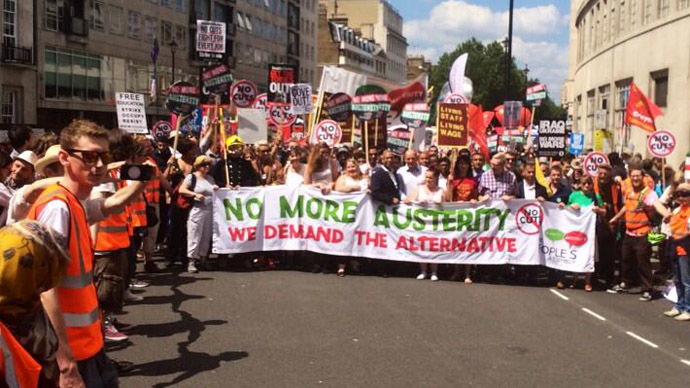
Tens Of Thousands March Against Austerity

A spokesman for the People's Assembly, which organised the march, said the turnout was "testament to the level of anger there is at the moment". He said that Saturday's action was "just the start", with a second march planned for October in conjunction with the Trades Union Congress, as well as strike action expected next month. People's Assembly spokesman Clare Solomon said: "It is essential for the welfare of millions of people that we stop austerity and halt this coalition government dead in its tracks before it does lasting damage to people's lives and our public services." Sam Fairburn, the group's national secretary, added: "Cuts are killing people and destroying cherished public services which have served generations."

London: Massive Assembly Against Austerity

Tens of thousands rallied in London today to protest imposed austerity and cuts to basic services. Here is the day in their own words through their tweets and photos. The mainstream media failed to cover the protest despite its size. They protested privatization of public services such as health care and they protested growing unemployment and poverty. And they chastised the media for blacking out the event.

Chinese Tycoon To Feed 1,000 Poor Americans In Charity Dinner

China’s recycling tycoon Chen Guangbiao placed ads in the US media inviting one thousand poor Americans for a dinner worth $1 million in New York on June 25. The philanthropist also said that he will give out US$300 to each guest after the meal. The billionaire placed a full-page advertisement in Monday’s New York Times and a half-page advertisement in Wednesday’s Wall Street Journal, the South China Post reported. The ad in Chinese and English, designed by Chen himself, said that the event will be held on June 25 at the Loeb Boathouse Central Park in New York. The eccentric tycoon said that he wanted to send a message to Americans that rich Chinese are “not all crazy spenders on luxury goods,” as cited by the South China Post. “At the same time, there are many wealthy Chinese billionaires but most of them gained their wealth from market speculation and colluding with government officials while destroying the environment,” Chen said. “I can’t bear the sight of it, because all they do is splurge on luxury goods, gambling and prostitution and very few of them sincerely live up their social responsibility.”

Ending Child Poverty In The US: Financially Prudent, Morally Just

More than one in five children in the US lives in poverty: that’s 790,000 children in New York, 429,000 in Chicago, and 125,000 in Washington, D.C. In all, there are 16 million poor children. Child poverty is also rising, up six percentage points since the turn of the century. Those numbers make it seem like a pretty intractable problem. After all, it’s literally millions of our children—living without adequate shelter, without healthy food, without adequate opportunities to play and learn and grow. If we’ve let things get this bad then surely child poverty must be nearly impossible to solve. But the fact is it isn’t difficult to end child poverty, or at least to dramatically reduce it. As Austin Nichols, an economist at the Urban Institute, wrote last year: If the United States offered cash benefits to children in poor families, we could cut child poverty by more than half. According to calculations using the 2012 Current Population Survey, poor children need $4,800 per year each, on average, to escape poverty. That’s $400 a month for each child.

Increasing Wages Is An Effective Poverty Reduction Tool

Broad-based wage growth—if we can figure out how to achieve it—would dwarf the impact of nearly every other economic trend or policy in reducing poverty. Even in 2010, the bottom fifth of working age American households relied on wages for the majority (56%) of their income. When you add in all work-based income including wage-based tax credits, nearly 70% of income for low-income Americans is work-related. Yes, the targeted efforts to strengthen the safety net are well deserved. Programs such as food stamps (SNAP), unemployment insurance, and Social Security have helped reduce poverty over the last four decades. But market based poverty (or poverty measured using only income from wages) has been on the rise and the safety net has to work even harder to counterbalance the growing inequalities of the labor market. There was once a strong statistical link between economic growth and poverty reduction, but rising inequality has severed it, and the results are deeply dispiriting. If the statistical link between economic growth and falling poverty that held before the mid-1970s had not been broken by rising inequality, then poverty, as the government measures it, would be virtually eradicated today. Furthermore, the impact of rising inequality is nearly five times more important in explaining poverty trends than family structure.

Victory Gardens DC Is Growing Food & Community

Victory Gardens DC, a new urban farm in Washington, D.C., grew out of one young couple’s desire to serve city residents in a practical way. Alex Shek, an entrepreneur, and his wife Julia, a nurse, decided that the best way to help the people in their Southeast neighborhood is to provide healthy food to those who can’t afford it. With Alex’s business know how, Julia’s knowledge of healthy food and cooking, and the aid of some talented friends, they started an urban farm in their own neighborhood. Neighbors, local businesses, churches and contributors on indigogo.com have provided labor and money, and the couple’s dream is now a reality. Food Tank: What inspired you to start Victory Gardens DC? AS: My wife and I moved to the city from Northern Virginia with the idea of ministry and outreach in our heart, and we wanted to fill a need, a practical need, and how practical is food? The ability to find organic food or good fresh fruits and vegetables at a low cost in the city is really challenging, and I hope we can make an impact through providing food for those that can't afford it.

Brazilians Take Back The City

Only the steady flow of men, women and children through a rusted, grey door alert passersby that anyone lives inside the 22-story building. It's covered in graffiti: a small house - bright yellow, with a brown door, window and roof - two women's faces, and the number 911. With an abundance of unused buildings peppering the city, low-income residents of Sao Paulo occupy vacant structures, often with the help of local social and housing rights movements. This is one of them. "We occupy [buildings] to give a social function to the properties and give houses to people without houses," said Maria Silva, one of the residents. In other cases, several families occupy large homes, and each family rents out a single room while sharing other facilities, like bathrooms and kitchens. These structures are known as corticos (boarding houses, or tenement buildings). Unlike the favelas, corticos consist of large, urban apartment-syle buildings shared by several families. In Sao Paulo, rapid urbanisation was linked to a shift from agriculture to more modern industries, and as labourers moved into makeshift communities to be closer to work. While most favelas are in the peripheries of Sao Paulo, many low-income families also moved into the city centre to be closer to basic services

Activists Pour Concrete Over Spikes In Protest

As if their city’s failure to provide them with shelter weren’t bad enough, homeless people in London faced further acts of dehumanization recently when a property developer and supermarket erected spikes meant to deter them from sleeping there. A few weeks ago, spikes were assembled outside a grocery store called Tesco as well as in front of the entrance to luxury flats. “There was a homeless man asleep there about six weeks ago,” an anonymous resident told the Telegraph. “Then about two weeks ago all of a sudden studs were put up outside. I presume it is to deter homeless people from sleeping there.” In response to the inhumane construction, activists called the London Black Revolutionaries took to pouring concrete over the spikes outside of Tesco, leaving signs behind that read “Homes Not Spikes.”
assetto corsa mods

Urgent End Of Year Fundraising Campaign

Online donations are back! Keep independent media alive. 

Due to the attacks on our fiscal sponsor, we were unable to raise funds online for nearly two years.  As the bills pile up, your help is needed now to cover the monthly costs of operating Popular Resistance.

Urgent End Of Year Fundraising Campaign

Online donations are back! 

Keep independent media alive. 

Due to the attacks on our fiscal sponsor, we were unable to raise funds online for nearly two years.  As the bills pile up, your help is needed now to cover the monthly costs of operating Popular Resistance.

Sign Up To Our Daily Digest

Independent media outlets are being suppressed and dropped by corporations like Google, Facebook and Twitter. Sign up for our daily email digest before it’s too late so you don’t miss the latest movement news.