Skip to content

Taxes

An Independent Thinker’s Guide To The Tax Debate

By Chuck Collins for Other Words - For 40 years, tax cutters in Congress have told us, “we have a tax cut for you.” And each time, they count on us to suspend all judgment. In exchange, we’ve gotten staggering inequality, collapsing public infrastructure, a fraying safety net, and exploding deficits. Meanwhile, a small segment of the richest one tenth of 1 percent have become fabulously wealthy at the expense of everyone else. Ready for more? Now, Trump and congressional Republicans have rolled out a tax plan that the independent Tax Policy Center estimates will give 80 percent of the benefits to the richest 1 percent of taxpayers. The good news is the majority aren’t falling for it this time around. Recent polls indicate that over 62 percent of the public oppose additional tax cuts for the wealthy and 65 percent are against additional tax cuts to large corporations. Here’s the independent thinker’s guide to the tax debate for people who aspire to be guided by facts, not magical thinking. When you hear congressional leaders utter these claims, take a closer look. “Corporate tax cuts create jobs.” You’ll hear that the U.S. has the “highest corporate taxes in the world.” While the legal rate is 35 percent, the effective rate — the percentage of income actually paid — is closer to 15 percent, thanks to loopholes and other deductions.

Hundreds Of Billions In Taxes Avoided Off-Shore By Corporations

By Staff of U.S. PIRG - U.S.-based multinational corporations are allowed to play by a different set of rules than small and domestic businesses or individuals when it comes to paying taxes. Corporate lobbyists and their congressional allies have riddled the U.S. tax code with loopholes and exceptions that enable tax attorneys and corporate accountants to book U.S.-earned profits in subsidiaries located in offshore tax haven countries with minimal or no taxes. Often a company’s operational presence in a tax haven may be nothing more than a mailbox. Overall, multinational corporations use tax havens to avoid an estimated $100 billion in federal income taxes each year. Every dollar in taxes that corporations avoid must be balanced by higher taxes on individuals, less public investments and services and more federal debt. But corporate tax avoidance is not inevitable. Congress could act tomorrow to shut down tax haven abuse by revoking laws that enable and encourage the practice of shifting money into offshore tax havens. This should be the cornerstone of any congressional tax reform effort. Instead, many in Congress are considering proposals that would make offshore tax avoidance worse. By failing to act, our elected officials are tacitly approving a status quo in which corporations don’t pay what they owe and ordinary Americans inevitably must make up the difference.

Taxpayer-Subsidized DC Wharf Creates Low Wage Jobs

By Staff of DC Fiscal Policy Institute - The District of Columbia’s economic development efforts – including the enormous Wharf project – too often support creation of low-wage jobs with minimal benefits, because they do not link large public subsidies with requirements to create high-quality jobs, according to a new analysis by the DC Fiscal Policy Institute. This means that DC is failing to use its substantial economic development investments to reduce the city’s large income gaps or to ensure that benefits of DC’s growing prosperity are shared widely. The redevelopment of the Southwest Waterfront is one of the largest real estate development projects in the history of the District. It is transforming an historic area of the city’s waterfront, while creating new retail, dining, entertainment and housing options within walking distance of the Mall. Yet the project faces growing questions about the type of jobs it is actually creating, and who truly benefits from large taxpayer subsidies for such developments. The District approved $300 million in public subsidies for the Wharf project, including public land and cash subsidies through DC’s Tax Increment Financing (TIF) and PILOT economic development subsidy programs.

How Alabama’s ‘New Poll Tax’ Bars Thousands Of People From Voting

By Connor Sheets for AL - Randi Lynn Williams assumes she will never be able to afford to vote again. The 38-year-old Dothan resident lost her right to vote in 2008, when she was convicted of fraudulent use of a credit card. She was on probation for over two years, then served a few months behind bars ending in early 2011, at which point she would have been eligible to vote in most states. In Maine and Vermont, she would have never lost that right in the first place. But in Alabama and eight other states from Nevada to Tennessee, anyone who has lost the franchise cannot regain it until they pay off any outstanding court fines, legal fees and victim restitution. In Alabama, that requirement has fostered an underclass of thousands of people who are unable to vote because they do not have enough money. For folks like Williams, who said she regularly voted prior to her conviction in 2008, poverty is the only remaining obstacle to participation in the electoral process. "When all this started, the county told me I lost my right to vote and I don't get my vote back until I pay all my fines and costs and get off probation and all that," she said. Alabama's felon disenfranchisement policies are likely unconstitutional, and they have disparate impacts on felons who are poor, black, or both, according to experts.

The Scandal Of Pentagon Spending

By William D. Hartung for Toms Dispatch - Hawks on Capitol Hill and in the U.S. military routinely justify increases in the Defense Department's already munificent budget by arguing that yet more money is needed to “support the troops.” If you’re already nodding in agreement, let me explain just where a huge chunk of the Pentagon budget -- hundreds of billions of dollars -- really goes. Keep in mind that it’s your money we’re talking about. The answer couldn’t be more straightforward: it goes directly to private corporations and much of it is then wasted on useless overhead, fat executive salaries, and startling (yet commonplace) cost overruns on weapons systems and other military hardware that, in the end, won’t even perform as promised. Too often the result isweapons that aren’t needed at prices we can’t afford. If anyone truly wanted to help the troops, loosening the corporate grip on the Pentagon budget would be an excellent place to start. The numbers are staggering. In fiscal year 2016, the Pentagon issued $304 billionin contract awards to corporations -- nearly half of the department’s $600 billion-plus budget for that year. And keep in mind that not all contractors are created equal.

Divest From War, Invest In People 2017

By Sam Koplinka-Loehr for National War Tax Resisters. At the national war tax resistance gathering in Florida in November 2016, a group of folks sat down to think through this initiative. A number of us brought it back to our communities as our redirection effort for the coming year. We decided that it makes most sense for war tax resisters to coordinate this effort on the local level based on our relationships with other organizations, and NWTRCC will help publicize the effort and gather information on the total amount that was redirected. Tax resisters have been engaged with struggles for racial justice in our communities for a long time. This is an opportunity to redirect resources to those fights and more directly support Black and Brown leaders in our areas.

Funding Universal Basic Income Without Increasing Taxes Or Inflation

By Ellen Brown for Web of Debt Blog - In May 2017, a team of researchers at the University of Oxford published the results of a survey of the world’s best artificial intelligence experts, who predicted that there was a 50 percent chance of AI outperforming humans in all tasks within 45 years. All human jobs were expected to be automated in 120 years, with Asian respondents expecting these dates much sooner than North Americans. In theory, that means we could all retire and enjoy the promised age of universal leisure. But the immediate concern for most people is that they will be losing their jobs to machines. That helps explain the recent interest in a universal basic income (UBI) – a sum of money distributed equally to everyone. A UBI has been proposed in Switzerland, trials are beginning in Finland, and there is a successful pilot ongoing in Brazil. The cities of Ontario in Canada, Oakland in California, and Utrecht in the Netherlands are planning trials; two local authorities in Scotland have announced such plans; and politicians across Europe, including UK Labour Party leader Jeremy Corbyn, have spoken in favor of the concept. Advocates in the US range from Robert Reich to Mark Zuckerberg, Martin Luther King, Thomas Paine, Charles Murray, Elon Musk, Dan Savage, Keith Ellison and Paul Samuelson. A new economic study found that a UBI of $1000/month to all adults would add $2.5 trillion to the US economy in eight years.

The Trump-Goldman Sachs Tax Cut For The Rich

By Jack Rasmus for Jack Rasmus - “This past week Trump introduced his long awaited Tax Cut, estimated between $2.0 to $2.4 trillion. Like so many other distortions of the truth, Trump claimed his plan would benefit the middle class, not the rich—the latest in a long litany of lies by this president. Contradicting Trump, the independent Tax Policy Center has estimated in just the first year half of the $2 trillion plus Trump cuts will go to the wealthiest 1% households that annually earn more than $730,000. That’s an immediate income windfall to the wealthiest 1% households of 8.5%, according to the Tax Policy Center. But that’s only in the first of ten years the cuts will be in effect. It gets worse over time. According to the Tax Policy Center, “Taxpayers in the top one percent (incomes above $730,000), would receive about 50 percent of the total tax benefit [in 2018]”. However, “By 2027, the top one percent would get 80 percent of the plan’s tax cuts while the share for middle-income households would drop to about five percent.” By the last year of the cuts, 2027, on average the wealthiest 1% household would realize $207,000, and the even wealthier 0.1% would realize an income gain of $1,022,000.

Newsletter – Greater Austerity Coming Unless We Act

By Margaret Flowers and Kevin Zeese. As one of the world's richest nations, the US stands out for having the greatest wealth divide and high levels of poverty. Over the past 40 years, wages have stagnated and, as Lynn points out, "the richest one percent took more than half of all income growth since 1979." Currently, the top 0.1 percent have wealth equal to the bottom 90 percent. It isn't a matter of whether the US has enough money to support basic necessities like health, education and housing, but who has the wealth in the US and where our tax dollars are being spent.

Trump’s Unpaid-For Tax Cuts May Total $5 Trillion In New Tax Plan

By Staff of Americans For Tax Fairness - Failure to pay for tax cuts by closing tax loopholes may put Social Security, Medicare, Medicaid and Education on the Chopping Block. An analysis by Americans for Tax Fairness of the tax framework released today by President Trump and Republican leaders in Congress shows that Trump’s tax cuts could total a massive $6.7 to $8.3 trillion, $3 to $5 trillion of which may not be paid for by closing other tax loopholes and/or by limiting tax deductions. The resulting jump in the deficit threatens funding of Social Security, Medicare, Medicaid, public education and other vital services. The framework is very similar to key features of the tax plans previously released by President Trump and House Speaker Ryan, which is the basis for ATF’s analysis. The table below summarizes the proposed tax cuts in the Trump-Republican leaders’ tax plan, along with estimates of their considerable costs.

Trump Tax Plan Is For The Superrich – Like Trump

By Staff of Public Citizen - Donald Trump is going from a failed repeal of the Affordable Care Act, in which every proposal considered by the House and Senate Republicans made health insurance more unfair and covered less, to a tax proposal designed primarily to benefit the wealthy. An analysis by Americans for Tax Fairness of the tax framework, released today by the President and Republican leaders in Congress, “shows that Trump’s tax cuts could total a massive $6.7 to $8.3 trillion, $3 to $5 trillion of which may not be paid for by closing other tax loopholes and/or by limiting tax deductions. The resulting jump in the deficit threatens funding of Social Security, Medicare, Medicaid, public education and other vital services. The framework is very similar to key features of the tax plans previously released by President Trump and House Speaker Ryan, which is the basis for ATF’s analysis.”

Trump’s Tax Plan: A Billion Or 3 For Guys Like Him

By Bob Lord for Inequality - What’s the largest personal stake a U.S. president has ever had in legislation he signed into law? Whatever it was, it’ll be dwarfed by what Donald Trump’s signature will be worth — to himself — if Congress passes his proposed tax plan and puts it on his desk. If that happens, Trump will be effectively cutting himself a check from the U.S. Treasury for several billion dollars. Call me cynical, but it seems that’s exactly what Trump has in mind. His plan just fits his tax situation — or what we know of it, without access to his tax returns — too perfectly. The president’s tax proposal eliminates two taxes that mostly benefit the wealthy, and cuts a third tax roughly in half. That would bestow a windfall worth billions on the Trump family. First, there’s the elimination of the alternative minimum tax, or AMT. The AMT applies to taxpayers whose income tax liability otherwise would be reduced excessively by certain deductions, including deductions commonly claimed by real estate owners like Trump. It’s like an alternative tax system in which the rates are lower but fewer deductions are allowed.

Here’s What Real Tax Reform Looks Like

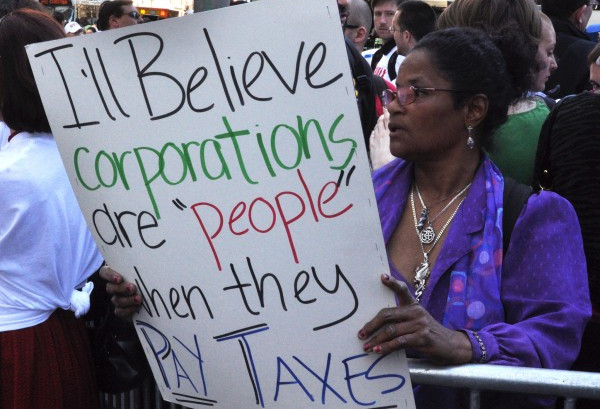
By Paddy Quick for Indypendent - President Donald Trump will not succeed in carrying out any significant tax “reform,” but it is likely that he and the Republican majority in Congress will further skew the existing tax structure to benefit the rich, the top 1 percert, at the expense of everyone else. This will continue the policies that have made the federal tax system significantly less progressive over the past several decades and thus contributed to increasing income inequality. The fundamental cause of that growing inequality is that the income created by the increase in productivity that has taken place over the past 40 years has gone almost exclusively to capital, while wages have remained stagnant. In contrast, the growth in productivity between 1945 and 1975 led to increases in both wages and profits. The main cause of this is the globalization of production, as multinational corporations transfer work to countries with much lower wages. Workers in the United States, however, have suffered more than those of many other “developed” countries such as Canada. The assault on the working class has worked systematically at both federal and state levels to undermine working-class organizations, in particular, trade unions. It has defeated hard-won restrictions on the power of money to influence elections, such as in the Supreme Court’s 2010 Citizens United decision that granted “free speech” rights to corporations and thus abolished limits on their financing of electoral campaigns.

Tax Cuts For The Rich Help The Rich, Not You

By Josh Hoxie for Other Word - You’ll see images of families flashing across your TV screen while a soothing narrator assures you that the tax plan being debated in Washington really is good for you. The newspapers you read, the social media apps you scroll through, the websites you frequent, and the snippets of radio you catch will all feature ads talking about it. That’s what a marketing blitz looks like, and there’s one coming for the Trump tax plan. It will be well-produced, well-orchestrated, and completely devoid of facts. President Trump started his sales pitch for his tax cutting agenda in Missouri in August, where the assembled audience was treated to a fact-free sermon on the virtues of his plan. Gone were any specifics of what’s in it, or who gets what. Looking at Trump’s tax plan from the campaign, as well as what the Republican majority in the House of Representatives have proposed, we can see the basic outlines of what’s coming. Corporations will see their nominal tax rates drop from 35 percent to 20 or even 15 percent. Individual rates will go down — possibly for everyone, but definitely and most strikingly for the very wealthy. Overall tax revenue will tank, potentially by as much as $10 trillion over ten years. What does all this look like in the real world? On the corporate side, we know for sure that lower corporate taxes do not create jobs.

The Coming Tax Fight — And Why We Need You!

By Chuck Collins for Inequality - Are you ready to resist? With Donald Trump’s August 30 tax cut speech in Springfield, Missouri, the great tax fight of 2017 has now begun. The Trump tax cut plan, the President blustered in Missouri, will raise wages and benefit America’s working people. “This speech was an extraordinary effort to obfuscate, fabricate, and create an alternative reality,” says Frank Clemente, co-founder and director of Americans for Tax Fairness. “Trump has a big sales job: to make a tax cut that will mostly benefit Trump and his fellow billionaires appealing to his regular base.” The Americans for Tax Fairness coalition, founded in 2012, now represents over 425 national and state organizations and serves as the key advocacy umbrella organization on progressive tax reform. The coalition has been preparing for this moment all year. Clemente has essentially been preparing his whole life. From campaigns to expand health care and reform the campaign finance system to serving as issues director for the 1988 Presidential campaign of the Rev. Jesse Jackson, Clemente has put in decades working for economic justice. “I’ve been fighting corporate power in different ways all my life,” he notes. “But I don’t think we’ve gone up against a lobbying operation this size before.”
assetto corsa mods

Urgent End Of Year Fundraising Campaign

Online donations are back! Keep independent media alive. 

Due to the attacks on our fiscal sponsor, we were unable to raise funds online for nearly two years.  As the bills pile up, your help is needed now to cover the monthly costs of operating Popular Resistance.

Urgent End Of Year Fundraising Campaign

Online donations are back! 

Keep independent media alive. 

Due to the attacks on our fiscal sponsor, we were unable to raise funds online for nearly two years.  As the bills pile up, your help is needed now to cover the monthly costs of operating Popular Resistance.

Sign Up To Our Daily Digest

Independent media outlets are being suppressed and dropped by corporations like Google, Facebook and Twitter. Sign up for our daily email digest before it’s too late so you don’t miss the latest movement news.