Skip to content

Voting Rights

Supreme Court Asks Why It Shouldn’t Gut The Voting Rights Act

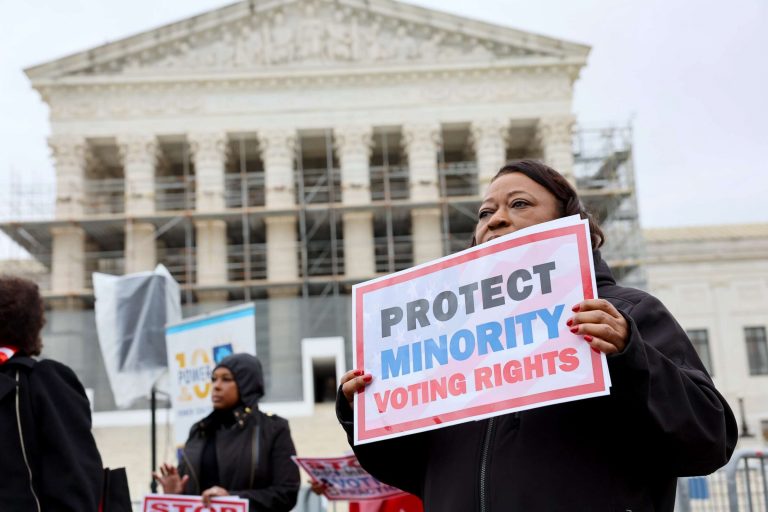
In what may prove to be the most consequential redistricting case to come before the Supreme Court, Louisiana is urging the court to gut the main provision of the Voting Rights Act of 1965 (VRA) and ban any consideration of race in redistricting. Louisiana filed its brief after the high court on August 1 asked the parties whether compliance with Section 2 of the (VRA) violates the Constitution’s 14th or 15th Amendments. By framing that question, the court may be signaling its intention to eviscerate the VRA. Louisiana v. Callais reached the Supreme Court after a coalition of civil rights organizations and Black voters sought to reinstate a map that the state legislature had adopted in 2024.
He Who Pays The Piper Calls The Tune

In theory, the fundamental premise of American democracy is “one man (or person), one vote.”  Under the original concept of Jeffersonian Democracy, in most states access to the franchise was limited to White males who owned at least a fifty-acre plot of land. Towards the end of the 18th century and early into the 19th century, states began lifting the property and education requirements for White males. African Americans were legally granted the right to vote with the ratification of the 15th Amendment to the U.S. Constitution in 1870.  Women were granted the right to vote with the ratification of the 19th Amendment in 1920.

Seven Supreme Court Cases That Black Americans Should Track This Summer

From voting rights to health care to workplace equality, the U.S. Supreme Court will weigh in on a number of issues this summer that could have major implications for Black Americans. “In America, for Black people, we’ve had a long season where our rights were generally respected,” said Andrea Young, executive director of the ACLU, who has been closely following the Trump administration’s legal moves. “We have Black elected officials … Black leaders in corporate America, we have extreme poverty, but we also have thriving middle class communities. We have many areas where we have lots of highly educated black people. All of those things rest on a legal framework that allows those rights to be protected.”

Voter Suppression Makes The Racist, Anti-Worker Southern Model Possible

There is a long strand of history connecting the legacy of slavery to the political and economic landscape of the Southern United States today. As EPI’s Rooted in Racism1 series has shown, the Southern economic development model is characterized by low wages, regressive taxes, few regulations on businesses, few labor protections, a weak safety net, and fierce opposition to unions. Just like the antebellum South’s economy was built on the exploitation of enslaved labor, today’s Southern economy also relies on a disempowered and precarious workforce (Childers 2024b). This spotlight examines how political and economic suppression—dynamics in the South which are rooted in racism—have played a central role in creating and maintaining the Southern economic development model.

In The US, Voting Is A Privilege, Not A Right

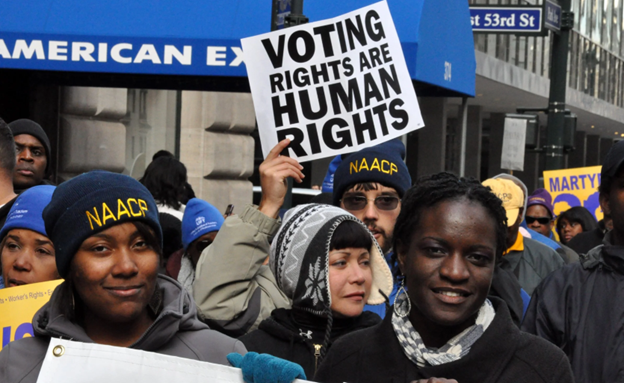
As US presidential elections approach in the coming weeks, activists and organizers are ringing the alarm bells about the broad practice of voter suppression that still exists in the United States. On October 19, a group of students and activists at the historically Black institution of Morehouse College in Atlanta, Georgia marched in protest of election measures that they compare to Jim Crow laws that enshrined racist oppression into law for decades in the US South. A 2021 law, dubbed the Election Integrity Act, has made it illegal in Georgia for anyone to hand out water to those waiting in line to vote—polling lines which can often last for several hours in the Southern heat.

Why Is New Caledonia On Fire?

New Caledonia’s capital city, Noumea, has endured widespread violent rioting over the past 48 hours. This crisis intensified rapidly, taking local authorities by surprise. Peaceful protests had been occurring across the country in the preceding weeks as the French National Assembly in Paris deliberated on a constitutional amendment that would increase the territory’s electoral roll. As the date for the vote grew closer, however, protests became more obstructive and by Monday night had spiralled into uncontrolled violence. Since then, countless public buildings, business locations and private dwellings have been subjected to arson.

2023, A Year Of Progress: Expanding Voting Rights Across The Country

This year, thanks to the tireless efforts of dedicated advocates and organizations, we’re witnessing a remarkable shift in the political landscape when it comes to expanding and protecting the right to vote for justice-impacted people. Advocacy Based on Lived Experience (ABLE) – an organization dedicated to working to engage people in the democratic process – held several community events across Kentucky, allowing attendees and lawmakers to hold discussions on pertinent issues in their communities, regardless of their political affiliation. Participants frequently discussed state legislation that would restore the right to vote to over 160,000 Kentuckians who are disenfranchised due to their history with the criminal legal system.

Reverend William Barber Leads Moral Monday Action At US Capitol

Washington DC — Community organizers and faith leaders from 33 States converged on the U.S. Capitol to demand passage of the John Lewis Voting Rights Advancement Act (H.R. 4) and the Build Back Better Bill (H.R. 5376), now pending Senate approval. They chastised West Virginia Senator Joe Manchin for his role in delaying passage of the legislation which would provide protection for voting rights and financial relief for millions of impoverished Americans. Reverend William Barber called out Senator Joe Manchin by name for playing a “trick” on his constituents by delaying a vote in the Senate on the voting rights bill. Barber said that by delaying the vote until March it would give State legislatures time to gerrymander districts and allow passage of more restrictive voting laws.

In Florida, Protesting Can Cost You Your Right To Vote

Delilah Pierre first got involved with the Tallahassee Community Action Committee (TCAC) in 2019, during a campaign to stop the capital city from building a new police headquarters in the same shopping center as the only grocery store in a predominantly Black neighborhood. Today, as Vice President of the grassroots organization, she has her sights set on taking down larger forces: A state law that levels felony and misdemeanor charges against protesters like her, and prevents them from posting bail until their first court appearance. Governor Ron DeSantis signed Florida House Bill 1, the Combating Public Disorder Act—also known as the "anti-riot" bill—into law in April, following Senate approval along party lines.

Reverend William Barber Leads Moral Monday March For Voting Rights

On Monday August 2, 2021, Reverend William Barber II walked alongside Jesse Jackson leading several thousand on a revival of that same moral imperative. Their Moral Monday March was to demand that Congress restore the Voting Rights Act, signed by President Johnson on August 8, 1965, by passing the For The People Act, legislation which will strike down at the Federal level, all new voting restrictions passed in States like Georgia, Pennsylvania, Louisiana, and Arizona.

Nonviolent Protest Over Voting Rights Ends With Arrests In DC

Activists with the national Poor People's Campaign were arrested Wednesday after blocking a street in front of the Hart Senate building in Washington, D.C. to demand passage of the For the People Act, a popular voting rights expansion bill that Republicans successfully filibustered just 24 hours earlier. After rallying in front of the U.S. Supreme Court, hundreds of low-wage workers, faith leaders, and advocates—including residents of West Virginia, Kentucky, and several other states—marched to the nearby Senate building to demand meetings with Democratic Sen. Joe Manchin (W.Va.) and Republican Minority Leader Mitch McConnell (Ky.), two key opponents of the For the People Act.

Indigenous Group Launches Campaign Against New Voting Bills

An advocacy group for Native Americans is putting up billboards in various states to oppose measures that it says would increase voting restrictions. The campaign launched by the Global Indigenous Council comes as more state legislatures are considering voting laws like the one in Georgia that sparked corporate backlash. Tom Rodgers, president of the Global Indigenous Council and an enrolled Blackfeet tribal member, said the goal of the campaign is to draw attention to bills that would limit the number of available polling stations and ballot drop-off spots, calling the measures especially harmful to Native Americans who may not have access to the remaining voting locations.

Countering Rightward Drift In The United States: This Struggle Is Long Term

This week, people are planning protests across the nation beginning the day after the election. Some, like Democratic Party-aligned groups and unions, will only demonstrate if President Trump loses and refuses to leave office. Trump will fail if he tries because the ruling class has clearly shifted its support to Biden. Professor Adrienne Pine explains this in her analysis of the opposition to Trump. Others such as issues-based groups, coalitions and community groups are planning to take the streets no matter what the outcome of the election is. This is good news...

Pandemic Transforms People Into Voting Rights Activists

For Regina Root, 53, the journey to suing Virginia’s election officials began during the state’s nomination contest in June when the university professor cast her ballot in person before the voting day to avoid potential crowds at her polling place. The brain surgery that saved Root’s life left her with impaired vision and her election office lacked a machine that would allow her to cast her vote without relying on her husband. “I thought wait, this doesn’t make sense. I can vote on my own. I have a PhD,” said the Williamsburg, Virginia, resident.
assetto corsa mods

Urgent End Of Year Fundraising Campaign

Online donations are back! Keep independent media alive. 

Due to the attacks on our fiscal sponsor, we were unable to raise funds online for nearly two years.  As the bills pile up, your help is needed now to cover the monthly costs of operating Popular Resistance.

Urgent End Of Year Fundraising Campaign

Online donations are back! 

Keep independent media alive. 

Due to the attacks on our fiscal sponsor, we were unable to raise funds online for nearly two years.  As the bills pile up, your help is needed now to cover the monthly costs of operating Popular Resistance.

Sign Up To Our Daily Digest

Independent media outlets are being suppressed and dropped by corporations like Google, Facebook and Twitter. Sign up for our daily email digest before it’s too late so you don’t miss the latest movement news.