Skip to content

US Empire

Four Year Anniversary Of Odessa Massacre, Activists Ask For Protection

The Odessa Solidarity Campaign is calling on the federal governments of Ukraine and the United States and the city government of Odessa to ensure that the civic rights of those attending the upcoming May 2 memorial in Odessa are respected, including the delegations of international monitors who will be present on that day. On May 2, a memorial will be held in Odessa, Ukraine, to honor the scores of pro-democracy activists who were brutally murdered on that date four years ago in the city’s House of Trade Unions.

Media Exonerates the US Empire in Venezuela

The United States has for years undermined the Venezuelan economy with economic sanctions, but US media coverage of Venezuela’s financial crisis has gone out of its way to obscure this. The intent of the sanctions is clear: to inflict maximum pain on Venezuela so as to encourage the people of the country to overthrow the democratically elected government. SUNY professor Gabriel Hetland (The Nation, 8/17/16) pointed out in 2016 that the Obama government “prevented Venezuela from obtaining much-needed foreign financing and investment.” Such policies, Hetland notes, have had a considerable and highly detrimental impact at a time when Venezuela is in desperate need of dollars but is prevented from gaining access to them by Washington.

US Doubles Down As Empire Declines

US empire is in decline. Reports of the end of the US being the unitary power in world affairs are common, as are predictions of the end of US empire. China surpassed the United States as the world economic leader, according to Purchasing Power Parity Gross National Product, and Russia announced new weapons that can overcome the US' defense systems. What is happening in the United States, in response, is to do more of what has been causing the decline. As the Pentagon outlined in its post-primacy report, the US' plan is more money, more aggression and more surveillance.

Time For US To Leave Guantanamo Bay

No foreign military base is more controversial than that of the detention facility in Guantanamo Bay, Cuba. February 23rd, 2018 marks the 115th anniversary of when the US Government signed a lease with the Cuban government for a 45 square mile chunk of land. This 45 square mile chunk of land would only cost 2000 gold coins a year, and the lease would be perpetual, only to be broken by a mutual agreement. The reason Cuba sold the US this patch of land was to facilitate the military withdrawal of US troops from Cuba.

Regime Change Fails: Is A Military Coup Or Invasion Of Venezuela Next?

Secretary of State Tillerson brought up a potential military coup in Venezuela on February 1, 2018 at his alma mater, the University of Texas.  Tillerson then visited allied Latin American countries urging regime change and more economic sanctions on Venezuela. Tillerson is considering banning the processing or sale of Venezuelan oil in the US and discouraging Venezuelan oil in other countries. Further, the US is laying the groundwork for war against Venezuela. Not recognizing elections and urging a military coup are bad enough, more disconcerting is that Admiral Kurt W. Tidd, head of the Southcom, held a closed door meeting in Colombia after Tillerson's visit. Tidd has claimed the humanitarian crisis, created in large part the economic war against Venezuela, requires military action for humanitarian reasons. War preparations are already underway in Colombia. People in the United States who support the self-determination of other countries should show solidarity with Venezuelans, expose the US agenda and publicly denounce regime change. 

New Defense Strategy: War With Great Nations & Arms Race

This week, following the recent announcement of a new National Defense Strategy that focuses on conflicts with great powers and a new arms race, the Pentagon announced an escalation of nuclear weapons development. The United States' military is spread across the world, including several dangerous conflict areas that could develop into an all-out war, possibly in conflict with China or Russia. This comes at a time when US empire is fading, something the Pentagon also recognizes and the US is falling behind China economically.

Colonial Rule Of Hawaii For 125 Years Puts Hawaii At Risk

The effects of a political overthrow that happened 125 years ago in Hawaii could not have been felt more vividly this month. The fear and distress that cast a shadow over the Hawaiian islands on Saturday morning during a false missile alert is part of the legacy of American occupation. And yet, resistance is as strong as ever. On the anniversary of Queen Liliukalani’s forced abdication, thousands march in peace to protest the illegal overthrow, honour the Hawaiian monarchs and celebrate Hawaiian culture and traditions.

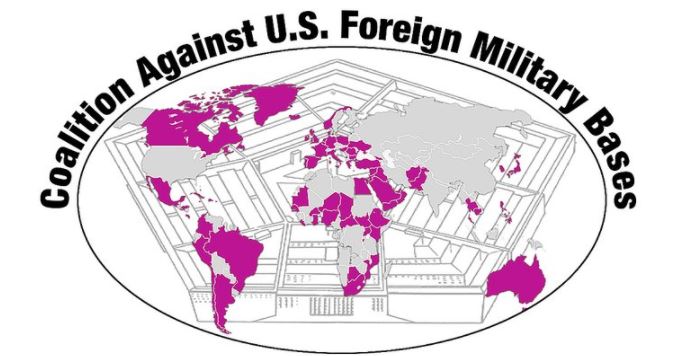
No Foreign Bases: Challenging the Footprint of US Empire

The United States cannot be a moral or ethical country until it faces up to the realities of US empire

Reasons To Divest From The War Machine And Week Of Action

Excessive military spending in the U.S. is undermining the well-being of our people and starving our non-military sectors. The cost of U.S. domestic and foreign militarism in 2016 totaled $741.3 billion: 64 percent of discretionary spending. Meanwhile, many of our cities are in ruins. Our public transportation systems are in shambles. Our educational system is in steep decline and being privatized. Opioid addiction, suicide, mass shootings, and hunger plague a country that has sunk into profound despair and poverty.

The United States Empire Is Falling. What Does That Mean?

In his latest book, "In the Shadow of the American Century: The rise and decline of US global power," Alfred McCoy writes about the tools used by the United States to maintain global domination and how its status is declining. McCoy predicts that China will replace the US as the dominant global power holder by 2030. We speak with him about US Empire, what the decline will look like and how it will impact people in the US and around the world.

Public Is Overwhelmingly Opposed To Endless US Military Interventions

Last week, the bipartisan Committee for a Responsible Foreign Policy—a bipartisan advocacy group calling for congressional oversight of America’s lengthy list of military interventions abroad—released the results of a survey that show broad public support for Congress to reclaim its constitutional prerogatives in the exercise of foreign policy (see Article 1, Section 8 of the US Constitution) and for fewer US military interventions generally.

Ensuring Justice In The Era Of Transformation

In our last article, we predicted that the 2020’s will be an era of transformation. We focused on the development of the movement since the “Take-Off” phase of the 2011 Occupy encampments, followed by Black Lives Matter, Fight for $15, Idle No More, carbon infrastructure protests, debt resistance, immigration protests and more. The 2020s will be a decade when the impacts of years of mismanagement of crisis situations, such as climate change, inequality and US militarism, become unavoidable requiring major transformations. What we do now to prepare will help determine the result.

U.S. Soldier Died In Niger. What Is U.S. Doing There?

By Peter Certo for Other Words - In our military-revering culture, it’s a strange thing for a president to start a war of words with the grieving families of slain soldiers. Strange, yes. But from Donald Trump’s campaign season feud with the parents of Humayun Khan, who died protecting fellow soldiers in Iraq, to his recent feud with the mourning widow of La David Johnson, who died on patrol in Niger, it’s no longer surprising. At root in the latest spat is a comment Trump made to La David’s widow Myeshia Johnson: “He knew what he signed up for.” Myeshia thought that remark was disrespectful — she later said it “made me cry.” Beyond insensitive, though, there’s a good chance it simply wasn’t true. Why, after all, should La David have expected to die in a dusty corner of Niger — a Saharan country most Americans (and, one suspects, their president) couldn’t find on a map? And where the U.S. isn’t actually at war? If you were surprised to learn the U.S. has nearly a thousand troops in Niger, you’re not alone. Senator Lindsey Graham, a South Carolina Republican who serves on the Armed Forces Committee, told NBC he “had no idea.” Neither did Chuck Schumer, the Senate’s top Democrat. Well, the surprises may keep coming.

A Chapter In A Declining Empire

BY Greg Godels (Zoltan Zigedy) for ZZs Blog. Those familiar with the history of Cold War US repression are not surprised by liberal complicity in the anti-Russia madness today. It should be no surprise that the liberals and the petty-bourgeois left betray the truth, make common cause with the forces of hate, distrust, and prejudice. In times of crisis, that’s what they too often do. Outside of a few notable voices, liberal/left intellectuals are buying the anti-Russia frenzy. Despite the fact that US security services have an unbroken record of lies and manipulations, they are today manufactured to be the saviors of US “democracy.” The entertainment industry has cast “deep throat” Mark Felt-- a crazed, disgruntled FBI official, bitter because he didn’t inherit the directorship from J. Edgar Hoover-- as the hero of the Watergate debacle. Industry moguls stretch credulity to portray him as the courageous forerunner of the sleazy James Comey. How quickly the liberals have forgotten the shame of 2003, when a ruling class-induced frenzy of lies and distortions prompted an unprovoked US invasion of a sovereign country.

The Empire’s Hustle: Why Anti-Trumpism Doesn’t Include Anti-War

By Ajamu Baraka for Counter Punch - Libertarian U.S. Sen. Rand Paul (R-KY) declared from the Senate floor last week in anticipation of the vote on the National Defense Authorization Act (NDAA) of 2018: “I rise today to oppose unauthorized, undeclared and unconstitutional war…What we have today is basically unlimited war, anywhere, anytime, any place upon the globe.” With these words, Paul became one of the few voices to oppose the obscenity that is known as U.S. war policy. But only two other senators joined him: Bernie Sanders (I-VT) and Ron Wyden (D-OR). But there is a wrinkle here: Paul is not concerned with the size of the military budget. He’s pointing his finger at the continuation of the Authorization to Use Military Force Act (AUMF) of 2001, which was the “legal” basis for the U.S. global “war on terror.” He wants Congress to re-assess this legislation that has prompted endless wars abroad. After Paul’s amendment to the NDAA was defeated, the Senate went on to approve it with a vote of 89-9 Monday in what the New York Times correctly identified as a bi-partisan effort, to authorize a military budget of $696 billion—an increase in the military budget of almost $75 billion and well over the $54 billion that Pres. Donald Trump had originally proposed.
assetto corsa mods

Urgent End Of Year Fundraising Campaign

Online donations are back! Keep independent media alive. 

Due to the attacks on our fiscal sponsor, we were unable to raise funds online for nearly two years.  As the bills pile up, your help is needed now to cover the monthly costs of operating Popular Resistance.

Urgent End Of Year Fundraising Campaign

Online donations are back! 

Keep independent media alive. 

Due to the attacks on our fiscal sponsor, we were unable to raise funds online for nearly two years.  As the bills pile up, your help is needed now to cover the monthly costs of operating Popular Resistance.

Sign Up To Our Daily Digest

Independent media outlets are being suppressed and dropped by corporations like Google, Facebook and Twitter. Sign up for our daily email digest before it’s too late so you don’t miss the latest movement news.