Skip to content

Brazil

Brazil Indians Clash With Police Outside Congress

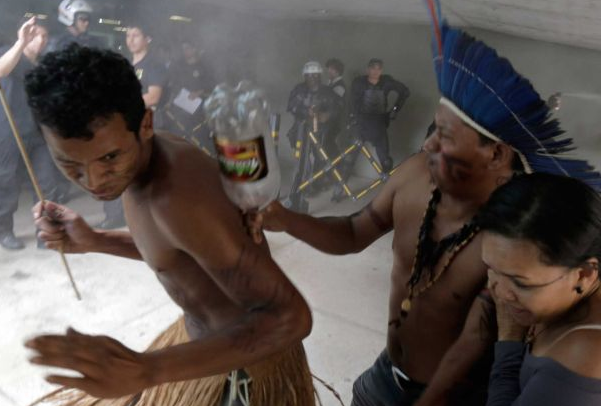
The lower house of the Brazilian Congress says that about 30 Indians armed with bows and arrows tried to break into thechamber of deputies but police and security personnel held them at bay with pepper spray. Four police officers suffered light injuries during Tuesday’s brief confrontation. The Chamber of Deputies press office says a police officer escaped injury when an arrow struck his boot. The Indians were protesting a bill that would give Congress the authority to demarcate indigenous territory. That authority currently resides with the executive branch. Indians and other opponents of the bill say it would give more power to large landowners and mining and lumber companies that operate in the Amazon region where most of Brazil’s indigenous population resides.

Brazil: ‘Dalai Lama Of Rainforest’ Faces Death Threats

Davi Kopenawa, the leader of the Yanomami people in Brazil’s Amazon rainforest, who is internationally renowned for his struggle against encroachment on indigenous land by landowners and illegal miners, is now fighting a new battle – this time against death threats received by him and his family. “In May, they [miners] told me that he wouldn’t make it to the end of the year alive,” Armindo Góes, 39, one of Kopenawa’s fellow indigenous activists in the fight for the rights of the Yanomami people, told IPS. Kopenawa, 60, is Brazil’s most highly respected indigenous leader. The Yanomami shaman and spokesman is known around the world as the “Dalai Lama of the Rainforest” and has frequently participated in United Nations meetings and other international events. “The landowners and the garimpeiros have plenty of money to kill an Indian. The Amazon jungle belongs to us. She protects us from the heat; the rainforest is essential to all of us and for our children to live in peace.” -- Davi Kopenawa He has won awards like the Global 500 Prize from the United Nations Environment Programme (UNEP). His voice has drawn global figures like King Harald of Norway – who visited him in 2013 – or former British footballer David Beckham – who did so in March – to the 96,000-sq-km territory which is home to some 20,000 Yanomami.

Activists Fighting To Protect Environment — And Their Lives

908. That’s the number of environmental and land-reform activists assassinated worldwide between 2003 and 2013, according to a study by the NGO Global Witness. The number might shock you, but perhaps even more shocking is that nearly half of those murders — 448 — took place in one country: Brazil. What is it that makes Brazil the most dangerous place in the world to be an activist? You’ll find clues in the story of Guarabana Bay. The bay, just minutes from downtown Rio’s world famous beaches, is a study in pollution and filth. Dark sludge cakes the shoreline. Garbage floats everywhere. It’s so bad that some sailors set to compete here in the 2016 Summer Olympics are warning colleagues not to let this water touch their skin. The sailors' worries do not surprise local fisherman Sandy Anderson de Souza. He said he was out in his boat in 2001 when Brazil’s state-run oil giant Petrobas accidentally dumped 1.3 million tons of oil into the waterway. “There was so much oil it looked like there was no water at all,” he said during a recent tour of the coastline. “A year later we noticed that many species of fish were disappearing and we started to catalogue this. There are 46 species of fish and shrimp that are no longer here.”

A World Cup For The 1%

When Germany and Argentina square off in the Word Cup Final, the whole world will be watching the culmination of what may be the most exciting FIFA World Cup Tournament ever. What most people are unaware of, however, is the brutal conditions that FIFA creates to pull off the games.

Majority Of Brazilians Think World Cup Is Bad

In this episode of Acronym TV, Derek Poppert of Global Exchange talks with Dennis about his Re-Think The Cup series. In a recent piece from the series, FIFA: Return The Beauty To The Beautiful Game, Derek writes: “So who wins the World Cup? While it may seem that decision is still getting played out in stadiums across Brazil, FIFA president Sepp Blatter is surely laughing from his luxury suite. The winner had already been decided well before the first match even began. FIFA’s 4 billion dollars in untaxed revenue from the event is the trophy. It appears to be of little interest to Mr. Blatter or other FIFA execs that this trophy has come on the backs of 200,000 low-income people being forcefully evicted from their homes to make room for the event, 8 construction workers dying in the frenzied rush to erect stadiums on time, or 14 billion dollars in Brazilian taxpayer money being spent on the tournament in the face of poverty, inequality, and widespread social issues within Brazil.”

Families Displaced By World Cup Wait For Relief

In preparation for hosting the World Cup, the Brazilian government spent the outrageous amount of $10 billion and displaced as many as 250,000 people–evicting the poorest from their homes and sweeping up homeless from the streets. Since the World Cup started, thousands have protested lavishing public resources on a sports event while poverty is rampant. Journalists Tim Eastman and Shay Horse have been in Brazil covering the protests and events outside the sports arenas. We had the opportunity to visit a group of families who were victims of these forced removals. One hundred days ago, military police evicted 160 families of the Telerj area of Rio de Janeiro from their homes. They lived in an area which had been gifted by the government of Dilma Roussef. For a short time, they occupied City Hall but were violently ejected by military police. Since then, they have traveled around and resettled in various areas of Rio, wandering from place to place without a home.

Protest Against Police Suppression Of Protests

On June 29, in Rio de Janeiro a silent march took place to call attention to the suppression of protests, and deaths in Favelas by the UPP (Pacifying Police Unit). As with any other march this one also made clear the angst in Brasil was against FIFA and the World Cup, not Soccer. To portray the censorship they have experienced protesters wore gags around their mouths. To exhibit the loss of life from efforts to pacify Favelas, protesters carried signs with the names of activists and "-1" Some protesters also carried signs with another idea for how to pacify favelas... "Mais educação. Menos caveirão." "More education. Less military police."

Seeds Of A New Financial Structure

On the day following the end of the World Cup in Brazil, the Sixth Summit of BRICS (Brazil, Russia, India, China and South Africa) will be held in Fortaleza and Brasilia, on the 14th, 15th and 16th of July, to establish a financial architecture under the slogan: “Inclusive growth and sustainable solutions”. In contrast to the initiatives of financial regionalization in Asia and South America, the BRICS countries, since they do not have a common geographical space, at a time when they are less exposed to simultaneous financial turbulence, can increase the effectiveness of their defensive instruments. A monetary stabilization fund called Contingent Reserve Arrangement (CRA) and a development bank called BRICS Bank will operate as a multilateral mechanism in support of balance of payments and investment financing. De facto, the BRICS will distance themselves from the International Monetary Fund (IMF) and the World Bank, institutions created some seven decades ago under the orbit of the US Treasury Department. In the midst of the crisis, both of these initiatives open space for financial cooperation in the face of the volatility of the dollar, and financial alternatives for countries in critical situations without subjecting themselves to structural adjustment programmes or economic reconversion. As a consequence of the growing economic slowdown on a world level, it has become more complicated for BRICS countries to reach growth rates above five per cent.

Medical Cooperative Provided Health Services At World Cup

UNIMED, the largest system of medical co-operatives in the world and also the largest healthcare network in Brazil, is the official provider of emergency medical services at this year’s World Cup. Throughout the event that runs from 12 June to 13 July, UNIMED will be providing medical services to all athletes and technical staff of all delegations taking part in the World Cup. “We have an infrastructure across the country, with centres and hospitals and we will be responding to all necessities and requirements directly and individually. We are responsible for the health of all athletes, teams, officials and technical staff that will be involved in the World Cup,” explained Eudes de Freitas Aquino, President of UNIMED. Founded in 1967 by Doctor Edmundo Castillo, UNIMED consists today of 354 medical co-operatives, which offer health services to more than 20 million customers. It has over 109,000 active physicians and 106 hospitals, as well as emergency care, laboratories and ambulances. Dr Eudes de Freitas Aquino thinks the success of UNIMED was determined by the co-operative structure of the organisation.

Transnational Social Movements And Power

Q: Why is it important to build transnational social movements? Of course, there are specific issues and power structures in each country, but it's important to overcome borders and make a transnational movement because the root causes of injustices, of exclusion, of the violence and discrimination we face are the same. They are systemic issues. They are global issues. As social organizations and movements, we need to move forward beyond merely the national level and see the big picture. And to understand how the specific reality we live in is related to the reality of other countries and other communities. Inasmuch as we're able to realize that, we'll also be able to raise peoples' hopes, to strengthen the struggles of each other and bring about transformation, on a much bigger scale than anything we could do at a merely national level. It would do no good or very little good to bring about some great transformation in just one country if things remain exactly the same in other countries.

Repressing World Cup Protests: A Booming Business For Brazil

On June 12, Brazilian police fired tear gas on a group of 50 unarmed marchers blocking a highway leading to the World Cup arena in São Paulo. On June 15 in Rio de Janeiro another 200 marchers faced floods of tear gas and stun grenades in their approach to Maracana stadium. Armed with an arsenal of less lethal weapons and employing tactics imported from U.S. SWAT teams in the early 2000s, police clad in riot gear are deploying forceful tactics, wielding batons and releasing chemical agents at close range. In Brazil, this style of protest policing is not only a common form of political control, but also a booming business. World Cup and related economic protests occurring across the country are bringing in big profits for Rio-based company Condor Nonlethal Technologies. As part of the World Cup’s massive security budget Condor scored a $22-million contract, providing tear gas, rubber bullets, Tasers and light and sound grenades to police and private security forces. Selling riot control and public order weaponry to law enforcement, military and United Nation buyers, Condor’s business has grown by over 30 percent in the past five years.

Brazil: Journalist Arrested, Beaten, In Police Custody

UPDATE: After a day of being under arrest by the police of Belo Horizonte, and after her case became known to international audiences, the social media journalist was released, together with two other activists. See more here. Translated press release from Midia NINJA Karinny de Magalhães correspondent from Midia NINJA was arrested while working as a journalist covering the protests against the World Cup in the city of Belo Horizonte. While live streaming the protest “Copa sem povo, tô na rua de novo” Karinny suffered a long series of outrages by the Military Police. In the live stream we saw a frame where she claimed she had been assaulted. The transmission was disconnected and Karinny stopped filming. After being held for over an hour inside a police car, she was taken in secret to a police barracks where she was beaten by five policemen into unconsciousness. She was then taken to the 6th Regional Police Civilian Police – North West, where she was held overnight, and testified that tests were performed corpus delicti. Karinny is accused of being part of the group that flipped a Civil Police vehicle during the protests. Another video shows the entire event and proves the accusations against her are false. Two other protesters were also arrested.

Brazilians Take Back The City

Only the steady flow of men, women and children through a rusted, grey door alert passersby that anyone lives inside the 22-story building. It's covered in graffiti: a small house - bright yellow, with a brown door, window and roof - two women's faces, and the number 911. With an abundance of unused buildings peppering the city, low-income residents of Sao Paulo occupy vacant structures, often with the help of local social and housing rights movements. This is one of them. "We occupy [buildings] to give a social function to the properties and give houses to people without houses," said Maria Silva, one of the residents. In other cases, several families occupy large homes, and each family rents out a single room while sharing other facilities, like bathrooms and kitchens. These structures are known as corticos (boarding houses, or tenement buildings). Unlike the favelas, corticos consist of large, urban apartment-syle buildings shared by several families. In Sao Paulo, rapid urbanisation was linked to a shift from agriculture to more modern industries, and as labourers moved into makeshift communities to be closer to work. While most favelas are in the peripheries of Sao Paulo, many low-income families also moved into the city centre to be closer to basic services

Media Ignored Protest At World Cup Opening

According to Brazilian news site G1, a protest took place at the opening ceremony, but the TV cameras ignored it. The site reports that Werá Jeguaka Mirim was one of three children who released white doves just before the kick-off of the first game, between Brazil and Croatia. As he left the field, he opened a banner calling for new boundaries for Brazil’s indigenous lands. Pictures of the boy’s protest were posted on the Comissão Guarani Yvyrupa (CGY) Facebook page. The Guarani are an indigenous people from South America’s interior. The CGY describes itself as “an autonomous political organization that brings together the Guarani people of the villages located in the South and Southeast of Brazil in the common struggle for land.” There is currently a new law called PEC 215 being debated in the Brazilian legislature. It would transfer the power to demarcate their ancestral lands from the federal government to Congress, and has caused protests.

Anti-World Cup Protests Countdown To Kick-Off

Riot police fired percussion grenades and teargas at anti-World Cup protesters in São Paulo and Rio de Janeiro on Thursday as the countdown to the kick-off was marred by demonstrations in at least 10 Brazilian cities. Just hours before the opening ceremony at the Itaquerão stadium, about 100 protesters started fires and threw rocks at police in an apparent attempt to block a road leading to the venue. The confrontation led to at least one arrest and five injuries, including a suspected broken arm suffered by a CNN producer who was hit by a teargas canister. Amnesty International accused the police of using excess force. "The Brazilian authorities must, without delay, investigate why excessive force was used against peaceful protesters, bring those responsible to justice and ensure this does not happen again," said Atila Roque, director of Amnesty International Brazil. The "Our Cup is on the Street" protests are targeting the high cost of the stadiums, corruption, police brutality and evictions. Similar demonstrations have been organised via social networks in 100 cities, including several that host World Cup games, such as Brasilia, Belo Horizonte, Fortaleza, Porto Alegre and Recife.
assetto corsa mods

Urgent End Of Year Fundraising Campaign

Online donations are back! Keep independent media alive. 

Due to the attacks on our fiscal sponsor, we were unable to raise funds online for nearly two years.  As the bills pile up, your help is needed now to cover the monthly costs of operating Popular Resistance.

Urgent End Of Year Fundraising Campaign

Online donations are back! 

Keep independent media alive. 

Due to the attacks on our fiscal sponsor, we were unable to raise funds online for nearly two years.  As the bills pile up, your help is needed now to cover the monthly costs of operating Popular Resistance.

Sign Up To Our Daily Digest

Independent media outlets are being suppressed and dropped by corporations like Google, Facebook and Twitter. Sign up for our daily email digest before it’s too late so you don’t miss the latest movement news.