Skip to content

Occupy

Occupiers Flock To Sacramento For Meeting

They gathered Thursday under a stand of redwoods near the steps of the state Capitol, a modest mix of young people and the graying veterans of the progressive and protest movements. They came to Sacramento, in the words of one, to reclaim the public square. Three years after Occupy Wall Street and the larger Occupy movement sprang into the national consciousness with rallies across the country and calls for economic justice, foot soldiers of the grass-roots movement are arriving in Sacramento for the third annual Occupy National Gathering. Previous gatherings were in Kalamazoo, Mich., and Philadelphia. “All of our grievances are connected,” said Nikohl Vandel of Palm Springs, who is advocating to close the Diablo Canyon nuclear power plant in San Luis Obispo County. Activists from across the country and as far away as Europe and Australia are meeting in the capital city over the next three days – a rally is planned Saturday at Sacramento’s Southside Park – to mobilize, strategize, share ideas and take the temperature of a movement that has seemingly faded from the limelight of its heady early days.
Oakland Police Officer Fired Over Occupy Incident Is Reinstated

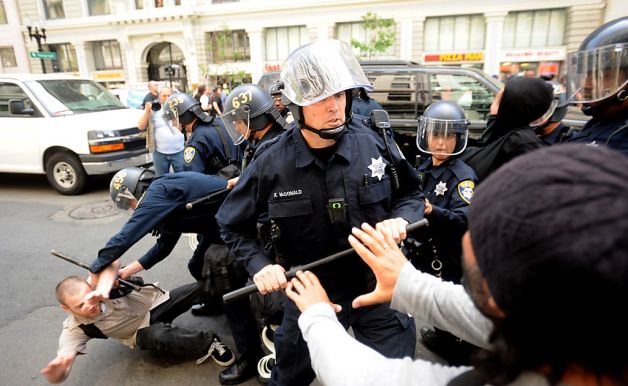
A police officer fired for throwing a tear gas grenade into a crowd of Occupy Oakland protesters who were tending to a wounded comrade is getting his job back. An arbitrator on Wednesday overturned the Police Department's termination of Officer Robert Roche and ordered him reinstated with back pay. Roche became the lightning rod over police handling of the 2011 Occupy protests when he was caught on camera tossing the grenade into a crowd of protesters trying to assist Iraq War veteran Scott Olsen. The grenade incident came less than a minute after a police officer who has never been identified struck Olsen in the head with a lead-filled beanbag, fracturing Olsen's skull and causing him permanent brain damage. Olsen received a $4.5 million settlement from the city earlier this year. The incident, which made international headlines, turned many citizens against the Police Department and turned many officers against their commanders, who they felt had left them far too understaffed to deal with a major protest. "Roche is a phenomenal police officer, and he was scapegoated like all the other officers from the Occupy experience," said Sgt. Barry Donelan, who heads the police union.

Media Decides To Report On Cecily McMillan’s Clothing Choice

Cecily McMillan, the 25-year-old Occupy Wall Street activist who was jailed for elbowing a police officer during a protest, returned to court on Thursday, where a cadre of hard-hitting journalists greeted her with questions about her courtroom attire. "My editor told me to ask who you're wearing," a photographer was spotted eagerly asking McMillan, according to The Village Voice. McMillan, who was earlier this month released from Rikers Island -- one of the country's most notoriously violent jails -- explained that although she was free, she no longer felt safe in New York "because I was sexually assaulted and then put in jail for it," according to the Voice. McMillan has alleged from the start that the officer involved in her assault case forcibly grabbed her breast from behind during the protest; after elbowing him, she was promptly arrested and put in jail. Upon hearing her explanation Thursday, a Post reporter responded, "Well, you look fabulous! But you should eat more." The interactions resulted in a blatantly sexist portrayal of McMillan sprinkled with mocking details about her fashion choices -- all of which fail to mention that she was asked such questions by the press. The Daily News went straight to the sartorial details with the headline, "Occupy Wall Street protester wears Calvin Klein to court."

San Jose: Medical Marijuana Advocates Will Occupy City Hall

In a bid to collect enough signatures for a referendum by the Friday deadline, cannabis clubs are offering free evaluations and medical marijuana to San Jose residents. The Silicon Valley Cannabis Coalition, which aims to overturn a city ordinance that may shut down more than 70 collectives, secured vouchers for 30,000 free medical recommendations and more than 45,000 vouchers for free grams of pot. Opponents of the city rules soon going into effect will pass out vouchers at a dozen spots in San Jose. For a map of locations, click here. The group will also stage an “Occupy-style” protest at City Hall for the rest of the week. The signature drive needs 100,000 names by the week’s end. “City polling proved that over 80 percent of San Jose residents do not want to ban collectives,” said John Lee, head of the coalition. “So instead of banning collectives outright, the mayor decided to make it impossible to operate them. That’s what we’re fighting against.”

Another US Military Study Of Social Media Users

The activities of users of Twitter and other social media services were recorded and analysed as part of a major project funded by the US military, in a program that covers ground similar to Facebook’s controversial experiment into how to control emotions by manipulating news feeds. Research funded directly or indirectly by the US Department of Defense’s military research department, known as Darpa, has involved users of some of the internet’s largest destinations, including Facebook, Twitter, Pinterest and Kickstarter, for studies of social connections and how messages spread. While some elements of the multi-million dollar project might raise a wry smile – research has included analysis of the tweets of celebrities such as Lady Gaga and Justin Bieber, in an attempt to understand influence on Twitter – others have resulted in the buildup of massive datasets of tweets and additional types social media posts. Several of the DoD-funded studies went further than merely monitoring what users were communicating on their own, instead messaging unwitting participants in order to track and study how they responded.

The Ebb And Flow Of Social Movements

I'm at the annual conference of the northwest branch of the Fellowship of Reconciliation as I write. I've done a few songs so far, and have been very well-received. It's an easy audience for leftwing sentiment combined with acoustic music. These are mostly people a bit older than I, who came of age during the times of the movements against the war in Vietnam, and for civil rights. These movements had lasting effects not only on the politics of those in attendance, but on their taste in music. Also, they're members of an organization that has a culture of its own, to some extent, which has somewhat insulated it from the ebb and flow of social movements (though it has also undoubtedly drawn so much from those movements, too). Groups like FOR in places like western Washington feel slightly insulated from how things are in what you might call Middle America. A nice little bastion of sanity amid what often feels like the alienated drones in the “real world.” But what of the times when those drones come to life, and beyond the walls of the artificially-produced fortresses of progressivism, the regular people get motivated to think outside the box? Movements large and small can happen, and have broad and lasting ripple effects. Like the 60's -- the repercussions of which we'll still be feeling for many decades I'm sure.

Cecily McMillan Released From Prison, Speaks For Those Inside

Imprisoned Occupy Wall Street activist Cecily McMillan was released from Rikers Island on Wednesday morning, July 2nd, after serving 58 days. She spoke publicly at a 1pm press conference outside the jail’s outer gates on Hazen Street. This was the first time she was able to speak publicly after testifying in her trial. Cecily’s controversial trial garnered international media attention. She was supported by elected officials, community leaders, and celebrities. While serving her term at Rikers Island she was visited by members of Russian rock group Pussy Riot, themselves unjustly imprisoned in 2012. The Following is Cecily’s Statement as read to members of the press at 1pm EST: “Fifty nine days ago, The City and State of New York labeled me a criminal. Millionaires and billionaire–who had a vested interest in silencing a peaceful protest about the growing inequalities in America–coerced the justice system, manipulated the evidence, and suddenly I became dangerous and distinguished from law-abiding citizens. On May 5th, the jury delivered its verdict, the judge deemed me undesirable, and officers drove me across that bridge and barred me within. On the outside, I had spent my time fighting for freedom and rights. On the inside, I discovered a world where words like freedom and rights don’t even exist in the first place. I walked in with one movement, and return to you a representative of another. That bridge right there, that divides the city from Rikers Island, divides two worlds – today I hope to bring them closer together. Crossing back over, I have a message to you from several concerned citizens currently serving time at the Rose M. Singer Center.

American Revolutionaries | Acronym TV 009

Adam Kokesh, who recently served four months in prison in connection with an Independence Day incident in which he videotaped himself loading a shotgun in Freedom Plaza, near the White House, sits down with Dennis to discuss Libertarianism, performance art in protest, and the book he wrote in prison, Freedom. In part 2 of the show, Eleanor Goldfield, the front woman of the band Rooftop Revolutionaries, joins Dennis to discuss the movement to get Money out of Politics, and her new venture Art Killing Apathy.

Movements Of 2011: From Occupation To Reconstruction

Ever since I wrote a book about Occupy Wall Street, I’ve often found myself being asked, “What happened to Occupy, anyway?” Now, more than two years since the movement faded from the headlines and in the wake of French economist Thomas Piketty’s best-selling diagnosis of economic inequality, the urgency of the question is mounting, not diminishing. The answer is also becoming clearer: The networks of activists that formed in the midst of 2011’s worldwide wave of protest are developing into efforts to create durable economic and political experiments. Rather than focusing on opposing an unjust system, they’re testing ways to replace it with something new. The 2011 movements were always prefigurative in some respects. From Tahrir Square in Cairo to Zuccotti Park in New York, protesters eschewed formal leadership in order to practice direct democracy, a means of revealing just how false our societies’ claims to being democratic have become. They built little utopias that provided free food, libraries, music, religious services and classes, trying to put on display what they thought a good society should look like. The 2011 movements also reflected the emergence of a global community that spans borders as protesters in different countries borrowed strategies and slogans from one another.

Hong Kong Prepares For Mass Protest Against Beijing Control

Hong Kong is braced for protests on Tuesday, which organisers expect will draw at least 500,000 people, potentially making it the region's largest demonstration in recent history. The scale of the protests reflects frustration at Beijing's plans to choose Hong Kong's next chief executive. Nearly 800,000 residents – more than a fifth of the city's electorate – had cast ballots in an unofficial "referendum" as the polls closed on Sunday, according to the vote's organisers. The pro-democratic protest group Occupy Central with Love and Peace (OCLP) announced that 798,000 Hong Kong residents had voted in its "civil referendum", an unofficial vote on how their next chief executive – the region's top official – should be elected. Beijing has bristled at the poll. One government official called it illegal and invalid, while China's state-run media has called it a farce and a folly. The referendum website has been barraged by highly advanced cyber-attacks.The region's activists remain unmoved. "The turnout [at this year's protest] will be a sort of signal, just as the referendum was a signal of the number of people who are satisfied with Beijing's method of choosing the chief executive," said Benny Tai Yiu-ting, an assistant law professor at Hong Kong university and one of the movement's leaders. "It takes just two minutes to vote. But attending the rally – that takes a lot of time and effort. That's evidence of stronger determination."

At The Heart Of An Occupation And Beyond

I was drawn in initially before it existed by the idea that something like this might happen. In the summer of 2011, I was meeting with activists from around the world who were involved with different manifestations of global uprising that year, and I started wondering whether people were planning something like that in the United States. I started looking for planning processes. First, I found the group that was planning to occupy Freedom Plaza in Washington DC. I went to one of their meetings, and it was through that that I learned about this group planning to occupy Wall Street. That was late July or early August. Out of curiosity and a desire to see the process of people trying to figure out what joining this global movement might mean in the United States, I went to my first meeting on August 10th, 2011. I had been covering activism in New York for a few years. I didn’t recognize anyone, which was really exciting. They were younger than a lot of the people that I’d been following around and getting to know. There was a sense of possibility that I had never felt before in that group, while also a sense of chaos and madness in good ways and sometimes in frustrating ways. I went as a reporter looking to cover this, and the first thing that happened when I arrived was having to present myself as a reporter and having a debate ensue about that. By the time the occupation began, I had felt a sense of connection with this community beyond the kind of normal reporter relationship.

Cecily McMillan Leaves Prison Behind, But Won’t Forget Fellow Inmates

McMillan’s time in Rikers may have taken a toll, but it has not broken her. She describes the many indignities there as struggles endured in solidarity with comrades, not as personal complaints. She says that before Rikers, she didn’t know that placing your hands on your hips expressed defiance. In Rikers, she says, you have to keep your head down, your hands behind your back–postures of compliance, passivity. She sleeps in a dorm room with forty other women. There are invasive searches of your personal items, your body. Her phone calls are recorded. Contrary to the notion of inmates lazing about watching the clock tick, prison is endless activity, endless lines—the movieBrazil “on steroids,” she says. Still, her mind isn’t dulled or her spirit crushed. She is thinking, writing, planning, talking.

Protests Seek To Occupy Westminster Abbey Over Cuts To Disabled

Campaigners have tried to occupy the grounds of Westminster Abbey in protest against the Government's decision to axe a fund for the disabled. The move, reminsicent of the long protest occupation at St Paul's Cathedral in 2011, saw at least ten police vans were part of a heavy police presence, with officers at times three rows deep to deal with around 100 protesters. The Guardian reported the protestors had planned to occupy the space until July 22 but the police presence caused the number of protestors to dwindle to around 50. The BBC reported that the protest ended at around 9pm on Saturday. The group had sent a letter to Archbishop of Canterbury Justin Welby, urging the Church of England not to forcibly remove them, The Guardian reported. Tents were erected on the grass and draped with banners against the planned closure of the Independent Living Fund (ILF) for severely disabled people. Protesters claimed their attempts to negotiate their presence on the Abbey's grounds with the Dean of Westminster, Dr John Hall, had been rejected and they had been advised by police to leave the grounds or face arrest. Many moved on but a group of disabled protesters, many in wheelchairs, stayed on to continue the protest.

People’s Justice: Where Does Our Authority And Power Derive?

Nothing is more offensive to our innate sense of justice than the continuing freedom of known financial criminals - financier fraudsters who used money as a weapon to commit well-documented crimes, stealing homes and jobs and life-savings from our parents, our friends, our comrades and neighbors. Blankfein et al are jetting around free as birds... and getting richer each fiscal quarter. Meanwhile we fear our piling up bills, pull our hair and wonder aloud, "Why haven't the guilty bankers been arrested? Why has not a single corporate megabank been put on trial? Why is Goldman Sachs still alive?" only to be reminded that our current system is unwilling, unable and unequipped to dispense justice on mega-banks. If the regulators and the police and the courts and the President won't bring justice, then we the people must, right? But how? By what right do "we, the people" have to take the law into our own hands? By what authority can we go out and handcuff the CEOs, put Chase on trial and pass a fair sentence? How do we step outside the established law and use vigilante justice while still being confident that what we are doing is righteous and just?

Bread And Roses A Hundred Years On

One hundred years ago, in the dead of a Massachusetts winter, the great 1912 Lawrence Textile Strike—commonly referred to as the “Bread and Roses” strike—began. Accounts differ as to whether a woman striker actually held a sign that read “We Want Bread and We Want Roses, Too.” No matter. It’s a wonderful phrase, as appropriate for the Lawrence strikers as for any group at any time: the notion that, in addition to the necessities for survival, people should have “a sharing of life’s glories,” as James Oppenheim put it in his poem “Bread and Roses.” Though 100 years have passed, the Lawrence strike resonates as one of the most important in the history of the United States. Like many labor conflicts of the 19th and early 20th centuries, the strike was marked by obscene disparities in wealth and power, open collusion between the state and business owners, large scale violence against unarmed strikers, and great ingenuity and solidarity on the part of workers. In important ways, though, the strike was also unique. It was the first large-scale industrial strike, the overwhelming majority of the strikers were immigrants, most were women and children, and the strike was guided in large part by the revolutionary strategy and vision of the Industrial Workers of the World (IWW).
assetto corsa mods

Urgent End Of Year Fundraising Campaign

Online donations are back! Keep independent media alive. 

Due to the attacks on our fiscal sponsor, we were unable to raise funds online for nearly two years.  As the bills pile up, your help is needed now to cover the monthly costs of operating Popular Resistance.

Urgent End Of Year Fundraising Campaign

Online donations are back! 

Keep independent media alive. 

Due to the attacks on our fiscal sponsor, we were unable to raise funds online for nearly two years.  As the bills pile up, your help is needed now to cover the monthly costs of operating Popular Resistance.

Sign Up To Our Daily Digest

Independent media outlets are being suppressed and dropped by corporations like Google, Facebook and Twitter. Sign up for our daily email digest before it’s too late so you don’t miss the latest movement news.