Skip to content

China

The Economic ‘Protracted War’ Between The US And China

China and the U.S. have come to a 90-day trade agreement. This was a clear victory in the first battle of the “trade war” for China — as was admitted even in the U.S. media. As Bloomberg, a fiercely anti-China source, summarised the analysis of the overwhelming majority of Western media: “Xi Jinping’s decision to stand his ground against Donald Trump could hardly have gone any better for the Chinese leader.” But it would be an error to mistake this decisive victory for China in the first battle with a belief that the U.S. will abandon the economic struggle against China – it will not. This is in economic terms a “protracted war”, not a single battle.
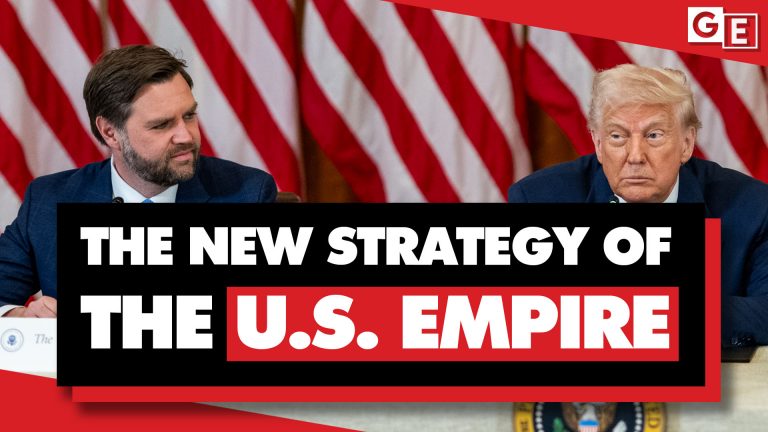
JD Vance Announces New Strategy Of Blatant Imperialism, Aimed At China

US Vice President JD Vance has announced what he calls a “new era” in military strategy. “What we are seeing from President Trump is a generational shift in [foreign] policy”, he claimed. The Donald Trump administration is abandoning the US government’s previous emphasis on soft power, Vance explained, and is instead focusing on “hard power” and “overwhelming force”, in a return to blatant, 19th century-style imperialism. According to Vance, Washington’s top priority is now “great power competition”, and preparation for potential war with China. The vice president laid this out in a speech at the commissioning ceremony of the US Naval Academy on 23 May.

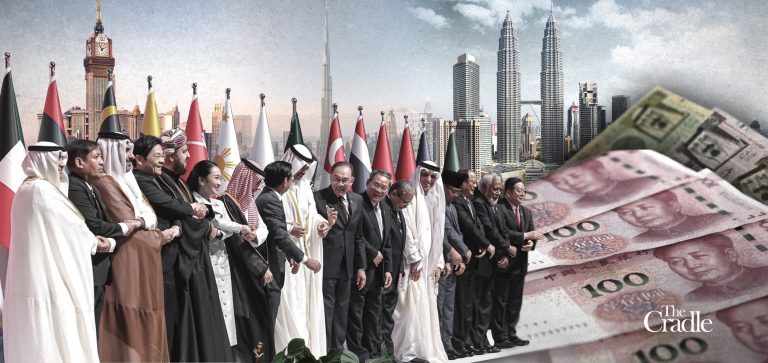
A New Asian Triad: ASEAN, China, And The Persian Gulf Align

On 26–27 May, the Malaysian capital, Kuala Lumpur, hosted the first-ever Association of Southeast Asian Nations (ASEAN)–Gulf Cooperation Council (GCC)–China summit, bringing together three of the Global South’s most economically dynamic regions for a trilateral meeting of immense strategic consequence. While not formalized as a binding alliance, the summit marks the beginning of a bold realignment – one that unites East and West Asia via economic interdependence, shared development visions, and a collective desire to escape western economic coercion. The summit is historic not only because of its trilateral format, but because it signals the emergence of a flexible Global South bloc capable of recalibrating regional and global power balances.

Serbia’s Organized Chaos

Serbia is a small country which used to be a favorite of Western Allied powers like France and Britain for its heroic resistance to Austrian and German invasion in two world wars.  They liked it so much that in redrawing European boundaries at Versailles in 1918, they enlarged it into the Kingdom of Serbs, Croats and Slovenes which later became Yugoslavia. Some Serb leaders at the time felt that this was too much, but at the time, Croat and Slovene leaders were glad to leave the Austro-Hungarian Empire and join the winning side.  All this changed abruptly in the 1990s. Germany had been reunited and began to drop its humble post-World War II foreign policy. 

Trump’s Far-Fetched Attempt To Divide Russia And China Is Clearly Failing

US President Donald Trump claimed he would “un-unite” Russia and China. However, this divide-and-conquer strategy — which prominent US officials like Henry Kissinger have advocated since the 1970s — is clearly failing. In a meeting in Moscow celebrating the 80th anniversary of their nations’ shared victory in World War Two, Presidents Xi Jinping and Vladimir Putin reaffirmed that “China-Russia relations have reached the highest level in history”. In a lengthy statement, Beijing and Moscow vowed to “jointly resist any attempts to interfere with and disrupt the traditional friendship and deep mutual trust between China and Russia”.

Pentagon Strategy Increases Risk Of Nuclear War With China

China and Russia released a joint declaration on the need for global strategic stability, which included an explicit condemnation of the US's nuclear counterforce strategy. Historian Peter Kuznik and filmmaker Regis Tremblay join us to discuss the risks of nuclear war in the current moment and the historical implications of the Russia-China alliance. Our understanding of China — and U.S.-China relations — has become a defining feature of all global politics. The China Report is a new show produced in collaboration with Pivot to Peace where every week, we will be helping you through all the propaganda with an independent view of the country we are taught to hate, but know so little about.

Pentagon Using Fabricated Chinese Threat To Build GE Soldiers

On April 8, a bipartisan commission chartered by Congress warned that China is rapidly advancing a terrifying new military threat: genetically engineered “super soldiers.” The report by the National Security Commission on Emerging Biotechnology (NSCEB) urges the U.S. to respond with a sweeping effort to militarize biotechnology. It offers little concrete evidence that such Chinese programs even exist. In the name of national security, Washington is now pushing for deregulation, massive government investment, and human experimentation. Experts say this effort echoes Cold War-era paranoia and threatens to erode ethical boundaries in science and warfare.

Whole Process People’s Democracy: The Path Forward

China’s political form is called ‘Socialism with Chinese Characteristics.' Chinese scholar Zhang Weiwei calls the Chinese political content ‘whole-process people’s democracy’. He distinguishes this model from the formulaic, procedure-obsessed, and anti-democratic model of the North American Republic and European social democracies. What separates the Chinese model from the political model of the central capitalist formations are a number of variables: firstly, mass participation from top to bottom is a key feature of Chinese socialism. Secondly, the subordination of the capitalist class to the party-state and thus the imperatives of the masses defines China’s ability to develop a socialist market economy.

China-Celac Forum Brings Latin America And China Together

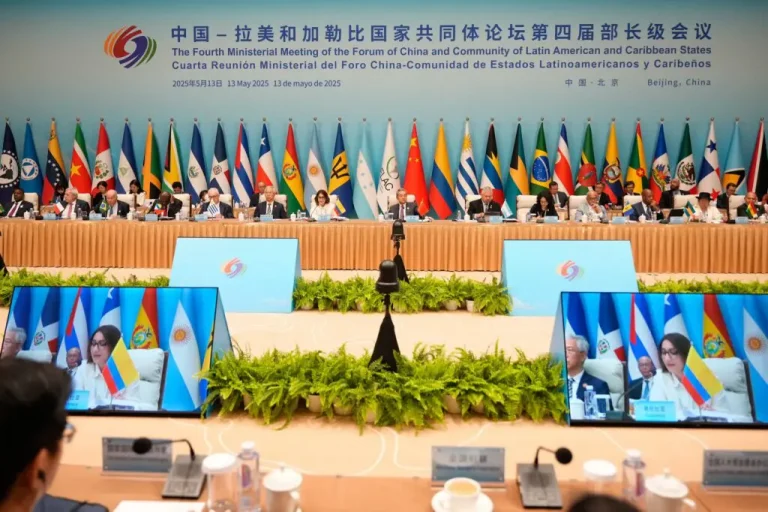
Ten years after its creation, the China-CELAC Forum has consolidated its position as one of the most relevant platforms for dialogue between Latin America, the Caribbean, and Asia. “The platform has strengthened cooperation between CELAC members and China, based on sovereign equality, mutual respect, plurality, and shared benefits,” states the meeting’s final joint declaration. Under the theme “Planning development and revitalization together, jointly building a China-LAC community with a shared future,” the meeting brought together representatives from more than 30 countries and leaders such as Xi Jinping (China), Luiz Inácio Lula da Silva (Brazil), Gustavo Petro (Colombia), and Gabriel Boric (Chile).

Trump’s Tariffs And The New Cold War On China

The first thing to say about the Trump administration’s tariff war is that it is primarily designed to weaken, undermine and isolate the People’s Republic of China. It’s part of a broader program of “decoupling” from China and a broader New Cold War on China – a system of hybrid warfare incorporating economic measures, diplomatic measures and propaganda measures, along with a significant military component: the deployment of hundreds of thousands of troops to the Pacific region; the US military bases in the Philippines, Guam, Okinawa, Japan, South Korea, Australia; the deployment of sophisticated weapons systems to the region; and the various attempts to create some sort of Asian NATO.

Trump’s Tariffs Are Uniting China, Europe, Japan, South Korea, And ASEAN

Trump’s Treasury Secretary Scott Bessent revealed that the US government has what he called a “grand encirclement” strategy aimed at isolating and weakening China. Trump hit China with tariffs of 145%, imposing what is essentially a trade embargo. The Trump administration wanted to pressure Japan, South Korea, Vietnam, and India to follow the US and “approach China as a group”, Bessent said, according to Bloomberg. This strategy is clearly failing. The finance ministers and central bank governors of China, Japan, South Korea, and members of the Association of Southeast Asian Nations (ASEAN) met in Italy on May 4 and published a joint statement pledging “to further strengthen regional financial cooperation”.

Trump’s Tariffs Turbocharge De-Dollarization

Donald Trump has made it clear that one of his top goals is to maintain the dominance of the US dollar as the global reserve currency. When he was running for president in 2024, Trump promised he would punish any country that sought alternatives to the US currency by hitting them with sky-high tariffs. “Many countries are leaving the dollar. They’re not going to leave the dollar with me!”, Trump vowed at a campaign rally. “I’ll say, ‘You leave the dollar, you’re not doing business with the United States, because we’re going to put 100% tariff on your goods'”. Since Trump has returned for his second term as US president, however, his tariffs and trade war have actually accelerated the decline of the dominance of the US dollar, not slowed it.

We Must Adhere To The People-Centered Development Philosophy

During the New Democratic Revolution, the Chinese trade unions united and mobilised the broad masses of workers to bravely throw themselves into the revolutionary torrent against imperialism, feudalism, and bureaucratic capitalism with a fearless revolutionary spirit. They fought bravely and made important contributions to achieving national independence and people’s liberation and establishing the new China. During the period of socialist revolution and construction, the Chinese trade unions united and mobilised the broad masses of workers to actively participate in the construction of New China with a sense of ownership and passion, worked hard and built enterprises with arduous efforts, and sang the strong voice of the times that “we workers are powerful”.

Trade Wars: The Decline Of America

Not a day goes by without a new shock to Americans and our neighbors around the world from the Trump administration. On April 22, the International Monetary Fund (IMF) downgraded its forecasts for global growth in 2025 from 3.3 percent to 2.8 percent and warned that no country will feel the pain more than the United States. Trump’s policies are expected to drag U.S. growth down from 2.7 percent to 1.8 percent. It’s now clear to the whole world that China is the main target of Trump’s trade wars. The U.S. has slapped massive tariffs — up to 245 percent — on Chinese goods. China hit back with 125 percent tariffs of its own and refuses even to negotiate until U.S. tariffs are lifted.

China Helps Cuba Fight Blackouts, Strengthen Power Grid

Cuba may slowly ease its crippling blackouts and strengthen the electricity grid as it begins building seven solar parks with the first batch of equipment from China. The Chinese aid helps Cuba’s plan to build 92 solar installations by 2028, adding about 2,000 megawatts to the island’s power grid and help reduce dependence on fossil fuel imports. Once completed, the project would significantly boost Cuba’s strained power system, which currently has a capacity of 7,264 MW. Installation work is set to begin soon in Artemisa, about 50 kilometers west of Havana, where the equipment arrived late last month. Additional solar parks are planned for the provinces of Pinar del Rio, Las Tunas, Holguin, Granma and Guantanamo.
assetto corsa mods

Urgent End Of Year Fundraising Campaign

Online donations are back! Keep independent media alive. 

Due to the attacks on our fiscal sponsor, we were unable to raise funds online for nearly two years.  As the bills pile up, your help is needed now to cover the monthly costs of operating Popular Resistance.

Urgent End Of Year Fundraising Campaign

Online donations are back! 

Keep independent media alive. 

Due to the attacks on our fiscal sponsor, we were unable to raise funds online for nearly two years.  As the bills pile up, your help is needed now to cover the monthly costs of operating Popular Resistance.

Sign Up To Our Daily Digest

Independent media outlets are being suppressed and dropped by corporations like Google, Facebook and Twitter. Sign up for our daily email digest before it’s too late so you don’t miss the latest movement news.