Skip to content

Poverty

Newsletter – Dismantling White Supremacy

By Margaret Flowers and Kevin Zeese. Last weekend, tens of thousands of people marched in Washington, DC in the combined March for Racial Justice and March for Black Women. Native Americans joined black and brown people to lead the march. At the march, Rev. Graylan Hagler said, “White Supremacy has been given aid and comfort by a so-called president and so-called administration, and so-called leaders of that ideology are comforted and feel that they are back as a centerpiece of American political life.” From coast to coast, it is true that white supremacists are active and are being more visible than they have in decades.

While Outrage Mounts Over Puerto Rico…

By Whitney Webb for Mintpress News. San Juan, Puerto Rico – Since Hurricane Maria devastated the island of Puerto Rico, the U.S. territory – which rarely garners much attention from the national media – has received widespread coverage which has focused on the Trump administration’s slow response to the disaster. The situation in Puerto Rico is undoubtedly dire, as many struggle without power and access to basic necessities more than a week after the storm struck. In addition, the Trump administration’s response has been notably lackluster in several regards, which has brought renewed scrutiny to its attitudes and performance.

Small Class Size – Reform We’re Too Cheap To Try

By Steven Singer for Gadfly on the Wall. We’re one of the richest countries in the world, yet we treat our own children – especially if they’re poor and brown – as if they were refugees from the third world. Well, perhaps marginally better. To my knowledge no one is suggesting we send the unwashed masses back to Africa, Europe or wherever else they originally came from – at least those who can prove they were born here. But we certainly aren’t bothering ourselves too much about taking care of them. What would that look like? Nothing all that radical. Imagine a classroom where students have the space to be individuals and not nameless cogs in the system.

The Myths Of Recovery: Why American Households Aren’t Better Off

By Constantin Gurdgiev for Market Watch - The Census Bureau data shows that bulk of the gains in real income in 2016 has been down to one factor: higher employment. In other words, hours worked rose, but wages did not. American median householders are working harder at more jobs to earn an increase in wages. Which would be OK, were it not down to the fact that working harder means higher expenditure on income-related necessities, such as commuting costs, child-care costs, costs for caring for the dependents, etc. In other words, to earn that extra income, households today have to spend more money than they did back in the 1990s. Now, I don’t know about you, but for my household, if we have to spend more money to earn more money, I would be looking at net increases from that spending, not gross. Census Bureau does not adjust for this. There is an added caveat to this: caring for children and dependents has become excruciatingly more expensive over the years, since 1999. Inflation figures reflect that, but the real income deflator takes the average/median basket of consumers in calculating inflation adjustment. However, households gaining new additional jobs are not average/median households to begin with — and most certainly not in 2016, when labor markets were tight.

Sometimes The Poor Make It Big. Usually They Stay Poor

By Jill Richardson for Other Words - We all want to live in a country where all it takes is hard work and some talent for anyone to succeed. We tell ourselves that we do. We even see examples of people who “came from nothing” and ended up rich and famous. And it’s true that it sometimes happens. Sometimes a child born into poverty grows up to become the president of the United States, a multi-billionaire, or an Olympic gold medalist. Most of the time, however, they don’t. And it’s not because they’re bad, lazy, stupid, or immoral. Often it’s because of our system itself. Take our school system for a start. By funding schools with property taxes, we guarantee that the children from the richest neighborhoods go to the wealthiest schools. If we lived in neighborhoods that were economically mixed with families of all incomes, this wouldn’t be a big deal. But we don’t. Instead we have areas of very wealthy people whose children attend wonderful schools, and areas of concentrated poverty where children attend failing schools.

Fewer Poor In 2016: Biggest 2-Year Decline Since 1969

By David Elliot for CHN - The poverty rate declined to 12.7 percent in 2016, down from 13.5 percent in 2015 and from 14.8 percent in 2014. That 2.1 percentage point drop is the largest two-year decline since 1969. Since 2014, the number of people in poverty has dropped by more than 6 million. Children remain disproportionately poor, with 18 percent (13.3 million) living in poverty, but the proportion of children in poverty also declined steeply over the past two years (down from 21.1 percent in 2014, nearly a 2.3 million decline). In part, the improvement in poverty was related to the increase in people with earnings (up 1.2 million since 2015), and the increase in the number of people working full-time/year-round (up 2.2 million since 2015). The lowest 20 percent of households saw their incomes increase by about 9 percent over two years. Also very important in reducing poverty were government programs. As shown by the Census Bureau’s Supplementary Poverty Measure, without Social Security, the total number poor would have been more than 26 million higher (with nearly 1.5 million more children poor). Low-income tax credits such as the EITC and Child Tax Credit prevented nearly 8.2 million from being poor (nearly 4.4 million children). SNAP/food stamps lifted nearly 3.6 million out of poverty (1.5 million children). Housing subsidies and Supplemental Security Income each lifted more than 3 million people out of poverty.

Newsletter – No #NAFTA2, Yes To Trade For People & Planet

By Daniel Cooper Bermudez. The Trump administration is renegotiating the North American Free Trade Agreement (NAFTA) with Canada and Mexico in secret, just as President Obama did with the TPP. Over the past two decades, NAFTA has resulted in workers losing their jobs and being replaced by machinery, ruined family farms throughout the continent, displaced communities and privatized social services, environmental disasters like the BP oil spill in the Gulf of Mexico and a widespread attack on labor rights and unions. This week, we explain our opposition to NAFTA2 and put forward a strategy to remake trade so it is no longer corporate-driven trade for the profits of a few, but people-driven trade to benefit all and protect the planet.

Disaster Coverage Blind Spot For Low Income Victims

By Neil Demause for Fairness and Accuracy in Reporting. as Hurricane Harvey has wreaked devastating flooding across southeast Texas, reporters’ ability to notice the nearly one-third of Americans living in or near poverty has again been put to the test. And though direct comparisons with Katrina are tough—Harvey is a different storm, playing out over days of rising waters instead of mere hours, and Houston chose not to call for residents to evacuate as New Orleans did in 2005—news coverage has revealed some of the same blind spots that have plagued reporting on previous natural disasters. The slow progression of floodwaters made for plenty of ready-made drama: At times, CNN seemed to have converted itself into a 24-hour rescue network, with tales of narrow escapes and heroic first responders.

Don’t Lie To Poor Kids About Why They’re Poor

By Josh Hoxie for Other Words - Those at the bottom — and the top — deserve to know why their experiences are so different. Work hard and you’ll get ahead — that’s the mantra driven into young people across the country. But what happens when children born into poverty run face first into the crushing reality that the society they live in really isn’t that fair at all? As new research shows, they break down. A just released study published in the journal Child Development tracked the middle school experience of a group of diverse, low-income students in Arizona. The study found that the kids who believed society was generally fair typically had high self-esteem, good classroom behavior, and less delinquent behavior outside of school when they showed up in the sixth grade. When those same kids left in the eighth grade, though, each of those criteria had degraded — they showed lower self-esteem and worse behavior. What caused this downward slide? In short, belief in a fair and just system of returns ran head-on into reality for marginalized kids. When they see people that look like them struggling despite working hard, they’re forced to reckon with the cognitive dissonance.

Tax The Rich To House The Poor

By the National Low Income Housing Coalition. Washington, DC - The National Low Income Housing Coalition (NLIHC) released the “Reforming the Mortgage Interest Deduction: How Tax Reform Can Help End Homelessness and Housing Poverty” report today calling for Congress and the Trump administration to use mortgage interest deduction (MID) reform to end homelessness and housing poverty in America. The report identifies solutions to the homelessness and affordable housing crisis in America that would incur no additional cost to the federal government, those proposed by the NLIHC-led United for Homes (UFH) campaign. The report and UFH campaign call for modest reforms to the mortgage interest deduction (MID)—a $70 billion tax write-off that primarily benefits higher income households—and for reinvesting the billions in savings in affordable housing for the lowest income families with the greatest needs.

Newsletter: Fight For Health Care Begins

By Margaret Flowers and Kevin Zeese. Republican efforts to repeal the Affordable Care Act (ACA) were stalled again this week, due in large part to public pressure including courageous and persistent civil resistance in Congress. This was another battle won to prevent millions more from losing health insurance and tax cuts for the rich, but the fight for a universal healthcare system is far from over. In fact, we have barely begun. 1hcsenDr. Carol Paris writes, "Today, we breathe a quick sigh of relief. But we cannot celebrate a return to the status quo, a system that rations health care based on income and allows 18,000 Americans to die each year unnecessarily." Dr. Paris argues that rather than focusing on the ACA, we must now advance National Improved Medicare for All (NIMA) - a publicly-funded and comprehensive universal healthcare system in the United States. Imagine the impacts National Improved Medicare for All will have when it is achieved...

How A Federal Program Is Destroying Public Housing

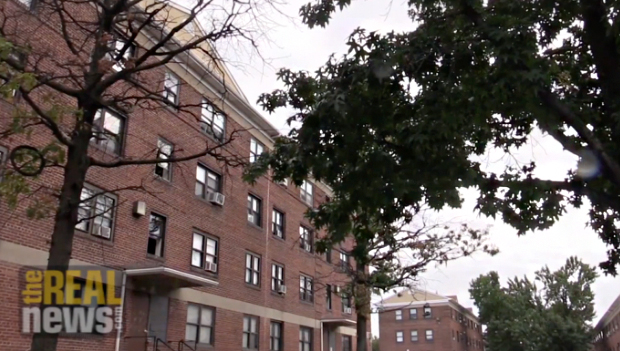
By Taya Graham for The Real News. Taya Graham: If there's a single issue that illustrates Baltimore's economic divide, it's housing. While developers continue to reap generous tax breaks to build luxury apartments downtown, other neighborhoods suffer from neglect. In fact, when Under Armour billionaire Kevin Plank received $600 million in tax breaks to build Port Covington, he also won an exemption from the city's affordable housing law. It's this dichotomy between rich and poor, the haves and the have not, which the city has failed to address, a lack of balance even more profound in our public housing, which is literally falling apart, which is why we have assembled this panel of people to talk about how to solve this entrenched inequity. Jeff Singer is the former executive director of Health Care for the Homeless and a professor at the University of Maryland School of Social Work. Lucky Crosby is a former housing employee who was a key whistleblower about the deplorable conditions of public housing. Reverend Annie Chambers was the first Green Party candidate to win a city-wide election to the Citizen Advisory Board of Douglas Homes, a city-run housings facility.

Almost Half Of Americans Die Nearly Broke

By Maurie Backman for USA Today - In a recent GoBankingRates study, 69% of adults admitted to having less than $1,000 in the bank, while 34% said they actually don't have any savings at all. But apparently, this collective lack of savings doesn't get all that much better with age. A study by the National Bureau of Economic Research found not so long ago that almost half of Americans die nearly broke. Of the general population, 46% of retirees die with savings of $10,000 or less. But that number climbs to 57% among retirees who are single. Now when we take other assets, like homes, into account, the picture gets a bit less bleak. Still, 57% of single-adult households and 50% of widowed households had no housing equity to show for when they died. The problem is that dying nearly broke isn't just a matter of denying one's beneficiaries an inheritance. Rather, it points to a frightening degree of financial vulnerability during retirement. If seniors are passing without much in the way of assets, it means that in the years leading up to their death, they're ill equipped to handle a major unexpected expense, such as a significant medical bill. In fact, in that same GoBankingRates survey, only 37% of seniors 65 and older claimed to have $1,000 or more in the bank.

Poverty Fuels European Extremism

By Andrew Spannaus for CounterPunch. Less stable employment conditions and the stagnation or regression of salaries have created the fertile ground for populist movements on the right in particular, which now mix their traditional nationalist and anti-immigrant rhetoric, with criticism of the economic orthodoxy of the supranational European Union (E.U.) institutions. In recent years the prevailing response from economists has been that many Western nations are simply unable to compete in sectors dominated by low costs and the high efficiency unleashed by globalization. This narrative, however, is used to hide a more troubling reality: government institutions have contributed directly to the economic difficulties with their own actions, driving down living standards through multiple waves of austerity and blocking attempts to break from the neoliberal principles that dominate among E.U. institutions.

Our Economy Is Based On A Massive LIE That’s Killing People

By Lee Camp for Redacted Tonight. If you've noticed lately that corporations have been pillaging our world's ever-dwindling natural resources as if they're a Vegas style buffet while placing a premium on food, shelter, and medicine, then congratulations! You've seen that our country's free-market capitalist system is reinforcing false scarcity--creating scarcity where there is none in order to make us pay more than we should for basic necessities. Advertising is a perfect example of how our economy reinforces your insecurities in order to make you buy and consume things you don't really need, all while making corporations even richer. But by way of technology, there is hope that some human beings still want to create systems where everyone can benefit instead of a select few. Lee Camp has this and more on the latest Redacted Tonight.
assetto corsa mods

Urgent End Of Year Fundraising Campaign

Online donations are back! Keep independent media alive. 

Due to the attacks on our fiscal sponsor, we were unable to raise funds online for nearly two years.  As the bills pile up, your help is needed now to cover the monthly costs of operating Popular Resistance.

Urgent End Of Year Fundraising Campaign

Online donations are back! 

Keep independent media alive. 

Due to the attacks on our fiscal sponsor, we were unable to raise funds online for nearly two years.  As the bills pile up, your help is needed now to cover the monthly costs of operating Popular Resistance.

Sign Up To Our Daily Digest

Independent media outlets are being suppressed and dropped by corporations like Google, Facebook and Twitter. Sign up for our daily email digest before it’s too late so you don’t miss the latest movement news.