Skip to content

Germany

Germany’s Far-Right Supporters Outnumbered By Protesters In Berlin

BERLIN (Reuters) - Some 5,000 supporters of the far-right Alternative for Germany (AfD) marched through Berlin on Sunday, but they were heavily outnumbered by anti-AfD demonstrations, including one from the city’s club scene which blasted techno music across the capital. The AfD’s anti-immigration, anti-European Union and anti-Muslim messages helped it become the third largest party in the German Bundestag in last September’s vote but it has had little impact on parliamentary debate since then. The AfD demonstrators, bussed in from around Germany, marched from Berlin’s main station, down the banks of the Spree river to the Brandenburg Gate near the German parliament. But there were around 20,000 anti-AfD protesters - according to police estimates - most of them younger people, highlighting the divisions that have emerged in Germany since the 2015 refugee crisis.
Amazon Workers Booed Jeff Bezos In Berlin

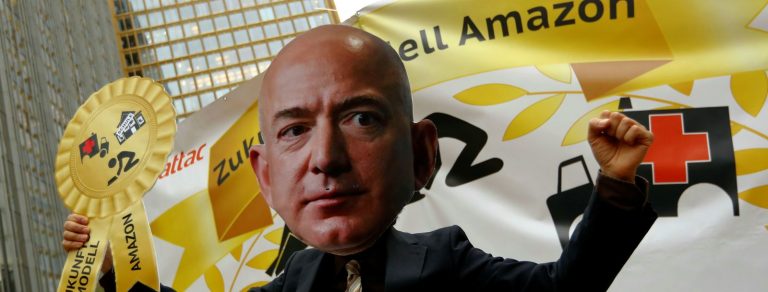
Amazon CEO Jeff Bezos received a hostile reception when he arrived in the German capital to pick up an innovation award on Tuesday (Apr. 24). Trade union Verdi confirmed that “several hundred Amazon workers,” who are members of the powerful union, amassed outside the offices of publisher Axel Springer, where the awards ceremony was taking place, carrying placards reading “Make Amazon Pay.” Amazon workers from other countries, including Poland and Italy, also traveled to Berlin to join the demonstration. Verdi boss Frank Bsirske said: “We have a boss who wants to impose American working conditions on the world and take us back to the 19th century.” Verdi has for years been a constant thorn in Amazon’s side in Germany, organizing workers strikes to demand improved pay and working conditions.

Germany’s 28-Hour Workweek

German metalworkers’ union IG Metall made international headlines last month after a twenty-four-hour “warning strike” compelled employers to sign a deal with the union giving its members the right to a twenty-eight-hour workweek. The deal — which covers 900,000 workers in the southwestern state of Baden-Württemberg — is seen as a landmark in European labor relations, granting workers who want to reduce their working hours the right to do so for a two-year period. It came after 15,000 workers in eighty companies downed tools as part of a campaign for a better work-life balance and also included a substantial pay raise. But is it too good be true? Jacobin’s Loren Balhorn sat down with German labor sociologist Klaus Dörre to find out more about the strike, what the workers really gained, and what it might say about the German labor movement’s future.

German Cities To Trial Free Public Transport To Cut Pollution

“Car nation” Germany has surprised neighbours with a radical proposal to reduce road traffic by making public transport free, as Berlin scrambles to meet EU air pollution targets and avoid big fines. The move comes just over two years after Volkswagen’s devastating “dieselgate” emissions cheating scandal unleashed a wave of anger at the auto industry, a keystone of German prosperity. “We are considering public transport free of charge in order to reduce the number of private cars,” three ministers including the environment minister, Barbara Hendricks, wrote to EU environment commissioner Karmenu Vella in the letter seen by AFP Tuesday. “Effectively fighting air pollution without any further unnecessary delays is of the highest priority for Germany,” the ministers added.

Unions Winning Major Demands In Germany

Industrial workers in south-western Germany have won the right to reduced working hours as part of a deal that could benefit millions of employees across the country. Workers will be able to reduce their weekly hours from 35 to 28 for up to two years to look after their families. The deal covers almost one million workers in Baden-Württemberg state and also gives them a pay rise. It could be extended to the 3.9 million workers in Germany's industrial sector. What has been agreed? A reduced working week to care for children, the elderly or sick relatives was a key demand by IG Metall, the country's biggest trade union representing metal and engineering workers.

At Berlin March, Tens Of Thousands Demand End To Industrial Agriculture

Tens of thousands of people—and more than 100 tractors—swarmed the streets of Berlin this weekend to demand a food system transformation nourished by political policies that foster ecological farming. "Policymakers at the European and national level need to listen, and use the upcoming reform of the EU's common agricultural policy to build a better food system for the future."

Fake Trump Marches In Carnival-Climate Protests At COP23

By Louise Osborne, Patrick Große and Rebecca Staudenmaier for DW. Carnival protest at the climate meeting in Bonn. A fake Donald Trump, the devil and a crew of buccaneering pirates were among thousands of environmental activists who hit the soggy streets of Bonn on Saturday to cast out coal, oil and nuclear energy — the "evil spirits of climate change." "Climate change doesn't react to pretty words — only to action," Dagmar Paternoga from Attac Germany, a network critical of globalization, told DW. "We demand an end to coal, an end to fossil fuels, [more] renewable energy and we're also demanding a mobility transition." No Climate Change, the group leading the demonstration, said some 2,000 people from Germany and around the world marched from downtown Bonn toward the site where the COP23 climate conference is taking place near the United Nations headquarters. A subsequent climate protest took place in the city center. They both wanted to grab the attention of climate conference attendees gathered in the western German city.

‘Hitler’s American Model: US And Making Of Nazi Race Law’

By Bill Moyers for Moyers and Company - Boy, did they ever. In fact, they saw America doing it in a more radical fashion than any of the Nazis themselves ever advocated. I mentioned earlier the demands of the radicals during the early Nazi period in 1933, which were embodied in something called the Prussian Memorandum. Kind of a sinister name, but that’s what it was. The Prussian Memorandum specifically invoked Jim Crow as a model for the new Nazi program, and here’s the irony: The Prussian Memorandum also insisted that Jim Crow went further than the Nazis themselves would desire to go. They were planning to ban offensive socialization between the races if it took place in public but not in private. They went on to observe that the Americans went even further than that, banning interactions even in private. As Nazi debates continued, however, there was a great deal of disagreement over whether anything like Jim Crow segregation was appropriate for Nazi Germany. In fact, if you read the stenographic transcript of that meeting we’re talking about, you’ll come across a leading Nazi radical who denied that segregation would work in Germany. As he put it, “The Jews are just much too rich and powerful. Segregation of the Jim Crow kind could really only be effective against a population that was already oppressed and impoverished,” like the African-American population in America.

The Front Lines Of Antifascism In Eastern Germany

By Morgan Meaker for Pacific Standard - A shy grin spreads across Maximillian's face as he stretches out his arm to show where he was bitten by a Nazi. A faint, teeth-shaped scar marks where the attacker's jaw clamped down on the 17-year-old. Wearing suspenders and a flat cap studded with anti-fascist badges, Maximillian says his assailant was probably on drugs but that he knew he was a neo-Nazi because the guy called Maximillian "a fucking anti-fascist." Maximillian shrugs as if to say it happens all the time. In the same month, December of 2016, he was ambushed by another gang of neo-Nazis in the town center. That time, they broke his jaw. The teenager's hometown of Bautzen in eastern Germany has earned a reputation for right-wing extremists since Angela Merkel opened Germany's borders to almost 900,000 refugees in 2015. Over the past two years, Bautzen has seen anti-migrant demonstrations, a mass brawl between the town's residents and its asylum-seekers, and an attack on the information desk of a pro-diversity non-profit. But the town's rising tensions reflect a nationwide surge in support for the far-right Alternative for Germany party (AFD). In the recent national election, the AFD became the first far-right party to sit in the Bundestag since World War II, with 12.6 percent of the vote (according to provisional results).

Merkel’s CDU Wins But Far-Right AfD Enters Bundestag

By Catherine Stupp for Euractiv. Germany - Merkel’s coalition partners, the Social Democrats, were also dealt shocking losses, bringing them their worst results since World War Two. Party leaders said on Sunday evening that they would leave the government and lead the opposition in the Bundestag. The AfD, which had campaigned on the anti-Islam and anti-immigration ticket, will be the first far-right party to take up seats in the Bundestag in more than 50 years. Merkel, SPD leader Martin Schulz and other parties’ leaders were frequently criticised for leading boring election campaigns. But the losses to the CDU and the SPD are bigger than polls predicted, and the AfD’s win marks a dramatic change in the German political landscape. After exit poll figures were announced Sunday, Merkel admitted she was disappointed by the results. “Of course we expected a slightly better result, that’s totally clear,” she said at the CDU party headquarters. The CDU suffered its biggest ever slide in support between elections, drawing 33% of the vote, compared to 41.5% in 2013. The centre-left SPD picked up only 20.5% of the vote, down from 25.7% in 2013. Merkel has been chancellor since 2005, and her win will be celebrated as a sign of stability by many in Brussels. But talks on a new government could take a while. Exit poll results rolled in starting at around 6 o’clock on Sunday evening. According to final figures that were released early Monday morning, the AfD pulled in 12.6% of the vote, making it the third strongest party in the next Bundestag.

Top German Politicians Want US Nuclear Weapons Out

By John Laforge for Counter Punch - A series of anti-nuclear weapons actions between March and August at Air Base Büchel in Germany brought widespread media attention to the 20 US nuclear weapons still deployed there. Surprising demands for the bombs’ removal soon came from high-ranking political leaders including Germany’s foreign minister. A timeline of events between July 12 and 18, involving a Nukewatch-organized delegation of 11 US peace activists, shows how the work may have moved the officials to speak out. July 12 — Upon its arrival, four members of the US group held a press conference in Frankfurt accompanied by Marion Küpker, international coordinator for DFG-VK — Germany’s oldest anti-war group — and organizer of the five-month peace camp. News of the unprecedented US group was reported in the daily Frankfurt Journal (“Activists from the US land in Frankfurt: Campaign against US nuclear weapons”), the online magazine FOCUS (“Nuclear fighters receive support from the US”) and picked up around the country. July 15 — Headlines like “Today in Büchel: Action day against nuclear weapons,” and “Konstantin Wecker sings for the peace,” was news across southwest Germany when the well known singer-songwriter drew about 400 to his performance near base’s main gates. The US delegates all spoke briefly to the gathering through interpreters.

How Should We Protest Neo-Nazis? Lessons From German History

By Laurie Marhoefer for The Conversation - Charlottesville was right out of the Nazi playbook. In the 1920s, the Nazi Party was just one political party among many in a democratic system, running for seats in Germany’s Parliament. For most of that time, it was a small, marginal group. In 1933, riding a wave of popular support, it seized power and set up a dictatorship. The rest is well-known. It was in 1927, while still on the political fringes, that the Nazi Party scheduled a rally in a decidedly hostile location – the Berlin district of Wedding. Wedding was so left-of-center that the neighborhood had the nickname “Red Wedding,” red being the color of the Communist Party. The Nazis often held rallies right where their enemies lived, to provoke them. The people of Wedding were determined to fight back against fascism in their neighborhood. On the day of the rally, hundreds of Nazis descended on Wedding. Hundreds of their opponents showed up too, organized by the local Communist Party. The antifascists tried to disrupt the rally, heckling the speakers. Nazi thugs retaliated. There was a massive brawl. Almost 100 people were injured. I imagine the people of Wedding felt they had won that day. They had courageously sent a message: Fascism was not welcome. But historians believe events like the rally in Wedding helped the Nazis build a dictatorship. Yes, the brawl got them media attention.

Interior Ministry Shuts Down, Raids Left-Wing German Indymedia Site

By Staff of Deutsche Welle - Germany's Interior Ministry on Friday banned and ordered raids on a portal popular with leftist readers and activists. Possibly the last posts from linksunten.indymedia.org - commemorations of a 1992 far-right mob attack on apartments where foreigners lived in Rostock-Lichtenberg and reports of racist graffiti on a memorial to a young woman killed by neo-Nazis in the United States - went live the previous night. The site was closed for "sowing hate against different opinions and representatives of the country," said Interior Minister Thomas de Maizière, adding that the operation of the site was now "a criminal offence." He said authorities were treating linksunten.indymedia.org as an "association" rather than a news outlet, which would help officials get around constitutional protections on freedom of expression. De Maizière said at least two people constituted an association - the site has up to seven administrators - and the ban would not affect the international award-winning Indymedia network. "We are currently searching multiple facilities," said Baden-Württemberg state Interior Minister Thomas Strobl, a member of German Chancellor Angela Merkel's Christian Democrats, which is also de Maizière's party.

Berlin Calls For Retaliation Against ‘Illegal’ US Sanctions On Russia

By Staff of RT - New penalties against Moscow proposed by US lawmakers violate international law and officials in Brussels should consider countermeasures, the German economy minister said on Monday. "We consider this as being against international law, plain and simple,"Brigitte Zypries told the Funke Mediengruppe newspaper chain. "Of course we don't want a trade war. But it is important the European Commission now looks into countermeasures,” she added. According to the minister, “the Americans can not punish German companies because they operate economically in another country." Last week, both chambers of the US Congress decided to impose new sanctions against Russia over its Crimea reunification and alleged meddling in US elections. The bill has still to be signed by US President Donald Trump. This is the first time Washington has made a move against Moscow without European consent. The bill appears to target Russia’s Nord Stream-2 pipeline that will deliver natural gas from Russia to Germany. The proposed expansion would double the existing pipeline's capacity and make Germany EU's main energy hub. The legislation seeks to introduce individual sanctions for contributing in Russian energy projects and targets major sectors of Russia’s economy, including defense, railway, and banking industries.

Some Americans Do Love Their Health Care (They’re Expats)

By Allison Williams for Handelsblatt - Luisa Weiss is a German-American writer about food and culture who lives in Berlin and has a cult following for her recipes for bagels, cinnamon buns and chocolate-chip cookies, which usually combine her American, Italian and German heritage. Earlier this year she had a baby by caesarian section. First the baby arrived, then the bill — and she was shocked, in a good way. In the United States the procedure would have cost insurers $50,000; in Germany, it cost $3,000. “There’s nothing like major surgery and a week of recovery in the hospital to reinforce how lucky I feel to live in a country where affordable and good-quality health care for all is a given,” she wrote in a blog post that earned a torrent of ‘likes’. Ms. Weiss’ comments — she also posted a photo of the hospital bill on Instagram — added fuel to the never-ending debate about health care on either side of the Atlantic. US-based mothers responded, one writing that she had been discharged from hospital two days after having a C-section. “It was brutal coming home and not having the nursing care. Germany has got it right when it comes to maternity health care,” another mom said. In Germany, health-care coverage is mandatory, based on an insurance system that is founded on solidarity and mutual support.
assetto corsa mods

Urgent End Of Year Fundraising Campaign

Online donations are back! Keep independent media alive. 

Due to the attacks on our fiscal sponsor, we were unable to raise funds online for nearly two years.  As the bills pile up, your help is needed now to cover the monthly costs of operating Popular Resistance.

Urgent End Of Year Fundraising Campaign

Online donations are back! 

Keep independent media alive. 

Due to the attacks on our fiscal sponsor, we were unable to raise funds online for nearly two years.  As the bills pile up, your help is needed now to cover the monthly costs of operating Popular Resistance.

Sign Up To Our Daily Digest

Independent media outlets are being suppressed and dropped by corporations like Google, Facebook and Twitter. Sign up for our daily email digest before it’s too late so you don’t miss the latest movement news.