Skip to content

Brazil

What The 17th BRICS Summit Declaration Says And Omits

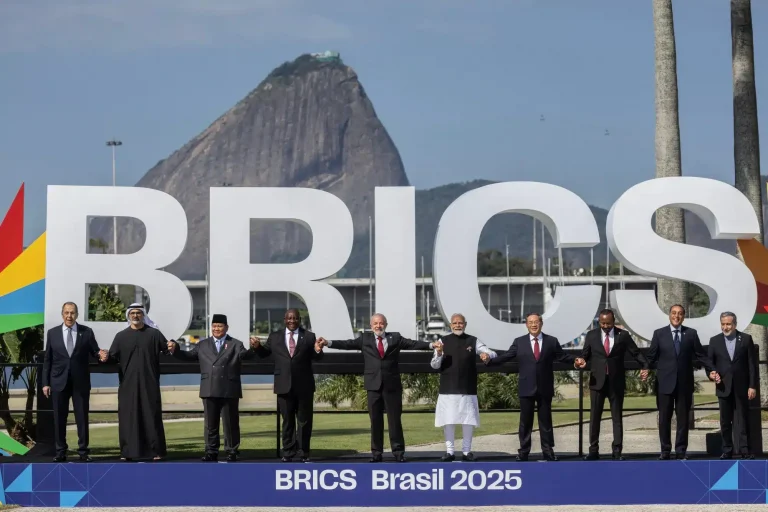
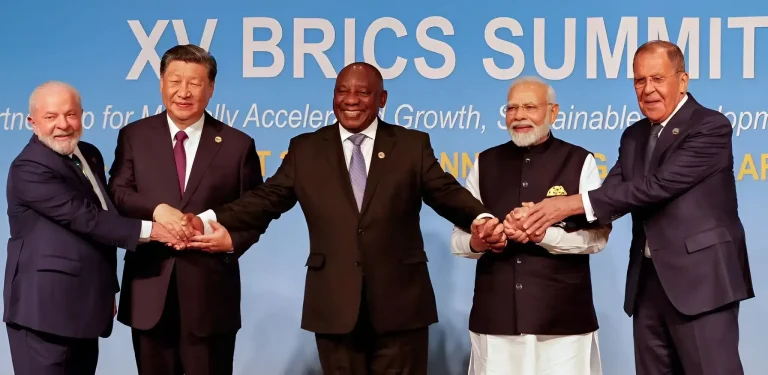
At the 17th BRICS Summit, held in Rio de Janeiro from July 6 to 7, 2025, the bloc’s leaders issued a declaration reaffirming the bloc’s central role as a representative voice of the Global South. However, the declaration does not mention the word “genocide” when referring to the Israeli massacre of the Palestinian population, and despite condemning unilateral sanctions, it fails to mention one of the countries that has suffered the greatest impact from them: Venezuela, a strategic ally of China and Russia, two of the founding countries of the BRICS. In this regard, the final declaration condemns “the imposition of unilateral coercive measures contrary to international law” and denounces that such measures “have far-reaching negative implications for human rights, including the rights to development, health and food security of the general population of the affected states.”
Spain And Brazil Launch Initiative To Push Global Tax On The Ultra-Rich

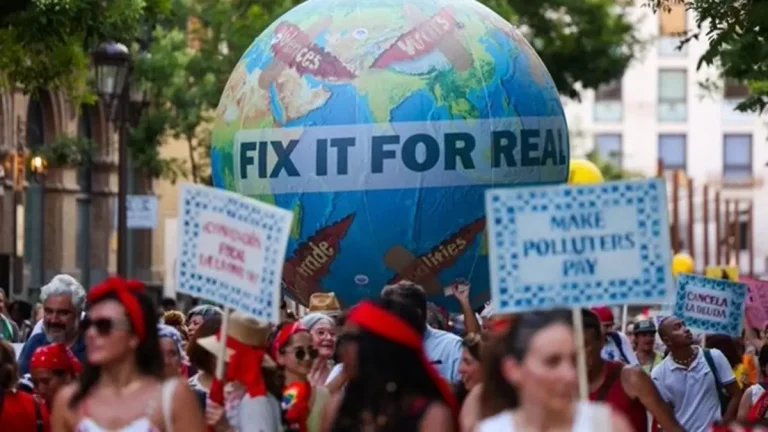
On Tuesday, Spain and Brazil will launch a joint initiative to promote a global tax increase on the superrich, aiming to achieve a fairer redistribution of wealth. The initiative, to be presented at the fourth U.N. International Conference on Financing for Development in Seville, seeks to encourage a multilateral debate on the effective taxation of large fortunes and how it impacts social cohesion. The project aims to tackle the issue of extreme inequality and move toward a fairer redistribution of wealth “through a progressive and just tax system in which those who have more, pay more,” Spain’s Finance Ministry said.

BRICS Demands End To Violence In West Asia

The BRICS, the influential bloc of emerging geopolitical powers, demanded an immediate end to the cycle of violence in West Asia following the recent attacks against Iran. The group also pushed for the establishment of a zone free of nuclear weapons and other weapons of mass destruction in the region as a whole, a crucial measure to ensure long-term stability, The Brazilian government, the current president of the bloc, issued the forceful statement on Tuesday, June 24. The statement responds directly to the recent United States and Israeli military attacks against Iran, events that have dangerously escalated regional tensions.

Pedagogy And Class Power: Reclaiming Freire In An Age Of Reaction

In the early decades of the twenty-first century, education has become a frontline in the ideological struggle over the future of global capitalism. The coordinated assault on teachers, curriculum, and institutions of public learning is not an isolated culture war but a structural feature of neoliberal governance. In this context, the pedagogical philosophy of Paulo Freire demands renewed attention—not as an abstract theory of “engaged learning,” but as a revolutionary praxis situated in a broader Marxist tradition of class struggle.¹ Freire’s Pedagogy of the Oppressed, first published in 1970, emerged not from elite seminar rooms but from literacy campaigns among Brazil’s dispossessed.

Brazil’s MST Promotes Agrarian Reform Amidst Environmental Crisis

Brazil’s Landless Rural Workers’ Movement (MST) launched the third edition of Nature Day this Monday, an initiative that is part of its national plan “Plant Trees, Produce Healthy Food.” The goal is not only reforestation but also strengthening popular agrarian reform as an alternative to the current environmental crisis. This was stated by Camilo Augusto, project coordinator, in an interview with local media. Since 2021, the MST has promoted this event across Brazil, carrying out activities that include planting, seed distribution and mobilizing around environmental preservation.

MTST Consolidates Occupation In Rio De Janeiro’s Port Region

In the early hours of Saturday, May 31, the Homeless Workers’ Movement (MTST) strengthened an occupation in an area of Rio de Janeiro’s port region that already brought together around 200 families. According to the Movement, the area belongs to Jornal do Brasil and Docas S.A. and had been abandoned for more than two decades. Members of the MTST have been cleaning up the land, preparing the area to organize housing and a community kitchen. “This is an occupation that has been going on for a few days and today we are in the process of consolidating it, guaranteeing more structure for the families,” explains Gabriel Siqueira, national coordinator for the MTST.

Brazilian Oil Unions Demand Energy Embargo On Israel

Two of Brazil’s largest federations of oil trade unions have called on the country’s President Luiz Inacio Lula da Silva to impose an energy embargo on Israel over its brutal war against the Gaza Strip.  The National Federation of Oil Workers and the Single Federation of Oil Workers signed a letter to the Brazilian president and a number of his ministers urging the government to take a firmer stance against the genocidal war against Palestinians.  The federations said Brazil must do more than make public statements and impose a full ban on oil sales to Israel in an effort to actively prevent the “ongoing Nakba” – using the Arabic word for catastrophe, which refers to the ethnic cleansing and mass exodus of Palestinians in 1948. 

Brazil: Military Police Violently Evict Families Of Landless Rural Workers

Families belonging to the Landless Rural Workers’ Movement (MST) from the Edivaldo Sena Camp, in Boa Esperança Farm, municipality of Rafael Jambeiro, Bahia state of Brazil, have been violently evicted by the Military Police. More than 10 police vehicles participated in the operation on Saturday, May 17, which was carried out without the presence of any representative from the Ombudsperson’s Office. The MST condemned the Bahia Public Security Secretariat (SSP-BA) for ordering the eviction, which represents a serious violation of human rights and disrespect for a previous judicial decision. According to the movement, the families had established the camp more than three years ago and, after being evicted on April 30, they returned on May 16 to defend their legitimate right to the land.

MST Promotes Solidarity Between Global South Nations At Reform Fair

In an Internationalist Act held on Sunday, May 11, during the 5th National Agrarian Reform Fair, the Landless Workers’ Movement (MST) reinforced its role in fostering solidarity between countries facing massacres imposed by imperialism. At the Fair at Parque da Água Branca in São Paulo (SP), representatives from Cuba, Palestine, the Sahrawi Arab Democratic Republic, and Venezuela highlighted the trajectory of resistance in their territories against external oppression and reaffirmed their partnership with the MST in the fight for sovereignty.

Our Future Is Not Determined By The US Or Europe

“Debating the resources of the Global South is becoming urgent, but it is even more urgent to discuss how it is that most of the resources for the production of technology and goods are from the Global South and yet it is the North that takes all the wealth,” Cassia Bechara began her presentation, adding: ”in 2024 the wealth of the world’s richest millionaires was the greatest in history.” Although the speakers focused on the Global South in their presentations, they expressed different views on the same topic, as in the case of Márcio Pochmann, President of the Brazilian Institute of Geography and Statistics (IBGE).

Project In Venezuela Wants To Build Food Sovereignty

A project to guarantee Venezuela’s food sovereignty: This is how the Patria Grande del Sur program is being treated by the Venezuelan government and the Landless Rural Workers’ Movement (MST, in Portuguese). The initiative was launched two weeks ago and will use 180,000 hectares for food production based on agroecology. Rosana Fernandes has been coordinating the MST brigade in Venezuela for two months. The movement has been active in the country for 20 years and is now the central organization leading the project in southern Venezuela. She says it intends to occupy the territory of Vergareña and expand the food production carried out by small families in the region.

International Conference On Perspectives For Building Sovereign, Socialist Economic Policies

Renowned economists, sociologists, and movement leaders from Mexico, Russia, Benin, China, Brazil, Sri Lanka, Argentina, and more, will come together in São Paulo, Brazil from April 7-11 to participate in the IV International Dilemmas of Humanity Conference: Perspectives for Social Transformation. The conference is being organized by the Landless Rural Workers’ Movement (MST), the Tricontinental: Institute for Social Research, and the International Peoples’ Assembly (IPA). It follows the III International Dilemmas of Humanity Conference which was held in Johannesburg, South Africa in October 2023.

Participatory Budgeting Includes Community Members In Public Funding

In 1989, one-third of the inhabitants of Porto Alegre, Brazil, lived in impoverished regions on the fringes of the city, cut off from sanitation, clean water, medical facilities, and other essential resources. In response, the Brazilian Workers’ Party created participatory budgeting (PB), a citizen engagement process that enables community members to decide how to use a portion of public funds. A 2007 report by the North American Congress on Latin America stated that this brought treated water to 99 percent of Porto Alegre’s population, expanded the sewer system’s reach from 46 percent in 1989 to 86 percent of the city, led to the construction of more than 50 schools from around 1997 to 2007, decreased truancy from 9 to less than 1 percent, and helped double the number of students attending university from 1989 to 1995.

Landless Workers’ Movement Pressures Government With Occupations

A series of actions on Thursday led by women from Brazil’s Landless Rural Workers’ Movement (MST, in Portuguese) increased the pressure on the Lula government (Workers’ Party) to push agrarian reform policies forward. The mobilization occurred in 24 Brazilian states where there are MST activities and was part of the Landless Women’s Day of Struggle,previous to the MST’s Red April, massive actions to demand agrarian reform in the country. Landless families occupied areas in the states of Bahia and Ceará that did not comply with the social function provided for in the Brazilian Constitution.

Global North Has Nine Times More Voting Power At The International Monetary Fund Than Global South

As far as the International Monetary Fund (IMF) is concerned, each person in the Global North is worth nine people in the Global South. We get that calculation from IMF data on voting power in the organisation relative to the population of the Global North and Global South states. Each country, based on its ‘relative economic position’, as the IMF suggests, is given voting rights to elect delegates to the IMF’s executive board, which makes all of the organisation’s important decisions. A brief glance at the board shows that the Global North is vastly overrepresented in this crucial multilateral institution for indebted countries.
assetto corsa mods

Urgent End Of Year Fundraising Campaign

Online donations are back! Keep independent media alive. 

Due to the attacks on our fiscal sponsor, we were unable to raise funds online for nearly two years.  As the bills pile up, your help is needed now to cover the monthly costs of operating Popular Resistance.

Urgent End Of Year Fundraising Campaign

Online donations are back! 

Keep independent media alive. 

Due to the attacks on our fiscal sponsor, we were unable to raise funds online for nearly two years.  As the bills pile up, your help is needed now to cover the monthly costs of operating Popular Resistance.

Sign Up To Our Daily Digest

Independent media outlets are being suppressed and dropped by corporations like Google, Facebook and Twitter. Sign up for our daily email digest before it’s too late so you don’t miss the latest movement news.