Skip to content

Bolivia

Bolivian Military Officers Graduate From Anti-Imperial School

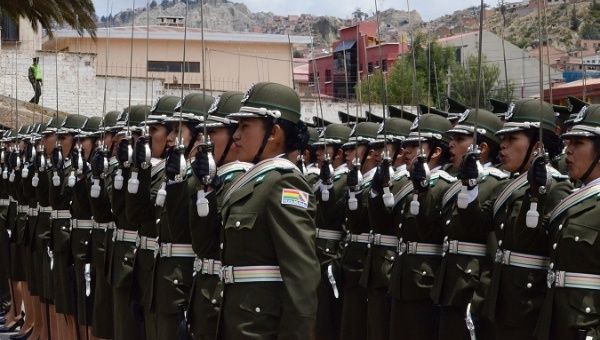
"We can never co-habitate and co-exist with an empire," the head of the School of Anti-Imperialism said during the graduation ceremony. Bolivian President Evo Morales has attended the graduation of 407 military officers from the School of Anti-Imperialism in Bolivia, highlighting the importance of the Bolivian Armed Forces in defending sovereignty. "We are convinced that the liberation of a people comes with the anti-imperialist struggle not only in Bolivia, but rather in the whole world," Morales said during the ceremony Friday.  "Why must humanity struggle? Because there is injustice, there is inequality. Some models only seek hegemony, only seek natural resources to take them."

World Premiere: In The Shadow Of The Revolution

By Staff of The Caracas Chronicles - Caracas Chronicles is proud to be the venue chosen by long-time friend and much-appreciated copy-editor Clifton Ross, and his colleague J.Arturo Albarrán, to premiere their latest film project, In the Shadow of the Revolution. The authors hope this timely work will challenge the Bolivarian government’s narrative about itself and the opposition through interviews with Left social movement activists, journalists, academics and intellectuals. Through this latest collaboration, Albarrán and Ross hope to reach an international public that has been subject to a bombardment of propaganda from the Bolivarian government. You’d be surprised how many people still buy into chavismo propaganda, and the narrative in which a popular, Left-wing government that brought great benefits to a nation is under attack by imperialists and a right-wing “fascist” opposition. The film disputes that line and offers a much-needed alternative view from the perspective of social movements and a democratic left. That this narrative comes in the voice of the very supporters that chavismo claimed to champion, now disillusioned and oppressed, is what really lends this film its powerful authenticity.

Evo Morales Warns Against US Plan to ‘Recolonize’ Latin America

By Staff for Telesur. The Bolivian president emphasized that the United States utilizes their so-called support for “democracy” as a pretext for their objectives. Bolivian President Evo Morales on Tuesday took to Twitter to state that the United States is planning to “recolonize” Latin America. The socialist Indigenous leader cited Venezuela as being the strategic link behind the scheme, of which “the empire has initiated a wide-scale battle to recolonize Latin America and the Caribbean.” In another tweet, Morales emphasized that the United States utilizes the same pretexts to justify their objective, including support for “democracy,” combating “terrorism” and fighting “narcotrafficking,” among others. He added that mainstream corporate media outlets replicate the same excuses, according to La Radio del Sur. After delineating the threat, Morales urged all troops in the region to remain alert to defend their sovereignty and independence.

Morales Declares ‘Total Independence’ From World Bank And IMF

By Staff of Tele Sur - Bolivia’s popular uprising known as the The Cochabamba Water War in 2000 against United States-based Bechtel Corporation over water privatization and the associated World Bank policies shed light on some of the debt issues facing the region. "The Bank and the IMF have been requiring these countries (in the Global South) to accept “structural adjustment,” which includes opening markets to foreign firms and privatizing state enterprises, including utilities," the New Yorker reported. At the time, the World Bank had stated, "Poor governments are often too plagued by local corruption and too ill equipped" and "no subsidies should be given to ameliorate the increase in water tariffs in Cochabamba." The New Yorker, reported, "Most of the poorest neighborhoods were not hooked up to the network, so state subsidies to the water utility went mainly to industries and middle-class neighborhoods; the poor paid far more for water of dubious purity from trucks and handcarts. In the World Bank's view, it was a city that was crying out for water privatization."

Soft Coups Made In USA To Control Latin America: Bolivia

By Staff of Tele Sur - While the U.S. employs brute military force in the Muslim world to obtain foreign policy objectives, soft coups are reserved for Latin America. Cesar Navarro, Bolivia's minister of Mining and Metallurgy, emphasized Wednesday that the main objective of the United States is to implement soft coups in order to reestablish hegemony over Latin America during a speech launching a new book, according to Prensa Latina. The official was commenting on "Geopolitics and Regional Integration — Latin America in the World System," a compilation which includes a variety of prominent Latin American intellectuals. He noted that while the United States employs brute military force in parts of the Muslim world to obtain foreign policy objectives, soft coups are reserved for its southern neighbors or as top U.S. officials — including former U.S. Secretary of State John Kerry — refer to the region as its “backyard.” To support his claim, Navarro cited the removal of democratically-elected Manuel Zelaya in Honduras; Fernando Lugo in Paraguay; and Dilma Rousseff in Brazil, describing how the United States supported their ouster despite the fact that it goes against all claims of supporting democracy.

The Latin American Left Today Global Center For Resistance

By Staff for Telesur. From Brazil to Venezuela there have been radical shifts in the geopolitical landscape of the region. However, Latin America remains a global center for creativity and resistance. Torn between right and left – and dealing with the significant pressures of imperialism and a colonial legacy – popular forces have been fighting for their social rights and progress, making significant strides and remaining vital despite setbacks. Amid this complicated scenario, teleSUR takes a look at the Latin American left of today – from the Indigenous councils to the national assemblies, the urban centers to the rural villages – which continues to stand strong and fight for an integrated, united and socialist future.

US Funded NGO’s: New Face of Destabilization in Latin America

By Staff for Telesur. Starting in 1999, the United States has increasingly lost the ability it once had to determine policy in Latin America. The Bolivarian Revolution that began in Venezuela quickly grew throughout the region, and over the decade the idea of reclaiming national sovereignty through regional integration gained momentum. A decade later, organizations like ALBA, CELAC and Unasur were formed by countries from Latin America and the Caribbean, who came to consensus on the benefits of excluding the United States (and to a lesser extent, Canada). Also during this time, the United States government began putting an increasing amount of resources into organizations operating in Latin America. Under seemingly altruistic pretexts—including environmental promotion, defense of human rights, and strengthening democracy—these organizations received U.S. dollars often to intervene in the political affairs of country whose policies fall out of line with U.S. policies and objectives.

Venezuela’s Maduro: US Imperialsim To Blame For Latin American Unrest

By Staff for Telesur. President Maduro said the recent events in Bolivia and Brazil are part of a new plan to destabilize progressive governments in the region. Following the murder of the Bolivian vice minister by miners and as the impeachment process against President Dilma Rousseff reaches its final stage, Venezuela's President Nicolas Maduro warned Saturday of "imperialist" attacks on the region's left and compared the situation to a new Plan Condor. "It's an imperialist attack against all," said Maduro. "From Venezuela we will fight the coup of the oligarchy." Plan Condor was a U.S.-backed military and intelligence operation in the 1970s that saw Washington tacitly support state-sponsored terror to eliminate subversive, left-wing sectors of society and control the perceived threat of communism.

Bolivia Flips Bird To World’s Richest Man

By Sputnik News. Last week, Bill Gates, listed as the world’s richest person, with a net worth in excess of some $79.4 billion, turned heads when he proposed that those living on less than $2 per day should invest in chickens, fancying that he could heroically survive such an austere life of extreme poverty. In a piece titled, "Why I Would Raise Chickens," the tech magnate, who earns more per year in interest alone than the poorest 45 countries in the world, lectured humanity’s most economically-depressed on surviving hardship. Wealthy American liberals heaped praise on the mega-billionaire for his humanitarian mission, without asking how people living in extreme poverty, in societies with endemic corruption and a constant threat of violence, would feed their flock.

The US Returns To Latin America

By Vijay Prashad for the Hindu and Counterpunch. The financial crisis of 2007-08 dented China’s economy and saw the slow deterioration of commodity prices. It took a few years for the economic impact to strike Latin America with ferocity. A sharp tumble in oil prices in the summer of 2008 put the brakes on many of the social programmes that had become essential to the Bolivarian dynamic. It signalled the weakness in the experiment against Western domination. President Barack Obama’s administration focussed intently on Latin America. Opportunity struck with the 2009 coup in Honduras against the Left-wing government of Manuel Zelaya. Mr. Obama recognised the new military-backed government. It opened the door to a more aggressive stance vis-à-vis Latin American states. The presidency of Peru’s Ollanta Humala (2011) and the second presidency of Chile’s Michelle Bachelet (2014) — both ostensibly of the Left — hastily drew in cabinet members vetted by the bankers and made their peace with the hegemony of the U.S. Chávez’s death in 2012 meant that the Bolivarians lost their most charismatic champion. The impact of the Honduran coup and Chávez’s death had made itself felt along the spine of Latin America. The U.S., it was being said, is back.

Is South America’s ‘Progressive Cycle’ At An End?

By Claudio Katz for Venezuelanalysis. The progressive cycle arose in popular rebellions that brought down neoliberal governments (Venezuela, Bolivia, Ecuador, Argentina) or eroded their continuity (Brazil, Uruguay). These uprisings modified the power relations but did not alter South America's economic insertion in the international division of labour. On the contrary, in a decade of rising prices for raw materials all countries reinforced their status as exporters of primary products. The right-wing governments (Sebastián Piñera in Chile, Álvaro Uribe-Juan Manuel Santos in Colombia, Vicente Fox-Enrique Peña Nieto in Mexico) used the foreign exchange bonanza to consolidate the model based on openness to free trade and privatizations. The centre-left administrations (Néstor and Cristina Kirchner in Argentina, Inácio Lula da Silva-Dilma Rousseff in Brazil, Tabaré Vázquez-José “Pepe” Mujica in Uruguay, Rafael Correa in Ecuador) promoted increased internal consumption, subsidies to local business owners and social welfare programs.

Horizon Of Evo Morales’ Long Decade In Power

By Benjamin Dangl for Counter Punch - Bolivian President Evo Morales lost the referendum last Sunday that could have given him the ability to run for re-election in 2019. The margin was small, but the implications are huge: Bolivia’s longest standing and most popular president finally has an end date for his time in power, on January 22, 2020. The lead up to the election was brutal, with an array of corruption scandals and conflicts, the most tragic of which was a protest last Wednesday against the opposition-controlled mayor’s office that resulted in a fire leading to six deaths.

A Message Of Hope For The New Year

By Jack Balkwill for Dissident Voice. There have been many victories and we need to celebrate them. Among the victories was stopping the northern portion of the KXL pipeline, various new laws in 24 states to prevent police violence and an increase inprosecutions of police who commit violence, and the increase in wages across the country and winning the critically important battle for net neutrality. These were people-powered victories that showed when we act together we have the power to defeat corporate interests. Another ongoing series of victories is seeing local people, who have not been involved in activism, working along with experienced, often young, energy activists, taking on big energy companies in an aggressive way. This is a victory.

Ten Proposals For Chavismo In The Face Of Our Defeat

By Luis Britto Garcia for Venezuela Analysis - There was no popular defeat harder than the 27th of February, 1989*. Rebelling against the economic measures levied by the International Monetary Fund, thousands were murdered in the streets, while neither the left nor any patriotic officials were able to coordinate efforts to defend them. Almost as serious as the above was the defeat of February 4th, 1992*. Neither the masses nor the left wing managed to organize manifestations in their support; dozens of patriotic military officials lost their lives or careers; the triumph of the right seemed definitive.

Newsletter: Transformation – Elections & Movements

By Kevin Zeese and Margaret Flowers for Popular Resistance - The United States has unusual challenges for movements working in the electoral system. The two party system is deeply embedded in law and political consciousness so it is very hard for a party challenging Wall Street to be successful. Wall Street and big business are the dominant funders of both parties, the corporate media echoes their message and debates managed by the two parties through a phony “debate commission” keep out alternative views. People challenging that system have little opportunity to get their message out and be viable in the rigged US democracy. The relationship between movements and elections is complicated to navigate but to succeed we will need both an electoral and non-electoral movement that are independent of the corporate duopoly.
assetto corsa mods

Urgent End Of Year Fundraising Campaign

Online donations are back! Keep independent media alive. 

Due to the attacks on our fiscal sponsor, we were unable to raise funds online for nearly two years.  As the bills pile up, your help is needed now to cover the monthly costs of operating Popular Resistance.

Urgent End Of Year Fundraising Campaign

Online donations are back! 

Keep independent media alive. 

Due to the attacks on our fiscal sponsor, we were unable to raise funds online for nearly two years.  As the bills pile up, your help is needed now to cover the monthly costs of operating Popular Resistance.

Sign Up To Our Daily Digest

Independent media outlets are being suppressed and dropped by corporations like Google, Facebook and Twitter. Sign up for our daily email digest before it’s too late so you don’t miss the latest movement news.