Skip to content

Newsletter

Newsletter: Climate Breakdown

By Kevin Zeese and Margaret Flowers for Popular Resistance. Climate breakdown is happening before our eyes at the same time the science on climate change grows stronger and has wider acceptance. Hurricane Harvey, which struck at the center of the petroleum industry – the heart of climate denialism – provided a glimpse of the new normal of climate crisis-induced events. In Asia, this week the climate message was even stronger where at least 1,200 people died and 41 million were impacted. By 2050, one billion people could be displaced by climate crises. Climate disasters demonstrate the immense failure of government at all levels.

Newsletter: As US Empire Fails, Trump Expands A Quagmire

By Kevin Zeese and Margaret Flowers for Popular Resistance. Many ask why are we still at war in Afghanistan: Osama bid Laden is dead, other alleged 9-11 attack attackers are caught or killed. This shows that calling Afghanistan the longest running Fake War in US history is right -- fake because it was never about terrorism but about business. If terrorism were the issue, Saudi Arabia would be the prime US enemy, but Saudi Arabia is also about business. We share the conclusion of human rights activist and Green vice presidential candidate in 2016 Ajamu Baraka who wrote for the Black Alliance for Peace that: "In an obscene testament to U.S. vanity and the psychopathological commitment to global white supremacy, billions have already been wasted, almost three thousand U.S. lives lost and over 100,000 dead. It is time to admit defeat in Afghanistan and bring the war to an end. Justice and common sense demand that the bloodletting stop." When we understand the true motives of US Empire, that conclusion is even worse

Newsletter: Success Against Racists, Build On It

By Margaret Flowers and Kevin Zeese. Last week, we wrote about the events in Charlottesville, Virginia in terms of their historical and political context. Since then, the national and international response to right wing mobilization has been rapid and powerful. The response has been global, e.g. women in Poland held photos of slain Heather Heyer while they blocked a far right wing march. The national conversation is changing to include criticism of white supremacy and confederate statues are being taken down. This week, we present a greater focus on the tasks of the movement for social justice and racial equality. It is possible to halt the rise of right wing extremism. To do that we must understand what institutions maintain white supremacy and turn our energy towards ending racist institutions in the United States and globally.

Newsletter: The Movement Must Respond To Racial Violence

By Kevin Zeese and Margaret Flowers. We had planned to focus on climate change this week given the contradiction between not just the science of climate change but our lived-reality of it getting stronger while the Trump administration denies this reality. An impressive government report on the climate crisis was recently leaked out of fear that the Trump administration would prevent its publication. At the same time, a wide variety of resistance actions are being taken by people across the country to stop the construction of more carbon infrastructure and people are working to increase the use of cleaner, more sustainable energy sources. The events in Charlottesville, Virginia yesterday required us to change course and attempt to put the racist violence that occurred into historical and political context as well as to discuss what the movement should do to respond to aggressive racism by extremist groups.

Newsletter: Policies For The People

By Margaret Flowers and Kevin Zeese. Political economist C. J. Polychroniou recently interviewed David M. Kotz, author of "The Rise and Fall of Neoliberal Capitalism," about the transition in the US from a regulated capitalism instituted under FDR that protected workers and the vulnerable to some extent to a financialized global neoliberal capitalism that started in the 1970s. Under neoliberalism, the rich got richer while protections for workers in the form of unions and and the vulnerable in the form of a social safety net were dismantled. In addition, the environmental impacts of industry and fossil fuels are barely considered despite the reality of climate change. Neoliberalism crashed in 2008 and has remained in a crisis state ever since with a stagnating economy, growing wealth divide and political turmoil. Crises are turning points.

Newsletter: Fight For Health Care Begins

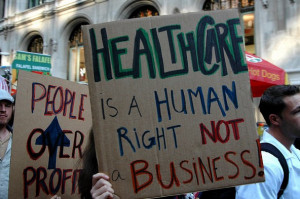
By Margaret Flowers and Kevin Zeese. Republican efforts to repeal the Affordable Care Act (ACA) were stalled again this week, due in large part to public pressure including courageous and persistent civil resistance in Congress. This was another battle won to prevent millions more from losing health insurance and tax cuts for the rich, but the fight for a universal healthcare system is far from over. In fact, we have barely begun. 1hcsenDr. Carol Paris writes, "Today, we breathe a quick sigh of relief. But we cannot celebrate a return to the status quo, a system that rations health care based on income and allows 18,000 Americans to die each year unnecessarily." Dr. Paris argues that rather than focusing on the ACA, we must now advance National Improved Medicare for All (NIMA) - a publicly-funded and comprehensive universal healthcare system in the United States. Imagine the impacts National Improved Medicare for All will have when it is achieved...

Newsletter: When Empires Fall

By Margaret Flowers and Kevin Zeese. The Pentagon recently released a report, "At Our Own Peril: DoD Risk Assessment in a Post-Primacy World," which details its concerns about losing access to resources and "resistance to authority" both at home and around the world as governments lose legitimacy. Faced with these changes, the United States could embrace them, become a cooperative member of the world, transition to a lower-waste lower-energy sustainable existence and draw back the military to use those resources to meet domestic needs. Sadly, that is not what the Pentagon has in mind. There is a saying, when all you have is a hammer, everything looks like a nail. The US is the biggest empire in the world; therefore, the Pentagon's solutions are "more surveillance, more propaganda ('strategic manipulation of perceptions') and more military expansionism." The United States' reign as an Empire is coming to an end. It is up to those of us living in the US to take action to prevent more aggression and demand that the US dismantle its empire in a way that causes the least harm at home and abroad.

Newsletter: Power Dynamics Changing In World Order

By Kevin Zeese and Margaret Flowers for Popular Resistance. The G-20 summit highlighted a transition in geopolitical power that has been developing for years. The process has escalated in recent months since President Trump took office, but its roots go much deeper than Trump. The United States is losing power, a multi-polar world is taking shape and people power is on the rise. The G-20 bordered on being a G-19, with the US a loner on key issues of climate change, trade and migration. These are some of the biggest issues on the planet. German Chancellor Angela Merkel has been saying lately "We as Europeans have to take our fate into our own hands." This is an indication they no longer see the US as the leader or even a reliable partner on some issues. In a summation of the G-20, Politico writes: "Hamburg will also go down as a further mile marker in Europe’s slow emancipation from the U.S."

Newsletter: Color Revolution Comes Home?

By Kevin Zeese and Margaret Flowers for Popular Resistance. The United States has perfected the art of regime change operations. The US is the largest empire in world history with more than 1,000 military bases and troops operating throughout the world. In addition to military force, the US uses the soft power of regime change, often through 'Color Revolutions.' The US has been building its empire since the Civil War era, but it has been in the post-World War II-time period that it has perfected regime change operations.US military presence around the world Have the people of the United States been the victims of regime change operations at home? Have the wealthiest and the security state created a government that serves them, rather than the people? To answer these questions, we begin by examining how regime change works and then look at whether those ingredients are being used domestically.

Newsletter – Positive Actions You Can Take This Summer

By Margaret Flowers and Kevin Zeese for Popular Resistance. This week, we look at some of the current struggles in the United States and ways that you can get involved this summer. From protecting health care, net neutrality and the environment to building positive alternatives that transform our current dysfunctional systems, there is something for everyone to do. Read on to learn what's happening and how to take action. This is the time to rise up and protect our families, communities and planet.

Newsletter – This Juneteenth, End “US Way Of War”

By Margaret Flowers and Kevin Zeese. We just returned from the weekend-long United National Anti-War Coalition (UNAC) conference in Richmond, VA. This is the fourth UNAC conference since its founding in 2010 to create a vibrant and active anti-war movement in the United States that opposes all wars. The theme this year was stopping the wars at home and abroad in recognition that we can't end one without ending the others, that they have common roots and that it will take a large, broad-based and diverse movement of movements to succeed. Speakers at the conference ranged from people who are fighting for domestic issues - such as a $15/hour minimum wage and an end to racist police brutality and ICE raids - to people who traveled from or represented countries such as Russia, Ukraine, Hungary, Korea, the Philippines, the Congo, Iran, Syria, Colombia and Venezuela, which are some of the many countries under attack by US imperialism.

Newsletter: Corbyn Teaches To Embrace Change We Need

By Kevin Zeese and Margaret Flowers for Popular Resistance. The shocking election result in the United Kingdom – the Conservatives losing their majority and the creation of a hung Parliament; and Jeremy Corbyn being more successful than any recent Labor candidate – cutting a 20 point Theresa May lead down to a near tie – gives hope to many that the global shift to the right, fueled by the failures of governments to meet the basic needs of their population and growing economic insecurity, may be ending. Corbyn is a lifelong activist (as you will see in the photos below), whose message and actions have been consistent. He presented a platform directed at ending austerity and the wealth divide and was openly anti-war. There are a lot of lessons for the Labor Party in the UK from this election but there are also lessons for people in the United States. We review what happened and consider the possibilities for creating transformative change in the United States.

Newsletter: After Trump’s Climate Withdrawal

By Kevin Zeese and Margaret Flowers for Popular Resistance. President Donald Trump's decision to withdraw from the Paris climate agreement follows the path of previous presidents who have undermined international climate agreements. We disagree with Trump but it is important to understand his actions in the context of the history of the United States regarding previous climate agreements. Once again, the political problems in the US are bigger than Trump. His action brings greater clarity to the inability of the US government to confront the climate crisis and clarifies the tasks of people seeking smart climate policy.

Newsletter – United To Save The Internet

By Kevin Zeese and Margaret Flowers. The former Verizon lawyer, Ajit Pai, who now chairs the Federal Communications Commission has taken the first official steps to destroy the free and open Internet by proposing the end of Title II net neutrality rules on May 18. This would be a giveaway to Comcast, Verizon, AT&T and other large Internet Service Providers that would allow them to control access to content on the Internet and charge users more fees. Chairman Pai, a former lawyer for Verizon, is an example of the revolving door between government and industry that serves big business interests, and not the people. Pai has demonstrated during his first few months as chairman that he will say anything, including obvious lies, to serve the telecom industry. We must act quickly to save the Internet from going the road of cable TV

Newsletter – Information Is Power

By Margaret Flowers and Kevin Zeese. Information is power, and when access to information is unbalanced, so is power. Malkia Cyril of the Center for Media Justice wrote this week about the use of technology to surveil communities, especially black communities, to suppress dissidence and the use of technology by those communities to watch back. This is one reason why protecting net neutrality is a fundamental struggle. Cyril concludes with "The open internet can represent the future of digital democracy, or we can use technology to continue encoding inequality into our modern world." Technology is being used in many ways to suppress dissent. Censorship of social media for political purposes is one method. Another method is mass surveillance using facial recognition software. There are also ways to suppress dissent through economic measures.
assetto corsa mods

Urgent End Of Year Fundraising Campaign

Online donations are back! Keep independent media alive. 

Due to the attacks on our fiscal sponsor, we were unable to raise funds online for nearly two years.  As the bills pile up, your help is needed now to cover the monthly costs of operating Popular Resistance.

Urgent End Of Year Fundraising Campaign

Online donations are back! 

Keep independent media alive. 

Due to the attacks on our fiscal sponsor, we were unable to raise funds online for nearly two years.  As the bills pile up, your help is needed now to cover the monthly costs of operating Popular Resistance.

Sign Up To Our Daily Digest

Independent media outlets are being suppressed and dropped by corporations like Google, Facebook and Twitter. Sign up for our daily email digest before it’s too late so you don’t miss the latest movement news.